Skip to content
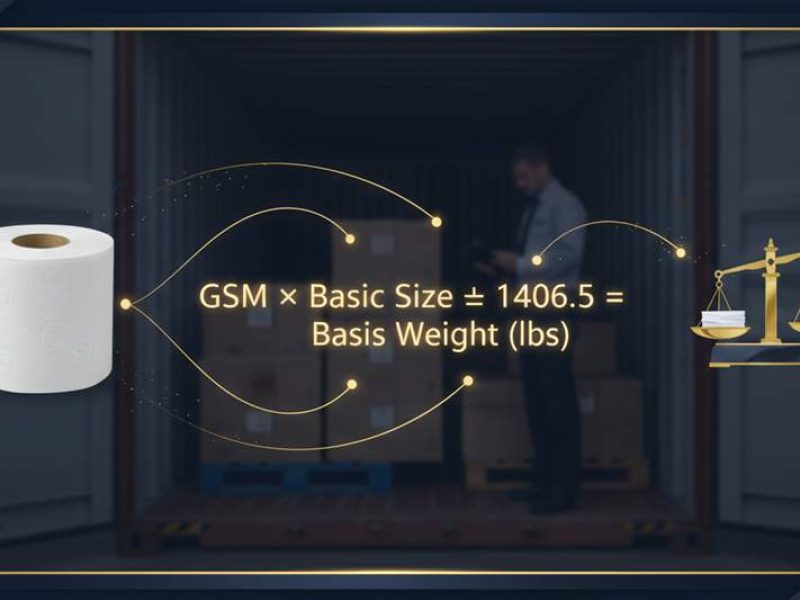
GSM & Basis Weight metrics dictate the landed cost per roll for every bulk tissue shipment. Ignoring these technical standards leads to significant payload waste or rolls that fail the septic-safe disintegration test, costing distributors thousands in customs delays and lost hospitality contracts.
We benchmark production against the 13–22g/m² per ply standard using 100% Virgin Wood Pulp. This analysis evaluates how point-to-point embossing and ISO 12625-6 compliance ensure your 40HQ inventory hits the 7,000kg to 9,000kg targets required for maximum B2B profitability.
What is GSM and Why Does It Matter in Tissue Production?
GSM measures tissue weight per square meter. It determines absorbency and production costs, serving as the 2026 benchmark for product thickness and manufacturing efficiency in the tissue industry.
Understanding Grammage and Tissue Classification
GSM represents the weight of a single square meter of paper. This universal metric allows buyers to compare tissue quality across global markets without relying on subjective terms like “thick” or “heavy.”
- Standard Classification: 10 to 35 GSM for most tissue grades.
- Facial Tissue Range: Typically 10–16 GSM for pliability.
- Paper Towel Range: 28–35+ GSM for heavy-duty absorbency.
- Density Correlation: Higher GSM ratings increase material mass, leading to better durability and fluid retention.
Accurate basis weight control keeps production lines running. If grammage fluctuates, you see jams and tearing on high-speed packaging equipment. Consistent GSM ensures the roll behaves predictably during the converting process.
Top Source Hygiene’s 13–22 GSM Precision Standards
We maintain a strict range of 13–22g/m² per ply. This specific window allows us to balance softness with the tensile strength required for high-end distribution. We do not guess; we measure.
- Measurement Standard: ISO 12625-6 protocols.
- Tolerance Threshold: ±3% variance across 40HQ container orders.
- Absorbency Boost: Point-to-point embossing increases fluid capacity by 30% without adding weight.
- Fiber Integrity: 100% Virgin Wood Pulp ensures high wet-strength.
Our GSM management focuses on septic-safe performance. By engineering the paper to a precise density, the tissue remains strong during use but disintegrates rapidly once flushed. This meets the strict plumbing requirements of North American and European markets.
The Direct Correlation Between GSM and Absorbency
Higher GSM increases fiber density and surface area, providing the essential structural capacity for superior liquid retention in professional hygiene applications.
GSM measures the density of the fiber network within each paper ply. Higher values mean more fiber mass per square meter, which allows moisture to bind more effectively with the cellulose. For distributors in 2026, standardizing weight between 13–22g/m² ensures optimal liquid retention for professional-grade products.
Understanding the Relationship Between Fiber Mass and Liquid Retention
Material density serves as the physical foundation for how much liquid a tissue can hold before the fiber network saturates. This relationship is critical for maintaining performance in high-traffic commercial environments.
- Fiber Concentration: Higher GSM indicates a denser concentration of 100% virgin wood pulp fibers.
- Storage Capacity: Increased fiber mass creates more interstitial spaces within the paper web to store liquids.
- Wet Strength: Material density provides the structural capacity needed to maintain integrity while wet.
- Batch Uniformity: Consistency in GSM ensures uniform absorbency across large production batches for global distributors.
Enhancing Absorbency with Point-to-Point Embossing Technology
Manufacturing techniques complement base weight to maximize performance without adding unnecessary bulk. We utilize precision mechanical processes to change how the paper interacts with moisture at the molecular level.
- Absorbency Gain: CNC-precision point-to-point embossing patterns increase functional absorbency by 30%.
- Wicking Speed: Strategic embossing creates air pockets between plies that facilitate faster liquid wicking.
- Optimized Range: Top Source Hygiene maintains a strict 13–22g/m² range to balance high-wet-strength durability with softness.
- Ply Lamination: Multi-ply bonding through high-pressure lamination prevents layer separation during heavy liquid contact.
Custom Toilet Paper: Factory-Direct Wholesale Solutions
How to Calculate the Basis Weight of a Bulk Shipment?
Basis weight converts GSM into pounds using the formula: GSM × Basic Size ÷ 1406.5. This ensures 2026 customs accuracy and optimizes 40HQ container payload efficiency.
The Mathematical Formula for Paper Grade Conversion
Calculating basis weight requires three specific inputs to translate metric density into the imperial measurements used by North American logistics teams. We use the GSM (grams per square meter), the basic sheet size for the specific paper grade, and a fixed divisor of 1406.5. This math keeps weight documentation accurate for HS Code 4818.1000 reporting and 2026 customs clearance.
The formula (GSM × Basic Size ÷ 1406.5) converts density into pounds (lbs). Accuracy here prevents discrepancies in bulk weight totals that can stall shipments at international borders. Buyers must verify these numbers to ensure the physical weight matches the declared values on the commercial invoice.
| Variable | Definition | Function |
|---|---|---|
| GSM | Grams per Square Meter | Determines tissue density and quality. |
| Basic Size | Sheet Area (Inches) | The standard surface area for the paper grade. |
| 1406.5 | Standard Divisor | The constant used for weight conversion. |
Optimizing 40HQ Payload with Precision Ply Density
We strictly control ply density between 13g/m² and 22g/m² to maintain consistency across bulk shipments. Precise weight metrics allow our Hebei loading teams to maximize 40HQ container space, hitting target payloads between 7,000kg and 9,000kg. This precision reduces the landed cost per roll for distributors.
Accurate basis weight data for high-density models like the TSH-3396 allows buyers to plan storage and local distribution effectively. By managing the weight-to-volume ratio, we ensure every bundle reaches its full 5000g capacity within the available cubic meterage.
- Ply Density Range: 13–22g/m² per ply.
- 40HQ Payload Target: 7,000kg to 9,000kg (7–9 Tons).
- High-Density Example: TSH-3396 5-ply solid rolls.
- HS Code Compliance: 4818.1000 for toilet paper.

Standard GSM Ranges for 2-Ply vs. 3-Ply Products
Standard production uses 13–22 GSM per ply. 2-ply rolls total 26–34 GSM for retail, while 3-ply reaches 39–54 GSM for premium hospitality and luxury markets.
Weight Distribution Benchmarks for 2-Ply Household Tissue
2-ply tissue products balance structural integrity with cost-efficiency for high-turnover retail. We utilize ply-bonding technology to laminate two layers, achieving a total basis weight that supports heavy commercial usage without layers separating.
- Ply Density: 13–15 GSM per individual sheet of wood pulp.
- Standard Configuration: TSH-2559 (Global Retail Favorite) focuses on high tensile strength.
- Plumbing Compatibility: Engineered for rapid-disintegration and septic safety in North American and European markets.
- Material: 100% Virgin Wood Pulp ensures a soft hand-feel despite the lean weight.
Technical Performance of 3-Ply High-Density 13–22 GSM Layers
3-ply products increase the total basis weight to 45–60 GSM by layering three distinct plies. The addition of a middle layer increases vertical rigidity and improves point-to-point embossing definition, which traps more moisture between the fibers.
- Absorbency: CNC-precision embossing increases liquid retention by up to 30%.
- Flagship Model: TSH-3266 utilizes 3-ply 100% virgin wood pulp for GCC and European hospitality groups.
- Skin Safety: Strict OBA-free calibration ensures the tissue remains lint-free and safe for sensitive skin across all three layers.
- Density Range: Utilizes the higher end of the 13–22g/m² range to meet luxury standards.
Is Higher GSM Always Better for Luxury Hotels?
Luxury guests expect plushness, but ultra-heavy GSM strains laundry and storage. Most 5-star properties now optimize within the 500-700 GSM range for maximum efficiency.
Standard luxury specifications typically range from 600 to 900 GSM for towels, offering the dense, absorbent feel synonymous with premium service. However, choosing the highest possible weight often creates a bottleneck in hospitality logistics that offsets the guest experience benefits.
The Operational Costs of High-Density Paper Products
High-density materials impact more than just the touch-test. They dictate the rhythm and cost-effectiveness of back-of-house operations. Operational managers must account for three primary logistical pressures when selecting heavy-weight tissues and towels:
- Storage Load: Heavy-weight towels and tissues consume significantly more space in storage closets and 40HQ transport containers.
- Utility Overhead: Dense fibers require longer drying cycles and specialized laundry handling, which directly increases electricity and water expenses.
- Humidity Risk: Dense materials retain moisture longer in humid climates, which can lead to musty odors and slower room turnover rates.
5-Ply Lamination for Targeted Luxury Hospitality
We use engineered density to achieve luxury standards without the logistical strain of excessive weight. By laminating multiple thin layers, we create a product that feels substantial but remains operationally manageable.
- TSH-4010 Model: We manufacture these 5-ply solid rolls specifically for high-end hotel chains to provide maximum thickness.
- Ply-Bonding Technology: High-pressure lamination keeps 13–22g/m² layers intact, ensuring the tissue feels soft and thick without shredding.
- Precision Embossing: Point-to-point CNC embossing increases absorbency by 30%, allowing lower-weight rolls to perform like higher GSM alternatives.
This technical approach allows 5-star properties to maintain their “Gold Standard” hygiene reputation while protecting their bottom line. High-ply counts from 100% Virgin Wood Pulp provide the necessary tensile strength for a lint-free experience that guests associate with premium care.
Frequently Asked Questions
1. What is GSM?
GSM stands for Grams per Square Meter. It is the standard unit of measurement for the density and weight of paper products.1 In the tissue industry, it determines the “grammage” or the mass of a single ply of paper. It is the primary factor that dictates raw material costs, absorbency, and the physical thickness of the roll.
2. How to measure tissue GSM?
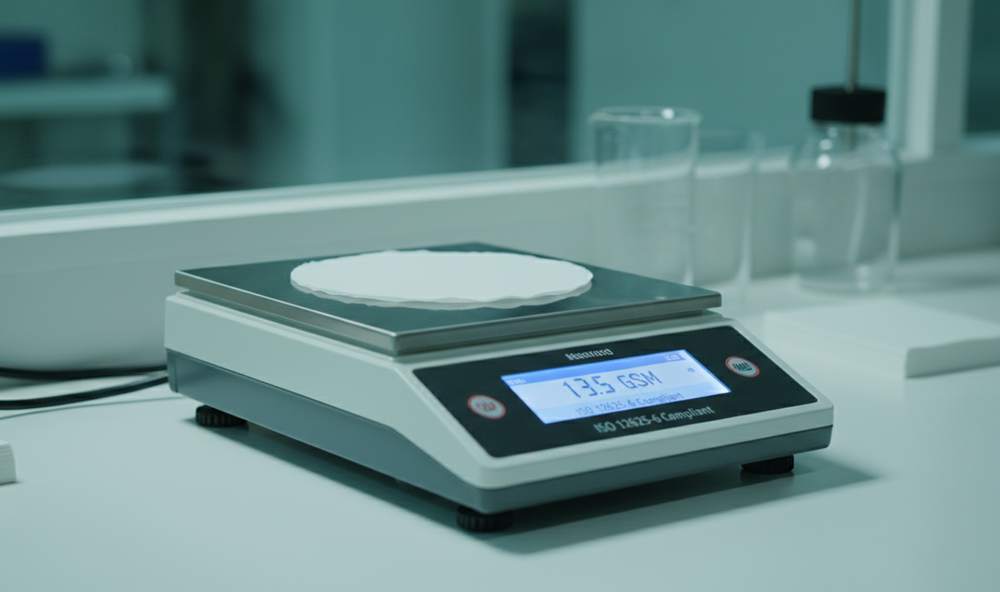
Professional measurement follows the ISO 12625-6 protocol.
To get an accurate reading, you cannot simply weigh a roll. You must:
-
Sample: Use a precision circular cutter (usually 2$100\text{ cm}^2$ area) to cut multiple samples from the web.3
-
Condition: The paper must be conditioned in a lab at 23°C and 50% humidity to reach equilibrium moisture.
-
Weigh: Use a high-precision digital scale (accurate to 0.001g).
3. Does higher GSM mean better quality?
Not necessarily; it means more “mass.”
While a higher GSM (e.g., 22 GSM per ply) results in a stronger, more absorbent sheet, “quality” also depends on:
-
Fiber Type: 15 GSM of 100% Virgin Wood Pulp is often stronger and softer than 20 GSM of recycled pulp.
- Embossing: A well-embossed lower-GSM sheet can feel thicker (bulkier) than a flat higher-GSM sheet.For B2B buyers, the “best” quality is the lowest GSM that still meets the required tensile strength and softness for your specific market.
4. Why is my 2-ply thinner than 1-ply?
This happens when the individual ply GSM is significantly lower.
Tissue is engineered in layers.4 You might be comparing:
-
A heavy 1-ply: 25 GSM (common in low-cost commercial jumbo rolls).
- A light 2-ply: Two layers of 11 GSM (Total 22 GSM).Even though there are two layers, the total mass is lower. Furthermore, if the 2-ply lacks Point-to-Point embossing, the layers sit flat against each other, reducing the “perceived thickness” compared to a bulkier single ply.
5. Is 15 GSM enough for hotels?
It is the industry standard for 3-ply and 4-ply premium rolls.
For 5-star hospitality, we typically recommend:
-
3-Ply: $15\text{ GSM} \times 3 = 45\text{ GSM}$ total.
- 4-Ply: $13.5\text{ GSM} \times 4 = 54\text{ GSM}$ total.At 15 GSM per ply, 100% virgin pulp provides the “cloud-like” softness and lint-free experience guests expect. Anything lower than 13 GSM per ply in a hotel setting often risks “finger-through” (tearing during use).
6. How does GSM affect shipping weight?
GSM is the primary variable in your 40HQ payload calculation.
Since ocean freight is often charged per container, but road weight limits apply to the total tonnage:
-
Higher GSM: Increases the weight of the container. If your GSM is too high, you might hit the 9,000kg (9-ton) weight limit before the container is physically full.
- Lower GSM: Allows for more rolls per container.The Goal: Optimize GSM so that your 40HQ container hits the “sweet spot” of $7,000\text{kg}$ to $9,000\text{kg}$, maximizing the number of rolls and lowering your Landed Cost per Roll.