Skip to content
High-speed packaging systems provide the primary defense against moisture damage and crushed inventory during long-haul 40HQ transit. While slower manual lines invite contamination risks, automated sealing protects the integrity of 100% virgin wood pulp, preventing expensive batch rejections and protecting wholesaler margins.
We benchmark technical performance using the 250 units per minute HFFS standard and 9,000kg payload optimization. This analysis evaluates how Format A individual wrapping and mechanical compression secure hygiene-sensitive paper goods for global hospitality and retail markets.
The Logistics of Primary Wrapping: Ensuring Hygiene and Seal Integrity
Automated HFFS systems create hermetic seals to protect 100% virgin wood pulp from contaminants, achieving speeds of 250 units per minute for high-volume B2B distribution.
Horizontal Flow Wrapping and Automated Contamination Control
Horizontal form-fill-seal (HFFS) systems at our Hebei factory form, fill, and seal packages in one continuous motion. This automation removes direct human contact, which is essential for meeting ISO 9001 and FDA safety requirements for hygiene-sensitive paper goods.
- Sealing Mechanism: Multi-pair sealing rollers and long-dwell systems ensure consistent tension and barrier integrity.
- Production Speed: High-performance units maintain output between 175 and 250 units per minute.
- Quality Tracking: Integrated Human-Machine Interfaces (HMI) monitor real-time seal performance and machine status.
- Fiber Protection: Automated distribution systems prevent breakage or dust contamination of the 100% virgin wood pulp.
Individual Film Wrapping for Hospitality Grade Hygiene Standards
For premium hospitality and hotel-grade exports, we utilize Format A packaging. This process wraps each roll individually in paper or plastic film to provide a maximum hygiene barrier before secondary consolidation into master poly bundles.
- Chemical Safety: We use 100% OBA-free wrapping materials to prevent fluorescent whitening agents from contacting sensitive skin.
- Model Specs: This format is standard for the TSH-4010 luxury model, serving the North American and European markets.
- Double-Layer Protection: Individual wraps combined with secondary PE bagging protect rolls from moisture during 40HQ container transport.
- Logistics Optimization: Our loading teams maximize every inch of the 40HQ payload, ensuring batch consistency and the lowest landed cost for wholesalers.
Servo-Driven Packaging Machines: Achieving the Balance Between Speed and Precision
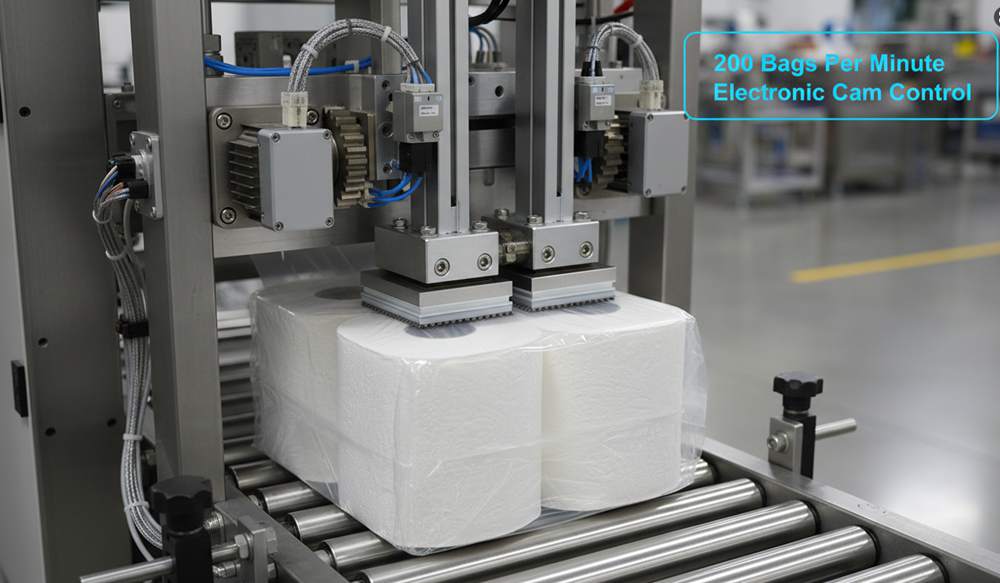
Multi-axis electronic servos replace mechanical cams to reach 50m/min speeds. This technology ensures 0.1mm accuracy and 200 bags per minute output for high-volume global retail distribution.
Multi-Axis Motion Control and Color Mark Tracking
Traditional mechanical systems rely on physical cams that wear down and limit maximum speed. We use electronic servo drives to eliminate these bottlenecks, allowing for real-time adjustments that keep the production line moving at peak velocity without physical reconfiguration.
- Tracking Accuracy: Electronic drives achieve 0.1mm precision in bag placement by utilizing high-speed color mark tracking sensors.
- System Throughput: Simultaneous control of multi-axis motors powers double-jaw systems, reaching output levels of 200 bags per minute.
- Digital Changeovers: HMI touch screens store recipe-based programming, enabling operators to switch between roll configurations instantly.
- Efficiency Optimization: Automatic speed curve generation maximizes machine uptime while reducing the mechanical wear associated with traditional stop-start cycles.
CNC-Precision Embossing and Ply-Bonding Integration
High speed is only valuable if the product remains intact. Our production lines integrate synchronized servo motors directly into the embossing and bonding units to ensure Top Source Hygiene quality standards are met even at 50m/min line speeds.
- CNC Embossing: Synchronized motors maintain a consistent 30% increase in absorbency by applying precise pressure to floral and dot patterns.
- Lamination Integrity: High-pressure ply-bonding technology keeps 5-ply rolls bonded securely during high-speed wrapping and eventual retail handling.
- Perforation Precision: Perforation lines are cut with millisecond timing to prevent shredded edges on premium 100% virgin wood pulp rolls.
- Logistics Efficiency: Mechanical compression technology works with servo bagging to maximize 40HQ container payloads, typically reaching 7,000kg to 9,000kg per shipment.
Build Your Custom Toilet Paper Brand

Multi-Pack Bundling: Can Your Line Handle 4 to 48 Roll Configurations?
Modern bundling systems use multi-lane architecture and adjustable film to handle 4 to 48-roll packs, maximizing container payload for high-volume international shipping efficiency.
| Configuration Type | Film Width Range | Control Logic |
|---|---|---|
| Retail Multi-Packs (4-12 Rolls) | 16 – 24 Inches | High-speed servo indexing |
| Industrial Bundles (24-48 Rolls) | 32 – 42 Inches | Multi-lane compression grouping |
Scalable Multi-Lane Architecture and Film Width Adaptability
Switching between 4-roll retail packs and 48-roll industrial bundles requires a system that moves beyond rigid mechanical gears. Modern lines utilize digital control to adapt the physical flow of rolls without stopping the entire production process for manual re-tooling.
- Dual Film Systems: We use dual film carriage and side infeed technologies to create varied pack patterns, including 2 x 3 or 4 x 7 configurations.
- Variable Widths: Systems support film widths ranging from 16 to 42 inches to accommodate different bundle volumes without hardware swaps.
- Servo Precision: Servo-controlled lane dividers manage product flow for 20 to 120 cycles per minute, ensuring rolls stay aligned during high-speed stacking.
- HMI Presets: Operators switch between 4-roll and 48-roll settings instantly via digital presets on the touch-screen interface.
High-Density Bundle Optimization for 40HQ Shipping Efficiency
Logistics costs often dictate the final margin for B2B wholesalers. We focus on maximizing the density of every bundle to ensure that air is removed while the integrity of the 100% virgin wood pulp fibers remains intact.
- Mechanical Compression: We use compression technology to minimize roll bulk, allowing more units per cubic meter in high-density models like the TSH-3396 28-roll bundle.
- Payload Maximization: We optimize 40HQ container loads to reach 7,000kg to 9,000kg by aligning bundle dimensions with international shipping standards.
- Direct Bundle Formats: Optimized formats for 10, 12, 18, and 32 roll configurations cater specifically to high-volume retail and warehouse club requirements.
- Reinforced Protection: Finished goods are packed into 5-ply export cartons or secondary poly-bundles to prevent crushing during high-stacking in long-haul transit.
PE, CPP, or Bio-Plastics: Which Material is Best for Your Market?
Choosing materials requires balancing unit cost against regional regulations. PE fits high-volume retail, CPP offers premium clarity, and bio-plastics serve eco-niches where brand positioning justifies higher production expenses.
Material Selection Based on Thermal and Barrier Properties
The choice between polymers dictates how a product survives the supply chain and how it looks on a retail shelf. Each material offers specific technical trade-offs regarding durability and seal integrity.
- PE (Polyethylene): Provides high flexibility and crack resistance at low temperatures. It is the most cost-effective option for automated high-volume retail lines.
- CPP (Cast Polypropylene): Offers superior transparency and moisture resistance compared to PE. Factories often use it in multi-layer structures to create a premium visual finish.
- Bio-plastics (PLA/PBS): Cater to environmental compliance needs but involve higher production costs and lower heat resistance than traditional petroleum-based films.
- Laminated Structures: Combining PE or CPP with PA (polyamide) is necessary for vacuum-sealed applications that require high puncture resistance.
Industrial Grade Polyethylene and Compression-Ready Wrapping
Logistics efficiency in the paper industry depends heavily on how the film interacts with the product under pressure. High-quality wrapping ensures hygiene while optimizing shipping costs.
Top Source Hygiene utilizes mechanical compression technology during the bagging process. This system minimizes roll bulk to save container space while maintaining the original fluffiness of the 100% virgin wood pulp. Using high-density PE bundling, we optimize 40HQ container payloads to carry between 7,000kg and 9,000kg of product per shipment.
Packaging formats vary by market requirement:
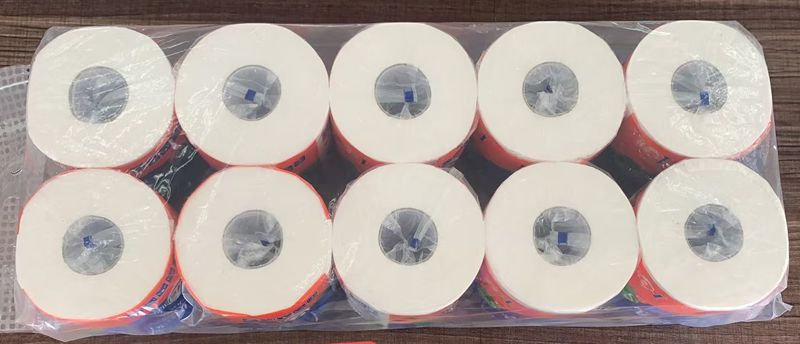
- Format A (Individual Wrap): Each roll is wrapped in plastic film to ensure maximum hygiene for hospitality-grade rolls in the Middle East and European markets.
- Format B (Direct Bundle): Rolls are packed directly into bundle packs using reinforced PE layers. This prevents tearing during high-stacking in large-scale B2B distribution centers.
By focusing on the strength of the secondary PE layers, distributors can reduce damaged inventory during the final “last mile” transport to retail outlets.
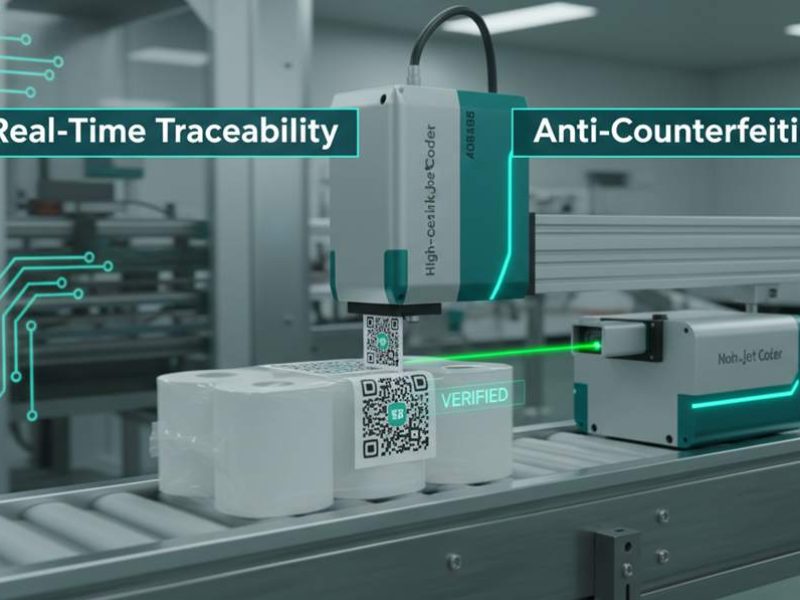
Ink-Jet Coding and Batch Tracking for End-to-End Supply Chain Security
Ink-jet coding applies unique QR codes and batch numbers to packaging, enabling real-time GS1-compliant tracking and preventing counterfeiting throughout the global supply chain.
Supply chain security for high-volume hygiene products hinges on the ability to track every bundle from the manufacturing floor to the distributor’s warehouse. Digital ink-jet technology eliminates the risks associated with manual labeling, ensuring that every 40HQ container leaving our Hebei industrial hub carries verifiable data. This system automates the verification process, allowing wholesalers to manage inventory with surgical precision.
Traceability via Real-Time Variable Data Printing
We integrate high-speed variable data printing (VDP) directly into the production line. This allows for the immediate application of unique identifiers that sync with global logistics standards. By moving away from static labels, we reduce misrouted shipments and ensure 100% compliance with international retail requirements.
- UIDs and QR Codes: We deploy unique identification codes to monitor individual product movements across diverse distribution channels.
- GS1 Automation: Our systems generate compliant barcodes that sync directly with Enterprise Resource Planning (ERP) and Warehouse Management Systems (WMS) to improve accuracy by up to 68%.
- Forensic Security Inks: We utilize taggant-based inks for covert product authentication, providing a forensic layer of protection that counterfeiters cannot replicate.
Pre-Shipment Visual Verification for Order Transparency
Top Source Hygiene operates on a “Trust but Verify” principle to protect dealer margins. Before any balance payment is required, we provide a complete digital audit of the order. This protocol ensures that the technical specifications—such as ply density and embossing clarity—match the client’s exact requirements before the goods depart Tianjin Xingang Port.
- Multimedia Documentation: We execute high-resolution photo and video logs for all finished goods to verify batch codes and packaging integrity.
- Loading Supervision: Our team validates batch color consistency and structural durability during the 40HQ container loading process.
- B2B Profit Protection: We provide direct reporting to clients, ensuring 100% transparency and preventing the dilution of brand value through unverified substitutions.
This rigorous approach to data and visual verification secures the entire lifecycle of the product. It allows our partners to receive goods with total confidence in the fiber performance and safety standards of every roll.
Vacuum Mold Sealing: How Can It Reduce Your Shipping Volume by 10%?
Mechanical compression extracts air from virgin pulp rolls, shrinking bundle dimensions to maximize 40HQ payloads up to 9,000kg and lower landed costs per unit.
Removing Trapped Air for Denser Product Loading
100% virgin wood pulp is naturally fluffy due to its long-fiber structure. While this ensures the “cloud-like” softness required for premium retail, it also traps significant amounts of ambient air. This air increases the total volume of your shipment without adding any actual product value, effectively forcing you to pay for shipping empty space.
Our mechanical air removal process creates a tighter, more stable bundle. By neutralizing the natural “spring-back” of the paper fibers, we ensure that the dimensions recorded at the factory remain consistent during transit and storage. This stability prevents the bundles from shifting or leaning during ocean transit, which is a common cause of unloading delays and damaged inventory.
- Material Characteristic: 100% Virgin wood pulp with high-purity long fibers.
- Load Stability: Tighter bundles resist deformation during multi-week ocean transit.
- Stacking Efficiency: Enables more layers per pallet or higher floor-loading in 40HQ containers.
- Dimensional Control: Minimizes package expansion to match warehouse shelf specifications accurately.
Space-Saving Compression Specs for 40HQ Efficiency
We apply specific mechanical compression technology during the primary bagging stage for high-density models like the TSH-3396. This allows us to fit more product into a standard 40HQ container compared to non-compressed rolls. The goal is to move the container’s payload into the 7,000kg to 9,000kg range, which significantly reduces the freight cost per roll for the importer.
A common concern with compression is the loss of paper fluffiness. We solve this by using CNC-precision ply-bonding and high-pressure lamination. These techniques bond the layers together so that even after the roll is compressed and then released by the end-user, the quilted texture and absorbency remain intact. To protect this seal under the weight of a full container, we utilize reinforced 5-ply export cartons for secondary protection.
- Efficiency Model: TSH-3396 (5-Ply High-Density Solid Rolls).
- Payload Target: 7,000kg to 9,000kg (7-9 Tons) per 40HQ container.
- Fiber Protection: Ply-bonding maintains sheet integrity under high-pressure sealing.
- Packaging Grade: Reinforced 5-ply cartons prevent crushing at the bottom of high stacks.
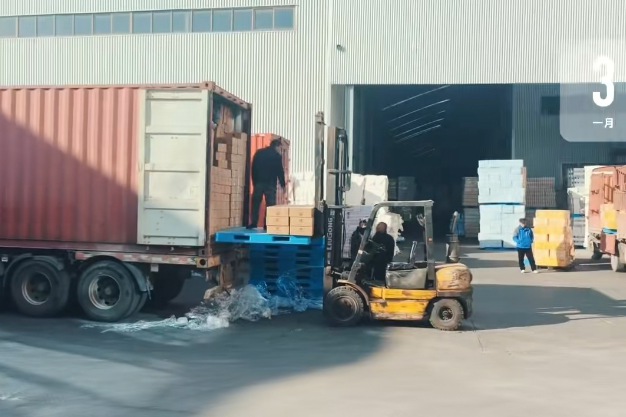
Automated Rejection: Handling Misaligned Bags at High Production Speeds
Vision sensors and checkweighers identify defective bags in real-time. PLC-triggered pneumatic arms remove misaligned items at 50+ units per minute, protecting 40HQ loading workflows from jams.
Core Principles of Real-Time Bag Detection
Manual inspection creates a bottleneck that high-volume facilities cannot afford. We integrate detection directly into the flow wrapping stage to catch errors before they ever reach the loading dock.
- Detection Speed: Integrated vision systems monitor bag alignment and seal integrity at rates exceeding 50 units per minute.
- Contaminant Control: Metal detectors identify ferrous and nonferrous fragments as small as 0.2 mm, sending instant digital signals to the rejection controller.
- Throughput Maintenance: Continuous monitoring eliminates manual checks, allowing the facility to maintain a 2,860-ton monthly output without line stoppages.
PLC-Driven Rejection for High-Density Bundle Lines
Removing a single roll is simple, but heavy-duty bundles like the TSH-3396 require synchronized mechanical force. Misaligned packs in a ‘Format B’ configuration can cause significant downtime if they enter the secondary compression stage.
- Pneumatic Diversion: Mechanical gates remove misaligned ‘Format B’ bundle packs before they reach the high-pressure compression phase.
- PLC Coordination: Programmable Logic Controllers (PLC) manage the rejection of TSH-3396 high-density solid rolls (5000g) to prevent jams during the final 40HQ loading workflow.
- Quality Compliance: Automated sorting ensures only bags meeting strict ISO 9001 and FDA standards proceed to palletization and export.
Frequently Asked Questions
What are the primary components of an automated toilet paper packaging machine?
These systems rely on a synchronized network of feeding systems, film frames, and vacuum mold formers. PLC-controlled servo drives manage the precision of roll arrangement and counting, while intelligent heat sealing units secure the film. Integrated conveyors and speed reducers ensure the product moves smoothly from the cutting station to the final output delivery.
How do these machines ensure rolls remain hygienic throughout the packaging process?
Automated lines minimize human contact and utilize regular cleaning protocols for sensors, rollers, and belts. For products like Top Source Hygiene’s OBA-Free toilet paper, specialized storage and daily cleaning of hoppers prevent the transfer of dust or moisture. Sterilization of contact parts is mandatory for maintaining the 100% Virgin Wood Pulp’s purity.
Which materials are commonly used for primary and secondary packaging?
Most factories utilize Polyethylene (PE) polybags or Polyolefin (POF) shrink films because they offer high moisture resistance and a smooth hand-feel. Inner rolls use recycled cardboard tubes. In 2026, many high-speed lines are optimized for reduced-thickness films to lower plastic waste while maintaining enough tensile strength for bulk shipping.
Can your production lines handle custom pack configurations like 24 or 48 rolls?
Modern servo-driven indexing systems allow for toolless changeovers, enabling rapid shifts between different pack sizes. Operators use an HMI touchscreen to adjust parameters for various configurations, such as the TSH-3266 warehouse club packs. This flexibility allows factories to process 20-30 units per minute regardless of the specific roll count per bundle.
What is the most effective maintenance strategy for high-speed packing equipment?
A dual approach works best: daily autonomous maintenance by operators to clean debris and sensors, combined with scheduled preventive maintenance by technicians. This includes lubricating chains and bearings, checking belt alignment, and monitoring pneumatic pressure levels to prevent unplanned downtime and ensure consistent seal quality.
Why is heat sealing technology vital for bulk international shipping?
Heat sealing creates airtight, moisture-proof barriers that protect the paper’s integrity during long-distance transit in 40HQ containers. By preventing air and humidity from entering the package, it preserves the natural 85-92% brightness of the wood pulp and prevents spoilage, which is essential for maintaining quality in different climate zones.
Final Thoughts
Choosing cheap packaging often leads to crushed inventory and rejected shipments during long-haul 40HQ transit. Our mechanical compression and reinforced 5-ply export bundles protect the structural integrity of 100% virgin wood pulp while maximizing your payload up to 9,000kg. Investing in these high-speed, servo-driven standards secures your dealer margins and upholds the OBA-free safety promise your retail clients expect.
We recommend reviewing our pre-shipment visual audits to see our batch consistency and loading precision firsthand. Contact our Hebei factory team to discuss private label configurations for high-demand models like the TSH-3396 or TSH-2559. Let’s finalize your specifications and secure a production slot for your first 40HQ trial order from Tianjin Xingang Port.
SEO
Title: Packaging for Protection: High-Speed Primary and Secondary Wrap
Description: Toilet Paper Packaging Machine. High-speed HFFS for 100% virgin pulp. Factory direct wholesale for 40HQ loads. ISO certified OEM/ODM.
URL: toilet-paper-packaging-machine
Keywords: toilet paper packaging machine