Skip to content
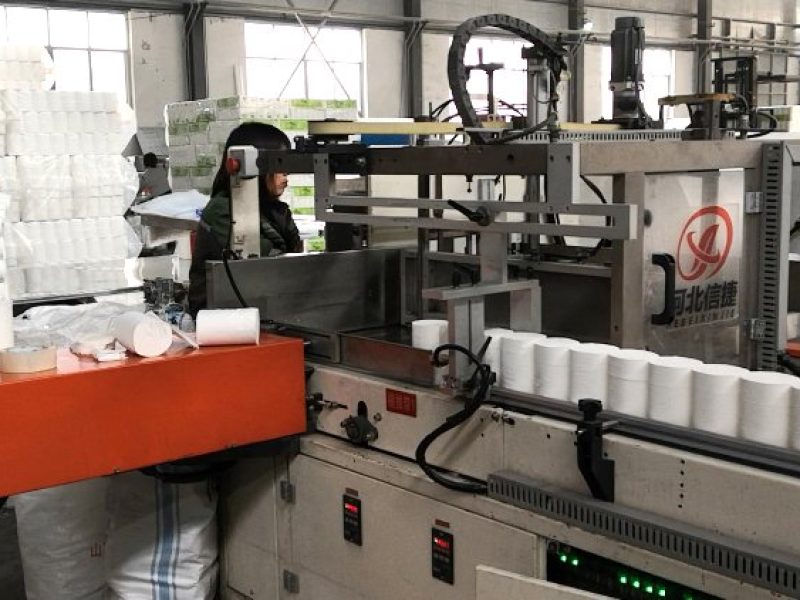
Log-Saw Technology serves as the final barrier against inconsistent roll heights and excessive production waste in high-volume tissue manufacturing. Poorly calibrated cutting cycles result in slanted edges and diagonal shearing, which causes downstream packaging jams and destroys the shelf-ready visual appeal retailers demand for their 100% virgin wood pulp inventory.
Our technical standards focus on achieving a strict ±0.5mm height consistency by integrating automated sharpening with CNC-controlled orbital paths. We benchmark these precision protocols against the TSH-2559 and TSH-3396 models to ensure every 40HQ container maintains the dimensional integrity required for professional B2B distribution.
From Logs to Rolls: Why is the Cutting Phase So Critical?
The cutting phase transforms massive logs into finished rolls, dictating dimensional accuracy, edge quality, and total material yield for high-volume B2B manufacturing.
Maximizing Material Utilization and Production Throughput
Log slitting streamlines manufacturing by slicing finished paper logs directly. This method bypasses the complex tension management found in rewind slitting, making it the standard for high-volume output in the Hebei paper industrial hub.
- Production Speed: Direct slicing enables rapid manufacturing cycles and scales easily for 40HQ container orders.
- Narrow Tolerances: Blade adjustments allow for precise width modifications down to 1mm, ensuring almost 100% utilization of the parent roll.
- Waste Control: Automated log-saw systems eliminate manual handling errors, significantly reducing material scrap during large-scale runs.
- Model Flexibility: Simplified machine setups allow for quick transitions between cored and solid rolls, such as the TSH-3396 efficiency model and the TSH-2559 retail favorite.
Precision Perforation and Structural Ply Integrity
The final cut must respect the structural bonding of the paper fibers. We synchronize blade speeds to ensure clean edges and protect the integrity of the perforated lines for a smooth user experience.
- Batch Uniformity: CNC-precision cutting maintains a strict ±0.5mm height consistency across all 2-ply to 5-ply ultra-soft rolls.
- Ply Stability: High-pressure lamination ensures layers stay bonded even under the mechanical force of high-speed industrial saws.
- Visual Quality: Sharp, automated blades prevent thermal discoloration, preserving the 85-92% natural brightness of the 100% virgin wood pulp.
- Clean Tears: Precision perforation prevents “shredded edges,” ensuring the final product meets the professional standards required by hospitality and wholesale distributors.
Orbiting Blade Technology: How Do We Ensure 90-Degree Precision?
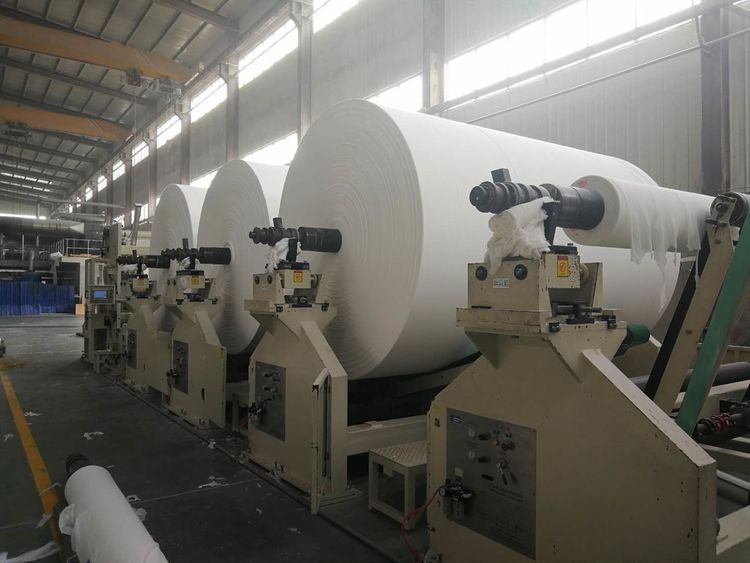
Synchronized orbital paths and CNC controls prevent diagonal shearing, ensuring perfectly square roll faces for stable 40HQ stacking and professional B2B presentation.
Mechanical Synchronization of Orbital Motion
Standard saws often struggle with slanted or “stepped” roll faces because the log moves forward while the blade cuts. We solve this by matching the blade’s orbital trajectory precisely to the conveyor speed. This synchronization ensures the blade enters and exits the log at a perfect perpendicular angle, even during high-speed production of our heavy 5-ply rolls.
- Trajectory Alignment: We calibrate the orbital path to the linear conveyor speed to eliminate diagonal shearing.
- Oscillating Tip Dynamics: These dynamics reduce vibration and fiber displacement when the blade contacts 100% Virgin Wood Pulp.
- Arc Stabilization: A rigid blade body prevents the excursion arcs that typically cause soft tissue trauma or fraying in lower-tier equipment.
Precision Perforation and CNC Edge Controls
Maintaining edge integrity requires more than just a sharp blade. We integrate CNC-precision embossing with cutting intervals to keep height consistency across our “Big 10” inventory models. This is critical for models like the TSH-4010, where luxury hotel standards demand a clean, non-shredded edge on every roll.
- Precision Perforation Logic: Automated controls ensure clean-cut lines that prevent shredded edges on premium 5-ply rolls.
- Height Tolerance: We maintain strict ±0.5mm consistency by using servo-driven positioning for every cut.
- Ply-Bonding Calibration: High-pressure lamination occurs before the cut to prevent layer separation in rolls using 13–22g/m² paper.
- Automatic Depth Control: Calibrated blade depth ensures the core is severed cleanly without crushing the 100% OBA-free fibers.
Scale Your Brand With Factory-Direct Pricing

Why Automated Blade Sharpening Defines Your Roll’s Edge Quality?
PLC-controlled sharpening eliminates manual error, maintaining precise blade geometry and ±0.5mm height consistency to ensure clean, lint-free edges on 100% virgin wood pulp rolls.
Manual sharpening introduces variability that degrades the physical integrity of a toilet paper roll. In high-volume B2B manufacturing, even a slight deviation in blade angle causes fiber tearing. Automated systems remove this risk by standardizing the grinding process across every production cycle.
Maintaining Blade Geometry Through PLC-Controlled Grinding
We use PLC-controlled systems to ensure the log-saw blade maintains its exact specified diameter and tooth pitch. This level of repeatability is impossible to achieve through manual grinding, which often leads to uneven blade wear and rejected batches.
- Repeatable Accuracy: PLC systems deliver consistent sharpening results that eliminate human error during the cutting phase.
- Fiber Protection: Sharp blades prevent paper fibers from splintering or tearing during high-speed log-saw operations, resulting in smooth roll ends.
- Service Life: Automated roto-reverse sharpening extends blade life by approximately 30% through precise grindstone interference settings.
- Waste Reduction: Consistent restoration of blade specs minimizes material waste across large-scale 40HQ production runs.
Precision Perforation and Shred-Free Edge Integrity
The quality of the perforation line depends entirely on the sharpness of the cutting edge. For Top Source Hygiene products, maintaining optimal blade geometry is what prevents “shredded edges” and ensures the 100% Virgin Wood Pulp layers remain bonded together.
- CNC Perforation: Sharp blades support the precision lines required to prevent shredded edges during consumer use.
- Lint-Free Output: Clean-cut edges protect the integrity of long-fiber wood pulp, ensuring a premium experience for retail markets.
- Ply-Bonding Maintenance: Precision cutting equipment prevents high-pressure lamination layers from separating at the edges.
- Height Consistency: Our automated systems maintain a strict ±0.5mm height tolerance, meeting the rigorous standards of luxury hospitality clients.
By integrating these automated maintenance protocols, we ensure that every container of TSH-2559 or TSH-4010 arrives with the exact edge quality promised to our wholesale partners. This technical precision directly reduces downtime in your downstream automated packaging and bundling processes.
Managing Thermal Expansion: Does Blade Cooling Really Matter?
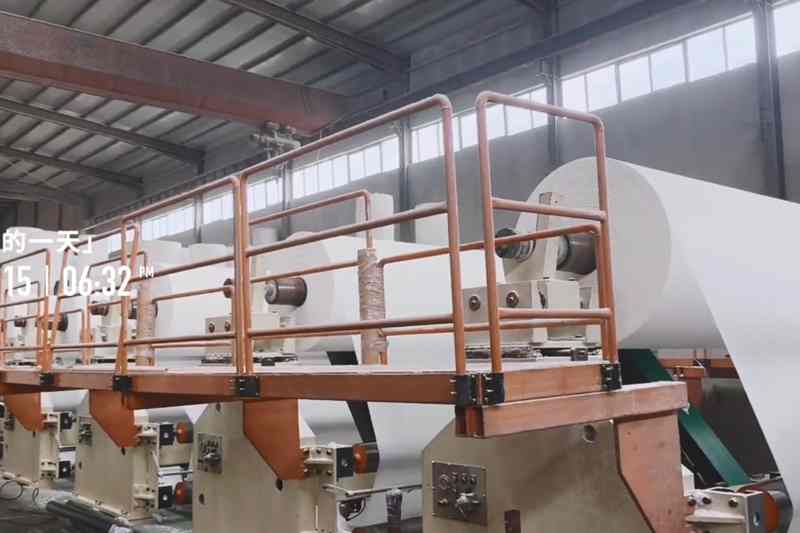
Thermal expansion causes blade warping and vibration. Keeping temperature gradients below 15°F prevents “dishing” and ensures consistent roll height without edge shredding.
Thermal Stress and Its Impact on Cutting Precision
Friction between the blade and the paper log generates intense heat during high-speed conversion. This heat triggers physical metal expansion, which alters the blade’s geometry mid-run. For high-volume manufacturers, this expansion is the primary enemy of dimensional accuracy.
Temperature gradients as narrow as 11°C (20°F) between the blade center and the rim cause severe thermal stress. This often results in “dishing,” or permanent warping, where the blade loses its flat profile. Once a blade dishes, it cannot maintain a straight path through the log.
Overheated blades suffer from excessive vibration and misalignment. These instabilities lead to uneven cuts and rejected batches. For B2B distributors, this translates to inconsistent roll heights and fuzzy edges that fail quality inspections.
Integrated Water Cooling and Carbide Material Stability
Maintaining precision at high speeds requires active heat management. Standard steel blades often fail under the thermal loads of 24/7 production, making specific cooling and material choices necessary:
- Water-Cooling Systems: These systems continuously regulate rim temperature to maintain blade stiffness and lateral precision during long cycles.
- Carbide-Tipped Blades: Carbide provides superior thermal stability over standard steel, allowing the edge to maintain sharpness even at high operating temperatures.
- Segmented Blade Designs: Precision gaps between segments improve airflow and natural heat dissipation during high-speed rotation, reducing the reliance on external coolants.
By controlling the thermal environment, we ensure that every cut remains clean and every roll meets strict height requirements. This is especially vital for our 100% Virgin Wood Pulp products, where fiber integrity depends on a sharp, cool, and stable cutting edge.
How to Achieve a Strict ±0.5mm Height Consistency Across Batches?
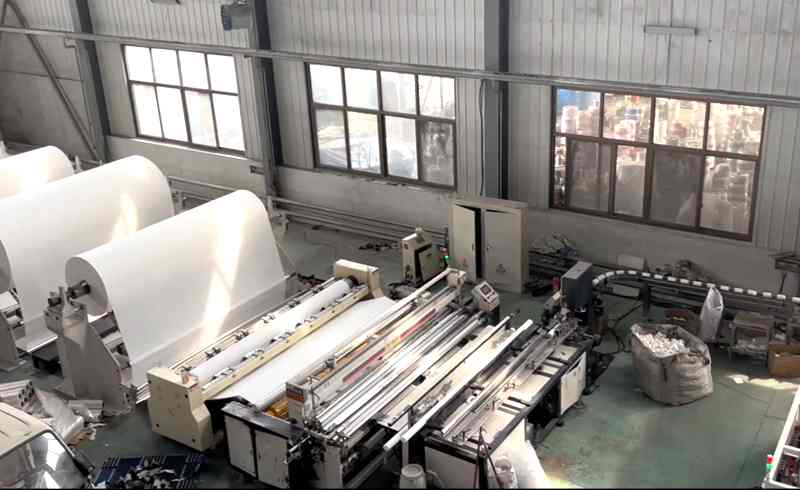
Combine servo-driven positioning with high-pressure ply-bonding and 100% virgin wood pulp to stabilize logs and ensure ±0.5mm tolerance during high-speed cutting.
| Technical Factor | Requirement for ±0.5mm Consistency |
|---|---|
| Positioning System | Servo-driven motor (±0.1mm mechanical accuracy) |
| Control Interface | PLC integration with real-time drift monitoring |
| Material Density | High-pressure ply-bonding for log stability |
| Fiber Type | 100% Virgin wood pulp (Long-fiber) |
Servo-Driven Feeding and PLC Automation
Standard log-saw operations often suffer from dimensional drift as mechanical parts wear or heat up. We mitigate this by replacing traditional chain drives with high-precision electronics.
- Positioning Accuracy: Servo-driven systems achieve mechanical precision of ±0.1mm, providing a safety margin that comfortably meets the ±0.5mm commercial standard.
- Automated Cutting Cycles: Programmable Logic Controllers (PLC) manage the entire cycle, ensuring the blade enters the log at a consistent speed to prevent deflection.
- Variable Speed Control: Our systems adjust feed rates between 10–30 m/min to accommodate different ply counts and paper densities without losing accuracy.
- Real-Time Monitoring: Sensors detect and recalibrate log advancement instantly if the system identifies any drift in the feeding mechanism.
Mechanical Compression and Ply-Bonded Log Stability
A precise machine cannot fix unstable material. At Top Source Hygiene, we ensure the log remains rigid throughout the conversion process to prevent crushing or uneven widths.
- High-Pressure Bonding: We use advanced ply-bonding technology to laminate layers together, which prevents rolls from “telescoping” or shifting during the log-saw cycle.
- Material Integrity: Utilizing 100% virgin wood pulp with long-fiber characteristics provides the tensile strength needed for a clean, lint-free cut at tight tolerances.
- Log Density: Mechanical compression during winding produces high-density solid rolls, such as the TSH-3396, that resist deformation when the blade applies pressure.
- CNC-Embossing Alignment: Precision perforation and embossing ensure the structural integrity of the log is uniform from the core to the outer wrap.
Can Advanced Extraction Reduce “Lint Dust” During the Cutting Stage?
Point-of-contact vacuum systems capture cellulose fibers at the blade interface, while 100% virgin wood pulp ensures long-fiber integrity to prevent dust formation during high-speed log sawing.
Mechanisms of Point-of-Contact Vacuum Extraction
Capturing debris at the exact moment of impact is the most effective way to maintain a clean converting hall. Modern log saws integrate high-velocity suction hoods positioned millimeter-close to the orbiting blade. This setup removes micro-debris before it can become airborne or settle on the product surface.
- Suction Placement: High-velocity hoods sit adjacent to the orbiting blade to capture micro-debris instantly.
- Surface Protection: Automated extraction prevents lint from settling on the roll surface or the precision sharpening stones.
- Air Filtration: Modern systems in 2026 utilize HEPA-grade filtration to maintain air quality in the converting hall.
How 100% Virgin Wood Pulp Prevents Fiber Fragmentation
Material selection dictates the volume of dust generated. While recycled paper contains brittle, short fibers that shatter upon impact, 100% virgin wood pulp utilizes long-fiber structures. This structural integrity allows the blade to slice through the log without creating the “shredded edge” effect typical of lower-grade materials.
- Fiber Strength: Long-fiber virgin pulp provides superior tensile strength that stays intact during the blade’s 90-degree impact.
- Material Purity: Avoiding recycled waste ensures the absence of brittle, short fibers that contribute to surface dust.
- Density Standards: Strictly controlled 13–22g/m² ply density allows for clean cuts without the fragmentation found in low-grade rolls.
Top Source Hygiene maintains a lint-free experience by combining these extraction technologies with high-purity wood pulp. By ensuring the web remains stable and the cutting zone remains under constant vacuum, we prevent the “snowfall” effect that often complicates downstream packaging and bundling processes.
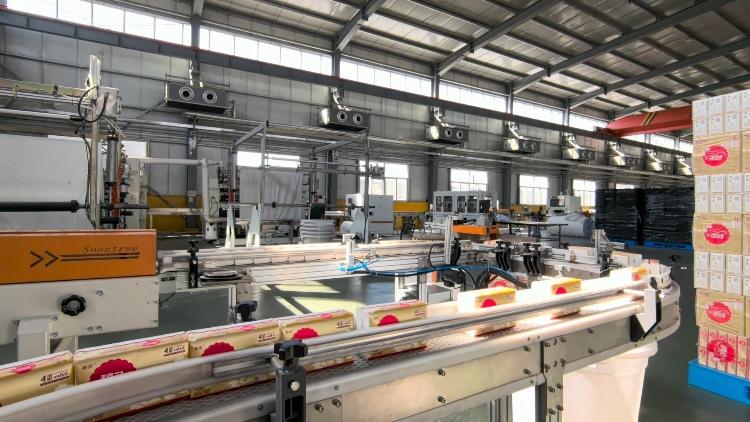
Safety Engineering: Protecting Operators in Automated Cutting Sections?
Modern log-saw sections isolate operators using enclosed housings and optical interlocks, ensuring strict compliance with ISO 9001 and EU hygiene standards for high-volume B2B manufacturing.
Automated Interlocks and Physical Isolation Barriers
High-speed orbiting blades pose severe risks during the converting stage. We eliminate these hazards by isolating the entire cutting unit within a sealed environment that prevents any physical access during active cycles.
- Robotic Enclosures: Fully enclosed safety housings shield operators from high-speed blade rotation and thermal energy discharge.
- Optical Interlocks: Integrated safety sensors trigger an immediate system shutdown if access doors open while the machinery is in motion.
- Automated Cycles: Mechanized loading and unloading cycles minimize the time personnel spend near the cutting bed, reducing the risk of accidental contact.
Integrated Dust Extraction and ISO 9001 Safety Compliance
A safe production floor requires more than just mechanical guards. We manage environmental hazards like airborne paper lint that often compromises industrial workspaces and operator health.
- High-Volume Extraction: Specialized fume and lint extraction systems remove particulate matter to prevent respiratory hazards and maintain clear visibility on the line.
- Standard Adherence: Compliance with ISO 9001 and EU hygiene standards ensures the manufacturing layout promotes ergonomic movement and reduces worker fatigue.
- Secure Maintenance: Dedicated access points allow for 100% OBA-free material handling and blade inspections without exposing workers to active mechanical zones.
Frequently Asked Questions
What causes fuzzy or fraying edges on industrial toilet paper rolls?
Rough edges usually stem from poor slitting performance during the converting process. If circular blades are dull or misaligned, they create fraying instead of clean cuts. Top Source Hygiene utilizes edge-trimming systems and size verification to remove these irregularities before the rolls move to the packaging stage.
How do automated log saws achieve high-speed precision in 2026?
Modern systems rely on 3D laser scanning and real-time algorithms to analyze log shape before the first cut. Servo-driven feeds and PLC systems make micro-adjustments during the cycle, maintaining tight tolerances of ±1/16-inch while following the natural curvature of the material to reduce waste.
Why is roll height consistency critical for downstream packaging lines?
Inconsistent dimensions force automated packaging machines to stop for manual recalibration, which leads to operational downtime. Misalignment causes higher defect rates in sealing mechanisms and reduces overall throughput. Stable roll height ensures the packaging film runs smoothly through high-speed bundlers.
Is the toilet paper safe for specialized septic systems and sensitive skin?
Yes. Top Source Hygiene uses 100% virgin wood pulp to ensure a lint-free texture that is 100% OBA-free. These rolls are engineered to dissolve quickly in water, meeting international standards for septic safety and preventing plumbing clogs in high-traffic commercial environments.
What is the typical lead time and capacity for a 40HQ wholesale order?
Production for a standard 40HQ container typically takes 20-25 days. These orders carry a payload between 7,000kg and 9,000kg. By 2026 logistics standards, our loading teams maximize every inch of the container to ensure the lowest landed cost per roll for international distributors.
Final Thoughts
Relying on manual slitting or unstable cutting tools risks your reputation through frayed edges and inconsistent roll heights that jam automated packaging lines. Our precision log saws and ±0.5mm height standards eliminate these operational bottlenecks, ensuring every roll in your 40HQ container is shelf-ready. Investing in technical uniformity protects your margins by reducing downstream waste and securing long-term contracts with high-end hospitality and retail clients.
Verify our edge quality and ply-bonding integrity by requesting a sample kit of our TSH-2559 or TSH-4010 best-sellers. We recommend a 40HQ trial order to experience our payload optimization and factory-direct pricing firsthand. Contact our Hebei production team today to discuss your private label requirements and receive a detailed logistics quote.