Skip to content

Bamboo Toilet Paper sits at the procurement line where a wrong supplier choice drives supply-chain disruption and costly operational downtime. Procurement teams wrestle with mixed sustainability claims, variable tensile performance, and texture complaints that can erode margins or stall account wins; buyers face greenwashing exposure, failed quality audits, and higher returns when specs and testing protocols stay vague.
This guide functions as a technical SOP for sourcing premium bamboo fiber tissue: it compares bamboo to other fibers on sustainability, lays out lab protocols for tensile-strength and softness testing, explains process and fiber-engineering fixes to address perceived roughness, maps the carbon-accounting inputs you need for net-zero reporting, explores bleach-free whitening and finishing options, and provides a market-positioning playbook that turns ESG claims into defensible price premiums. Use the sectioned checklists, supplier-audit items, and FAQ answers to write clear specs, run validation tests, and build the pricing and compliance case buyers will accept.
Is Bamboo Really the Most Sustainable Fiber for Modern Hygiene?
Choose bamboo when lifecycle CO2e, water use, and rapid renewability matter to your Scope 3 targets and plumbing performance.
Lifecycle emissions and water‑use benchmarks: bamboo vs. virgin wood vs. recycled pulp
Benchmark lifecycle numbers show why procurement teams must treat bamboo as a distinct category: a lifecycle analysis reports roughly 177 g CO2e per 140 g roll for bamboo versus about 245 g CO2e for virgin wood (≈27–30% higher), while recycled pulp recorded ~322 g CO2e per 140 g roll driven by energy‑intensive de‑inking. Bamboo also matures in 3–5 years and sequesters roughly 30% more CO2 than typical hardwoods, so plantation renewal and carbon accounting differ materially from tree‑based sources.
Water footprint favors bamboo: suppliers in many regions rely on rainfall with minimal irrigation, which lowers irrigation‑related water use compared with tree plantations that require supplemental watering. Require supplier LCA data expressed as CO2e per tonne and litres of water per tonne, and compare those metrics directly against your virgin wood and recycled pulp baselines when you evaluate bids.
Manufacturing and product‑performance parameters when integrating bamboo pulp
Bamboo fiber behaves differently on the machine: fibers run smoother and yield a softer hand while maintaining tensile strength comparable to long‑fiber wood pulp. Target ply and GSM to balance comfort and function—keep per‑ply GSM in the 13–22 g/m² range to preserve wet‑strength and septic performance. Specify OBA‑free processing and prefer oxygen or mechanical whitening over elemental chlorine; document all bleaching chemistries in supplier specifications.
Validate conversion and downstream performance by running North American and EU septic‑safe disintegration tests and matching the rapid dissolution benchmarks you expect from 100% virgin wood products. Tune embossing patterns and ply‑bonding pressure on converting lines to retain absorbency and prevent ply separation. Monitor pulp freeness (CSF), refining energy (kWh/t), and pulp yield (%) to compare processing costs and throughput against your virgin wood baselines.
- Ply/GSM target: 13–22 g/m² per ply for a balance of softness and septic performance.
- Bleaching controls: OBA‑free; prefer hydrogen peroxide/oxygen or mechanical whitening; list chemicals and dosages.
- Septic testing: run NA and EU disintegration tests and require supplier data showing parity with virgin wood roll benchmarks.
- Process metrics: measure CSF, refining energy (kWh/t), and pulp yield (%) for cost and throughput comparisons.
Supply‑chain, certification and packaging controls to realize genuine bamboo sustainability
Treat sustainability claims as verifiable controls. Demand ISO 9001 plus applicable FDA/EU hygiene compliance and chain‑of‑custody certification (FSC or equivalent for bamboo plantations). Test finished tissue for contaminants—BPA, PFAS and heavy metals—because recycled lines may introduce de‑inking residues that your clients will reject. Mandate plastic‑free or minimal plastic packaging; prefer individual paper wrap or recyclable secondary cartons to avoid introducing landfill plastics into the product story.
Factor logistics and commercial math into every sourcing decision: use Top Source commercial parameters—MOQ 1×40HQ, payload 7–9 tonnes, and production lead times of ~20–25 days—as planning inputs. Calculate cost per meter, landed CO2e, and freight efficiency to determine whether bamboo yields a net environmental and commercial advantage for each SKU. Include supplier audits, pre‑shipment visual verification, batch color consistency requirements, and a documented chemical inventory as contract line items.
- Required certifications: ISO 9001; FDA/EU hygiene compliance; FSC or equivalent chain‑of‑custody.
- Contaminant screening: test for BPA, PFAS, heavy metals on finished goods—compare to recycled pulp risk profile.
- Packaging spec: mandate plastic‑free or minimal plastic; prefer individual paper wrap and recyclable cartons.
- Procurement logistics: plan around 1×40HQ MOQ; payload 7–9 tonnes; production lead time 20–25 days for custom orders.
- Commercial evaluation: calculate cost per meter, landed CO2e, and freight efficiency for SKU selection.
- Operational controls: include supplier audits, pre‑shipment photos/videos, batch color consistency clauses, and documented chemical inventories in contracts.

Structural Engineering: Why Bamboo Offers Superior Tensile Strength
Bamboo’s smooth long fibers and rapid renewability cut lifecycle emissions while enabling lower-GSM tissue with measurable tensile gains that reduce material and freight costs.
Assessing bamboo fiber mechanics and measurable tensile performance
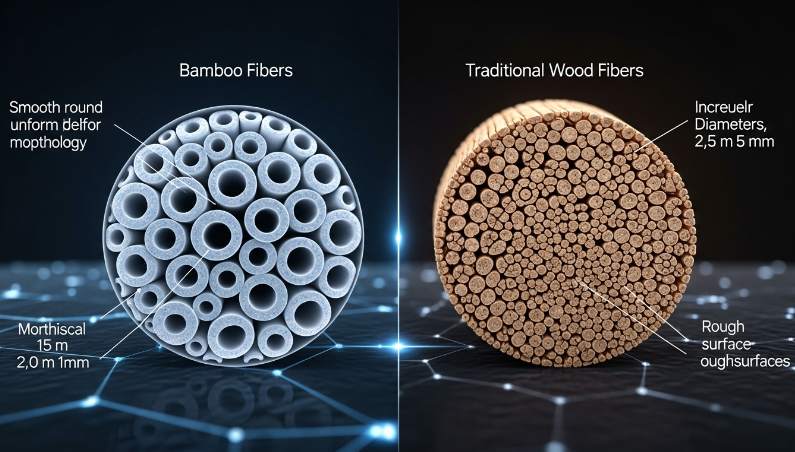
Bamboo fibers have a naturally round, smooth morphology that preserves tactile softness while delivering high dry tensile and strong wet-tensile compared with typical hardwood pulps. Use lifecycle data to support material choice: a representative LCA reports 177 g CO2e per 140 g bamboo roll versus 245 g CO2e for virgin wood and 322 g CO2e for recycled rolls, which strengthens procurement arguments for bamboo when buyers target Scope 3 reductions.
Quantify performance in the lab. Run tensile tests to ISO 1924-2 or TAPPI T494 and report tensile index (Nm/g), wet tensile, elongation at break, and burst strength for product-grade comparisons. Note that raw bamboo tensile values vary by species and source (reported ranges run roughly 115–370 N/mm²), so tie test data to batch-specific certificates rather than generic claims. Document biodegradability (compostable breakdown in weeks) and lower irrigation needs to close the environmental-performance case for buyers.
Process parameters to maximize tensile strength in tissue manufacturing
Select a high-purity bamboo pulp grade and process without optical brightening agents (OBA-free) to protect skin contact safety and meet brightness targets through fiber selection rather than chemistry. Tune refining and beating: increase fibrillation to raise tensile index but stop before over-beating that reduces bulk and absorbency; target per-ply GSM between 13–22 g/m² when you use long-fiber bamboo to hit tensile targets with lower paper weight.
Use high-pressure ply bonding and controlled creping/embossing to create structural interlock across plies; point-to-point embossing boosts absorbency by roughly 30% and improves ply cohesion. Favor mechanical bonding and minimal wet-strength chemistry for septic-safe lines; if you add wet-strength agents, validate rapid disintegration and regulatory compliance. Implement inline quality control: run batch sampling for tensile, wet-tensile, burst, and disintegration tests and store results for pre-shipment verification.
- Testing checklist: ISO 1924-2 / TAPPI T494 tensile, wet tensile, bursting strength, elongation at break, disintegration time.
- Process controls: pulp grade spec, OBA-free declaration, refining PFI revolutions or rotor energy targets, crepe ratio and adhesive dosing.
- Quality evidence: batch test reports, LCA summary (e.g., 177 g CO2e/140 g roll), and pre-shipment photos/videos.
Product design and market integration using bamboo’s tensile advantages
Leverage bamboo’s tensile performance to trade GSM for equivalent strength: reduce per-ply GSM or drop a ply and preserve durability, which lowers raw-material spend and freight cost per meter. Optimize roll formats for logistics: prioritize coreless, high-density rolls and heavy-bundle formats (example: 5000 g bundles) to maximize meters per 40HQ container. Compress bundles and use reinforced export cartons to hit typical payloads of 7–9 tonnes per 40HQ.
Map product families by market. Offer low-GSM 2–3 ply septic-safe lines for North America, 5-ply luxury lines for the Middle East, and eco-branded bamboo pulp lines for Europe that pair OBA-free claims with LCA data. Match packaging to channel: individual wraps for hospitality, bundle packs for retail. Produce ISO 9001, FDA and EU hygiene-compliant documentation, tensile and LCA test reports, OBA-free declarations, and pre-shipment media to protect buyer margins and speed procurement approvals.
- Logistics spec: heavy bundles (5000 g), coreless rolls, reinforced cartons, compression to maximize 40HQ density.
- Market specs: NA — septic-safe 2–3 ply; ME — 5-ply luxury; EU — FSC/OBA-free eco lines with LCA backing.
- Buyer deliverables: tensile test report (Nm/g), wet-tensile, burst strength, LCA summary, OBA-free certificate, pre-shipment photos/videos.
Custom Toilet Paper — Factory-Direct Supply
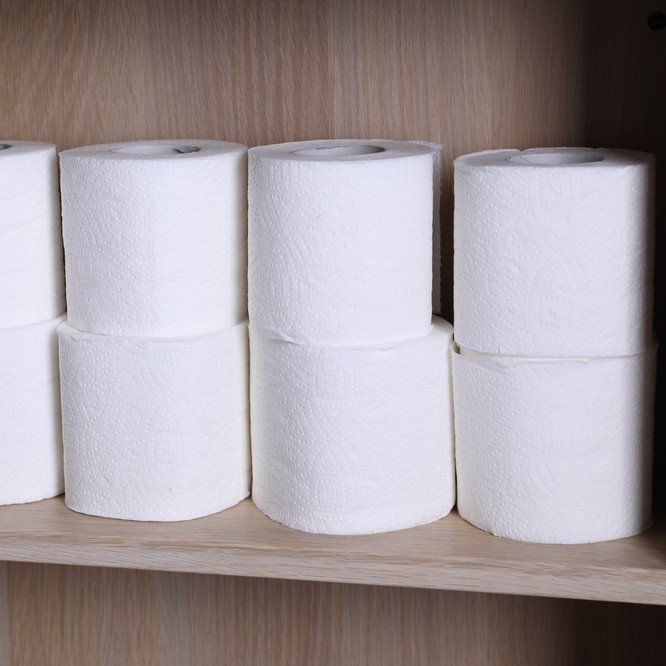
Why Do Some Customers Perceive Bamboo as “Rough” Compared to Wood?
Surface feel drives returns and placement; control fiber and mill parameters to preserve softness while keeping septic-safe and sustainability claims intact.
Fiber morphology and pulping factors that influence surface feel
Bamboo pulp fibers differ from long-fiber wood pulp in diameter, silica content, and fibrillation profile; untreated silica and coarse fiber fragments raise surface friction and increase perceptible harshness even if the raw fiber is naturally smooth. Design the pulping route to remove abrasive particulates early, and remember bamboo naturally produces less lint and dissolves faster, which supports septic-safe claims.
Choose chemical pulping steps and targeted silica removal to lower coarse particulates, then control refining to increase fibrillation (softness) while preserving tensile strength. Aim final ply GSM in the 13–22 g/m² range to balance handfeel and durability, and maintain natural brightness at about 85–92% without Optical Brightening Agents to avoid surface residue that changes tactile perception.
Mill process settings to reduce perceived roughness: refining, creping, embossing, and finishing
Raise refining intensity incrementally to improve fiber bonding and softness; monitor freeness and tensile metrics at each step and stop before the sheet loses necessary tensile strength. Adjust creping parameters—blade angle, machine speed, and adhesive pick-up—to increase micro-folding and reduce surface harshness, while tracking sheet stretch and tensile strength during raw-stock trials.
Reduce embossing depth or change pattern scale: point-to-point embossing boosts absorbency by ~30% but deeper embossing can increase perceived roughness. Use CNC-precision patterns to optimize tactile outcome. Apply light calendaring with soft calender rolls to smooth the final surface without eliminating bulk; validate combinations against target GSM and wet-strength specifications. When OBA-free and septic-safe labelling matters, test enzymatic softening or approved natural softeners as process additives to gain extra softness without chemical residues.
- Incrementally increase refining; record freeness and tensile after each increment.
- Tune creping: test at three blade angles and two adhesive pickups per speed setting.
- Compare embossing patterns with CNC control to find minimum depth that meets absorbency targets.
- Trial softening enzymes on pilot batches to confirm OBA-free compliance and septic disintegration.
Quality metrics and product-spec options to align customer perception with performance
Measure surface objectively: use Bendtsen roughness tests and structured handfeel panels, then set accept/reject thresholds tied to each SKU. Track tensile strength, absorption rate, disintegration time for septic safety, and batch color consistency; certify OBA-free status for sensitive-skin markets and include that on spec sheets to reduce subjective complaints.
Offer SKU differentiation to mitigate roughness complaints: provide higher-ply variants (4–5 ply), premium wider formats (for example, 165 mm available in our product range) or blended pulps (bamboo plus long-fiber wood) to combine softness with durability. Control packaging compression and surface protection to prevent transit abrasion; perform pre-shipment visual verification and handfeel samples before releasing the balance payment. Reference lifecycle advantages in technical specs—bamboo rolls can show ~177 g CO2e per 140 g roll versus ~245 g CO2e for virgin wood—to explain how you preserve softness while delivering environmental benefits.
- Set Bendtsen and handfeel thresholds per SKU and reject batches that exceed limits.
- Publish tensile, absorption, and disintegration numbers on B2B spec sheets; certify OBA-free where required.
- Offer 4–5 ply and 165 mm wide premium SKUs as a tactile upgrade path.
- Require pre-shipment handfeel verification and document packaging compression settings to avoid surface damage in transit.
The Carbon Story: Bamboo’s Role in Corporate Net-Zero Goals
Bamboo saves ~68 g CO2e per 140 g roll versus virgin wood; validate with supplier LCA to claim verifiable Scope 3 reductions.
Lifecycle emissions: quantify bamboo’s carbon advantage
Use the LCA figures directly when you model Scope 3 swaps: bamboo tissue registers ~177 g CO2e per 140 g roll versus ~245 g CO2e for virgin wood and ~322 g CO2e for recycled. Translate those deltas into quick percentages for screening — bamboo ≈28% lower than virgin wood and ≈45% lower than recycled — then run the arithmetic against your annual roll count to produce verifiable savings.
Apply this formula in procurement models: annual CO2e saving = (baseline CO2e per roll − bamboo CO2e per roll) × annual roll count. For example, swapping virgin wood for bamboo on 100,000 rolls saves 68 g × 100,000 = 6.8 t CO2e. Flag recycled streams for extra due diligence: de-inking consumes significant energy and may introduce BPA/PFAS traces that increase downstream treatment impacts. Require supplier LCA certificates or independent third-party verification before you include the reductions in corporate net-zero accounting.
Material and product specifications: designing bamboo tissue for corporate procurement
Specify material and format to lock in the carbon and performance benefits. Top Source Hygiene offers bamboo pulp alongside 100% virgin wood and recycled pulps; select bamboo pulp for projects that target lower lifecycle emissions and rapid renewability. Control tactile and plumbing outcomes with concrete targets: ply density, roll width, brightness by fiber selection, and coreless formats to maximize shipped square meters.
- Ply density: 13–22 g/m² per ply to balance softness with wet-strength durability.
- Roll widths: specify 102–132 mm (custom widths available) to match dispensers and regional comfort norms.
- Brightness: target 85–92% through fiber selection, not optical brightening agents (OBA-free formulations).
- Formats: prefer coreless solid rolls (example: 5000 g / 28 rolls) to maximize paper-per-container and lower transport CO2 per m² shipped; offer 2–5 ply variants for comfort vs weight trade-offs.
- Safety and plumbing: require OBA-free formulation and rapid-disintegration (septic-safe) test results for North American and European markets.
- Performance tests to demand: tensile strength, wet-strength retention, CNC point-to-point embossing (deliver +30% absorbency), and rapid-disintegration validation under target sewage conditions.
Supply chain levers and packaging choices to lower embodied emissions
Base logistics planning on full-container economics. Top Source Hygiene loads exclusively into 40HQ containers with typical payloads of 7,000–9,000 kg and an MOQ of 1 × 40HQ. Use that container baseline to model emissions per shipment and unlock savings through packaging and format choices: plastic-free wrapping, mechanical compression, and coreless rolls raise the m² per container and cut the number of required voyages.
Build procurement controls to protect quality and carbon claims: require pre-shipment visual verification, batch color consistency reports, and ISO 9001 / EU or FDA hygiene certificates for bamboo runs. Align ordering cadence to avoid airfreight — in-stock dispatch runs 10–15 days, production 20–25 days from Hebei — and gather supplier-specific transport and processing emissions for your corporate LCA model to convert product swaps into verifiable net-zero credits.
- Model container CO2e: compute reduced container count after format changes, then multiply by per-container sea-freight CO2e from your freight provider to quantify transport savings.
- Packaging levers: request plastic-free outer wrap, specify mechanical compression to increase pallet density, and prefer coreless 5000 g solid rolls to maximize paper-per-container.
- Procurement actions: require LCA certificates, independent material composition testing, pre-shipment photos/videos, and batch color consistency reports before final payment.
- Scheduling: consolidate orders to full 40HQ loads and avoid airfreight; use the supplier lead times (10–15 days in-stock, 20–25 days production from Hebei) to plan reorder points.
- Accounting: collect supplier-specific manufacturing and transport emissions and feed them into corporate LCA software so you convert a product swap into auditable Scope 3 reductions.
Can Bamboo Tissue Be Bleach-Free and Still Look Premium?
Bleach-free bamboo tissue can deliver hotel-grade whiteness and performance while cutting lifecycle emissions and chemical risk—crucial for buyers who must balance specs, compliance and brand claims.
Pulp selection and fiber processing to achieve natural brightness
Specify raw material and pulping practices up front to hit natural-brightness targets without optical brighteners. Source bamboo harvested on a 3–5 year cycle to maximize renewability and reduce land impact, then refine fibers to reach an 85–92% brightness range through mechanical and enzymatic refining rather than chemical bleaching. Track lifecycle carbon to support supplier claims: target documentation showing roughly 177g CO2e per 140g roll for bamboo versus ~245g for virgin wood and ~322g for recycled, and include the verified LCA reference on the spec sheet.
- Raw material: bamboo from 3–5 year harvest cycles; record plantation GPS and harvest date.
- Brightness: 85–92% achieved by fiber selection and refining; ban OBAs and fluorescent brighteners.
- Mechanical processing: control refining/beating to preserve fiber length for tensile strength while smoothing fiber surfaces for perceived softness.
- Compliance document: require supplier OBA-test certificates with every batch and attach LCA proof (CO2e per 140g roll).
Sheet architecture and finishing parameters that read as premium without bleaching
Design sheet architecture to deliver soft hand, visible sheen and robust wet strength without chemical whiteners. Offer 3–5 ply SKUs with per-ply density controlled at 13–22 g/m² to balance cushion and durability. Bond plies using high-pressure lamination so the roll retains loft while preventing delamination; combine that with CNC point-to-point embossing to raise absorbency by approximately 30% and create a textured surface that reads premium to consumers.
- Ply construction: 3–5 ply options; maintain ply density 13–22 g/m² per ply.
- Bonding: high-pressure lamination for multi-ply stability and loft retention.
- Embossing: CNC point-to-point patterns; target ~30% absorbency uplift versus non-embossed reference.
- Dimensions & SKUs: roll widths 102–132 mm; bundle weights 780g–5000g to match retail or hospitality positioning.
- Finishing tolerances: set emboss depth, calendering pressure and perforation tolerance to deliver surface sheen and a clean tear without whitening chemistry.
- Options: offer coreless heavy-solid rolls and individually wrapped hotel-grade rolls to increase perceived quality while preserving material purity.
Quality controls, compliance and packaging specs that reinforce premium claims
Lock quality and claims behind measurable controls. Require ISO 9001 plus FDA and EU hygiene evidence, and publish septic-safe and rapid-disintegration test outcomes on every spec sheet. Measure batch color with a colorimeter and set a pass/fail threshold so buyers receive consistent natural brightness across containers. Use packaging that signals quality while avoiding OBA-containing inks and unnecessary plastics.
- Certifications: require ISO 9001, FDA and relevant EU hygiene certificates; attach test reports for septic-safe and rapid disintegration (reference lab ID and standard).
- Color control: measure batches with a colorimeter; set Delta E or equivalent threshold (example: Delta E ≤ 1.5) as pass/fail and record results on QC paperwork.
- Packaging variants: individual wrap (hotel-grade) or bundle pack (retail); specify material (paper or film) and ban OBA-containing inks and fluorescent labels.
- Compression & logistics: document compression ratio and rebound metrics (recommend compression ratio range 1.8:1–2.5:1 with roll rebound ≥80% after 24 hours) to maximize container density while preserving perceived loft.
- Pre-shipment verification: require photographic evidence and container loading photos for private-label orders; include serial batch numbers in images.
- Label claims: specify exact wording only—’OBA-free’, ‘biodegradable — compostable within weeks’—and cite the supporting test standards and lab report IDs on the label spec sheet.

Market Positioning: How to Justify the Price Premium of Bamboo
Buyers will pay a premium for bamboo when you quantify environmental savings, performance gains, and landed cost-per-use against clear buyer KPIs.
Preparation — Segment buyers and set measurable premium thresholds
Map buyers by region and SKU to set realistic premium windows: assign TSH-4010 and TSH-2269 to GCC luxury hotels, TSH-1071 and Custom Bamboo to Europe eco-retail, TSH-2559 to North American septic-safe retail, and TSH-3396 to SEA bulk/value channels. Run a competitive price audit that compares local incumbents by pack format and SKU to establish the maximum uplift a buyer will accept given stated benefits like sustainability, softness, and septic safety.
Collect buyer KPIs up front—price per roll, cost-per-meter, preferred pack formats (individual wrap versus bundle), and procurement MOQ constraints (standard MOQ = 1 x 40HQ). Use those KPIs to translate an abstract premium into a measurable delta (e.g., X% higher price per roll but Y% lower cost-per-use or Z% reduction in septic-related claims).
Technical differentiation — Use lifecycle and fiber data as selling points
Lead with lifecycle metrics: cite the LCA figure of ~177 g CO2e per 140 g bamboo roll versus ~245 g CO2e for virgin wood and ~322 g CO2e for recycled rolls to show a 27% carbon advantage over virgin pulp and a materially better carbon profile versus recycled in many assessments. Back that with resource data: explain that bamboo matures in 3–5 years and typically requires minimal irrigation, producing a much lower water footprint than hardwood sources and reducing scope‑3 exposure for corporate buyers.
Pair environmental claims with product metrics buyers care about: state GSM per ply (13–22 g/m²), brightness (85–92%), and call out point-to-point embossing that increases absorbency by roughly 30%. Use these specs to argue that bamboo achieves soft, high-absorbency performance while delivering verifiable sustainability gains.
Cost modeling — Calculate cost-per-use and landed-cost justification
Build a landed cost model that converts FOB unit pricing and freight allocations into cost-per-meter: cost-per-meter = (FOB unit cost + freight allocation) / meters per roll. Include container optimization inputs—40HQ payloads of 7,000–9,000 kg, space-saving compression, and coreless roll options—to show how higher paper density and coreless designs lower freight-per-meter and reduce landed cost.
Present side-by-side cost-per-use tables comparing bamboo SKUs with competing virgin and recycled SKUs under multiple freight scenarios, pack formats (individual wrap vs direct bundle), and bundle weights (780 g–5,000 g). Highlight where the premium pays back through lower replacement frequency, reduced disposal costs, and fewer septic/plumbing incidents for North American customers.
Product specification & manufacturing controls for premium positioning
Specify mandatory product attributes for any premium claim: 100% bamboo pulp or a clearly defined bamboo blend, OBA-free finishing, rapid septic-safe disintegration, target brightness 85–92%, controlled ply‑bonding, and clean perforation. Tie each spec to a buyer outcome—softness, consistent color, and predictable dissolution in plumbing systems.
- QC checkpoints: verify pulp origin, check GSM tolerance per ply (13–22 g/m²), validate embossing performance and tensile strength, and confirm batch color consistency before packing.
- Chemical controls: implement PFAS/BPA screens and document minimal-bleaching processes to support compostability and health claims.
Proof points and commercial collateral to support premium claims
Assemble a concise technical pack for procurement teams: include a third-party LCA summary (CO2e per 140 g roll), biodegradability/disintegration lab reports, copies of ISO 9001 and applicable EU/FDA hygiene certificates, and material safety data sheets. Label shipments with HS code 4818.1000 and provide explicit lead times (in-stock 10–15 days, production 20–25 days) and standard payment terms (T/T 30% deposit, 70% before shipment) to remove commercial friction.
Produce a one-page spec sheet showing CO2e, water-use statements, pack-format options, and comparative cost-per-use tables. Use that page as the single document procurement negotiators reference when justifying the premium internally.
Verification and after-sales — Field testing, KPIs, and corrective protocols
Run field validation that matches buyer environments: local plumbing disintegration trials for septic systems, tactile softness panels for hospitality buyers, and dispenser compatibility tests for JRT and hotel dispensers. Track a focused KPI set—return rate, complaint categories (shredding, poor tear, clogging), average replacement interval, and freight damage rate per 40HQ—to quantify in-market performance.
- After-sales protocol: quarantine problematic batches, rework embossing or perforation settings where necessary, and perform documented pre-shipment visual verification (photos/videos) before collection of the balance payment.
- Use corrective-action records and field-test results as commercial proof points to protect premium pricing and reduce buyer churn.
Conclusion
Careful attention to the technical steps — from fiber selection and ply‑bonding to embossing and packaging — matters because it preserves product performance on converting lines, protects worker safety, and keeps processes compliant with regulations such as OSHA. That discipline reduces downtime and costly rework and helps extend equipment longevity. Reliable manufacturing controls turn sustainability claims into consistent, scalable products buyers trust.
Start by auditing your current fleet’s setup to confirm material specs and line compatibility. Contact us for a certified lighting catalog/sample and a readiness checklist to evaluate how bamboo or virgin pulp options fit your supply strategy.
Frequently Asked Questions
Is bamboo toilet paper better for septic tanks than wood pulp?
According to the provided research, bamboo toilet paper is 100% biodegradable and compostable and generally breaks down in weeks, so it is typically easier on septic systems than conventional virgin wood-pulp toilet paper. The research also notes bamboo’s smoother fibers provide softness and durability while remaining biodegradable; by contrast, recycled tissue can contain de-inking residues (BPA/PFAS) that may cause issues when flushed.
Why is bamboo toilet paper usually more expensive to source?
The provided research content does not specify reasons why bamboo toilet paper is usually more expensive to source.
Does bamboo paper contain natural anti-bacterial properties?
The research does not report that bamboo paper contains natural anti-bacterial properties.
Can I get FSC-certified bamboo tissue from China factories?
The provided research content does not address whether FSC-certified bamboo tissue is available from China factories.
Is unbleached (brown) bamboo paper safer for sensitive skin?
The research does not directly address skin-safety differences for unbleached (brown) bamboo paper. It does recommend products that use minimal bleaching and plastic-free packaging for better environmental outcomes, but it does not provide evidence about reduced irritation for sensitive skin.
How to market bamboo toilet paper to a mainstream audience?
Use the research-backed sustainability and performance claims as core messaging: highlight roughly 30% lower lifecycle greenhouse gas emissions versus virgin wood, rapid renewability (bamboo matures in 3–5 years), lower water use, and reduced forest impact (fewer trees cut). Emphasize biodegradability and compostability plus the product’s soft-yet-durable feel compared with wood-based rolls. For mainstream audiences combine concise claims—“soft, strong, better for the planet”—with clear labeling about minimal bleaching and plastic-free packaging, comparative lifecycle figures, and simple visuals or samples to overcome perception barriers; also note bamboo can avoid de-inking contaminants (BPA/PFAS) that appear in some recycled tissues.