Skip to content
Understanding the technical nuances of GSM vs. Thickness determines whether a hygiene paper manufacturer meets global quality standards or faces costly shipment rejections. Procurement teams often equate weight with quality, yet a higher grammage does not always translate to the plush hand-feel consumers expect. Miscalculating this relationship leads to inefficient raw material usage and inflated shipping costs that erode profit margins in competitive international tender bids.
This guide breaks down the variables that decouple mass from volume, specifically how fiber choice and calendering influence final sheet bulk. We examine why 15 GSM virgin pulp often outperforms heavier recycled alternatives and how crepe ratios manipulate perceived thickness without adding weight. These insights provide a technical framework for verifying factory specifications and optimizing container loading for 40HQ shipments.
What Does GSM Actually Measure in the World of Hygiene Paper?
GSM (Grams per Square Meter) serves as the definitive metric for paper mass and density, providing a universal technical standard that dictates product performance, shipping weight, and manufacturing costs in the global hygiene market.
Defining Weight and Density in International Trade
International procurement functions most efficiently when buyers and manufacturers use a single, immutable metric for material density. GSM provides this standard, eliminating the confusion traditionally caused by fragmented regional basis weight systems. By utilizing this metric, Top Source Hygiene ensures that 2026 global trade agreements are executed with total transparency, allowing distributors to receive product that matches their exact technical requirements regardless of their location.
- Standardizes weight measurements across all international 2026 trade agreements, removing regional ambiguity.
- Enables Top Source Hygiene to maintain exact quality specifications regardless of the basis weight systems used in the destination country.
- Simplifies the procurement process for hospitality groups and retail sectors by providing a measurable quality baseline.
Setting Quality Benchmarks for Different Paper Grades
Categorizing hygiene paper by GSM allows manufacturers to separate products into distinct functional tiers. Lightweight facial tissues generally stay within the 17 to 28 GSM bracket to prioritize softness, whereas industrial towels require higher values for structural strength. This granular control over density ensures that our Hebei-based production lines maintain consistent quality across our 2,860-ton monthly capacity, providing buyers with predictable thickness for every SKU.
- Differentiates product tiers, ensuring facial tissues (17-28 GSM) maintain the necessary balance of softness and tensile strength.
- Guarantees consistency across high-volume production cycles, keeping output aligned with specified density targets.
- Assists buyers in selecting the appropriate thickness for specialized applications, such as high-traffic jumbo rolls versus luxury retail rolls.
Optimizing the Balance Between Cost and Durability
Managers use GSM as a primary tool to balance functional durability with production efficiency. Because GSM directly correlates to the volume of wood pulp used in each sheet, it remains the most accurate predictor of raw material costs and final product pricing for OEM and ODM projects. This precision supports ISO 9001 quality standards and enables the development of durable, cost-effective solutions for large-scale public facilities across Africa and Asia.
- Supports ISO 9001 compliance by providing objective, measurable density targets for every production run.
- Enables the development of cost-effective solutions for public facilities without sacrificing the durability required for high-traffic use.
- Provides a reliable framework for calculating raw material consumption, which stabilizes pricing for large-scale OEM and ODM orders.
Why Does 15 GSM Virgin Pulp Feel Thicker Than 18 GSM Recycled Paper?
Tactile thickness in hygiene tissue is a result of fiber architecture and air entrapment rather than raw mass, allowing lower-weight virgin sheets to outperform denser recycled alternatives in perceived bulk.
Fiber Length and Structural Airiness
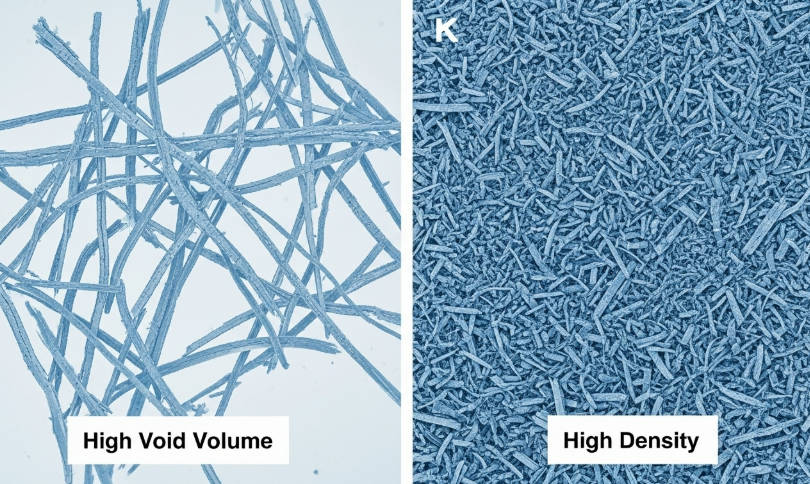
Virgin wood pulp consists of long, intact fibers that naturally form a three-dimensional lattice. This structure creates significant “void volume”—microscopic air pockets trapped between the fibers. These air pockets increase the physical height (caliper) of the sheet without adding weight. Because the fibers are stronger and haven’t been degraded by previous use, they maintain their spring-like quality, preventing the sheet from collapsing under its own mass.
- Virgin fibers maintain their natural length and strength, allowing them to form a lattice that traps more air.
- Long-fiber structures create higher bulk-to-weight ratios, making a 15 GSM sheet feel significantly more substantial.
- Top Source Hygiene utilizes 100% virgin pulp to ensure tactile softness and perceived thickness without adding unnecessary weight.
Density Differences in Recycled Paper Production
Recycled paper production involves fibers that have been shortened and weakened through multiple processing cycles. These shorter fibers cannot support a voluminous internal structure. To achieve a smooth surface and acceptable strength, manufacturers often use high-pressure calendering—a process that flattens the paper between heavy rollers. While this increases the weight per square meter (GSM), it destroys the air pockets, resulting in a product that feels thin, dense, and often stiff to the touch.
| Performance Metric | 15 GSM Virgin Wood Pulp | 18 GSM Recycled Pulp |
|---|---|---|
| Fiber Integrity | Long, flexible, and intact | Short, brittle, and fragmented |
| Internal Structure | High void volume (Airy) | High density (Compressed) |
| Hand-Feel | Soft, cushioned, and thick | Flat, stiff, and “papery” |
- Recycled fibers are shorter and more brittle because they have been processed multiple times.
- Manufacturers often use high-pressure calendering to smooth out recycled sheets, which collapses air pockets and reduces thickness.
- An 18 GSM recycled sheet contains more mass per square meter but lacks the structural height found in lower-weight virgin sheets.
Weight Versus Caliper Measurements
Standard procurement practices in 2026 distinguish clearly between weight (GSM) and caliper (thickness). GSM measures the mass of the fiber used, while caliper measures the distance between the two surfaces of the sheet. For high-end brands, GSM alone is an insufficient quality marker. We see a shift where distributors prioritize bulk optimization—achieving maximum caliper with minimal GSM—to reduce shipping weights and material costs while maintaining the “premium feel” consumers expect.
- GSM is a metric of mass, whereas thickness is determined by the manufacturing process and fiber type.
- Procurement teams should evaluate both GSM and caliper measurements to ensure products meet specific hand-feel requirements.
- Top Source Hygiene provides detailed specifications for both weight and thickness to help clients select the right material for their brand.
Premium OEM Manufacturing for Your Paper Brand
The Calendering Process: How Compression Dictates Final Sheet Bulk
Calendering serves as the final mechanical stage where we reorganize fiber structures to achieve the precise balance between surface silkiness and the tactile “bulk” that distributors require.
Compression Mechanics and Sheet Density
Traditional calendering utilizes high-pressure nips to flatten fibers, a process that inherently increases surface smoothness while stripping the sheet of its natural bulk. Engineers at Top Source Hygiene calculate the exact compression ratio for every run to ensure the tissue remains soft and compressible rather than becoming an overly compact, parchment-like material. Excessive nip pressure compromises the final product’s ability to trap air, making premium toilet paper feel thinner to the end consumer even if the GSM remains constant.
| Calendering Type | Mechanical Execution | Bulk Retention (%) |
|---|---|---|
| Hard-Nip Calendering | High-pressure steel rollers; aggressive fiber flattening. | 40% – 55% |
| Soft-Nip Technology | Elastic roll covers; distributed pressure zones. | 75% – 85% |
| Thermal Calendering | Heated rolls up to 200°C; surface fiber softening. | 80% – 90% |
Soft-Nip and Long-Nip Technologies
Modern finishing techniques prioritize the preservation of bulk by extending the contact time between the paper and the rolls. Soft-nip calendering employs elastic roll covers that conform to the paper’s topography, protecting the fiber structure from the crushing force typical of older steel-on-steel systems. Long-nip systems increase the “dwell time” in the compression zone, allowing our production lines to reach a monthly capacity of 2,860 tons while maintaining the high-loft standards expected in 2026.
- Elastic covers minimize fiber breakage, maintaining the sheet’s tensile strength.
- Extended dwell times allow for surface refinement without drastic thickness loss.
- Denser nip configurations are reserved for specialized industrial grades where smoothness outweighs loft.
Thermal Calendering for Surface Quality
Applying heat during the calendering process significantly improves tactile properties. Thermal systems at our Hebei facility reach temperatures of 200°C to soften surface fibers, creating a premium finish on 100% virgin wood pulp products. This heat treatment decouples surface smoothness from bulk loss; the paper feels silky and luxurious without losing the structural thickness required for 5-ply tissues like our TSH-4010 luxury hospitality rolls.
Optimizing Bulk for Absorbent Paper Products
Successful calendering requires a balance between moisture content and nip mechanics to preserve liquid absorption capacity. We manipulate moisture levels before the paper enters the calender stack to prevent fibers from becoming brittle under pressure. By focusing on roll surface characteristics rather than raw mechanical force, we keep internal pores open. This strategic bulk management ensures that high-capacity products, such as the TSH-JRT08 jumbo rolls, remain highly absorbent and cost-effective for commercial venues.

Does Increasing GSM Always Lead to Higher Liquid Absorption Capacity?
High grammage increases the total mass of a sheet, but effective liquid absorption depends more on the internal capillary architecture and fiber porosity than on raw weight alone.
The Role of Fiber Porosity and Void Volume
GSM measures material density, yet liquid capacity relies on the void volume between fibers to trap and hold moisture. A dense, high-GSM sheet without sufficient air pockets often acts as a barrier rather than a sponge. Precision engineering allows manufacturers to create bulky structures with high porosity even at lower grammages, ensuring the paper performs efficiently without unnecessary waste.
- Higher porosity enables faster wicking by providing clear paths for liquid travel.
- Dense sheets without enough capillary space exhibit slower absorption rates.
- Bulky, lighter structures can outperform heavier, compressed sheets in total moisture retention.
Impact of Material Selection and Fiber Length
The quality of the raw pulp dictates how efficiently a sheet transports liquid. Top Source Hygiene utilizes 100% virgin wood pulp, which provides the long-staple fibers essential for superior capillary action. These longer fibers create a more effective network for liquid distribution compared to the short, broken fibers found in low-grade recycled paper. Strategic fiber blending optimizes absorption performance without requiring an increase in paper thickness or weight.
- Long-fiber virgin pulp maintains structural integrity while creating large internal reservoirs.
- Recycled fibers often pack too tightly, limiting the space available for water molecules.
- Advanced blending techniques achieve high performance-to-weight ratios for B2B procurement.
Manufacturing Finishes and Hydrophilic Treatments
Chemical and mechanical finishing processes often override raw GSM as the primary driver of performance. Hydrophilic finishing techniques improve the surface tension of fibers, allowing for faster moisture intake. Mechanical embossing patterns, such as the CNC-precision designs used by Top Source Hygiene, increase surface area and help break liquid tension. These patterns can boost absorbency by up to 30% without adding a single gram to the paper weight.
- Point-to-point embossing creates pockets that physically trap liquid.
- Excessive calendering can compress high-GSM paper and reduce absorption by closing air pockets.
- Surface treatments ensure the paper remains skin-friendly while maximizing wicking speed.
Efficiency Trends for 2026
Modern procurement focuses on performance-to-weight ratios to balance cost and environmental impact. Global markets now prioritize towels and tissues that dry effectively while using less raw material. This shift helps companies lower shipping costs and carbon footprints, especially when optimizing 40HQ container payloads. Top Source Hygiene assists clients in engineering specific paper weights that meet 2026 sustainability standards without sacrificing the user experience or strength.
- Lower GSM with high absorbency reduces the landed cost per roll for distributors.
- Retailers prefer “right-weighted” products that offer premium feel with optimized material use.
- Sustainability mandates drive the demand for fiber-efficient manufacturing processes.
Market Standards: Navigating the 13.5 to 22 GSM Spectrum for Global Tenders
Standardizing paper weight within the 13.5 to 22 GSM range allows procurement officers to match material density with the specific mechanical stresses of commercial or residential dispensing environments.
Weight Specifications for Toilet Tissue and Commercial Jumbo Rolls
Procurement officers typically select 13.5 to 15 GSM for standard multi-ply toilet paper. This range balances skin-friendly softness with material efficiency, making it the primary choice for high-volume retail markets. In contrast, high-traffic commercial venues such as airports and shopping malls specify 15 to 17 GSM for jumbo rolls. The higher density ensures the paper withstands the tension of industrial dispensers without tearing prematurely.
| Application Type | Standard GSM Range | Strategic Procurement Value |
|---|---|---|
| Residential Multi-Ply | 13.5 – 15.0 GSM | Optimizes cost-per-roll for retail competitiveness. |
| Commercial Jumbo Rolls | 15.0 – 17.0 GSM | High tensile strength for industrial dispensers. |
| Kitchen/Premium Towels | 20.0 – 22.0 GSM | Structural integrity for liquid scrubbing. |
Kitchen towel tenders in 2026 focus on the 20 to 22 GSM range. This thickness provides the structural integrity required for liquid absorption and scrubbing tasks. We see that while lower GSM values serve the high-volume toilet paper market, towel specifications require higher mass to maintain wet strength and prevent sheet disintegration during use.
Regional Compliance and Sustainability Requirements for 2026
Tender requirements fluctuate based on regional geography and environmental mandates. North American and European tenders prioritize FDA and FSC certifications, favoring 100% virgin wood pulp that meets strict 2026 safety standards. These markets often demand OBA-free (No Optical Brightening Agents) products to ensure the paper is safe for sensitive skin and septic systems.
- Oceania and Asian markets emphasize hygiene compliance and rapid supply for branded hospitality chains in the 15-18 GSM category.
- African and South American public facility tenders seek cost-effective, high-capacity solutions that maintain durability at a 13.5 GSM baseline.
- Middle Eastern markets demand 5-ply luxury configurations using premium wide-format 165mm sheets, often exceeding standard GSM weights for maximum comfort.
Customization Capabilities in Large-Scale OEM Procurement
Top Source Hygiene facilitates global tenders by offering adjustable GSM settings across two advanced factories in the Hebei paper industrial hub. With a monthly production capacity of 2,860 tons, we allow clients to request specific ply counts ranging from 2-ply to 5-ply to complement their selected GSM weight. This direct-to-factory model reduces intermediary costs, enabling competitive pricing for 40-foot high-cube container orders.
Our loading teams maximize 40HQ payload efficiency, often reaching 7 to 9 tons per container depending on the GSM and roll compression. This logistical precision ensures that global distributors receive the lowest landed cost per unit while maintaining strict adherence to the technical specifications defined in their procurement contracts.
Can High-Crepe Ratio Tissue Artificially Boost Thickness Perception?
High-crepe ratios expand tissue caliper by up to 350% without adding wood pulp, utilizing a delaminated fiber structure that prioritizes perceived bulk over actual material weight.
Fiber Delamination and Internal Bulk Creation
Creping serves as the primary mechanical method for inflating sheet caliper without increasing wood pulp consumption. By utilizing a creping blade to physically delaminate internal fiber bonds, production teams create an “exploded” structure. This expansion allows a sheet to occupy significantly more volume while maintaining a low GSM, effectively decoupling weight from tactile thickness.
- Mechanical expansion increases tissue caliper by 200% to 350% relative to the base sheet weight.
- The process allows the tissue to occupy more volume while consuming less raw wood pulp material.
- Engineered bulk mimics the hand-feel of much heavier sheets while maintaining cost-efficiency for the manufacturer.
The 30 Crepes/cm Limit and Physical Thresholds
While high ratios improve tactile bulk, physical constraints dictate the ceiling for thickness gains. Technical data confirms that sheet thickness reaches a maximum at approximately a 5:1 ratio relative to crepe length. Pushing past these specific mechanical thresholds often results in a loss of sheet integrity rather than further gains in thickness perception.
- Once crepe counts reach the 30 crepes/cm threshold, the sheet loses its ability to buckle and generate further bulk.
- Exceeding these limits typically causes the sheet to tear or lose its tensile strength during conversion.
- Current 2026 production standards focus on finding the “sweet spot” where thickness perception peaks before structural degradation occurs.
Impact of Macrocrepe and Microcrepe Patterns
Perception of thickness relies on the specific frequency and amplitude of patterns visible to the user. Microphotography analysis shows that high microcrepe frequency improves both perceived softness and thickness. At the same time, macrocrepe patterns provide the visual “fluffiness” cue that drives market preference in the high-end hygiene sector.
- High microcrepe frequency correlates directly with improved tactile softness and perceived density.
- Macrocrepe patterns provide the initial visual cue of “fluffiness” that influences professional buyer decisions.
- Production teams adjust blade coating hardness and pocket angles to fine-tune these specific aesthetic and tactile structures.
Conclusion
Balancing GSM with fiber quality and calendering techniques allows procurement teams to source high-performance paper without paying for unnecessary weight. Precise specifications ensure products meet regional market standards while maintaining the softness and bulk end-users expect. We focus on 100% virgin wood pulp to ensure these technical metrics translate into a consistent, premium hand-feel across every container.
Review your current product specifications to see if a custom GSM or embossing pattern could improve your margins and product perception. Contact our team to request technical data sheets or a sample pack from our inventory for your next 40HQ shipment.
Frequently Asked Questions
What is the standard GSM for a premium 3-ply toilet paper roll?
For a premium 3-ply toilet paper roll, the industry standard is typically between 15 and 16 GSM per ply, resulting in a total finished weight of 45 to 48 GSM. This specific density provides the optimal balance of “quilted” bulk, high absorbency, and the luxurious hand-feel required for high-end retail positioning.
How can I verify the actual GSM of a shipment from a Chinese factory?
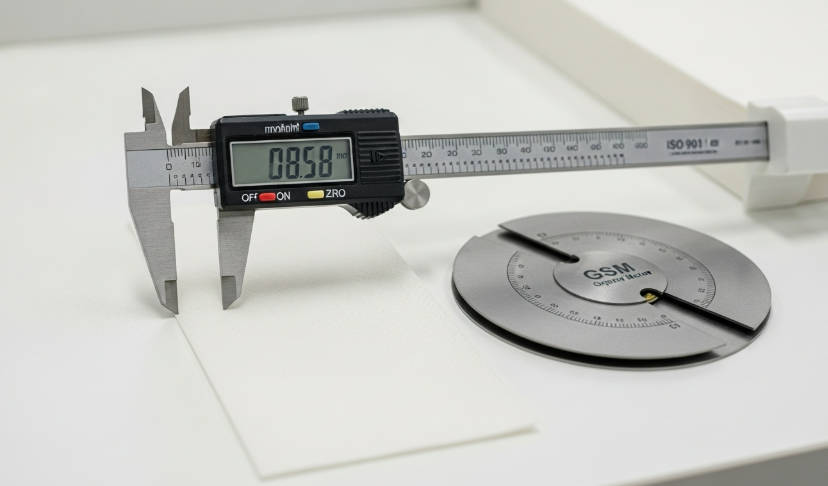
Verification is performed using a GSM circular cutter to extract a precise 100cm² sample from several rolls in the batch. Weigh the sample on a high-precision digital scale (0.01g accuracy); multiplying that weight by 100 gives you the exact GSM. Alternatively, calculate the total area of a roll (Length x Width) and divide the net paper weight by that area to find the average GSM across the entire roll.
Does a higher GSM necessarily mean the paper is stronger and more durable?
No, GSM only measures weight, not quality. While higher GSM adds thickness, durability is determined by fiber length and bonding. A 13 GSM sheet made from 100% virgin long-fiber wood pulp is significantly stronger and more tear-resistant than a 16 GSM sheet made from low-grade recycled short-fiber pulp or paper containing high amounts of filler.
Why do commercial jumbo rolls typically have a lower GSM than retail rolls?
Commercial Jumbo Relief Rolls (JRT) prioritize cost-per-meter and dispenser compatibility. By using a lower GSM (typically 12–13 per ply), manufacturers can wind more footage (300m+) onto a single roll while maintaining a manageable roll diameter for standard dispensers. Retail rolls prioritize “cushion” and consumer comfort, utilizing higher GSM to achieve a softer, more voluminous feel.
What is the impact of GSM on the final shipping weight of a 40HQ container?
GSM has a direct linear impact on cargo weight. In a 40HQ container, which often reaches its weight limit (approx. 26-28 tons) before its volume limit is reached, a 10% increase in GSM can reduce the total roll capacity by the same margin. This increases the freight cost per unit, making GSM management critical for maintaining international shipping margins.
How does calendering change the hand-feel without changing the GSM?
Calendering is a mechanical process where the paper passes through high-pressure steel rollers. This “irons” the surface fibers, reducing the paper’s caliper (thickness) and increasing smoothness and sheen. Because no mass is added or removed, the GSM remains identical, but the perceived hand-feel transitions from a textured, bulky surface to a silky, flat finish.