Skip to content

Dutch B2B procurement teams now face a strict regulatory landscape as the national mandate to halve primary raw material use by 2030 approaches. With the Corporate Sustainability Reporting Directive (CSRD) taking effect in 2026, sourcing facial tissues requires more than just comparing price points; it demands verified data on fiber circularity and carbon footprints. With the Corporate Sustainability Reporting Directive (CSRD) taking effect in 2026, sourcing facial tissues requires more than just comparing price points; it demands verified data on fiber circularity and carbon footprints. Local manufacturers are responding by shifting production toward 100% recycled content and agricultural sidestreams like straw and flax to meet these emerging standards.
This guide analyzes the leading facial tissue manufacturers operating within the Netherlands, focusing on those integrated into the 2026 circular economy framework. We evaluate how mills utilize the 430 million tonnes of annual throughput at the Port of Rotterdam to secure sustainable feedstocks and how they serve a market where private labels already command a 55% share. The following sections provide a breakdown of industrial infrastructure, environmental compliance for healthcare and corporate sectors, and the technical specifications required for EU Ecolabel certification.
Top 10 Facial Tissue Suppliers & Manufacturers Operating in the Netherlands
Quick Comparison: Top Picks
| Manufacturer | Location | Core Strength | Verdict |
|---|---|---|---|
| Top Source Hygiene | Mancheng, Baoding (Global Shipping) | Premium Facial Tissues, Toilet Paper, Jumbo Rolls | Premier factory-direct partner for high-capacity OEM/ODM production with strict quality compliance. |
| Essity Aktiebolag | Global, with operations in Netherlands | Facial tissues, professional hygiene systems | Global leader focused on the circular economy and professional tissue solutions in the Netherlands. |
| WEPA Hygieneprodukte GmbH | Germany, with operations in Netherlands | Recycled facial tissues, eco-friendly hygiene products | Expert in recycled paper technology, perfectly aligned with Dutch green and sustainable standards. |
| Metsä Tissue Corporation | Finland, with production in Netherlands | Facial tissues, high-grade professional tissues | High-quality supplier with a vertically integrated sustainable supply chain for industrial accounts. |
| Sofidel S.p.A. | Italy, with operations in Netherlands | Facial tissues, toilet paper, napkins | Major manufacturer recognized for investing in advanced low-emission production technologies. |
| Van Houtum | Swalmen, Netherlands | Circular Facial Tissues, Satino Eco-Line, Cradle-to-Cradle Papers | Dutch domestic leader in closed-loop corporate and hospitality hygiene contracts; exceptional local fulfillment. |
| Kimberly-Clark (Kleenex) | USA, with production in Netherlands | Kleenex branded facial tissues | Industry icon providing unmatched brand trust and superior softness and strength technology. |
| Crown Van Gelder | Velsen, Netherlands | Agricultural Sidestream Tissues, Straw & Flax Fiber Blends | Pioneering industrial plant utilizing non-wood circular biomass feedstocks; perfect for strict 2030 raw material targets. |
| The Navigator Company | Europe / Netherlands Hubs | High-GSM Private Label Tissues, Premium Virgin Soft Packs | Massive Iberian pulp-to-tissue integrated producer; top-tier choice for scalable 55% Dutch store brand programs. |
| Industrie Cartarie Tronchetti S.p.A. | Italy, European operations | Facial tissues, household paper products | Reliable player in the European market providing proven quality for consumer-grade paper products. |
Top Source Hygiene
Top Source Hygiene operates as a direct manufacturing partner with thirty years of experience in the paper industry. Based in the production hub of Mancheng, Baoding, they manage large-scale OEM and ODM projects for facial tissues and jumbo rolls using 100% virgin wood pulp. Their production lines follow international standards like FDA and FSC, making them a reliable choice for the Dutch circular economy and global hospitality markets that require high-grade hygiene products.
Working directly with the factory gives buyers more control over product specifications and cost management. This setup minimizes the risks often found with middlemen and ensures that high-capacity orders are handled with technical precision. While they focus on high-volume containers, the benefit lies in their ability to scale production while maintaining strict quality benchmarks for shipping to Europe and North America.
At a Glance:
- 📍 Location: Mancheng, Baoding (Global Shipping)
- 🏭 Core Strength: Premium Facial Tissues, Toilet Paper, Jumbo Rolls, Kitchen Towels
- 🌍 Key Markets: Netherlands, Europe, North America, Oceania
Why We Picked Them:
| ✅ The Wins | ⚠️ Trade-offs |
|---|---|
|
|
Essity Aktiebolag
Essity operates as a massive force in the global hygiene sector, securing a primary spot in the Netherlands through the household-name Lotus brand. They take a proactive stance in the Dutch circular economy by moving beyond standard manufacturing to integrate sustainable fiber sourcing across the entire supply chain. By prioritizing local execution and maintaining strict factory control, they ensure that products like facial tissues and paper towels meet high environmental standards while serving both consumer and B2B segments effectively.
The company’s professional hygiene systems focus on reducing operational risk through reliable, high-performance tissue solutions. They manage the transition to a greener economy by innovating within Dutch facilities, ensuring that every professional system helps clients meet their own sustainability targets. This dedication to quality and ecological responsibility positions them as a primary choice for businesses that value long-term reliability and premium branding.
At a Glance:
- 📍 Location: Global, with operations in Netherlands
- 🏭 Core Strength: Facial tissues, professional hygiene systems, paper towels
- 🌍 Key Markets: Europe, Netherlands consumer and B2B
Why We Picked Them:
| ✅ The Wins | ⚠️ Trade-offs |
|---|---|
|
|
WEPA Hygieneprodukte GmbH
WEPA operates as a specialized manufacturer focusing on sustainable hygiene solutions across Europe. The company manages extensive production facilities that turn recycled materials into high-grade facial tissues and paper goods. By maintaining direct factory control, they ensure consistent quality and adherence to strict environmental regulations, particularly for the German and Dutch markets. This localized production model helps minimize supply chain delays while meeting the specific sustainability requirements of green-conscious wholesale buyers.
Their operational strategy emphasizes local execution to reduce the risks often associated with long-distance sourcing. By keeping manufacturing within Europe, they provide faster turnaround times and lower carbon footprints compared to overseas alternatives. This approach allows them to align with the evolving eco-standards in the Netherlands. Buyers looking for reliable hygiene supplies benefit from their expertise in recycled paper technology and their ability to scale production without compromising core environmental values.
At a Glance:
- 📍 Location: Germany, with operations in Netherlands
- 🏭 Core Strength: Recycled facial tissues, eco-friendly hygiene products
- 🌍 Key Markets: Europe, eco-conscious wholesale
Why We Picked Them:
| ✅ The Wins | ⚠️ Trade-offs |
|---|---|
|
|
Metsä Tissue Corporation
Metsä Tissue Corporation operates as a specialized manufacturer focusing on premium tissue products for both retail and professional environments. By maintaining production facilities within the Netherlands, the company ensures tight control over factory output and local execution, which directly benefits buyers looking for reliable lead times. Their operations span the entire value chain, starting from wood raw material sourced from sustainably managed forests through to the finished facial tissues and professional-grade supplies used in various industries.
The integration of the supply chain significantly reduces risks associated with raw material volatility and quality fluctuations. Because they manage everything from forest management to the final production stage, clients receive consistent product specifications that meet strict European standards. This vertical model allows for precise tracking of environmental impact, making them a preferred choice for businesses that prioritize sustainability without compromising on the high-grade durability of their tissue solutions.
At a Glance:
- 📍 Location: Finland, with production in Netherlands
- 🏭 Core Strength: Facial tissues, high-grade professional tissues
- 🌍 Key Markets: Europe, Industrial and Retail
Why We Picked Them:
| ✅ The Wins | ⚠️ Trade-offs |
|---|---|
|
|
Sofidel S.p.A.
Sofidel S.p.A. operates as a prominent Italian manufacturer that has strategically scaled its footprint within the Netherlands. By establishing dedicated operations in the Dutch market, the company ensures direct oversight of its supply chain, which facilitates precise local execution for retail and wholesale partners. This localized presence allows for rigorous factory control, ensuring that the high quality standards required for facial tissues and paper products remain consistent across different European regions.
The group prioritizes risk reduction by integrating advanced, low-emission production technologies and sourcing certified sustainable raw materials. These initiatives help business partners meet strict environmental regulations and satisfy growing consumer demand for eco-friendly household goods. By maintaining a diverse portfolio of certified brands, Sofidel manages to serve various market segments while utilizing modern manufacturing practices to protect against supply chain vulnerabilities and ensure long-term reliability.
At a Glance:
- 📍 Location: Italy, with operations in Netherlands
- 🏭 Core Strength: Facial tissues, toilet paper, napkins
- 🌍 Key Markets: Europe, Dutch Retail and Wholesale
Why We Picked Them:
| ✅ The Wins | ⚠️ Trade-offs |
|---|---|
|
|
Van Houtum
Van Houtum operates highly specialized closed-loop converting assets from its home base in Swalmen, Netherlands, positioning itself as the leading regional partner for corporate and institutional procurement offices. The company focuses entirely on high-grade circular paper solutions under their trusted Satino Eco-Line label, crafting multi-ply facial tissues from verified post-consumer recycled paper waste. This targeted local execution provides Dutch procurement teams with a direct domestic supplier that operates independently of volatile trans-oceanic pulp transport.
Their operational framework places absolute priority on zero-waste manufacturing and strict chemical reduction. Sourcing and refining old paper layers locally allows Van Houtum to claim extensive Cradle-to-Cradle accolades, reducing carbon footprint indices across corporate office networks. This specialized facility gives Benelux buyers an agile, highly auditable supply partner configured explicitly to meet strict national 2030 raw material targets and CSRD compliance pathways.
At a Glance:
- 📍 Location: Swalmen, Netherlands
- 🏭 Core Strength: Circular Facial Tissues, Satino Eco-Line, Cradle-to-Cradle Papers
- 🌍 Key Markets: Netherlands, Belgium, Germany Corporate B2B Networks
Why We Picked Them:
| ✅ The Wins | ⚠️ Trade-offs |
|---|---|
|
|
Kimberly-Clark (Kleenex)
Kimberly-Clark stands as a dominant force in the global personal care market, particularly through its flagship Kleenex brand which has become the de facto standard for facial tissues. Based in the USA but operating with a strong manufacturing presence in the Netherlands, they cater primarily to large-scale retail markets across Europe. Their operation focuses on high-volume production that meets rigorous hygiene certifications, making them the primary choice for retailers and commercial distributors who prioritize quality and consumer trust.
The company leverages a sophisticated production and distribution network to maintain factory control and ensure consistent product performance. By managing local execution through their Dutch facilities, they effectively reduce logistics risks and supply chain disruptions for European partners. This infrastructure allows them to implement advanced softness and strength technologies across their product lines while maintaining the strict safety standards required for sensitive hygiene products.
At a Glance:
- 📍 Location: USA, with production in Netherlands
- 🏭 Core Strength: Kleenex branded facial tissues
- 🌍 Key Markets: Global, Europe Retail
Why We Picked Them:
| ✅ The Wins | ⚠️ Trade-offs |
|---|---|
|
|
Crown Van Gelder
Crown Van Gelder manages highly unique, eco-focused processing lines out of Velsen, Netherlands, leading a profound shift away from traditional timber dependence. The company integrates agricultural biomass side-streams, using fibers derived from straw, flax, and regional sugar beet pulps to engineer highly sustainable sheet substrates for specialized packaging and single-use hygiene systems. This local execution allows advanced procurement directors to secure verified tree-free materials right at the processing core.
Their smart mill layout emphasizes zero-waste chemical optimization and heavy resource circularity. Processing agricultural residues within localized Dutch supply networks ensures a 25-50% reduction in raw processing footprint indices, avoiding standard wood imports. Sourcing from their advanced regional infrastructure lowers structural environmental auditing risks, providing corporate and public sector buyers with clear, data-driven ESG verification records.
At a Glance:
- 📍 Location: Velsen, Netherlands
- 🏭 Core Strength: Agricultural Sidestream Tissues, Straw & Flax Fiber Blends
- 🌍 Key Markets: Dutch public e-tenders, sustainable merchant chains across Western Europe
Why We Picked Them:
| ✅ The Wins | ⚠️ Trade-offs |
|---|---|
|
|
The Navigator Company
The Navigator Company coordinates vast multi-ply tissue programs across the Benelux region, channeling products from its highly integrated pulp-to-tissue mills in the Iberian Peninsula straight to major Dutch logistics hubs. The group excels at executing container-scale private label programs, manufacturing premium soft-pack and box configurations tailored for dominant grocery store brands. Sourcing from their vertically managed forest footprints ensures complete material tracing and stable baseline costs.
The firm utilizes highly sophisticated automated converting lines, ensuring uniform sheet thickness and absolute weight parameters across massive wholesale orders. This integrated structure insulates large-scale retail buying departments from open-pulp market fluctuations, stabilizing contract pricing over multi-year framework agreements. For Dutch grocers capitalizing on the country’s 55% private-label market share, this provider offers exceptional volume scalability.
At a Glance:
- 📍 Location: Europe / Netherlands Hubs
- 🏭 Core Strength: High-GSM Private Label Tissues, Premium Virgin Soft Packs
- 🌍 Key Markets: Dutch grocery chains, major wholesale buying groups across Benelux
Why We Picked Them:
| ✅ The Wins | ⚠️ Trade-offs |
|---|---|
|
|
Industrie Cartarie Tronchetti S.p.A.
Industrie Cartarie Tronchetti S.p.A. maintains a strong foothold in the European paper industry through direct factory control and a focus on high-grade manufacturing. The company produces a wide range of facial tissues and household paper products, ensuring every batch meets strict quality benchmarks. This hands-on management style allows them to serve the Dutch supply chain with high reliability, delivering consumer-ready products that adhere to regional safety and texture standards.
The operational strategy emphasizes local execution within Europe to reduce shipping risks and overhead costs often associated with long-haul logistics. By keeping production close to its primary markets, the brand provides distributors with faster turnaround times and a more transparent supply chain. This focus on regional efficiency creates a stable partnership for retailers who need consistent stock without the unpredictability of global freight disruptions.
At a Glance:
- 📍 Location: Italy, European operations
- 🏭 Core Strength: Facial tissues, household paper products
- 🌍 Key Markets: Europe, Global
Why We Picked Them:
| ✅ The Wins | ⚠️ Trade-offs |
|---|---|
|
|
The Dutch Manufacturing Edge: High-Tech Sustainability in 2026
The Dutch manufacturing sector in 2026 defines itself through a rigorous circular economy framework that targets a 50% reduction in primary raw material use by 2030. Key developments include the commencement of large-scale chemical recycling at the Port of Rotterdam and the integration of the National Material Flow Registry, which enforces data-driven resource management across industrial supply chains.
National Frameworks for a 2050 Circular Economy
The Dutch Government-wide Programme for a Circular Economy establishes a clear trajectory for a resource-independent national economy by 2050. This initiative requires manufacturers to halve their use of primary raw materials—including minerals, metals, and fossil-based inputs—by 2030. Transition agendas now focus on five high-priority industrial chains where sustainable production methods and renewable resources replace traditional linear models.
The Raw Materials Agreement underpins these efforts by facilitating high-quality recycling and industrial symbiosis. By prioritizing sectors such as manufacturing, plastics, and biomass, the framework encourages the adoption of circular design principles. These principles ensure that materials maintain their highest value throughout the supply chain, reducing waste at the source and promoting the use of sustainable alternatives.
Industrial Infrastructure and Chemical Recycling Operations
Industrial infrastructure in the Netherlands reaches a significant milestone in 2026 with the full operation of the Xycle chemical recycling plant at the Port of Rotterdam. This high-tech facility processes 21,000 tonnes of plastic waste annually, converting discarded polymers into pyrolysis oil. This output serves as a direct feedstock for new plastic manufacturing, effectively closing the loop for industrial materials that were previously difficult to recycle.
Strategic partnerships between global leaders like Dow and Vopak, supported by financial institutions such as ING and Polestar Capital, drive the shift toward shared circular infrastructure. These industrial clusters reduce regional dependency on imported primary materials by establishing localized loops. Within these clusters, the waste from one manufacturing process becomes the raw material for another, optimizing resource efficiency across the Rotterdam industrial complex.
Data Transparency and Regulatory Compliance Standards
Data-driven circularity becomes a regulatory standard through the National Material Flow Registry, which enables precise tracing of resources from the production phase to end-of-life reuse. This system uses harmonized material codes and mandatory reporting to provide a clear view of resource efficiency. Such transparency aligns with the EU Circular Economy Act, which formally treats waste as a valuable resource and strengthens the internal market for secondary raw materials.
Compliance requirements expand in 2026 as the Corporate Sustainability Reporting Directive (CSRD) mandates detailed environmental disclosures for large industrial firms. Manufacturers utilize Digital Product Passports and verified environmental databases to provide sustainability credentials for their products. These tools ensure that every industrial component carries a verifiable record of its material composition, carbon footprint, and recycling potential, meeting the demands of eco-conscious wholesalers and B2B buyers.
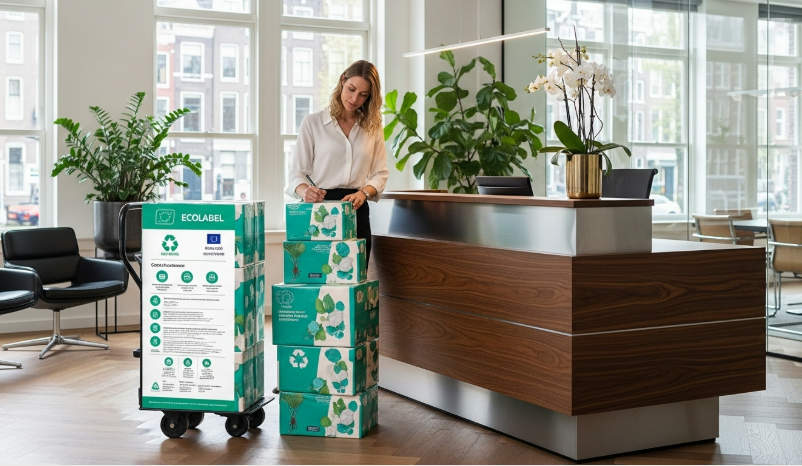
Innovation in Fiber: How Dutch Mills Lead in 100% Recycled & Tree-Free Tissues
Dutch tissue manufacturers are redefining facial tissue production by integrating post-consumer waste and agricultural residues like straw and flax into their supply chains. These facilities leverage advanced de-inking and non-wood pulping technologies to meet the Netherlands’ 2026 circularity goals, which mandate a significant reduction in primary raw material usage and the adoption of zero-waste manufacturing cycles.
Transitioning to 100% Circular Feedstocks
Dutch production facilities integrate post-consumer waste into high-grade facial tissues to meet 2026 circularity goals. This shift relies on advanced de-inking and purification processes that remove contaminants while maintaining the fiber integrity required for multi-ply products. By refining these technical stages, mills produce soft and durable tissues that match the performance of virgin pulp alternatives while adhering to strict environmental standards.
Local recovery systems in the Netherlands provide a stable supply of high-quality recycled material. Sourcing fibers domestically reduces the need for virgin pulp imports and helps manufacturers avoid the volatility of global pulp markets. This strategy directly supports the national goal of a 50% reduction in primary raw materials by 2030, ensuring that secondary resources remain the primary feedstock for the hygiene paper sector.
Scaling Tree-Free Fibers from Agricultural Sidestreams
Mills utilize agricultural residues like straw, flax, and miscanthus to replace traditional wood-based fibers. These tree-free alternatives turn agricultural sidestreams into high-value hygiene products, reducing the pressure on forest ecosystems. Non-wood pulping technologies adopted by 2026 significantly lower energy and water consumption compared to standard chemical pulping, as these fibers require less intensive processing to reach the desired softness.
Alternative fibers provide a lower carbon footprint and help manufacturers bypass the logistical costs associated with transcontinental wood pulp shipping. By processing agricultural waste near its source, Dutch mills create a more localized and efficient resource cycle. This innovation appeals to eco-conscious wholesalers and institutional buyers who seek products with minimal land-use impact and lower transport emissions.
Operational Compliance with 2026 Circularity Mandates
Manufacturing plants adapt to the Netherlands’ 2026 circular economy benchmarks through zero-waste production cycles. These facilities prioritize the recovery of minerals and process water to minimize discharge into the environment. FSC-certified and EU Ecolabel-compliant processes ensure that chemical usage and water treatment meet stringent standards, maintaining market access for Dutch-made tissues across the European Union.
Strategic partnerships between mills and waste management firms create closed-loop systems that prioritize resource efficiency over raw material extraction. These collaborations facilitate the high-grade recycling of materials, keeping them in the loop for multiple cycles. As the Corporate Sustainability Reporting Directive (CSRD) takes effect in 2026, these circular operations allow manufacturers to provide the transparent ESG data required by retail and healthcare sourcing teams.
Build Your Unique Toilet Paper Brand with 30 Years of OEM Expertise
Institutional Sourcing: Supplying the Dutch Healthcare and Corporate Sectors
Institutional sourcing for facial tissues in the Netherlands focuses on high-grade hygiene standards for healthcare and sustainability compliance for the corporate sector. Suppliers must navigate the 2026 CSRD mandate and the Dutch national goal of reducing primary raw material consumption by 50% by 2030, necessitating a shift toward FSC-certified recycled fibers and 100% virgin pulp solutions free from chemical whiteners.
Procurement Standards for Dutch Healthcare Facilities in 2026
Dutch healthcare facilities mandate hygiene-grade facial tissues that align with national circular economy frameworks. These regulations target a 50% reduction in the use of primary raw materials by 2030, forcing hospitals to evaluate the lifecycle of all disposable paper products. Procurement teams prioritize tissue supplies that utilize sustainable renewables while maintaining strict medical safety protocols. This includes a transition toward high-grade recycling processes that ensure secondary materials meet the same hygiene benchmarks as virgin alternatives.
Patient safety and skin compatibility remain the primary technical requirements for clinical environments. Sourcing departments specify 100% virgin wood pulp products that are entirely free from fluorescent whiteners and hazardous chemicals. These specifications prevent adverse reactions in sensitive patients and comply with EU Ecolabel criteria regarding chemical limits and water emissions during manufacturing. High-performance absorbency and lint-free properties are essential to maintain sterile environments in diagnostic and treatment rooms.
Customized packaging plays a vital role in medical facility logistics. Suppliers provide branded tissue boxes designed for specialized medical dispensers and storage units that meet sterilized protocol standards. These packaging solutions often incorporate moisture-resistant barriers to protect the product integrity during storage in high-humidity clinical areas. By integrating specialized distribution models, manufacturers help hospitals minimize waste and optimize inventory turnover across multiple departments.
Corporate Sourcing and the 2026 CSRD Mandate
The 2026 Corporate Sustainability Reporting Directive (CSRD) transforms how Dutch corporations manage office consumables. Large firms must now disclose detailed environmental data for their entire supply chain, including the ecological footprint of paper products used in office complexes. This regulatory shift drives procurement departments to seek suppliers that provide transparent material flow data and carbon footprint metrics for every shipment of facial tissues. Businesses use this data to fulfill mandatory ESG reporting requirements and demonstrate progress toward decarbonization goals.
Corporate buyers increasingly favor FSC-certified and recycled fiber options to match the Netherlands’ 2030 biomass sustainability targets. Sourcing strategies focus on substituting virgin materials with high-quality post-consumer recycled content without compromising the soft texture expected in professional settings. This preference supports the Dutch industrial shift toward circular business models, where secondary raw materials are redefined as resources rather than waste. Suppliers who provide third-party verified certifications gain a competitive advantage in the Dutch B2B market.
Large-scale office management utilizes high-capacity jumbo rolls and bulk facial tissue supplies to streamline maintenance and reduce packaging waste. By consolidating orders into high-volume deliveries, corporations minimize the environmental impact of transport logistics. This bulk approach allows facility managers to reduce the frequency of restocking cycles, lowering operational costs while contributing to waste reduction targets. Modern corporate complexes often integrate these high-capacity systems into smart building management protocols to track consumption patterns.
Logistics and Compliance for Dutch Institutional Supply Chains
Institutions utilize factory-direct sourcing models to eliminate intermediaries and secure stable lead times of 15-25 days for high-volume orders. This direct connection with manufacturers allows Dutch distributors to manage inventory more effectively, particularly for essential hygiene supplies. By bypassing traditional wholesalers, large-scale buyers in the healthcare and public service sectors achieve better price stability and more consistent product specifications. This model also facilitates faster adjustments to changing regulatory standards or volume requirements.
All tissue products must meet comprehensive EU regulations alongside specific Dutch hygiene standards for tensile strength and absorbency. Compliance involves adhering to the REACH framework for chemical safety and the EU Deforestation Regulation (EUDR) for fiber sourcing. Manufacturers provide technical data sheets that verify the absence of halogens like chlorine in bleaching processes, often substituting them with hydrogen peroxide and sodium salts. These technical benchmarks ensure the tissues perform reliably in demanding institutional environments while meeting environmental impact labels.
Suppliers coordinate 40-foot high-cube container deliveries to major Dutch logistics hubs, leveraging the world-class infrastructure of the Port of Rotterdam. These hubs facilitate the rapid movement of goods to the hospitality and public service sectors across the Benelux region. Efficient containerized transport reduces shipping costs per unit and ensures a consistent supply of products for institutions with high daily consumption rates. This logistical efficiency supports just-in-time inventory strategies, allowing facilities to maintain lower on-site stock levels without risking shortages.
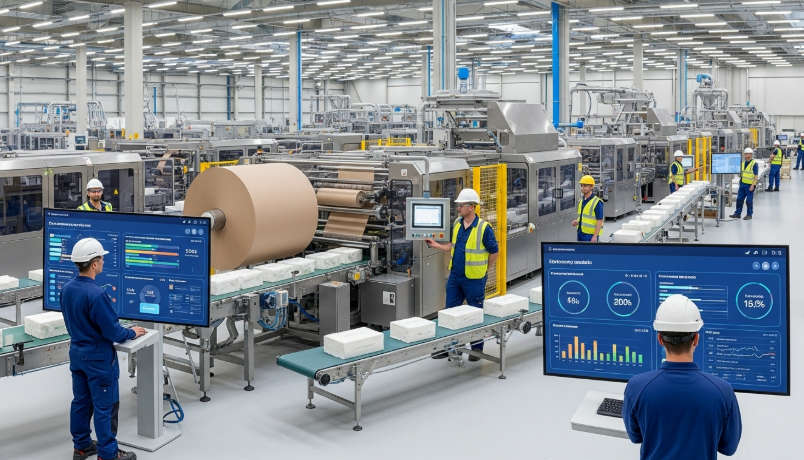
Environmental Compliance: Navigating EU Ecolabel and Dutch Circularity Mandates.
The Netherlands enforces a rigorous environmental framework for tissue manufacturers, requiring alignment with EU Ecolabel certification for sustainable forestry and a national commitment to reduce primary raw material consumption by 50% by 2030. Mandatory ESG reporting under the Corporate Sustainability Reporting Directive (CSRD) begins in 2026, forcing a shift toward high-grade recycling and renewable fiber substitution across the supply chain.
EU Ecolabel Standards for Tissue Production
The EU Ecolabel functions as a primary benchmark for tissue products in the Dutch market, assessing environmental impacts across the entire product life cycle. Manufacturers must ensure that all wood-based fibers originate from sustainably managed forests, verified by FSC or PEFC certifications. Beyond raw material sourcing, the standard imposes strict limits on the use of hazardous chemicals, specifically targeting bleaching agents and surfactants to protect local water systems.
Production facilities must also meet specific energy and water consumption thresholds to maintain compliance. By reducing air and water emissions during the pulp-to-paper conversion process, manufacturers decrease their environmental footprint and align with consumer expectations for verified eco-friendly goods. Maintaining this certification is often a prerequisite for securing contracts with Dutch institutional buyers and retail chains that prioritize sustainable procurement.
Dutch National Circular Economy Targets for 2030
The Netherlands government-wide programme aims to achieve a fully circular economy by 2050, with an aggressive interim goal of a 50% reduction in the use of primary raw materials—including minerals and fossils—by 2030. For the paper and biomass sectors, this mandate accelerates the transition from virgin wood pulp to secondary raw materials. Dutch transition agendas encourage the manufacturing sector to adopt innovative circular production methods that keep materials in the loop for longer periods.
Strategies for tissue manufacturers focus on high-grade recycling, where post-consumer waste is repurposed into premium tissue products without significant quality loss. Companies are increasingly exploring alternative fibers, such as agricultural residues or bamboo, to meet these circularity targets. These efforts help reduce dependency on imported virgin fibers and support the national goal of minimizing waste through efficient material flow registries and monitoring systems.
CSRD and ESG Reporting Obligations in 2026
Starting in 2026, large companies operating in the Netherlands with over 1,000 employees must comply with the Corporate Sustainability Reporting Directive (CSRD). This regulation requires detailed disclosures regarding environmental, social, and governance (ESG) performance. Manufacturers must provide transparent data on Scope 3 emissions, which covers the carbon footprint of their entire value chain, from pulp harvesting in Scandinavia or South America to the final distribution via the Port of Rotterdam.
Reporting must follow the European Sustainability Reporting Standards (ESRS), ensuring that data on material use, waste management, and energy efficiency is comparable across the EU. These obligations force tissue producers to implement advanced tracking systems for their supply chain partners. Transparent reporting serves as a critical tool for institutional partners and regulatory bodies to evaluate the sustainability claims of manufacturers, making data accuracy a central component of Dutch market participation.

Frequently Asked Questions
Who are the primary facial tissue suppliers active in the Netherlands in 2026?
The Dutch market features major global players including the Suzano-Kimberly-Clark joint venture, Essity, Sofidel Group, and WEPA. These companies manage significant production capacities, with the Suzano-KC venture alone overseeing 22 facilities and a capacity of 1 million tonnes of tissue annually. They supply popular regional brands like Lotus, Tempo, and Softis while also supporting extensive private-label manufacturing for local retailers.
Why is the Port of Rotterdam essential for European tissue logistics?
Rotterdam serves as the main entry point for the wood pulp and raw fibers necessary for tissue manufacturing. As Europe’s largest port, it manages an annual throughput of over 430 million tonnes. This infrastructure supports just-in-time supply chains for Dutch mills and converters, enabling efficient distribution of both raw materials and finished products across the Benelux region and beyond.
Is there a significant demand for private label facial tissues in the Netherlands?
The Dutch consumer market shows a strong preference for private labels, which hold a 55% share in the FMCG sector—the highest in Europe. Retailers such as Albert Heijn and Jumbo drive this demand by focusing on high-quality, sustainable tissue options. This environment provides significant opportunities for manufacturers to produce custom-branded soft packs and eco-friendly facial tissues for the retail and healthcare sectors.
What environmental standards govern tissue production in the Netherlands?
Manufacturers follow EU-wide regulations, specifically the EU Ecolabel, which requires sustainable fiber sourcing and limits hazardous substances. Compliance also involves FSC certification for wood pulp and ISO 14001 for environmental management. Dutch producers often prioritize 100% recycled content and use hydrogen peroxide instead of chlorine for bleaching to meet strict circularity mandates.
How do businesses connect with B2B hygiene distributors in the Dutch market?
Organizations can partner with established distributors like Cemex Trescon, Bunzl Foodservice, or digital marketplaces like Qogita. These companies provide comprehensive hygiene solutions, including facial tissues, PPE, and medical disposables. They specialize in serving the healthcare, hospitality, and corporate sectors, offering specialized logistics and wholesale distribution across the Netherlands.
Final Thoughts
The Dutch facial tissue market in 2026 reflects a shift where sustainability serves as the primary operational standard rather than an optional feature. Manufacturers now favor local agricultural sidestreams and high-grade recycled fibers over traditional imported wood pulp to meet the national mandate of halving primary raw material use by 2030. This transition relies on the advanced recycling infrastructure at the Port of Rotterdam and the integration of data-driven material tracking. Companies that adopt these circular models secure their position as preferred partners for institutional and retail sectors requiring verified environmental credentials.
Regulatory frameworks like the CSRD and EU Ecolabel ensure that transparency remains central to every supply chain decision. As healthcare facilities and corporate buyers prioritize products with minimal land-use impact, the use of Digital Product Passports and tree-free fibers becomes a functional requirement for market entry. This focus on localized resource loops and zero-waste production cycles establishes a resilient foundation for the Dutch hygiene sector. Success in this market depends on the ability to balance strict hygiene protocols with the rigorous data disclosures now expected by B2B procurement teams.