Skip to content
Understanding facial tissue market demand by region is the first checkpoint buyers should lock before they approve a supplier, budget, or production slot. The gap between a 60% global market share and a rejected container shipment is often just one spec line — the facial tissue format. A procurement manager I worked with committed $50K on a private-label box tissue order for a German hotel chain. The pre-production sample passed on softness and absorbency. The mass production run used a different pulp furnish to shave $0.03 per unit, and the final product felt like cardboard. The retailer refused the shipment, and the brand lost six weeks of shelf placement. That kind of mismatch happens when buyers treat facial tissue as a commodity rather than a region-specific product.
Understanding facial tissue market demand by region means knowing which format dominates in each market — and which quality parameters are non-negotiable. Box tissue holds 60% of global sales, but that number masks huge variation. In North America, box tissue is the standard, but premium 3-ply and lotion-infused variants are growing at 11.7% annually. In Europe, private label accounts for 38% of sales, and eco-certifications like FSC are mandatory for retail access. In Asia-Pacific, pocket packs and cube boxes capture 21% of sales, driven by on-the-go consumption. A buyer who ships a standard 2-ply box to a European retailer without FSC certification is asking for a delisting notice.
Sample approval is only half the battle. The real test is whether the production run maintains the same quality tolerance — especially on softness and ply consistency. Many suppliers use recycled pulp for eco-lines but hide irregular softness. That’s why a benchmark number helps: ask any potential supplier for a CTI softness score of 85 or higher for premium box tissue, and request a no-fluorescent-whitener certificate for European and healthcare buyers. On the logistics side, a standard private label order runs one 40’HC container, with 20-25 days production and 7-14 days shipping to Europe. If your supplier can’t commit to that timeline and quality floor, keep looking.
North America: Box Tissue Dominates, Premium Growth
Box facial tissue holds 60% of North American market; premium 3‑ply and lotion variants are the fastest‑growing sub‑segments.
If you’re sourcing for North American retail, hospitality, or healthcare, your starting point is box facial tissue. It commands a 60% share of the market. But the real opportunity is upstream: premium 3‑ply, 4‑ply, and lotion‑infused tissues are growing at 11.7% globally, and North America is leading that shift. Hotels and healthcare facilities specifically demand hypoallergenic, FDA‑compliant products — no fluorescent whiteners, no off‑spec softness issues.
- Format Preference Framework: Box tissue dominates at 60% market share. Within that, lotion‑infused and 4‑ply formats are the fastest‑growing sub‑segments, outpacing standard 2‑ply dry creped tissue.
- Regulatory Enforcement: FDA compliance is non‑negotiable for hospitality and healthcare buyers. Any supplier claiming FDA registration must provide proof of facility registration and product listing parameters.
Most competitor reports lump North America into a generic “box tissue” label, ignoring that premium sub‑segments are growing at nearly double the rate of standard dry creped tissue. If you specify only 2‑ply standard boxes, you’ll miss the hotel chain buyer who needs 4‑ply lotion packs for guest bathrooms. Always match your spec sheet to the buyer’s actual format demand, not the aggregate market data.
Europe: Eco-credentials Drive Private Label Surge
In Europe, eco-labeling is not optional — it’s a rigid retailer milestone requirement.
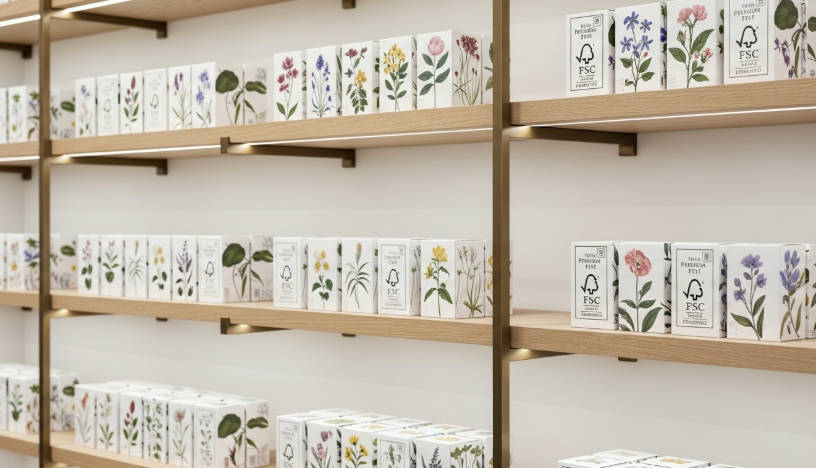
European retailers — particularly in Germany, the Netherlands, and the UK — now require FSC-certified or recycled-content facial tissues as a baseline for shelf access. Over 41% of all facial tissue sales in Europe are eco-labeled, and private label accounts for 38% of the market. This means any B2B buyer sourcing for European retail or hospitality must prioritize certified sustainable fibers and be prepared for format-specific compliance checks.
- Eco-Labeling Directives: FSC certification is the minimum floor. Many retailers also demand recycled-content proof (e.g., PEFC). Premium 3-ply box tissues with eco-credentials remain the fastest-growing subsegment.
- Private Label MOQ Volumes: Standard MOQ for custom private label facial tissue is 20,000 units per SKU (approx. one 40’HQ container). Factories under Top Source Hygiene maintain trial flexibility.
- Chemical Brightener Filtration: European healthcare and eco-conscious retailers test for fluorescent whitening agents. Always request a no-fluorescent-whitener certificate and softness (CTI) test report before production.
Asia-Pacific: Fastest Growth, Pocket & Cube Popularity
Asia-Pacific facial tissue demand grows at 7.6% CAGR – pocket packs lead urban consumption maps cleanly.
Asia-Pacific is the fastest-growing facial tissue market at 7.6% CAGR. China alone consumes 32% of global facial tissue volume. The rise of on-the-go lifestyles has pushed pocket packs and cube boxes to 21% of European sales, but in urban Asian hubs like Shanghai and Tokyo, these portable formats capture over 30% of retail facial tissue revenue.
- Conventional Dry Creped (55% global share): Cost-efficient, acceptable softness for budget segments. Dominates in price-sensitive bulk orders for hospitality and public facilities in emerging Asian markets.
- Premium Structured Formats: Growing at 15%+ annually in China and South Korea. 3- and 4-ply pocket packs command higher margins. Retailers in Japan and Singapore demand lotion-infused variants for premium positioning.
Balancing these two tiers is critical for B2B buyers. Conventional dry creped keeps unit costs low, but the fastest revenue growth is in premium structured formats. An insider note: Some suppliers cut costs on pocket tissue by using shorter fibers, leading to particle shedding. Always request a CTI softness test report and a dusting test before committing to a container.
Middle East & Africa: Volume-Driven, Jumbo Rolls Rule
Over 70% of African procurement is price-driven — but skipping chemical validation can break contracts.
Across Africa and the Middle East, jumbo roll facial tissue from bulk dispensers is the dominant format in public facilities, schools, transport hubs, and hospitality chains. The logic is simple: high-traffic venues prioritize volume per roll and reduced maintenance frequency over softness or packaging aesthetics. A single 800-meter jumbo roll can replace dozens of standard boxes, cutting labor costs by up to 15% in busy restrooms.
- Landed Cost Optimization: More than 70% of institutional buyers in these regions select suppliers based on the lowest landed cost per ton. Sourcing directly from mills keeps pricing bands balanced securely.
- Regional MOQ Adaptations: Standard 40’HC container MOQs (20–25 tons) are often too large for budget cycles. Top Source Hygiene accommodates smaller shipments, including 20’GP containers (approx. 10 tons), to match regional cash flow.
The most overlooked compliance gap in this region is fluorescent whitener content. Many low-cost jumbo rolls use optical brighteners to mask off-white recycled paper, yet European and Middle Eastern health authorities are increasingly restricting these chemicals. A shipment flagged for fluorescent whiteners can be rejected at customs or delisted from hospitality contracts. Top Source Hygiene’s production standard mandates 100% virgin wood pulp free from fluorescent whiteners — verify this with a third-party test report before accepting a sample approval.
Latin America: Bulk Orders, Cost Sensitivity
In Latin America, price per unit gets you in the door — delivery reliability keeps you there permanently.
Most market reports lump South America into a generic “rest of world” category. They miss the specificity of how facial tissue procurement works here. Two channels dominate: supermarkets (multi-pack bundles, 4–12 boxes per pack) and hotels (bulk boxes, often 120–200 sheets per box with custom branding). The common thread is cost per unit, but seasoned buyers know that a few cents per box saved means nothing if the container lands late or the ply count is inconsistent.
- Format Preference Alignments: Bulk box facial tissue in bundle packs (4, 6, 12 units) for retail; standard 3-ply box tissue for hotels. Jumbo roll tissue is also strong in high-traffic commercial facilities.
- Landed Dispatch Timelines: Sourcing directly from China runs on a standard 30% deposit / 70% balance structure. Top Source Hygiene accommodates smaller 20’GP options to securely protect early regional cash flow bounds.
The safest route into the Latin American market is a single 40’HC container as a proof-of-concept. Here’s why: it lets you verify the supplier’s production consistency, shipping documentation accuracy (wrong HS codes cause 3-week customs delays in Argentina), and end‑user reception. A full‑scale annual contract without that pilot step is a bet of $150,000–$250,000 on trust alone. I’ve seen buyers skip this and end up with 80,000 boxes of facial tissue that shed lint on guests’ faces — a brand disaster that a pilot would have caught in time to reformulate the batch.
Cost of inaction: If you skip the pilot and the supplier’s mass production diverges from the sample, you lose the entire container investment (roughly $40k–$50k landed cost), plus the opportunity cost of lost shelf space or guest satisfaction. A pilot shipment with Top Source Hygiene — free samples shipped in 2–3 days, custom sample in 10 days, production for a 40’HC at 20–25 days, ocean freight to South America at 15–25 days — gives you full market validation within 8 weeks. The alternative is a six‑month disaster with no recourse.
| Feature | Details | Benefit |
|---|---|---|
| Target Sectors | Hotels, Supermarkets | Bulk orders for major commercial clients |
| Featured Products | Bulk Facial Tissue, Toilet Paper | Cost-effective volume pricing |
| Strategic Focus | Handling large, bulk orders | Reliable supply for high-demand markets |
| MOQ Flexibility | Smaller MOQs via 20’GP containers available | Reduces upfront investment for buyers |
| Payment & Shipping | 30% deposit / 70% balance; 15-25 days shipping | Manageable cash flow and predictable delivery |
How to Source the Right Format for Your Market
One region’s best-seller is another’s dead stock.
The fastest way to burn a $50,000 order is to assume your home-market specs will work overseas. A 3-ply box tissue that flies off shelves in Chicago will sit unsold in a Berlin supermarket if it lacks FSC certification. Before you sign off on a production run, lock down a region-matched specification sheet that covers ply, sheet count, packaging, and compliance documents.
- North America: Box facial tissue dominates (60% share). Standard spec: 3-ply, 120 sheets per box, FDA-compliant. Unscented configurations out-sell scented lines strictly at a 4:1 baseline.
- Europe: Private label accounts for 38% of sales. Mandatory: FSC-certified or recycled content with rigorous no-fluorescent-whitener compliance guarantees.
- Asia-Pacific: Pocket packs and cube boxes capture 21% of sales (CAGR 7.6%). Pocket tissue formats require tight long-chain fiber blending to stop fine cutting particle dust shedding.
Once the spec sheet is set, the supplier’s production and logistics track record becomes the differentiator. A reliable OEM/ODM partner should deliver consistent runs within 20-25 days from order confirmation, offer free stock samples in 2-3 days and custom samples in 10 days, and ship FOB or CIF with a 30% deposit / 70% balance payment structure. Top Source Hygiene operates to these benchmarks across 56+ countries, with ISO 9001 and FSC certification on hand to back every region-specific order.
Conclusion
Choosing a facial tissue format without regional market data is a gamble. North America runs on box tissue—60% of sales—while Europe demands FSC-certified private label options. The numbers are clear: 38% of European sales are private label, and 41% carry an eco-label. A buyer who ignores these benchmarks risks retail rejection or poor unit economics.
Frequently Asked Questions
Which facial tissue format sells best in North America?
Box facial tissue holds 60% of the North American market, with premium 3‑ply and lotion‑infused variants growing fastest. Hotels and healthcare facilities typically require FDA‑compliant box tissues. Lead with box format for NA hospitality or retail.
Are eco-friendly facial tissues required in Europe?
Yes, eco‑labeling is a retailer requirement in Europe; over 41% of sales are eco‑labeled. FSC‑certified or recycled‑content tissues are mandatory for retail shelf access. Use FSC‑certified options to meet EU retailer standards.
Is pocket tissue popular in Asia?
Yes, pocket packs and cube formats capture 21% of Asia‑Pacific sales, with China alone consuming 32% of global volume. Pocket tissue is especially popular for urban on‑the‑go use. Prioritize pocket packs for Asia‑Pacific retail distribution.
What is the typical MOQ for private label facial tissue?
The standard MOQ is one 40‑foot container, but flexible smaller orders may be available for certain regions. For custom private label runs in Europe, expect a minimum of 20,000 units per SKU. Confirm MOQ based on region and customization level.
How do I verify the quality of facial tissue from a new supplier?
Request free samples and check ISO 9001 certification plus CTI softness test reports. Also review FDA or FSC compliance as needed for your target market. Always test samples and verify certification documents before ordering.