
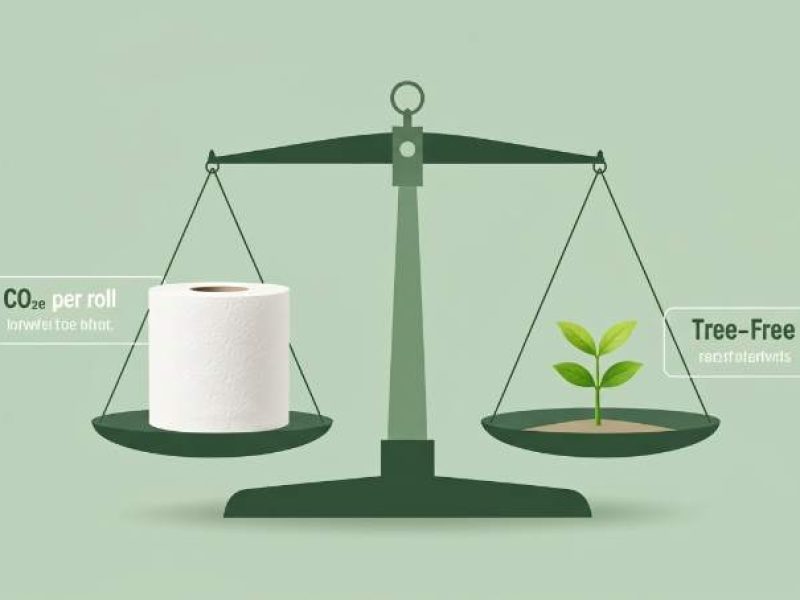
The “Reel” Growth Model is the difference between steady subscription margin and rapid margin collapse—OEM quality gaps, packing errors and surprise dimensional‑weight surcharges turn predictable revenue into churn and sunk acquisition cost.
This guide is a practical SOP for product, operations and marketing teams building subscription-ready bamboo brands: we cover why US bamboo tissue subscriptions are exploding, the specifications behind the plastic-free individual-wrap “Reel” aesthetic, a buyer’s checklist for matching premium DTC quality at wholesale OEM prices, carbon-math templates for tree-free claims, DIM-weight packaging tactics, and a step-by-step scale plan from first container to 10k monthly subscribers—complete with factory checklists, QA checkpoints, pack-out schematics and the exact deliverables you can hand to suppliers and fulfillment partners.
Why Is Bamboo Tissue Subscription Growth Exploding in the US?
Landed-cost volatility from tariffs, packaging and fulfillment mechanics, and clear LTV/CAC targets determine whether a bamboo subscription scales profitably.
Quantify tariff-driven landed-cost shifts and reprice subscription economics
Build a simple landed-cost model and run tariff scenarios at +10%, +50%, +100%, and +145% (U.S. duties reached 145% in April 2025) so you can recalculate per-roll economics using: FOB + freight + insurance + tariff% + port/clearance fees. Use that output to run a sensitivity analysis that produces break-even subscription price, contribution margin per shipment, and the margin impact at each tariff band compared to current retail parity (premium bamboo ≈ $1.25/roll vs conventional $0.69–$0.99/roll).
- Model step: input FOB, freight, insurance, port fees, then apply each tariff band to get landed cost/roll.
- Sensitivity: compute break-even subscription price and margin at target LTV/CAC thresholds and mark trigger points for automatic price or cadence changes.
- Action: implement dynamic pricing rules in your subscription engine that pass incremental costs in staged tiers and notify subscribers at predefined tariff thresholds.
- Mitigation: evaluate supplier diversification (non-Chinese mills), domestic converting, or blended pulp formulas to reduce exposure to rapid tariff swings.
Define unit economics and consumer price tolerance for bamboo subscription offers
Set unit-economics guardrails before scaling. Use the retail premium gap—about $0.26–$0.56 higher per roll for bamboo versus mainstream retail—to estimate the maximum sustainable premium and the adoption ceiling under rate pressure. Track subscription KPIs explicitly: target LTV/CAC ≥ 3:1, contribution margin per shipment after COGS and shipping, and a payback period ≤ 9 months. Those thresholds tell you whether to chase volume or protect margin.
- Test bundle sizes (12/18/24 rolls) and cadences (monthly vs bi-monthly) to lower per-shipment fulfillment cost and improve retention.
- Use price-locked multi-month prepay offers and loyalty credits to reduce churn and lengthen payback windows.
- Protect high-tenure cohorts by absorbing limited tariff deltas selectively to preserve LTV while adjusting acquisition economics for new subscribers.
Sourcing, product specs, and logistics levers to stabilize supply for subscriptions
Make sourcing decisions around material performance and regulatory certainty. Compare bamboo pulp vs 100% virgin wood pulp on cost, tensile strength, rapid-disintegration (septic-safe), and OBA-free compliance; run A/B pilots on SKU specifications before a full launch. Optimize container and packing tactics to lower landed cost per meter: maximize 40HQ payloads (7–9 tons), use space-saving compression and coreless rolls, and set MOQ policy around 1×40HQ for pricing stability and predictable lead time (production 20–25 days, in-stock 10–15 days at dispatch).
- Fulfillment blueprint: centralize subscription picks in regional warehouses, ship pre-bundled counts, and choose carriers with flat-rate or zone-optimized pricing to control DIM and transit costs.
- Packaging & DIM: optimize box sizes and cartonization; remember carriers use different DIM divisors (UPS/FedEx 139, USPS retail 166), so reduce volume where possible to cut billable weight.
- Regulatory controls: declare HS code 4818.1000 correctly, document OBA-free and septic-safe claims, and ensure FDA/EU hygiene compliance to avoid recalls or retail delisting.
- Commercial levers: negotiate 40HQ loading plans, require pre-shipment photos/videos, and enforce T/T terms (30% deposit, 70% balance) to protect cash flow and quality.

The “Reel” Aesthetic: Why Plastic-Free Individual Wrapping is Non-Negotiable
Plastic-free individual wraps cut material cost, protect roll performance, and deliver visible sustainability that reduces regulatory and supply-chain risk.
Material and compliance specs for paper-based individual wraps
Specify 100% virgin long-fiber wood pulp as the default core; allow bamboo pulp only with a supplier declaration of fiber source. Require OBA-free production and include an OBA assay and certificate of analysis in the RFQ so procurement can verify brightness without optical brighteners. Control ply density at 13–22 g/m² per ply and offer 2–5 ply variants; target roll widths of 102–132 mm for standard lines and up to 165 mm for premium lines to match Product Bible dimensions.
Use an uncoated kraft or certified biodegradable paper substrate ≤60 gsm, water-based adhesive, and no PE lamination; demand EN 13432 or ASTM D6400 compostability certification when a compostable claim appears. Set performance targets: natural brightness 85–92% through fiber selection, rapid disintegration to meet North American and European septic standards, and lint-free tensile strength to your specification. Include ISO 9001, FDA or EU hygiene compliance, a disintegration test report, batch color-consistency data, and the OBA assay in purchase specifications.
- Mandatory documents: ISO 9001 certificate, FDA or EU hygiene statement, OBA assay/COA, disintegration test report, batch color-consistency data.
- Material specs: 100% virgin long-fiber wood pulp (or declared bamboo pulp), OBA-free, ply density 13–22 g/m² per ply, roll widths 102–165 mm.
- Wrap substrate: uncoated kraft or biodegradable paper ≤60 gsm; no PE lamination; water-based adhesives only; require EN 13432 or ASTM D6400 where claimed.
- Performance checks: whiteness 85–92%, septic-safe disintegration, lint-free tensile test per spec.
Packaging engineering and logistics for plastic-free individually wrapped rolls
Pack individually wrapped rolls into paper sleeves or recyclable kraft bags in standard counts (10, 12, 18, 24). Replace PE inner bags with sealed kraft or paper-based alternatives and use paper tape for seals. For export protection, require reinforced 5-ply cartons with internal dividers and edge protection, and specify an ECT rating (ECT 32 for lighter stacks; ECT 44 for heavier stacks) and a defined maximum stack load to prevent top-crush in multi-tier storage.
Define a mechanical compression ratio and allowable post-unpack expansion to preserve softness while optimizing space; target a 40HQ payload of 7–9 tonnes by applying controlled compression during bagging. Provide palletization layout, carton dimensions and weights, and a loading plan that maximizes 40HQ cubic utilization; require pre-shipment loading photos and video as proof of correct stowage. Include a one-bundle drop/stack test, allowable moisture content, and compression tolerance in supplier acceptance criteria.
- Primary format: individually wrapped rolls in paper sleeves/kraft bags (10, 12, 18, 24 rolls); no PE inner bags.
- Secondary protection: 5-ply export cartons, internal dividers, edge protectors; specify ECT 32 or ECT 44 and max stack load.
- Compression controls: set compression ratio, allowable expansion post-unpack, and target 7–9 t payload per 40HQ.
- Container planning: pallet layout, carton dims/weights, loading plan; require pre-shipment loading photos and video.
- Supplier acceptance tests: one-bundle drop/stack test, moisture content limit, carton specification sheet, compression tolerance certificate.
Commercial controls and procurement checklist for plastic-free individual packs
Set commercial terms around a 1×40HQ MOQ for trial and private-label runs. Use lead times of 10–15 days for in-stock dispatch and 20–25 days for production from order confirmation, and require landed-cost per roll quoted using HS code 4818.1000 so buyers can compare duty and landed-cost scenarios. Model the cost delta between paper wrap and PE film in RFQ evaluations to quantify material and handling impact.
Enforce quality gatekeeping: require pre-shipment visual verification, batch color-consistency certificates, and independent lab samples for OBA, disintegration, and tensile tests before releasing balance payments. Allow CNC embossing and custom logo perforation but define artwork approval lead times and minimum private-label runs. Use standard payment terms T/T 30% deposit, 70% before shipment, and include a written QA checklist and acceptance criteria in contracts; require photos and video of finished goods and container loading prior to final payment.
- MOQ & lead times: MOQ = 1×40HQ; in-stock dispatch 10–15 days; production 20–25 days from order confirmation.
- Customs & costing: quote landed-cost per roll under HS code 4818.1000; include modeled cost delta for paper wrap vs PE film.
- Quality gates: pre-shipment visual check, batch color-consistency certificate, independent lab tests for OBA, disintegration, tensile strength.
- Branding & customization: permit CNC embossing and custom perforation; specify artwork approval timelines and minimums for private label.
- Commercial terms: T/T 30% deposit, 70% before shipment; require written QA checklist, acceptance criteria, and photos/videos before final payment.
Scale Your Private-Label Toilet Paper

Can You Match Premium DTC Quality at Wholesale OEM Prices?
Delivering DTC-level softness while preserving wholesale margins requires strict material specs, engineered plies, and logistics that cut landed cost per roll.
Material selection and target specifications
Choose long-fiber 100% virgin wood pulp as the baseline for tensile strength and a lint-free feel; reserve bamboo or recycled pulp only for projects that require a distinct sustainability claim or cost trade-off. Avoid optical brightening agents—specify 100% OBA-free pulp—and control whiteness through fiber grade, not aggressive bleaching, to hit a natural brightness target of 85–92%.
Set ply density and roll formats to match regional comfort expectations and freight economics: 13–22 g/m² per ply balances softness with wet-strength, standard roll widths of 102–132mm meet most market preferences, and bundle weights between 780g and 5000g let you tune price-per-roll versus transport efficiency.
- Core material: 100% long-fiber virgin wood pulp (primary); Bamboo or Recycled optional for specific SKUs.
- Chemical spec: 100% OBA-free, no fluorescent whiteners.
- Brightness: target 85–92% via fiber selection.
- Ply density: 13–22 g/m² per ply.
- Roll widths: standard 102mm–132mm.
- Bundle weights: 780g–5000g to match price point and logistics.
Ply engineering, embossing and perforation parameters
Engineer plies from 2 to 5 depending on positioning: use high-pressure lamination to lock layers and prevent delamination while keeping a quilted hand. Apply CNC point-to-point embossing patterns (floral, dot, or custom logo) and dial pressure to increase surface area and absorbency—empirical gains approach ~30% when emboss depth and pattern density match the ply architecture.
Set perforation and tear profiles to the consumer or institutional user: use precision clean‑cut settings to eliminate shredded edges, then test and adjust tear force to the target user profile. Maintain wet-strength to preserve structure during use while engineering rapid disintegration to meet septic-safe requirements. Monitor basis weight and thickness in-line and hold variance within a client-agreed tolerance (±3% is typical; confirm per contract).
- Ply construction: 2–5 plies with high-pressure lamination.
- Embossing: CNC point-to-point; target ~30% absorbency lift when patterned correctly.
- Perforation: precision clean-cut; tune tear force to user profile.
- Wet-strength: balance integrity with septic‑safe rapid disintegration.
- Gauging: inline basis-weight and caliper control; typical variance target ±3% unless client specifies otherwise.
Manufacturing setup and machine parameters
Define winding strategy up front: for coreless heavy rolls (for example, 5000g/28 rolls) set winding tension and density profiles to avoid core collapse and maintain roll roundness through handling. Tune machine speeds and nip pressure to reach the target GSM and emboss depth while avoiding fiber crushing—run speed trials that correlate RPM, nip load and finished caliper.
Program roll counters and length meters to map each SKU to its TSH model (TSH-2559, TSH-3396, etc.) so the line produces the specified meters/roll consistently. Institute quality checkpoints for tensile strength, tear resistance and absorbency at defined intervals each shift, and document a changeover protocol to switch ply counts and emboss patterns with minimal scrap.
- Coreless vs cored: set winding tension and density profiles for coreless 5000g heavy rolls.
- Machine speeds & nip pressure: configure by GSM and emboss depth to avoid fiber damage.
- Roll counters: program meters/roll per SKU (map to TSH models).
- Quality checkpoints: tensile, tear, absorbency measured at intervals per shift.
- Changeover protocol: document steps to switch plies and emboss patterns; aim to minimize scrap.
Packaging, compression and container loading for lowest landed cost
Choose packaging format to protect margin: Format A uses individual roll wrap for hospitality and premium retail; Format B bundles rolls directly for value retail and club channels. Use mechanical compression during bagging to reduce cubic volume while retaining paper loft; calibrate compression so rolls re‑fluff after unpacking but occupy less container space.
Consolidate wrapped or bundled packs into master poly bundles and reinforced 5‑ply export cartons to prevent crushing in high-stack scenarios. Plan 40HQ loading to hit a typical payload of 7,000–9,000 kg and maximize roll count per container. Standardize MOQ and lead times: a trial or private‑label run at 1 x 40HQ; in‑stock dispatch 10–15 days, production 20–25 days.
- Packaging formats: Format A — individually wrapped rolls (hospitality); Format B — direct bundle packs (retail bulk).
- Compression: mechanical settings to reduce cubic volume while retaining fluffiness.
- Secondary protection: master poly bundles + reinforced 5-ply export cartons.
- 40HQ optimization: load planning for 7,000–9,000 kg payload typical.
- MOQ & lead time: standard MOQ 1 x 40HQ; in-stock dispatch 10–15 days; production 20–25 days.
- Packaging cost note: plastic-free individual wrapping can cut material cost ~45–50% versus some pre-coated alternatives while boosting retail shelf appeal.
Quality assurance, compliance and pre‑shipment verification
Certify processes to ISO 9001 and meet FDA and EU hygiene standards; explicitly test for septic-safe rapid disintegration to satisfy North American and European plumbing rules. Apply batch controls for color and brightness across full-container orders to prevent visible variations at retail or in hospitality forks.
Run lab tests for tensile strength, wet-strength, rapid disintegration and microbiological safety where required. Provide buyers with detailed pre-shipment photos and videos of finished goods and the loading process before they pay the balance. Protect commercial terms with standard T/T: 30% deposit, 70% balance before shipment, and maintain private-label confidentiality and profit protection clauses in contracts.
- Compliance: ISO 9001, FDA, EU hygiene; septic-safe disintegration for NA/EU plumbing.
- Batch controls: color consistency and brightness across container loads.
- Lab tests: tensile, wet-strength, rapid disintegration, microbiological where required.
- Pre-shipment verification: photos and videos of finished goods and loading before balance payment.
- Troubleshooting checklist: perforation tearing, ply delamination, brightness inconsistency, coreless winding faults.
- Commercial terms: T/T 30% deposit, 70% before shipment; private-label confidentiality and profit protection enforced.
Marketing the “Tree-Free” Narrative: Carbon Math for Your Brand
Quantify product-level CO2e and traceability before you market “tree-free” to prevent overstated claims and protect distributor margins.
Cradle-to-gate carbon calculation for tissue grades
Calculate CO2e_per_roll with a mass-and-energy approach: CO2e_per_roll = material_mass_kg * material_emission_factor + process_energy_kWh * grid_emission_factor + transport_tkm * transport_mode_factor – end_of_life_credit. Estimate material mass per roll from GSM per ply (13–22 g/m²), sheet area, and ply count (2–5 ply), then convert to kg. Use embossing gain—point-to-point CNC embossing increases absorbency ~30%—to model potential GSM reductions while holding perceived performance steady.
- Required inputs: pulp type (100% Virgin Wood Pulp, Bamboo Pulp, Recycled Pulp), ply count, GSM per ply, roll width (102–132 mm), bundle weight (780 g–5000 g), and sheet dimensions.
- Manufacturing parameters: conversion yield, core vs coreless design (coreless increases usable paper per roll), perforation and packaging scrap rates; capture these as percentage losses.
- Logistics allocation: convert container CO2e to CO2e_per_roll using 40HQ payloads of 7,000–9,000 kg and applied compression ratios; allocate emissions across loaded roll count for Tianjin Xingang Port export routes and inland truck/ocean modal splits.
- Data hygiene: obtain region-specific emission factors, supplier energy intensity, and verified LCI datasets before publishing any brand claims.
Certifying and validating ‘tree-free’ claims: LCA, EPD and traceability steps
Start with a scoped LCA (cradle-to-gate minimum) aligned to a recognized PCR and capture pulp origin, bleaching method (OBA-Free), water use, and process energy. Deliverables that marketing can rely on include a third-party verified LCA report, a product-level EPD, and a documented PCR reference that supports any CO2e or percentage reduction statements.
- Traceability checklist: require certified feedstock chain (FSC or equivalent for plantations), batch identifiers, batch color consistency records, and supplier declarations for Bamboo/Recycled feedstock.
- Regulatory alignment: include ISO 9001, FDA, EU hygiene standards and septic-safe certifications on documentation; add HS Code 4818.1000 on shipping docs to align customs records with LCA boundaries.
- Claim phrasing guardrails: report results in units (g CO2e per 1,000 sheets or per roll), name the verification body and date (as of 2026), and avoid absolute terms unless the EPD explicitly supports them.
Operational levers to lower CO2e per roll in manufacturing and logistics
Run side-by-side LCAs for Bamboo Pulp, Recycled Pulp and Virgin Wood Pulp to reveal net CO2e and performance trade-offs; use production-location sensitivity because bamboo made in China can show ~2,400 kg CO2e/ton versus ~1,824 kg CO2e/ton for U.S. wood-based production, driven mainly by grid mix. Apply design-for-low-carbon tactics: reduce GSM while retaining strength via high-pressure ply-bonding and CNC embossing, then verify tensile strength and absorbency after each GSM step-down.
- Pack and roll engineering: switch to coreless formats (e.g., TSH-3396) and high-density rolls (TSH-3082, TSH-3396 variants) to raise meters per kg and lower transport CO2e per roll.
- Container optimization: use mechanical compression, A/B packing formats and 40HQ loading best practices to reach 7–9 ton payloads and reduce CO2e_per_roll from ocean freight.
- Supply-chain tactics: source closer to raw-material hubs like the Hebei Paper Industrial Hub, consolidate orders to MOQ = 1x40HQ, avoid air freight, and plan using lead times (in-stock 10–15 days; production 20–25 days) to favor lower-emission routing.
- Performance trade-offs: quantify how ply count, brightness (85–92%), and rapid-disintegration (septic safety) affect mass and customer acceptance before finalizing design changes.
How to Optimize Packaging for Dimensional Weight (DIM) ROI?
Reducing billed DIM weight directly lowers landed cost per roll and increases container ROI for every 40HQ you ship.
Compute DIM weight and breakeven cube (metric and imperial)
Use the correct divisor for the lane: metric DIM (kg) = (L_cm × W_cm × H_cm) / 5000 for international freight and carrier billing in kilograms; imperial DIM (lbs) = (L_in × W_in × H_in) / 139 for U.S. domestic LTL/parcel. Measure internal, usable carton dimensions (not external damage tolerances), calculate the DIM weight, then compare that value to gross weight — carriers bill whichever is greater. Note carrier differences in commercial pricing: UPS/FedEx use 139 divisor for many commercial lanes while USPS retail uses 166, so run the calculation against the applicable divisor before quoting rates.
- Example (metric): carton 60 × 40 × 40 cm → volume = 96,000 cm³ → DIM_kg = 96,000 / 5000 = 19.2 kg; if gross weight = 18.0 kg, carrier bills 19.2 kg.
- Breakeven height (cm) to match actual weight: required_H = (actual_kg × 5000) / (L_cm × W_cm). Use this to set maximum allowed carton height when packing.
- Rule of thumb to reach parity: reduce the chosen dimension (usually height) by percent = 1 − (gross_weight / DIM_weight); apply that percentage to current height to size the new carton.
Right-size product format and secondary packaging to increase density
Pick formats that raise mass per cubic metre while keeping handling safe. For SKUs where DIM drives cost, prefer high-weight bundles in the 2,000–5,000 g range — for example, TSH-3396 and TSH-3082 — because heavier, denser rolls reduce volumetric penalties and produce a lower cost-per-roll in a 40HQ. Use mechanical compression during bagging to remove excess fluff; target the minimum compression that preserves sheet integrity and customer experience.
- Choose bundle format by channel: Format B (direct bundle pack) for wholesale to cut per-roll air; keep Format A (individual wrap) for hospitality where hygiene premiums offset DIM penalties.
- Specify reinforced 5-ply export cartons sized to tightly fit inner bundles; design to achieve carton fill > 90% by volume and gross carton weights of 20–30 kg to balance unit density and manual handling.
- Use inner PE/poly bundling plus a master carton to improve stacking strength and reduce the need for bulky void fill; this combination preserves roll shape while maximizing cube utilization.
Palletization and 40HQ loading tactics to maximize per-container ROI
Match carton footprint to pallet footprints (120 × 100 cm or 120 × 80 cm) and use integer carton counts per layer so layers tile cleanly and avoid fractional gaps. Target container bulk density in the 92–118 kg/m³ window — equivalent to roughly 7,000–9,000 kg over a ~76 m³ 40HQ — to balance volume utilization against payload limits and port/road weight caps.
- Design stable stack height to reach container ceiling without leaving headspace; calculate layer count from carton height × layers = planned stack height and confirm fit against 40HQ internal height.
- Standardize carton dimensions so loaders can use modular patterns (columns, herringbone where necessary) and eliminate fractional gaps that waste cube.
- Protect cartons for high stacks: match stack load to carton R-value, specify 5-ply export cartons, add crate straps and edge protectors, and use master poly bundles or shrink to bind groups of cartons into rigid modules.
- Require pre-shipment verification: photograph pallet patterns and container loading, record gross weights and layer counts, and compare actual cube utilization to the plan before releasing the balance payment.

Scaling Your Niche: Moving from 1st Container to 10k Monthly Subscribers
Optimize container economics, SKU cadence, and compliance controls to convert a single 40HQ test load into a predictable 10k-subscriber subscription engine.
Container Fulfillment Plan: 40HQ Loadout, Packaging Formats, and MOQ Strategy
Load exclusively into 40HQ containers and target a payload of 7,000–9,000 kg to minimize landed cost per roll; that payload range maximizes freight efficiency for the Top Source Hygiene solid-roll SKUs and preserves margin when you price subscription tiers. Apply mechanical compression during bagging, pack into reinforced 5-ply export cartons, and use coreless or high-density bundles to increase units per cubic metre while preventing crushing during high stacking.
Offer two packaging formats to match buyer expectations and logistics constraints: individual wrap for hospitality and premium DTC, and direct bundle packs for value retail and bulk distribution. Maintain a strict MOQ policy of one 40HQ container for trials, private label runs, and custom packaging to simplify forecasting and cash flow.
- Container spec: 1 × 40HQ, payload 7,000–9,000 kg.
- Packaging formats: Format A — individual wrap (hotel-grade) in PE bag; Format B — direct bundle (value retail) in master poly bundles.
- Common pack sizes: 10, 12, 18, 24, 28, 32 rolls/pack; select SKUs per market to maximize fill rate.
- Lead times: in-stock dispatch 10–15 days to Tianjin Xingang Port; full production for a 40HQ 20–25 days.
- Payment & verification: T/T 30% deposit, 70% before shipment; provide pre-shipment photos and loading videos.
SKU and Pricing Framework to Build a 10k-Subscriber Base
Structure SKUs into three tiers that align with acquisition, retention, and premium margin goals: a Trial pack (10-roll) for conversion, a Core subscription (12- or 24-roll) for scale, and a Premium tier with individually wrapped 18–24 roll hotel packs for higher ARPU and social-share value. Match each SKU to the cost profile: use TSH-3396 (5,000g/28 rolls) when you need lowest cost-per-meter, TSH-2559 (10 rolls/1,800g) for North American septic-safe households, and TSH-4010 for luxury markets like GCC hospitality.
Run landed-cost math at SKU level using per-roll weights and an allocated freight cost per roll. For reference, TSH-2559 averages ≈180 g/roll and TSH-3396 ≈178.6 g/roll; use those figures to distribute container freight across units. Build subscription cadence around household behavior: monthly deliveries for typical homes, 6–8 week cadence for bulk buyers. Price tiers to absorb freight volatility and target a stable gross margin after distribution and fulfilment fees while enforcing a B2B-only channel policy to protect wholesale margins.
- Three-tier SKU structure: Trial (10-roll), Core (12/24-roll), Premium (18–24-roll individually wrapped).
- Key SKUs: TSH-3396 (5000g/28) for cost efficiency; TSH-2559 (10-roll/1800g) for septic-safe NA markets; TSH-4010 for premium hospitality.
- Landed-cost formula: FOB unit cost + allocated 40HQ freight per roll + local duties (HS 4818.1000) + distribution & fulfilment fees = baseline subscription price.
- Subscription cadence: monthly for households; 6–8 weeks for bulk buyers. Trigger reorder timing using production + freight lead-time buffer.
- Channel policy: B2B-only sales and profit-protection rules to preserve partner margins.
Compliance, Regional Product Fit, and Operational SLAs for Scale
Declare shipments under HS Code 4818.1000 and verify local import rules and duty regimes before contracting freight. Maintain ISO 9001, FDA, and EU hygiene compliance and advertise OBA-free and septic-safe properties where required. Map product families to regions: GCC prefers TSH-4010 and TSH-2269 for luxury and width; SEA prefers TSH-3396 for maximum efficiency; North America requires TSH-2559 for septic safety; Africa buys TSH-3082 and TSH-JRT08 for bulk value; Europe favors TSH-1071 and bamboo options with FSC claims.
Institute trade-risk controls by diversifying material options (virgin wood, bamboo) and alternative ports/routes to mitigate tariff and route volatility. Measure SLAs with operational KPIs and enforce a strict quality protocol: batch color consistency, CNC embossing verification, clean perforation checks, and septic-disintegration test certification before release. Define allowable defect thresholds per container, quarantine procedures, and corrective production steps to protect subscriber experience and retention.
- Customs & compliance: use HS 4818.1000; verify duty regimes pre-contract.
- Certs & safety: ISO 9001, FDA, EU hygiene; label OBA-free and septic-safe where relevant.
- Regional model mapping: GCC — TSH-4010/TSH-2269; SEA — TSH-3396; NA — TSH-2559; Africa — TSH-3082/TSH-JRT08; Europe — TSH-1071/bamboo.
- Trade-risk controls: diversify fibre sources and port/route options to soften tariff shocks.
- SLA & KPIs: on-time shipment %, pre-shipment verification completion rate, damage-in-transit rate, order-to-delivery lead-time adherence.
- Quality protocol: enforce batch color consistency, check CNC embossing, verify clean perforations, and confirm septic-disintegration test results before release.
- Returns & corrective action: set defect thresholds per container, quarantine nonconforming stock, and implement defined corrective production steps to prevent subscriber churn.
Conclusion
Following the technical steps for manufacturing, packaging, DIM optimization, and container loading protects product quality, shipping efficiency, and subscription margins. It also keeps operations safe and compliant with workplace and import standards, including OSHA, ISO, FDA, and septic-safety requirements. That foundation lowers returns, prevents supply disruptions, and extends product performance in market.
Next, audit your current supply setup and DIM costs to confirm the economics for scaling subscribers. Contact Top Source Hygiene for sample packs, MOQ guidance, and 40HQ loading estimates to plan your first private-label or subscription-ready shipment.
Frequently Asked Questions
What makes bamboo toilet paper subscriptions so profitable for e-commerce?
Subscriptions are attractive because direct-to-consumer channels bypass retail distribution complexity, environmental positioning drives committed repeat buyers, and recurring revenue provides stability against volatile import tariffs and pricing. Research notes the model helps offset higher per-roll costs (premium retail ~ $1.25/roll vs $0.69–$0.99 for conventional at Costco) and supply disruption from rapidly rising tariffs on Chinese imports, which contributed to market contraction rather than explosive growth. The U.S. market is projected to reach about $0.64 billion by 2030, so subscriptions support margin predictability rather than mass-market scale.
How can I manufacture high-end bamboo tissue that matches the Reel standard?
Research does not provide step-by-step manufacturing specifications. It indicates that matching a premium brand like Reel requires accepting a higher cost structure (premium retail pricing ~ $1.25/roll), sourcing higher-quality bamboo pulp (often via imports), and planning for tariff volatility that has driven market contraction. Practically, brands use direct-to-consumer/subscription channels to cover higher COGS; specific technical specs and supplier tooling must be confirmed with manufacturers.
What is the MOQ for plastic-free, custom-printed individual roll wraps?
Research contains no specific MOQ figures for plastic-free, custom-printed individual roll wraps. It does highlight that economics are sensitive (tariffs, higher per-roll costs) so MOQs and tooling charges will vary by factory and supplier. The recommended next step from the research context is to request quotes from multiple manufacturers and factor customs/tariffs into per-unit pricing and minimums.
How does bamboo tissue impact my brand’s carbon footprint calculations?
Available research does not provide quantitative lifecycle carbon data. It does show that bamboo positioning is a core environmental claim for brands, but also that sourcing and import disruptions (and associated shipping) materially affect economics. Therefore, calculate your brand’s footprint using supplier LCA data, include transport/import tariffs and routes, and account for changes to distribution when using subscription/DTC models.
Is bamboo paper safe for all septic systems used in e-commerce markets?
Research does not address septic-system compatibility. The reviewed sources do not provide septic safety test results; while many bamboo brands market their products as septic-safe, you should obtain manufacturer test data or third-party verification before making claims across different e-commerce markets.
What are the best shipping practices for bulky subscription tissue boxes?
Research recommends direct-to-consumer subscription strategies to manage volume and distribution complexity, but does not list operational shipping best practices. It does imply cost sensitivity from higher product price and tariff exposure, so prioritize predictable recurring shipments, optimize box dimensions and weight with your fulfillment partner, and model tariff/import scenarios in your shipping cost projections.
