

Hotel Individually Wrapped rolls are the frontline defense against cross-contamination, damp damage, and visible soiling—operational failures that trigger sanitation-audit penalties, guest complaints, and contract loss. Housekeeping teams spend extra time replacing compromised stock, procurement scrambles to explain noncompliance to corporate accounts, and brands risk churn when a single hygiene lapse gets amplified in reviews. Choosing the right primary-wrapped product reduces rework, protects nightly room-ready standards, and limits the business exposure tied to public hygiene incidents.
This guide serves as a technical SOP for buyers and operations managers: we lead with why individual wrapping is non-negotiable for hotel hygiene, then cover moisture protection and shelf-life in humid bathrooms, analyze whether the cost per roll maps to measurable guest-satisfaction gains, and weigh paper versus plastic film on sustainability and aesthetics. You will also get a practical look at custom-printed wraps as a discreet marketing touch and a clear rundown of high-speed primary-wrapping technology and quality checks from the factory floor. Each section ties back to procurement criteria, acceptance testing, and trial protocols so you can write specs, evaluate suppliers, and lock contracts with confidence.
Why Are Individually Wrapped Toilet Paper Rolls Non-Negotiable for Hotel Hygiene?
Individual wrapping prevents cross-contamination, preserves roll performance in humid bathrooms, and protects brand hygiene standards that drive guest confidence and regulatory compliance.
Specify material and performance requirements for individually wrapped rolls
Specify 100% Virgin Wood Pulp with long fibers to deliver tensile strength and low lint; require OBA-free chemistry and engineered rapid disintegration to meet North American and European septic standards. Control ply and density: offer 2–5 ply and hold GSM per ply at 13–22 g/m² so sheets balance softness and wet strength. Set brightness targets at 85–92% through fiber selection and require point-to-point embossing to increase absorbency by roughly 30%.
Make compliance non-negotiable: demand ISO 9001, FDA and applicable EU hygiene certificates in the RFQ and include these technical specs as mandatory contract clauses so suppliers must meet them before acceptance.
- Material: 100% Virgin Wood Pulp; OBA-free declaration required.
- Ply & GSM: 2–5 ply; 13–22 g/m² per ply.
- Finish: brightness 85–92%; point-to-point embossing (+~30% absorbency).
- Septic/Disintegration: certify NA/EU test method compliance.
- Certs: attach ISO 9001, FDA, and applicable EU hygiene certificates to RFQ and PO.
Define packaging format, wrap materials, and dispenser compatibility
Select wrap material to match your sustainability policy: choose recyclable kraft paper or a thin plastic film where moisture protection takes priority. Offer inner pack counts of 10, 12, 18, 24 or 32 rolls and pack into reinforced 5-ply export cartons. Specify roll form factors—coreless (solid) or cored—and standard widths between 102–132 mm so rolls fit hotel dispensers without modification.
Reference proven hotel SKUs in the PO: for luxury use 5-ply TSH-4010 (2500g/18 rolls); for high-traffic areas recommend JRT or commercial jumbo models. Require space-saving compression and state preferred carton orientation for container loading to maximize 40HQ payloads of 7–9 tons and reduce landed cost per roll.
- Wrap type: paper or plastic film — specify material and recyclability.
- Pack counts: inner options 10/12/18/24/32; master cartons 5-ply export quality.
- Roll width/core: 102–132 mm; coreless or cored—confirm dispenser fit.
- Model guidance: TSH-4010 (5-ply 2500g/18) for luxury; JRT models for high-traffic.
- Logistics: require compression packing and preferred loading orientation for 40HQ optimization.
Housekeeping handling protocol for single-use individually wrapped items
Store sealed packs in a dry storeroom at ambient temperature with humidity under 70% RH and rotate inventory by batch. Open packages at room-prep time and place the sealed roll into the room; do not rewrap or reuse an exposed roll. Require housekeeping staff to wear gloves during handling and replacement to limit cross-contact.
At checkout, remove used rolls and wrappers and follow local waste segregation rules. Train staff on a SOP checklist that includes visual confirmation and photographic spot checks; record competency sign-off and integrate these steps into daily housekeeping logs.
- Storage: sealed packs, humidity <70% RH, FIFO rotation and batch tracking.
- Handling: open at room-prep; place sealed roll in-room; never rewrap exposed rolls.
- PPE: require gloves during handling and replacement.
- Turnover: remove used roll/wrapper at checkout; follow waste segregation.
- Training: SOP checklist, photographic spot checks, daily log entries and staff sign-off.
In-room presentation steps to maximize guest confidence and visible hygiene
Place the individually wrapped roll and a paper glass cover in a consistent, visible location—next to the sink or on the tissue holder—so guests immediately see a sealed item. Orient the seal or label outward so the unopened status displays at a glance and use a short templated message to highlight single-use hygiene where appropriate.
Match wrap color and embossing pattern to brand guidelines and require batch color consistency. Capture a presentation photo standard and use it as the audit reference when inspecting rooms during quality checks.
- Placement: fixed location (sink or tissue holder) for all rooms.
- Seal orientation: face the seal/label outward to show unopened status.
- Signaling: short templated messaging for single-use hygiene where necessary.
- Aesthetics: consistent wrap color and embossing; check batch color consistency on receipt.
- Action: include a presentation photo in the quality checklist and audit rooms against that photo.
Operational metrics: inventory control, logistics triggers, and waste handling
Set procurement minimums at 1 × 40HQ and plan lead times: in-stock items ship in 10–15 days, full-production containers take 20–25 days. Expect a 40HQ payload of 7–9 tons; optimize SKU mix and packing density to reduce landed cost per roll using space-saving compression.
Define reorder points using the formula: rooms × average daily consumption × lead time (days) + safety stock. Store rolls away from moisture, segregate paper wraps for recycling where facilities allow, and dispose of plastic film per local regulations. Configure ERP to trigger reorder alerts, require supplier pre-shipment visual verification, and log waste diversion rates monthly.
- MOQ & lead times: 1×40HQ; in-stock 10–15 days; production 20–25 days.
- Container planning: 40HQ payload 7–9 tons; pack for lowest landed cost per roll.
- Reorder policy: rooms × ADC × lead time + safety stock; configure ERP alerts.
- Storage & disposal: keep dry; recycle paper wrap; dispose plastic film per law.
- Logistics action: require pre-shipment photos/videos and confirm packaging orientation for loading.
Verification, testing and QA checklist for procurement and on-site acceptance
Require pre-shipment photos and videos of production and carton loading before final payment. On receipt, inspect batch color consistency, roll weight, perforation integrity, embossing pattern and carton condition on sample lots. Run performance tests for perforation tear, sheet tensile feel and absorbency and confirm septic disintegration to NA/EU test methods.
Implement hygiene monitoring with ATP surface swabs on stocked items and schedule random microbiological sampling when risk indicators appear. Require a supplier Certificate of Analysis, ISO 9001, FDA and applicable EU hygiene certificates and material declarations with every shipment. Quarantine or reject shipments that fail acceptance criteria and document corrective action with CAPA records.
- Pre-shipment: supplier photos/videos of production and loading before final payment.
- Incoming QA: inspect color consistency, roll weight, perforation and embossing on samples.
- Performance tests: perforation tear, tensile feel, absorbency; confirm septic-safe disintegration per NA/EU methods.
- Hygiene monitoring: ATP surface swabs and targeted microbiological testing as needed.
- Documentation: require COA and ISO/FDA/EU certificates with each shipment; log CAPA on failures.

Moisture Protection: How Individual Wrapping Extends Toilet Paper Shelf Life in Hotel Bathrooms
Individual primary wrap plus sealed secondary consolidation prevent humidity ingress and preserve wet-strength, appearance, and guest confidence in humid bathroom environments.
Select wrap materials and construction for effective moisture barrier
Choose Format A individual wraps (paper or plastic film) to isolate each roll from ambient humidity and stop cross-contamination in guest-facing areas. Specify a heat-sealed plastic film or multi-layer paper wrap paired with a sealed PE bag as the primary barrier; then consolidate into master poly bundles or reinforced 5-ply export cartons to protect the load during transit and storage. Prioritize OBA-Free, 100% Virgin Wood Pulp for pulp purity and consistent fiber integrity, which reduces moisture-induced breakdown compared with mixed recycled content.
- Ply density: 13–22 g/m² per ply — balance softness with wet-strength.
- Embossing: point-to-point embossing increases absorbency by ~30% and helps perceived dryness after brief humidity exposure.
- Primary wrap materials: heat-sealed polyethylene film or multi-layer paper with waterproof inner layer.
- Secondary protection: sealed PE bag, master poly bundles, reinforced 5-ply export cartons for long-haul humidity control.
Design packaging formats and loading to reduce moisture ingress during storage and transit
Specify Format A (individually wrapped rolls) for humid bathroom supply chains; use Format B (direct bundle) only when downstream sealing and indoor dry storage are guaranteed. Apply controlled mechanical compression during bagging to remove internal voids and limit humid air circulation inside cartons while preserving sheet loft and softness. Consolidate sealed bags into master poly bundles and reinforced export cartons before container loading to ensure long-haul humidity control.
- Container strategy: load only 40HQ containers for export; plan for payloads of 7,000–9,000 kg to optimize landed cost while keeping cartons fully sealed.
- High-turnover venues: accept coreless or high-density bulk rolls (e.g., 5,000 g bundles) only if dispensers and storage stay moisture-controlled to prevent inner-core condensation.
- Compression control: reduce voids during bagging but maintain embossing and sheet loft to avoid performance loss at point-of-use.
Operational controls and inspection steps to preserve shelf life in humid bathrooms
Implement FIFO rotation and store sealed cartons off-floor on pallets in the driest available back-of-house area; keep rolls sealed until point-of-use to avoid steam exposure from showers. At receiving, verify packaging integrity by inspecting seals, checking for punctures or wet spots, and confirming batch color consistency as a quick proxy for exposure. Require pre-shipment visual verification (photos/videos) from suppliers when needed.
- Acceptance criteria: bundle weights 780 g–5,000 g, roll widths 102–132 mm, intact moisture-free seals; reject cartons with compromised master poly bundles or damaged PE bags.
- Receiving checklist: inspect carton seals, feel for dampness, note any discoloration, photograph suspect cartons, and quarantine until supplier confirms status.
- Housekeeping protocol: remove individually wrapped rolls from wet zones, store wrapped stock inside closed dispensers, and replace exposed rolls immediately to protect guest hygiene and product longevity.
Scale Your Brand with Custom Toilet Paper
Is the Cost of Individually Wrapped Rolls Justified by Guest Satisfaction?
Individually wrapped rolls justify cost when they cut hygiene incidents, reduce complaint handling, or lift repeat bookings in premium segments.
Calculate incremental cost per occupied room for individually wrapped rolls
Build the incremental-cost model from pack-level specs and operational inputs. Typical pack formats: individually wrapped rolls bundled into PE bags of 10, 12, 18, 24 or 32 rolls; bundle weights range from about 780g to 5,000g depending on model. Key inputs: supplier landed price per wrapped roll, landed price per non-wrapped roll, average rolls used per occupied room-night, and the property’s occupied room-nights (rooms × occupancy rate × nights). Use this formula: incremental cost per occupied room-night = (price_wrapped − price_unwrapped) × rolls_per_room_night. Multiply that result by occupied room-nights to get monthly or annual incremental spend.
Factor logistics and packing density into landed-price calculations. Wrapped formats add packaging volume and weight but you can offset this with mechanical compression and optimized 40HQ loading; Hebei factories commonly load 40HQ containers to a 7–9 ton payload to minimize landed cost per roll. Capture hidden savings as negative line items: reduced complaint-handling cost, lower cross-contamination remediation, and avoided laundering or replacement events. Convert those into offsets (for example, reduction of X complaints per 1,000 room-nights × average handling cost) and subtract from the incremental cost to get net cost impact.
Measure hygiene impact and guest-confidence metrics tied to individual wrapping
Treat individual wrapping as a quantifiable risk-reduction lever. The wrap blocks direct cross-contamination and limits transfer vectors for allergens and pests, including bed-bug transfer, so measure its effect with KPIs such as guest cleanliness score, hygiene-related complaint rate per 1,000 stays, room-turn time in minutes, and confirmed contamination events. Run an A/B test over 60–90 days: assign wrapped rolls to a test cohort of rooms and standard rolls to control rooms, then compare deltas in cleanliness scores, complaint volume, and repeat-booking rate.
Translate perception changes into revenue by linking observed lifts in repeat rate or review score to lifetime value. Use market research benchmarks (for example, surveys that show a majority of guests cite hygiene as a decisive factor) to model conservative LTV lift per percentage-point improvement in repeat bookings. Control the product specification people see: list 100% Virgin Wood Pulp, OBA-free, target ply level (2–5), clean perforation, and CNC embossing on guest-facing collateral to amplify confidence.
- KPIs to track: cleanliness score, hygiene complaints /1,000 stays, room-turn minutes, contamination incidents.
- A/B test design: 60–90 days, matched room types, control for seasonality and occupancy mix.
- Guest-facing specs to publish: 100% Virgin Wood Pulp; OBA-free; ply count; GSM per ply; CNC embossing; septic-safe statement.
Optimize procurement and on-property operations for wrapped-roll deployment
Select product spec by guest segment: economy rooms take 2–3 ply (GSM ~13–18 g/m² per ply); premium and luxury rooms use 4–5 ply with up to 22 g/m² per ply and wider widths (102–165 mm). Use coreless or solid-roll options for back-of-house to reduce cost-per-meter while reserving individually wrapped rolls for guest-facing bathrooms. When choosing wrap material, decide paper versus film by guest expectations and waste handling: paper supports sustainability messaging, film gives superior moisture resistance.
Apply logistics levers to protect margins: consolidate orders into 1×40HQ minimums, require space-saving mechanical compression during bagging, and insist on pre-shipment visual verification and loading photos. Include HS code 4818.1000 in customs planning to avoid clearance surprises. Manage lead times explicitly: keep in-stock SKUs available in 10–15 days; expect production lead times of 20–25 days for custom or private-label runs. Pilot with a defined inventory allocation (for example, X room-nights worth of wrapped rolls), train housekeeping on handling and disposal, update reorder points based on measured KPIs, then scale or roll back based on net cost and guest-impact outcomes.
- Product selection: match ply and width to guest tier; reserve 4–5 ply wide formats for luxury rooms.
- Logistics: MOQ = 1×40HQ for best landed cost; optimize compression to increase units per payload (7–9 tons typical).
- Packing: pick paper wrap for sustainability messaging, film for maximum moisture protection; set pack counts (10/12/24/32) to match housekeeping consumption.
- Cost controls: deploy coreless solid rolls in service areas, negotiate private-label batches, and require pre-shipment photos and batch color consistency guarantees.
- Rollout steps: pilot for defined room-nights, train staff, set reorder lead times (10–15 days in-stock; 20–25 days production), measure KPIs, then scale.
Paper vs. Plastic Film Wrapping for Hotel Toilet Paper: Sustainability vs. Aesthetics
Choose wrapping by where the product meets the guest: paper for visible, compostable touchpoints; film where moisture, abrasion, or freight cost dominate.
Material Profiles: 100% Virgin Wood Pulp Paper Wrap vs. PE Film (LDPE/LLDPE)
Paper options use 100% Virgin Wood Pulp, OBA-free fiber, and achieve natural brightness between 85–92%. Control ply density at 13–22 g/m² per ply to balance softness and wet strength. Paper disintegrates rapidly for septic-safe claims and delivers a premium tactile finish that guests notice. Film options use common packaging films (LDPE/LLDPE) with typical thickness between 20–60 µm, and provide superior moisture and puncture resistance for bulk transit and in-room humidity protection.
You face a clear operational trade-off: paper wins on guest-facing aesthetics and end-of-life compostability; film wins on barrier performance, lower damage rates, and smaller pallet footprint. Pick paper when biodegradability and premium presentation matter; pick film when humidity, abrasion risk, or freight optimization dominate.
- If guests touch the roll or the market values eco-credentials, specify 100% Virgin Wood Pulp, OBA-free, brightness 85–92%.
- If bathrooms expose products to high humidity or long supply chains, specify LDPE/LLDPE film at 20–60 µm for moisture barrier and puncture resistance.
- For hybrid programs, use paper primary wrap for guest-facing rooms and film-wrapped bulk for back-of-house or high-turnover areas.
Hygiene Operations: Implementing Individual Wrapping for Hotel-Grade Presentation and Cross-Contamination Control
Individual wrapping prevents cross-contamination and signals cleanliness to guests, so implement it for toiletries and toilet rolls in premium rooms and public restrooms. Use Format A: wrap each roll in paper or film, then consolidate into PE bags (common counts: 10, 12, 18, 24, 28, 32) and pack into reinforced 5-ply export cartons for shipment. Choose models that match your brand: recommend TSH-4010 (premium 5-ply) for luxury hotel supply and set roll widths between 102–132 mm to fit common dispensers and guest expectations.
Operationalize the change with clear steps and controls so housekeeping and procurement act consistently and audits pass without ambiguity.
- Define wrap material per property: select paper (specify brightness and ply density) or film (specify LDPE/LLDPE grade and µm thickness).
- Run a 1x40HQ trial sample pack to validate presentation, dispenser fit, and freight calculations before full roll-out.
- Update housekeeping SOPs: instruct staff how to remove and dispose of individually wrapped rolls and document handling to prevent cross-contamination.
- Require pre-shipment visual verification: collect photos and a short video of packed bags and 5-ply export cartons before releasing the final payment.
Logistics and End-of-Life Strategy: Container Loading, Packaging Trade-offs, and Regional Compliance
Optimize container loading around a single unit: 1x40HQ is the standard MOQ and delivers best landed cost when you load 7,000–9,000 kg per container. Use mechanical compression during bagging to reduce volumetric footprint while preserving paper bulk. Expect paper to increase pack volume and shipping weight but to simplify end-of-life composting and recycling; expect film to reduce damage and pallet footprint while requiring a local LDPE/LLDPE recycling stream.
Adjust material choices by region: in the EU prefer paper with FSC or bamboo pulp and clear recycling labels; in North America specify OBA-free, septic-safe claims; in Southeast Asia and Africa prioritize film-wrapped coreless or high-density solid rolls for freight value and durability. Always align with certifications and buyer protections to avoid customs or quality disputes.
- Shipping parameters: plan for 1x40HQ MOQ, 7,000–9,000 kg payload, and mechanical compression to maximize cubic efficiency.
- Packaging trade-offs: choose paper for compostability and brand perception; choose film for lower damage rates and better freight economics.
- Regional recommendations: EU — paper/FSC and clear recycling guidance; North America — OBA-free and septic-safe labeling; SEA/Africa — film-wrapped, coreless or heavy solid rolls for best freight value.
- Compliance actions: verify ISO 9001, FDA and EU hygiene alignment; specify reinforced 5-ply export cartons; include disposal/recycling instructions on packaging; require pre-shipment photos/videos before balance payment.
Custom Printed Individually Wrapped Toilet Paper: A Subtle Marketing Tool for Hotels
Individually printed wraps combine proven hygiene protection with a visible brand touchpoint that supports guest trust and operational compliance.
Material and hygiene specifications for custom-printed individual wraps
Select the wrap substrate to match your housekeeping workflow and environmental constraints: use paper wraps when sustainability and a premium tactile finish matter, and choose plastic film where moisture barrier performance or cost efficiency is the priority. Specify 100% Virgin Wood Pulp for the core roll to deliver long-fiber softness and tensile strength, keep brightness in the 85–92% range using fiber selection (no optical brighteners), and demand OBA-free chemistry for guest safety and sensitive-skin compliance.
Control sheet construction to balance comfort and durability: offer 2–5 ply with ply density set between 13–22 g/m² per ply. Use point-to-point CNC embossing (floral, dot, or custom logos) to raise absorbency by about 30% and precision perforation to ensure clean tears. Specify septic-safe rapid disintegration to meet North American and European plumbing standards and require ISO 9001, FDA and EU hygiene compliance in procurement documents.
- Core material: 100% Virgin Wood Pulp; OBA-free.
- Ply options: 2–5 ply; 13–22 g/m² per ply.
- Roll widths: standard 102–132 mm; premium up to 165 mm (adjust dielines accordingly).
- Embossing: CNC point-to-point to increase absorbency ~30%.
- Disintegration: engineered septic-safe performance for NA and EU plumbing rules.
- Standards: ISO 9001, FDA, EU hygiene compliance required.
Printing and design parameters that meet hotel-grade requirements
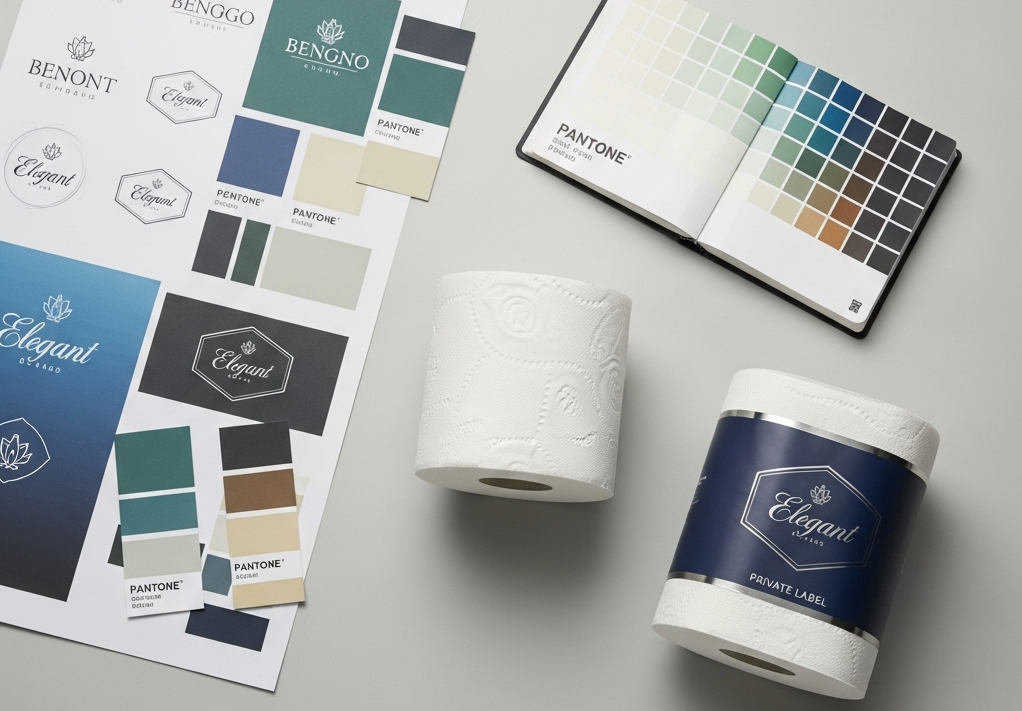
Validate substrate compatibility with your chosen print method—digital, flexo or offset—and confirm the wrap material withstands mechanical compression during bagging and container loading. Require batch color consistency across full-container runs, include Pantone references and a color proof with every order, and limit high-fidelity printing on tissue to 1–2 PMS colors to ensure repeatability and legibility on soft substrates.
Align artwork to actual dielines for roll widths (102–132 mm standard, up to 165 mm for premium formats) and allow extra bleed for automated wrapping machinery. Coordinate printed elements with embossing patterns so logos and motifs remain visually aligned after diecut and emboss operations. Specify FDA- and EU-compliant inks and coatings that remain stable after transit, compression and humidity exposure, and demand sample seal and abrasion testing that simulates 40HQ loading and on-site handling to confirm seal integrity.
- Require Pantone references and color proofs; enforce batch color consistency for full-container runs.
- Match dielines to roll width (102–132 mm; up to 165 mm for premium) and allow automated-wrapping bleed.
- Coordinate printed design with embossing to preserve alignment of logos and patterns.
- Specify FDA/EU-compliant inks and coatings resilient to compression and humidity.
- Run seal and abrasion tests that replicate 40HQ container loading and handling.
Supply chain, order sizing, and on-property deployment guidelines
Set order parameters around container economics: establish a Minimum Order Quantity of 1 x 40HQ for custom wraps and private label runs, expect in-stock dispatch in 10–15 days or production lead time of 20–25 days from Hebei/Tianjin ports. Specify optimized 40HQ payloads of 7,000–9,000 kg, require mechanical compression and consolidated poly bundles, and protect cartons with reinforced 5-ply export cartons for long-sea voyages and stacked storage.
Standardize payment and quality verification: use T/T with 30% deposit and 70% before shipment, and demand pre-shipment photos, videos and sample approvals to confirm print, seals and batch consistency. Choose packaging formats by location: Individual Wrap (Format A) for guest-facing rooms to prevent cross-contamination and boost perceived hygiene; Bundle Pack (Format B) for back-of-house inventory. Train housekeeping to inspect wrap seals and discard compromised items, and track guest feedback on visible branding to measure marketing lift.
- MOQ: 1 × 40HQ container; in-stock dispatch 10–15 days; production 20–25 days from Hebei/Tianjin.
- Container loading: 40HQ only; optimized payload 7,000–9,000 kg with mechanical compression.
- Packing: consolidated poly bundles and reinforced 5-ply export cartons.
- Payment: T/T 30% deposit, 70% before shipment; require pre-shipment photos/videos and sample approval.
- Product recommendations: TSH-4010 (Luxury Hospitality) and TSH-2269 (Premium Wide-Format); specify ply count and width on PO.
- On-property: train housekeeping to inspect seals and log compromised items; monitor guest feedback on visible wrap branding for marketing impact.
Automation in Toilet Paper Packaging: High-Speed Individual Wrapping Technology
High-speed primary wrapping protects hygiene, speeds throughput, and lowers landed cost by maximizing 40HQ density while meeting septic-safe and regional compliance.
Primary wrap materials and packaging flow for individually wrapped and bundle formats
Choose the wrap material to match the customer segment: paper or plastic film for Format A when hotels require a premium presentation and confirmed moisture barrier, and economical polyethylene films for Format B when buyers prioritize freight efficiency. Design wrapper tooling around standard roll widths between 102mm and 132mm and plan bundle targets from 780g up to 5000g so sealing heads, cutters, and sealer dwell times remain repeatable across SKUs.
- Individual roll options: paper wrap (FSC or kraft for sustainability) or plastic film for moisture resistance; support printed logos up to two PMS colors.
- Bundle workflows: Format A — individual wrap then consolidate into a PE bag; Format B — direct bundle pack into a master poly bundle.
- Tooling guidance: set wrapper widths for 102–132mm rolls and configure bundle weights from 780g–5000g when programming sealer power and web tension.
- Safety and materials: mandate 100% OBA-Free substrates and rapid-disintegration (septic-safe) compliance for North American and European markets.
- Secondary protection: consolidate wrapped bags into poly master bundles or reinforced 5-ply export cartons for container stowage and export handling.
High-speed wrapping line integration, compression management and throughput optimization
Configure the line as modular cells: individual-wrap sealing, bundle consolidation, and secondary bundling so you can switch between Format A and Format B without full-line rebuilds. Set mechanical compression profiles by bundle weight range (780g–5000g) to reduce roll bulk while preserving paper loft—adjust compression force and dwell time to avoid flattening emboss patterns and to protect coreless roll structure.
- Line speed targets: design for flow-wrap and bagging speeds aligned to product complexity — expect 40–600+ pieces per minute depending on pack type; film transport rates can reach ~80 m/min for high-speed flows.
- Compression control: program per-weight compression profiles; monitor bulk reduction and paper loft using inline displacement sensors and adjust roller gap in real time.
- Container packing: target exclusive 40HQ loading with typical payloads of 7,000–9,000 kg to minimize landed cost per roll; arrange cartons for high-stack stability in long-run export lanes.
- Production cadence: align wrapping throughput to factory lead times — schedule production runs for 20–25 days and reserve 10–15 days for in-stock dispatch and port clearance to meet shipment windows.
- Operational checkpoints: calibrate wrap/seal speed, seal temperature, and compression to prevent core collapse on coreless designs and to maintain batch color consistency across containers.
Quality controls for wrapped rolls: embossing, perforation, ply-bonding and compliance verification
Control embossing, ply-bond, and perforation on the wrapper line with measurable acceptance criteria: CNC point-to-point embossing should increase absorbency by about 30%, so monitor emboss depth and pattern registration with inline vision systems. Verify ply-bond integrity through peel tests and sample lamination inspections; enforce ply GSM of 13–22 g/m² per ply and brightness between 85%–92% as pass/fail thresholds before packing.
- Embossing checks: measure emboss depth and registration; log samples per shift and reject runs when absorbency gain deviates from ≈30% target.
- Ply-bond testing: perform high-pressure lamination checks and adhesion peel tests on wrapped samples to prevent delamination in use.
- Perforation control: verify perforation shear and alignment post-wrap; run tear tests to confirm clean edges and avoid shredded perforations in the field.
- Material QA specs: require 13–22 g/m² ply GSM, 85%–92% brightness, and documented OBA-Free certification as acceptance criteria for incoming rolls and finished goods.
- Regulatory verification: confirm ISO 9001, FDA, and EU hygiene compliance; capture rapid-disintegration (septic) test results and batch color consistency records; provide pre-shipment photos and videos as proof-of-goods before final payment.
Conclusion
Individually wrapped rolls are the hygiene baseline for hotels: single-roll protection reduces cross-contamination, keeps paper dry in humid bathrooms, and supports a consistent guest experience that aligns with international hygiene standards.
Start by auditing your current roll inventory, dispenser fit, and guest feedback at one or two properties to measure dampness, perceived value, and replacement cycles. Contact Top Source Hygiene for hotel-grade samples, custom-printed wrap options, and a factory-backed quote to run a low-risk trial.
Frequently Asked Questions About Individually Wrapped Toilet Paper for Hotels
Why do hotels prefer individually wrapped toilet paper rolls over bulk packs?
Individual wrapping provides assurance of cleanliness for every guest, prevents cross-contamination between users, and signals an establishment’s commitment to hygiene — factors that directly influence guest satisfaction, reviews, and repeat visits. Individually packaged disposables also reduce the need for labor‑intensive laundering and reinspection, support faster room turnover, and help meet operational and compliance standards.
Is paper or plastic wrapping more cost-effective for hotel toilet paper in B2B supply?
The provided research does not include a direct cost comparison between paper and plastic wrapping for B2B. It does note that individually packaged disposable products can reduce laundering and handling costs and facilitate waste management, which affect overall operational cost, but material-specific cost-effectiveness is not specified.
Can I customize the design and logo on each individual toilet paper wrap?
The research does not explicitly address customization options or printing on individual wraps. It does highlight that individually packaged items contribute to market recognition and signal brand commitment to hygiene, which explains why hotels often place importance on the presentation of packaged disposables.
How does individual wrapping prevent rolls from getting damp in hotel bathrooms?
While the research does not specifically quantify moisture protection, it explains that individual wrapping creates a sealed barrier that eliminates cross-contamination and protects items until use. That sealed barrier likewise reduces exposure to environmental contaminants, which includes humidity or splashes in bathroom environments.
What is the impact of individually wrapped toilet paper on total packaging waste?
The research emphasizes that primary wrapping facilitates proper waste management and reduces cross-contamination during handling, supporting compliance with health and safety standards, but it does not provide quantitative data on total packaging waste. No definitive increase-or-decrease estimate is given in the source material.
Does individually wrapped paper increase the perceived value of a 3-star hotel?
Yes. The research shows that visible, professional individually packaged products signal an establishment’s commitment to cleanliness and hygiene, and cleanliness is a top factor influencing guest reviews and repeat visits. Those signals contribute to guest confidence, satisfaction, and brand reputation, which can increase perceived value for mid‑tier properties.