
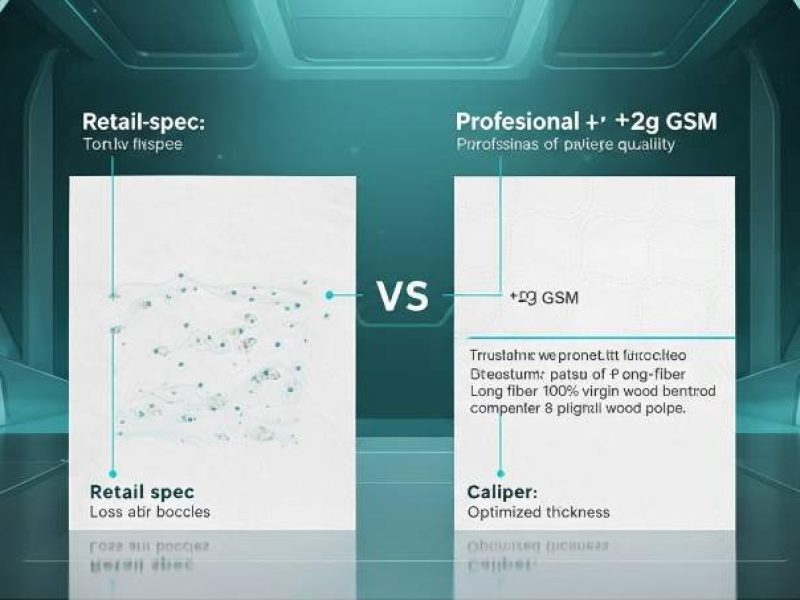
Professional 2-Ply vs. Retail can determine whether dispensers run cleanly or suffer repeated jams and web breaks that drive operational downtime, emergency restocking, and contract penalties for facilities teams.
This guide serves as a technical SOP for procurement and maintenance: it walks through the physics of GSM—the core section that links a few grams per square meter to measurable changes in tensile strength and absorbency—then tests retail-spec rolls against commercial pull speeds, explains why professional rolls are wound tighter, compares wet-strength and absorbency in real-world settings, and maps winding density and overstock risks to contract performance and TCO. Expect clear acceptance criteria, test methods, and vendor decision rules you can apply to avoid costly spec errors and keep operations running on schedule.
Why Does Retail 2-Ply Feel “Fluffy” While Professional 2-Ply Feels “Strong”?
Sheet density, embossing and ply-bonding determine bulk versus tensile performance—specify GSM, caliper and bonding pattern to hit comfort or facility durability targets.
Material and sheet construction: fiber choice, GSM and ply-bonding that create ‘fluff’ versus ‘strength’
Manufacturers create a fluffy hand by combining long-fiber 100% Virgin Wood Pulp with controlled low-to-mid GSM and high air incorporation; Top Source uses virgin long-fiber pulp for a soft, lint-free surface while alternatives like bamboo or recycled pulp trade softness for sustainability or cost. Control the ply GSM (13–22 g/m² per ply) and sheet formation: higher GSM and tighter sheet formation compress fibers and raise tensile strength, while lower GSM plus greater bulk and air yield a visibly thicker, fluffier sheet.
Ply-bonding and finishing decide whether that perceived thickness holds up in use. Professional grades use high-pressure lamination and denser bonding patterns to prevent ply separation and preserve wet and dry tensile; retail grades tune bonding to preserve quilted softness. CNC point-to-point embossing increases bulk and absorbency (manufacturer data: ~30% absorbency gain) and shifts the tactile balance toward cushiony feel, while precision perforation reduces edge shredding and reinforces perceived durability on commercial rolls.
Manufacturing parameters to tune tactile outcome: what producers adjust and how to measure it
Producers tune air incorporation, creping geometry, drying compaction and winding tension to move a product toward fluff or strength. Raise air content or deepen embossing to increase bulk and caliper (fluff); reduce air and compact the web to raise density and tensile performance (strength). Measure caliper in µm and bulk in cm³/g to quantify the effect; specify target caliper and bulk when you order.
Adjust creping and drying to hit hand-feel and tensile goals: softer crepe geometry and lower dry compaction produce a soft hand, while tighter crepe and higher compaction raise both dry and wet tensile. Increase lamination pressure and use denser bonding patterns to improve wet-strength and ply cohesion for high-traffic applications. Request these performance tests from suppliers to validate tuning: dry tensile (N/m), wet tensile (as % of dry and N/m), absorbency (g water/g paper), disintegration time (septic-safe), plus caliper and bulk values. For heavy-duty applications, set dry tensile targets in the mid-to-high hundreds N/m (industry examples show dry tensile up to ~420 N/m and wet toughness near 180 N/m for industrial grades) and require wet tensile retention above typical consumer towel minima (e.g., >15% wet-to-dry ratio for reliable performance).
Buyer specification checklist and procurement actions: pick the right 2-ply for use case and logistics
Define the end use, then lock numeric specs and testing requirements into purchase orders and lab requests. Retail comfort choices prioritize bulk, emboss depth and softer crepe; commercial choices prioritize tensile strength, rapid disintegration and consistent winding for dispensers.
- End-use decision: Household retail — prioritize bulk, deep embossing and softer crepe; Commercial/facility — prioritize dry tensile, wet tensile decay and dispenser compatibility.
- Core material: Specify 100% Virgin Wood Pulp for strength plus soft hand, or request bamboo/recycled options where sustainability or price dictates.
- Ply GSM: Specify 13–22 g/m² per ply depending on target (lower end for fluffier, higher end for strength and durability).
- Roll and bundle specs: Roll width 102–132 mm; bundle weight range 780 g–5000 g; choose coreless solid rolls for space efficiency or core rolls for dispenser fit.
- Performance tests to request: dry tensile (N/m), wet tensile (N/m and % of dry), absorbency (g water/g paper), disintegration time (septic-safe), caliper (µm) and bulk (cm³/g). Ask suppliers to state target ranges and provide lab reports.
- Chemical & safety: Require OBA-free formulation, specify brightness 85–92% achieved by fiber selection, and demand relevant certifications (ISO 9001, FDA, EU hygiene or equivalent).
- Packaging & format: Choose individual wrap for hospitality hygiene, direct bundle for retail value, or coreless solid rolls to maximize meters per container; include compression options for container optimization.
- Procurement actions before payment: Request lab test reports and disintegration data, ask for pre-shipment photos/videos, confirm brightness and batch color consistency, and confirm HS code 4818.1000 for customs paperwork.
- Commercial terms: Set MOQ and lead time expectations — typical MOQ = 1 x 40HQ; lead time in-stock 10–15 days, production 20–25 days; use T/T 30% deposit and balance before shipment and require pre-shipment visual verification.
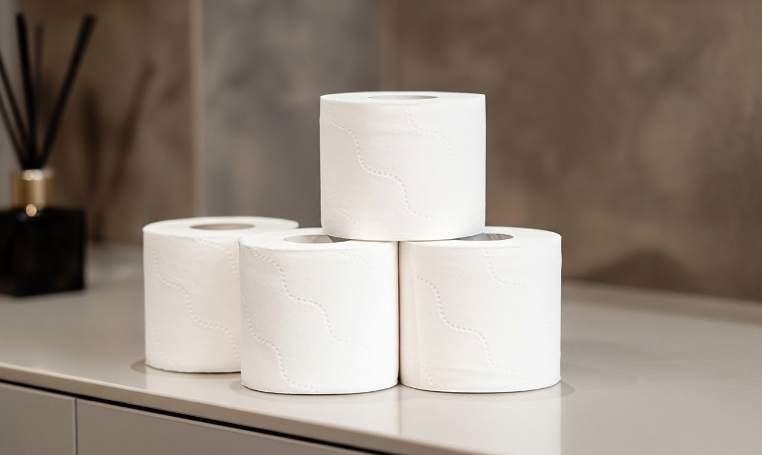
The Physics of GSM: How a 2-Gram Difference Changes Tensile Strength
Small GSM adjustments change fiber packing, bonding and crepe behavior — this directly shifts tensile index, feel and total cost of ownership in professional tissue production.
Define GSM and tensile targets, sampling and acceptance criteria
Set per-ply grammage within the Top Source Hygiene target window of 13–22 g/m²; use a working baseline (for example 16 g/m²) and define the test case at 18 g/m² (+2 g/m², a 12.5% mass increase). Specify tensile targets separately for dry and wet states and report results as tensile index (Nm/g) so you can compare strength efficiency across different grammages and plies. Measure GSM using ISO 536 and tensile using ISO 12625-4, and record elongation at break plus the wet-to-dry tensile ratio for every sampled lot.
- Sampling plan: pull 5–10 finished rolls per production batch; label samples with run number, date, and machine speed.
- Acceptance rule: accept batch if tensile index stays within the agreed tolerance band relative to spec (define +/- Nm/g limit with customer), and if wet/dry ratio meets minimum septic-safe thresholds.
- Nonconformance: flag out-of-spec batches, quarantine inventory, and trigger corrective-action steps including root-cause on fiber mix, refining or bonding.
Fiber selection and stock preparation to maximize tensile per GSM
Specify 100% virgin long-fiber wood pulp as the default for professional SKUs to maximize fiber length and bonding surface area; reserve bamboo or recycled pulp only for explicitly labeled eco SKUs. Control fiber quality metrics that drive tensile: fiber length distribution, degree of fibrillation and fines content. Prioritize fiber selection and refining strategy over chemical brighteners, and keep the product OBA-free to meet Top Source Hygiene safety and market requirements.
- Refine to increase fibrillation and bonding potential but stop before over-refining; over-refining cuts bulk and softness and reduces apparent volume.
- Dose dry-strength polymers sparingly to lift tensile index while preserving septic-safe rapid disintegration; avoid permanent wet-strength resins unless customer spec demands long wet retention.
- Maintain batch color and brightness via fiber selection and bleaching control rather than OBAs, matching Top Source Hygiene brightness targets (85–92%).
Forming, creping and drying parameters that modulate strength vs softness
Tune headbox consistency and forming fabric drainage to control fiber orientation and web formation; a more uniform formation raises cross-machine tensile uniformity and reduces weak spots. Set creping parameters — crepe ratio, Yankee adhesion, doctor blade angle and creping speed — to balance bulk and MD tensile: increasing crepe raises perceived softness and bulk but lowers machine-direction tensile and elongation at break.
Control the Yankee dryer temperature profile and contact time to set fiber bonding and residual moisture level; excessive drying embrittles fibers and reduces elongation. Use calendering nip pressure and roll configuration to increase sheet density and dry tensile where customers need strength, while accepting the trade-off that higher calendering reduces softness and volume.
- Key knobs to monitor: headbox consistency, forming fabric speed, crepe ratio, Yankee steam profile, doctor blade geometry, calender nip pressure.
- Target behavior: hold residual moisture that preserves elongation but avoids tack that interferes with emboss and winding.
Ply bonding, embossing and conversion effects on composite tensile strength
Use high-pressure ply-bonding with the correct adhesive chemistry and application pattern to maximize inter-ply load transfer and reduce delamination under stress; choose adhesive patterns that spread load without creating large unbonded zones. Design embossing patterns intentionally: point-to-point emboss increases apparent bulk and absorbency without fully sacrificing tensile retention, while deep continuous embossing raises bulk but concentrates stress and reduces cross-sheet tensile.
Ensure precise register and alignment during multi-ply lamination so embossing and bonding zones do not produce stress risers; verify bonding strength after emboss and after conversion. Account for roll format: coreless and high-density solid rolls change internal compaction and apparent tensile, so adjust bonding pickup, adhesive pattern and winding compression during conversion to maintain uniform unwind performance.
- Conversion checklist: confirm adhesive type and weight, verify emboss depth and pattern, test ply-bond shear strength after embossing.
- Winding note: increase initial winding tension and use tension tapering for coreless rolls to preserve core stability and avoid telescoping.
Testing protocol, expected effects of a +2 g/m² change and stepwise troubleshooting
Measure GSM by ISO 536 and dry/wet tensile by ISO 12625-4; compute tensile index (Nm/g) to compare strength efficiency before and after the +2 g/m² change. Expect a typical dry tensile gain of roughly 10–20% when a single ply moves from 16 to 18 g/m² with the same fiber mix and machine settings, but document actual Nm/g shifts since gains depend on refining, crepe and calender settings.
If tensile underperforms after the GSM increase, use the troubleshooting map below; if stiffness rises beyond customer tolerance, reduce calender pressure or increase crepe. Log every machine change and retest per the sampling plan to validate corrective actions and maintain ISO 9001 traceability and hygiene compliance while preserving OBA-free and septic-safe targets.
- Troubleshoot tensile shortfall: increase refining/fibrillation, reduce crepe ratio, raise calender pressure slightly, or improve ply-bond adhesive pickup and pattern.
- If product becomes too stiff: reduce calendering nip pressure, lower Yankee dryer temperature slightly, or increase crepe amplitude to restore bulk.
- Operational checks to run: confirm headbox consistency, adhesive pickup rate and bonding pressure, emboss depth and register, moisture profile at reel-up, and machine speed. Document readings and re-run ISO tests on the next 5–10-roll sample set.
- Compliance reminder: keep formulation OBA-free, meet septic-safe dissolution requirements, and keep batch records for ISO 9001 and applicable regional hygiene regulations.
Scale Your Brand with Factory-Direct Toilet Paper

Can a Retail-Spec Roll Survive the High-Speed Pull of a Commercial Dispenser?
Mis-matched roll format or weak construction causes jams, higher maintenance and hidden TCO—match physical fit and material specs before deployment.
Match roll format to dispenser mechanics: core type, roll width and physical clearances
Commercial dispensers apply repeated, high-speed pulls that demand specific roll geometry and core strength. Verify roll width compatibility (Top Source ranges 102–132 mm) and confirm maximum outer diameter (OD), maximum roll width, core inner diameter (ID) or spindle diameter, and throat/feed opening width before ordering—measuring these dimensions on-site prevents simple fit failures.
Decide between cored and coreless formats based on dispenser capability: choose coreless/solid rolls such as TSH-3396 (5000g/28 rolls) or jumbo commercial TSH-JRT08 where the dispenser supports high roll mass and spindleless operation. Check dispenser spool bearings and rated load; heavy solid rolls need low-friction spindles or spindleless dispensers rated for high-mass loads to avoid torque-related feed failures.
- Measure and record: max roll OD, max roll width, core ID or spindle diameter, throat/feed opening width.
- If dispenser cannot accept coreless rolls, specify required core tube ID and match retail cored rolls to that spindle size.
- Verify dispenser bearing/tension ratings against roll mass (example heavy bundles: 5000g per bundle for TSH-3396).
Assess paper construction for high-speed pulls: ply, bonding, and perforation integrity
Material choices control live performance under rapid dispensing. Request ply density (Top Source specifies 13–22 g/m² per ply), ply count options (2–5 ply), 100% Virgin Wood Pulp composition, and OBA-free formulation to ensure both tensile strength and user safety. Favor high-pressure ply-bonding and CNC-precision point-to-point embossing to raise absorbency and maintain layer cohesion during high-torque pulls.
Require supplier mechanical data before purchase: machine-direction and cross-direction tensile values, perforation tensile, and rapid-disintegration/septic-safe test results that meet North American or European standards. Run supplier samples on a bench tensile tester and a short-run dispenser at target feed speeds to confirm no ply delamination, clean perforation tears, and no shredded edges.
- Specify ply density: 13–22 g/m² per ply and confirm 100% Virgin Wood Pulp, OBA-free.
- Request tensile and perforation data: MD tensile, CD tensile, perforation tensile, plus septic-safe disintegration results.
- Validate with on-site tests: bench tensile test and short-run dispenser run at target pulls/sec.
Field test protocol and acceptance criteria for high-speed dispenser deployment
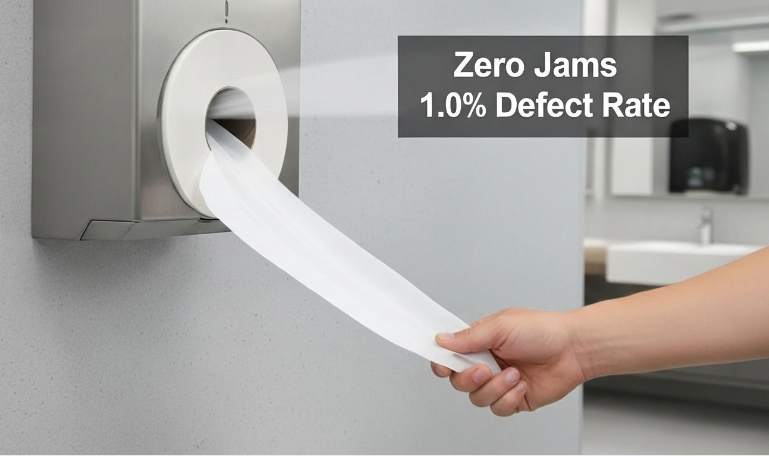
Follow a repeatable field test protocol: install the sample roll type, run an endurance cycle (example: 1,000 automated pulls or align with dispenser OEM guidance), and log ambient conditions (temperature and humidity). Capture objective metrics—pull force at dispense, dispenser feed speed (pulls/sec), failed feeds/jams, multi-sheet pulls, and user-reported issues—to quantify real-world reliability.
Set clear acceptance criteria: target jam/failure rate under 1% at the rated dispenser speed, consistent single-sheet tear at perforation, no ply separation, and no increase in lint or shredding. If failures exceed 1%, iterate by switching to a heavy-duty coreless model (TSH-3396 or TSH-JRT08), adjusting dispenser tension or clutch settings, or asking the manufacturer to alter perforation strength or ply-bonding. Confirm supplier compliance with ISO 9001, FDA and EU hygiene standards and require pre-shipment visual verification (photos/videos) for large deployments.
- Protocol: install, run 1,000 cycles (or OEM-specified count), record failures, log temperature/humidity.
- Key data: pull force, pulls/sec, % failed feeds, multi-sheet pulls, user complaints.
- Acceptance: <1% jam/failure at rated speed, single-sheet tear, no ply separation, no excess lint.
- Remediation: swap to TSH-3396/TSH-JRT08, adjust dispenser tension, or request modified perforation/ply-bonding from supplier.
- Compliance checklist: ISO 9001, FDA and EU hygiene compliance, plus pre-shipment photos/videos.
Winding Tension: Why Professional Rolls Are Wound 20% Tighter
Winding +20% tension compacts rolls, increases meters-per-roll and freight efficiency, but raises unwind torque and requires tighter process control and dispenser validation.
How a 20% Increase in Winding Tension Changes Roll Physical Properties
Raising winding tension by 20% compresses the web during laydown, which lowers outer diameter, increases bulk density and delivers more meters of paper per fixed bundle weight. Compression squeezes air from the sheet structure and reduces perceived fluff; with 100% Virgin Wood Pulp and high-pressure ply-bonding, tighter winding shifts tactile feel toward firmer stiffness while preserving tensile integrity.
Use this calculation to size rolls and confirm gains: meters per roll = roll_weight_g / (GSM_total_g_per_m2 × width_m), where GSM_total = GSM_per_ply × plies. Top Source Hygiene controls GSM per ply between 13–22 g/m². Example: a 2,000 g bundle, 2-ply at 16 g/m² per ply and 0.105 m width gives GSM_total = 32 g/m² and meters ≈ 2000 / (32 × 0.105) ≈ 595 m. Check outer diameter with calipers, weigh rolls, compute meters-per-roll and hold production to tolerances: diameter ±3 mm and weight ±2% to keep targets stable.
- Mechanical effect: smaller OD and higher bulk density increase meters-per-roll for the same bundle weight.
- Material interaction: tighter winding compresses air pockets; 100% Virgin Wood Pulp and strong ply-bonding reduce fluff and raise perceived stiffness.
- QC checks: measure diameter with calipers, weigh rolls, calculate meters-per-roll and compare to target tolerances (OD ±3 mm, weight ±2%).
Rewinder Settings and Process Controls to Achieve Consistent +20% Tension
Control tension with coordinated adjustments to brake/drive torque, nip roller pressure, dancer-arm setpoint, web speed and winding drum diameter. Implement tension changes in controlled increments—try +5% steps—and let the system stabilize before committing to full production. Use a tension-taper approach: start higher at the core then reduce as the roll builds to avoid over-stressing inner wraps; industry practice often uses a start point 25–50% above incoming web tension and tapers toward target as diameter grows.
Instrument the line with in-line tension sensors and torque meters and log unwind-force profiles. Sample 10 rolls per run to capture variance in web elongation and unwind torque. Run the following checks each batch: perforation tear integrity, ply-bond adhesion and tensile strength against virgin-pulp specifications. If you detect repeated micro-tears or delamination, act immediately: lower nip pressure, reduce line speed, verify embossing and ply-bonding pressures, then run a short test spool before resuming production.
- Primary controls: brake/drive torque, nip roller pressure, dancer-arm setpoint, web speed, winding drum diameter.
- Adjustment protocol: change tension in +5% steps and stabilize; apply tension tapering to protect inner wraps.
- Instrumentation & sampling: install in-line tension sensors and torque meters; sample 10 rolls per run and log unwind-force profiles.
- Batch tests: perforation tear, ply-bond adhesion, tensile strength; reject runs with delamination or repeated micro-tears.
- Process action on defects: lower nip pressure, reduce line speed, verify embossing/ply-bonding settings, re-run a short test spool.
Operational Impacts: Packing Density, Dispenser Compatibility, Transport, and B2B Specifications
Tighter winding raises packing density: smaller roll diameters increase cartons-per-40HQ and improve landed cost per meter. Model container loads using 40HQ payload guidance of 7–9 tons and your chosen bundle weights (780 g–5,000 g) to find the optimal mix between roll count, carton integrity and transport weight limits. Use mechanical compression during bagging but verify that higher-density rolls still meet carton stacking strength requirements.
Higher unwind torque can create issues in low-tension or older dispensers. Specify the wound-tension on B2B labels (for example: “wound +20% tension”) and include recommended dispenser torque compatibility ranges in technical data sheets. Test customer dispensers during pre-shipment sampling and supply unwind-force data so buyers can validate fit. For commercial terms, recommend Format A (individual wrap) for hospitality where hygiene and presentation matter, and Format B (direct bundle) for wholesale where freight efficiency and cost-per-meter dominate.
- Packing & freight: tighter winding reduces OD and raises cartons-per-40HQ; plan loads around 40HQ payload = 7–9 tons and bundle weights 780 g–5000 g.
- Dispenser compatibility: higher unwind torque may affect low-tension dispensers—document recommended dispenser torque ranges and validate with pre-shipment samples.
- Labeling & terms: include “wound +20% tension” on B2B labels; recommend Format A (individual wrap) for hospitality, Format B (direct bundle) for wholesale.
- Pre-shipment verification checklist:
- Randomly measure roll OD and weight against targets.
- Record meters-per-roll calculations and unwind-force samples (log sensor traces).
- Run dispenser-compatibility pulls on client models during sampling.
- Provide photos and videos of loading to follow Top Source Hygiene’s pre-shipment visual verification protocol.
Does Higher Grammage Lead to Better Absorbency in Professional Settings?
Grammage matters, but absorbency in professional tissue depends more on construction, embossing, and wet-strength balance than raw g/m² alone.
Measure absorbency versus grammage: methods and key metrics
Define grammage as grams per square metre per ply and control production to the Top Source range of 13–22 g/m² per ply. Run quantitative absorbency tests: gravimetric water uptake reported as ml or g water per g paper, capillary absorption time, and water retention under a standardized pressure. Normalize results to area (ml/cm²) so you can compare samples across roll widths and different ply counts.
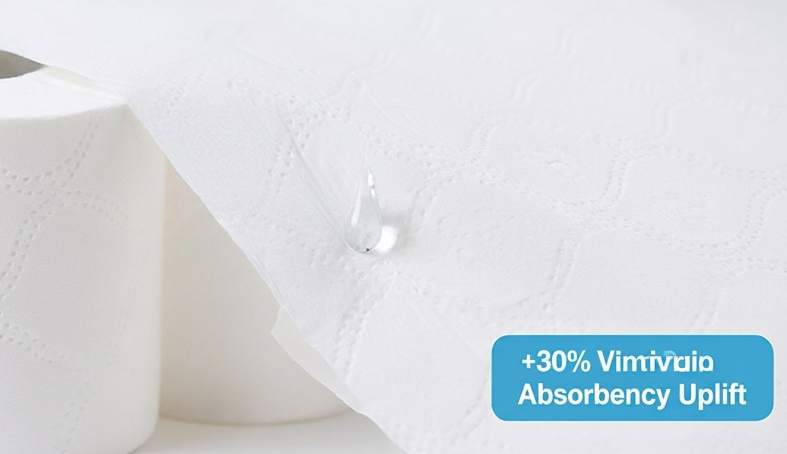
Measure wet tensile strength (N/25 mm) and disintegration time alongside absorbency; heavier grammage often increases capacity but also raises wet strength and slows disintegration. Account for construction: use 100% virgin long-fiber wood pulp where wet strength and lint control matter, and document point-to-point embossing performance—the Top Source CNC emboss patterns yield roughly +30% measured absorbency uplift—and record the ply-bonding method because high-pressure lamination alters the grammage→absorbency relationship significantly.
Specify grammage and construction by use case: high-traffic facilities versus hotel-grade
For high-traffic commercial restrooms, specify lower per-ply grammage (13–16 g/m²) combined with aggressive point-to-point embossing and high-pressure ply-bonding to keep soak capacity while ensuring rapid disintegration in plumbing. Favor compressed construction and tighter winding so rolls run reliably in dispensers and dissolve quickly in North American and European sewer and septic systems.
For luxury hotel or VIP areas, specify higher per-ply grammage (18–22 g/m²) and 4–5 ply construction to prioritize perceived softness and soak capacity. Match roll formats to operations: coreless/solid heavy bundles (for example, 5000 g/28 rolls) maximize paper per container and reduce refill frequency; jumbo rolls suit extreme throughput. Require OBA-free materials and documented ‘septic-safe’ rapid disintegration, and run a simple freight impact calculation because higher grammage increases bundle weight, landed cost, and warehouse space usage.
Procurement test plan and technical checklist to verify acceptable absorbency
Request a complete technical dossier and require laboratory verification before you accept bulk shipments. Ask suppliers for per-ply GSM, total GSM, fiber source, embossing pattern, ply-bonding method, and representative samples from the production batch. Use a short, repeatable test plan that your lab or a third-party lab can execute and reproduce.
- Documentation: supplier technical sheet with per-ply GSM (13–22 g/m² control range), total GSM, fiber source (100% virgin wood pulp or stated alternative), embossing pattern, and ply-bonding method.
- Required lab tests on supplier samples: basis weight verification, water uptake (ml/g and ml/cm²), capillary absorption time, dry and wet tensile strength (report N/25 mm), and disintegration/septic tests aligned with North American and European compliance protocols.
- Measurable acceptance criteria: brightness 85–92%, OBA-free confirmation, supplier-provided embossing uplift data (request comparative % against non-embossed control), and passing septic-disintegration thresholds used in NA/EU testing.
- Logistics and fit checks: verify roll width options (102–165 mm), roll length and core compatibility with your dispensers, packaging format (individual wrap vs bundle), bundle weight range (780–5000 g), HS code 4818.1000, and plan for 40HQ payloads of roughly 7–9 tons.
- Pre-shipment and QA enforcement: require pre-shipment photos/videos, batch color/brightness verification, sample lab reports, and up-to-date ISO 9001, FDA, and EU hygiene certification evidence dated to 2026.
Supply Chain Risk: Why Retail Overstock Fails in B2B Facility Contracts
Retail overstock breaches facility SLAs, inflates TCO, and turns simple inventory into contractual and operational liability for both buyers and operators.
Product–Facility Specification Mismatch: technical criteria to prevent unsuitable retail stock
Survey the facility before you pick SKUs: record dispenser type, roll width, core versus coreless preference, plumbing sensitivity, and daily turnover (units/day). Match that profile to product families — for example, specify TSH-4010 (hotel-grade 5-ply, 165mm wide) for luxury hospitality, TSH-JRT08 for high-traffic jumbo dispensers, and TSH-3396 coreless 5000g bundles for warehouse or urban storage — so you avoid sending retail-style stock that physically won’t run or will cause frequent restock events.
Set minimum material specs in sourcing and contracts: enforce ply density of 13–22 g/m² per ply and require ≥16 g/m² per ply for heavy-use sites to balance strength with rapid disintegration. Require 100% Virgin Wood Pulp or approved Bamboo/Recycled options, OBA-Free certification, ISO 9001 and FDA/EU hygiene statements. Insist on functional sample testing — tensile strength, rapid disintegration (septic-safe), perforation tear force and absorbency — and reject retail ‘fluffy’ 2-ply variants that fail strength or disintegration thresholds. Choose Format A (individual wrap) for hospitality hygiene and Format B (bundle) for high-turnover workflows so packaging matches dispenser and labour patterns.
- Survey checklist: dispenser model, roll width, core/coreless, plumbing type, units/day
- Approved SKUs: TSH-4010 (165mm/5-ply), TSH-JRT08 (jumbo), TSH-3396 (coreless 5000g)
- Material specs: 13–22 g/m² per ply; recommend ≥16 g/m² for heavy-use
- Required certifications: OBA-Free, ISO 9001, FDA/EU hygiene
- Functional tests: tensile, disintegration, perforation tear, absorbency
Freight and inventory economics: align 40HQ loading, MOQ and lead times to facility turnover
Plan procurement around 40HQ realities: expect payloads of roughly 7,000–9,000 kg and set MOQ at 1 x 40HQ for trials, private label, and custom packs. Use mechanical compression, master poly bundles and reinforced 5-ply export cartons to boost cubic utilization and lower landed cost per roll. Match bundle weight and roll size to channel needs: use 5000g heavy bundles for regional distributors focused on freight efficiency and 1900–2800g packs where storage footprint is limited.
Incorporate supplier lead times into reorder logic: use in-stock dispatch of 10–15 days and production lead time of 20–25 days to calculate reorder point = lead time demand + safety stock. Limit exposure by policy: cap allowed inventory days at a facility (example: 30–60 days based on turnover) and schedule SKU rationalization reviews. Lock commercial terms to control overstock risk — T/T 30% deposit with 70% before shipment, require pre-shipment photos/videos and batch color consistency verification before final payment — so you retain approval rights over what actually ships.
- Container planning: 40HQ payload ≈ 7,000–9,000 kg; MOQ = 1 × 40HQ
- Lead times: in-stock dispatch 10–15 days; production 20–25 days
- Reorder point formula: reorder point = (daily demand × lead time days) + safety stock
- Inventory policy: maximum allowed days on hand = 30–60 days depending on turnover
- Payment & verification: T/T 30% deposit / 70% before shipment; require pre-shipment photos/videos and batch color checks
Contractual controls and QA checkpoints to stop retail overstock from becoming a B2B liability
Write explicit acceptance criteria into contracts: list physical specs (width options 102–132mm), GSM/ply bands, brightness 85–92%, packaging format, and an allowed defect rate (for example ≤2% visible defects on arrival). Add commercial safeguards such as defined return/credit windows, limited cancellation rights tied to production milestones, and consignment or buyback clauses for initial cycles to reduce risk on first orders.
Mandate pre-shipment verification: require supplier batch photos/videos of loading, independent lab test results for disintegration and tensile, and certificates for OBA-Free, ISO and FDA/EU compliance. Define inbound inspection: random sample testing on receipt, place holds on shipments that fail spot checks, and specify corrective-action timelines and replacement obligations. Protect margins and channel integrity with ‘profit protection’ clauses that ban D2C sales and include private-label exclusivity where required. Finally, codify escalation: set SLA timelines for non-conforming batches, financial penalties or replacement obligations, and trigger thresholds for supplier audits or temporary suspension.
- Contract acceptance: width 102–132mm, GSM/ply, brightness 85–92%, ≤2% defect rate
- Commercial safeguards: return/credit windows, cancellation tied to production stage, consignment/buyback for first cycles
- Pre-shipment QA: batch photos/videos, independent lab reports, OBA-Free/ISO/FDA certificates
- Inbound protocol: random samples on receipt, hold failing shipments, define corrective action and replacement timelines
- Channel protection: no D2C clause and private-label exclusivity; SLA, penalties, audit triggers for non-conformance
Conclusion
Matching professional 2‑ply to dispenser specs — GSM, winding tension, and wet‑strength — keeps dispensers running reliably and reduces maintenance, safety hazards, and plumbing failures that can trigger OSHA citations. Using the right paper and proper winding also extends dispenser life and protects facility uptime.
Audit your installed dispensers and run pull tests on rolls across sites, or contact Top Source Hygiene for certified samples and spec sheets to confirm compatibility before your next contract buy. Our team can provide pre‑shipment photos and verification to help protect margins and reduce supply-chain risk.
Frequently Asked Questions
1. What is the standard GSM for high-quality professional 2-ply tissue?
The available research does not specify a single standard GSM for high‑quality professional 2‑ply tissue. Sources describe professional 2‑ply as engineered for high‑traffic facilities (prioritizing durability, consistency and operational efficiency) rather than household softness. To obtain an exact GSM for a given product, consult the manufacturer technical specifications because the reviewed material does not provide numeric GSM values.
2. Why do commercial toilet paper rolls often feel thinner but stronger?
Research highlights that the core difference is design intent: retail 2‑ply is formulated for household comfort and a “fluffy” feel, while professional 2‑ply is engineered for high‑traffic use with emphasis on durability, consistency and avoiding plumbing issues. The search results do not provide manufacturing‑level details (fiber mix, air incorporation, embossing patterns) that explain the tactile contrast, so manufacturer specifications would be needed for a full technical explanation.
3. How does grammage (GSM) directly affect the total cost of ownership (TCO)?
The reviewed content does not provide a direct GSM-to-TCO formula. It does note tradeoffs: higher GSM (thicker product) tends to increase comfort, while professional choices prioritize consistency, dissolvability and clog avoidance. Grammage can therefore influence TCO indirectly via roll yield, dispenser change frequency, maintenance and plumbing incidents, and end‑user satisfaction. Quantifying the effect requires supplier specs and facility usage metrics.
4. Can I use retail-branded toilet paper in a high-traffic office building?
The sources indicate retail products emphasize comfort, softness and aesthetic appeal, whereas professional products emphasize consistency and operational efficiency. Using retail‑branded toilet paper in a high‑traffic building is possible but not generally recommended without validation: retail grades may increase refill frequency, may not dissolve as predictably, and could raise maintenance or clog risk. For high‑traffic sites, choose products specified for commercial use or confirm performance with the manufacturer.
5. Does professional-grade tissue provide better wet-strength performance?
The reviewed research does not explicitly state that professional‑grade tissue has superior wet‑strength. It does indicate professional tissue is engineered for durability and to balance dissolvability with clog avoidance in high‑traffic settings. Wet‑strength is a specific technical attribute; to confirm differences between retail and professional grades you should review manufacturer wet‑strength data and compatibility test results.
6. Why is winding density more important for B2B logistics than retail bulk?
Although the provided sources do not discuss winding density directly, they emphasize that professional products prioritize consistency and efficiency for commercial environments. Winding density affects how much paper fits on a core, roll count per pallet, dispenser refill intervals and handling efficiency, which are primary logistics considerations for B2B customers. Exact impacts and optimal winding specs should be verified with manufacturers and logistics planners.