
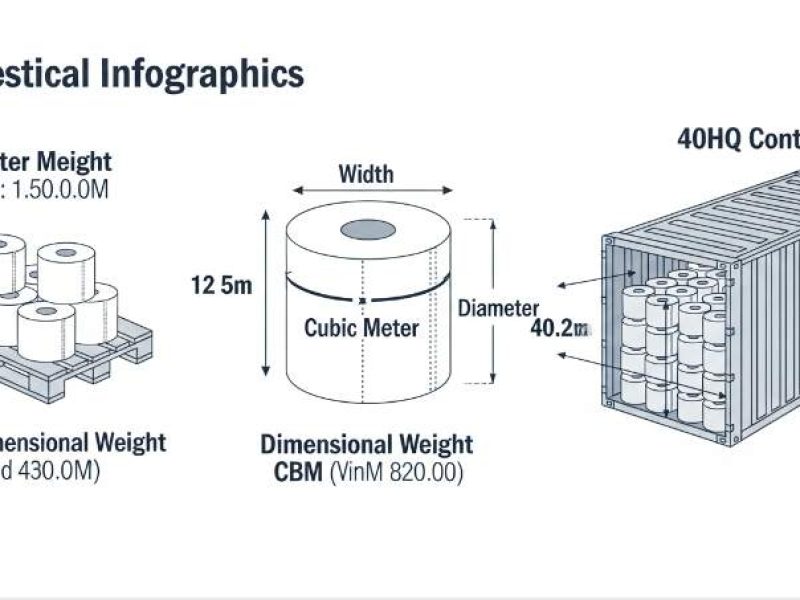
Roll Dimensions & CBM decide whether a container loads at target volume or leaves you paying surprise freight, detention and extra warehouse fees that crush margins. Small shifts in roll width or diameter ripple through pallet patterns, create unusable void space and turn predictable shipping plans into a costly logistics problem for procurement and operations.
This guide acts as a technical SOP: it walks product teams through US and EU roll standards, explains why 4.5‑inch heights matter, runs the math on shaving 5mm of diameter, highlights dispenser conflicts and sheet‑count risks, and focuses on pallet configurations and CBM calculations for 40HQ so you can quantify per‑unit savings. Read on for pallet patterns, measurement checks and testing thresholds logistics managers and private‑label teams can apply immediately to lock in better CBM ROI.
Is Your Roll Width Secretly Destroying Your International Shipping ROI?
Dimensional weight drives export freight costs; a few millimetres of extra roll width can multiply billed weight and erode margins fast.
Compute billable (DIM) weight from roll and pack dimensions — formula, rounding, examples
Carriers bill the larger of actual weight and dimensional (DIM) weight. Compute DIM weight with the formula: billable weight = (length × width × height) / DIM divisor. Use the carrier-specific divisor — common values are 5000 cm³/kg for metric international billing and 139 in³/lb for imperial billing. Carriers round each external dimension up to the nearest inch or centimetre before applying the divisor, so small increases in width or height can push a package into the next rate band and multiply cost.
Practical examples make the impact obvious: a package of 15″ × 12″ × 10″ gives (15×12×10)/139 ≈ 12.95 lb billed — carriers will charge 13 lb — while the actual weight may be ~2 lb, a ~550% billed increase. In metric: 30 cm × 20 cm × 20 cm = 12,000 cm³, and 12,000/5000 = 2.4 kg billed; if the actual weight is 1.8 kg, billed weight is 33% higher. Measure your finished packed bundle including cushioning and outer carton, apply the carrier divisor, then compare billed kg to actual kg to quantify per-shipment overcharge and identify immediate savings opportunities.
- Measure L × W × H of the finished master carton (include shrink, cushioning, pallet overhang).
- Round each dimension up to the carrier’s stated increment (nearest inch or cm).
- Apply the carrier DIM divisor (e.g., 5000 cm³/kg or 139 in³/lb) and compare to actual gross weight to compute billed weight.
- Record billed vs actual weight per container and multiply by shipment count to estimate annual overspend.
Right-size roll widths and pack layouts to cut cubic volume — specs and trade-offs
Choose roll widths deliberately. Common width bands affect pack cross-section and therefore DIM weight: 102–105 mm for narrow economy formats, 104–120 mm for standard retail, and 121–132 mm for premium comfort. Switching to coreless or high-density formats (for example, 5000 g/28-roll solid bundles) increases metres-per-cbm and eliminates wasted tube volume, which lowers per-roll CBM for export customers with volume-sensitive freight models.
Use packaging levers to compress CBM without compromising product performance: reduce rolls per bag, alter orientation (inline stacking versus staggered), apply mechanical compression during bagging, and move to tighter master carton footprints with reinforced 5-ply export cartons to avoid crushing. Run prototypes for each roll-width and pack-count combination and select the layout with the lowest billed weight per linear metre of paper while meeting market fit and dispenser compatibility expectations.
- Product width options: 102–105 mm (narrow), 104–120 mm (standard), 121–132 mm (premium).
- Packaging levers: reduce rolls per bag, change orientation, mechanical compression, tighter master cartons (reinforced 5-ply for export).
- Action: prototype pack layouts for 10/12/18/28/32 roll counts, measure packed L×W×H, calculate DIM weight, then compute billed weight per metre of paper to rank options.
- Trade-off note: narrower widths lower DIM cost but can affect perceived comfort and dispenser fit; match width to target market (example: 165 mm for GCC premium; 102–105 mm for SEA high-turnover).
Container loading and carrier tactics to protect ROI from dimensional pricing
Plan 40HQ loading around both payload and CBM. A well-packed 40HQ usually targets a payload between 7,000 kg and 9,000 kg while maximizing usable CBM through optimized stacking, compressed bundling, and tight carton sizes. Use the 40HQ height advantage (internal approx. 12.19 m × 2.44 m × 2.90 m) and roll-specific loading patterns — straight, turned, or pinwheel — to reduce wasted void space from cylindrical geometry.
Protect margins with pre-shipment controls and carrier negotiation. Perform dimensional audits and require pre-shipment photos/videos of packed pallets and the loaded 40HQ; verify master carton external dimensions before you release the balance payment. Negotiate carrier concessions: request a higher DIM divisor, demand volumetric billing audits, and compare carriers’ DIM policies and surcharge matrices. Model landed cost per roll under different billed-weight scenarios and run A/B container trials before standardizing a pack format.
- 40HQ baseline: target 7,000–9,000 kg payload and maximize CBM with optimized stacking and compressed bundles.
- Pre-shipment controls: perform dimensional audits, request loading photos/videos, and verify external master carton dimensions prior to final payment.
- Carrier levers: request a higher DIM divisor, require volumetric billing audits, and benchmark carriers’ DIM and surcharge policies.
- Cost model action: calculate landed cost per roll = (product cost + freight charged on billed weight + duties + handling) / total rolls per container; run scenarios for alternate widths to quantify ROI delta.
- Operational step: run A/B shipments with two width/pack configurations, track billed weight, total freight, and landed cost per roll across three consecutive containers, then standardize the superior configuration.

The 4.5-Inch Standard: Why US Markets Demand Specific Roll Heights
Standardize 4.5″ rolls to guarantee dispenser fit, reduce returns, and protect margins from dimensional-weight and storage penalties.
Dispenser and field compatibility: 4.5 in (114 mm) nominal height and core interface
Specify nominal roll height at 4.5 in (114.3 mm) and set the production target to 114 mm with a tolerance of ±2 mm to ensure consistent fit across US household and commercial dispensers. Design sheet width at 102–105 mm so rolls slide cleanly into universal toilet-roll holders while keeping the package footprint compact for retail shelving and shipping crates.
Support both coreed and coreless options. For coreed designs, specify an inner core diameter range of 38–42 mm so the roll works with common US spindles and aftermarket adapters. Control perforation with CNC tooling to ±1–2 mm so sheet pitch matches dispenser-feed mechanics. Validate fit with a 100-roll dispenser-fit program across at least five common US holder models and record feed reliability and jam rate targets of ≤1%.
- Specify production tolerance: roll height 114 mm ±2 mm; sheet width 102–105 mm; core I.D. 38–42 mm.
- Perforation control: CNC tolerance ±1–2 mm; confirm sheet-to-sheet pitch matches dispenser feed.
- Field validation: run 100-roll tests across ≥5 dispenser models; target feed reliability and jam rate ≤1%.
Roll construction and sizing: mass, ply GSM and converted length for a 4.5 in roll
Specify per-ply GSM between 13–22 g/m² and compute total GSM as per-ply GSM × ply count (for example, 2‑ply at 16 g/m² → total 32 g/m²). Use market reference TSH-2559 (10 rolls = 1800 g → ≈180 g/roll) as a US retail benchmark and set your production band to roughly 150–220 g/roll depending on ply and meterage targets.
Convert mass to length with the formula: roll length (m) = roll mass (g) ÷ (roll width (m) × total GSM (g/m²)). Example: 180 g ÷ (0.114 m × 32 g/m²) ≈ 49 m per roll. Control bundle weight to ±2% and limit roll-to-roll length variance to ≤3% so customers see consistent sheet counts. Perform batch checks for GSM, core concentricity, and roll OD to protect dispenser compatibility and perceived value.
- Per-ply GSM: 13–22 g/m². Total GSM = per-ply GSM × ply count.
- Target mass: reference TSH-2559 ≈180 g/roll; production band 150–220 g/roll by SKU.
- Length formula: length (m) = mass (g) ÷ (width (m) × total GSM). Example yields ≈49 m for a 180 g, 2‑ply roll at 114 mm width.
- Quality tolerances: bundle weight ±2%; roll-to-roll length variance ≤3%; check GSM, core concentricity, and OD each batch.
Packaging and logistics: minimize dimensional-weight impact for US-bound shipments
Carriers calculate DIM weight as Length × Width × Height ÷ DIM divisor, so reduce cubic volume per roll to protect margins. Design pack sizes to avoid inflated billable weight: prefer compressed bundles of 10–12 rolls or coreless high-density bundles to lower CBM and reduce cardboard and filler use. Keep master carton geometry tight because carriers round dimensions up to the next inch and that rounding can push shipments into higher rate tiers.
Optimize container loading for 40HQ shipments—target payloads of 7,000–9,000 kg—and use mechanical compression plus reinforced cartons to maximize rolls per CBM while protecting product. Keep any external carton dimension under the next integer inch threshold when feasible to avoid rounding penalties. Run carrier test-ships with representative master cartons, capture billed weight, then iterate pack dimensions. Negotiate DIM divisor where possible and include pre-shipment visual verification in the SOP.
- Design for DIM: L × W × H ÷ DIM divisor. Reduce width and dead space to lower billable weight.
- Pack formats: compressed 10–12 roll bundles or coreless high-density bundles to lower CBM.
- Container strategy: target 40HQ payload 7,000–9,000 kg; use mechanical compression and reinforced cartons to maximize units per CBM.
- Operational steps: run carrier test-ships, record billed weight, iterate pack dimensions, negotiate DIM divisor, and perform pre-shipment visual verification.
Custom Toilet Paper Manufacturing — Boost Margins

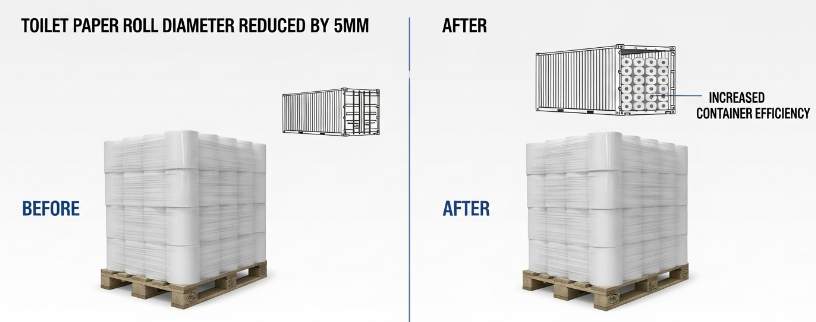
Can Reducing Roll Diameter by 5mm Save You 10% in Warehouse Fees?
Small reductions in roll OD change billable DIM weight and pallet geometry, delivering outsized savings when they drop you into a lower carrier or storage tier.
Calculate DIM weight delta from a 5mm diameter reduction
Use the DIM formula: (Length × Width × Height) / DIM divisor and keep units consistent so your result converts from cm³ to kg using the carrier divisor for international lanes. Measure the current roll outer diameter (OD) and the internal height of the bundle master carton; set the new OD = OD − 5 mm and recompute carton internal height and total carton CBM. Recalculate DIM weight with the carrier-specific divisor and compare it to actual mass to find the billable weight (billable = max(actual, DIM)).
Account for carrier rounding: most carriers round each dimension up to the next increment (usually 1 in / 2.54 cm), so a 5 mm reduction can push a rounded carton height down one increment and drop DIM weight materially. If that drop moves you below a common billable weight tier on your rate card, expect an outsized cost reduction relative to the percentage CBM change.
- Record baseline: log current carton dimensions, measured OD, and actual gross weight per carton.
- Recalculate: compute new carton height using OD − 5 mm, compute new CBM and DIM weight with your carrier divisor.
- Compare billable weight: take the larger of actual and DIM weight and model the cost difference per carton and per container load.
Recompute storage density and container/pallet gains for a 5mm smaller roll
Start with the factory bundle specs (for example, 5000 g/28 rolls or 4500 g/32 rolls and standard widths between 102–132 mm). Replace the original OD with OD − 5 mm and recalculate how many rolls fit per layer using cylindrical packing rules—use a rectangular grid for simple layouts or hexagonal close pack for higher density. Update layers-per-pallet based on the new stackable height; small OD reductions often allow an extra roll per layer or an additional partial layer that compounds across pallets.
Translate pallet-level gains into container impact: convert the additional rolls per pallet into CBM and rerun a 40HQ load plan using Top Source loading baselines (40HQ payload typically 7–9 tons). Re-run stowage to estimate extra units per 40HQ and update landed cost per roll; packing gains compound—each extra roll per pallet multiplies across 20–26 pallet positions in a 40HQ configuration.
- Simulate pallet layouts in CAD or packing software replacing OD with OD − 5 mm (test rectangular and hex packing).
- Update master-carton dims and pallet patterns, then calculate units per pallet and units per 40HQ.
- Compare landed cost per roll before and after the change to quantify freight and storage savings.
Levers that amplify savings: apply mechanical compression during bagging to reduce roll bulk further, and consider coreless (solid) rolls—Top Source coreless options increase linear meters per bundle and improve unit/CBM efficiency.
Manufacturing tolerances, QA checks and specification updates needed to implement −5 mm
Set a production spec: Target OD = current OD − 5 mm with a manufacturing tolerance of ±1 mm and record this in the technical pack for rewinders and converting lines. Adjust machines: change winder spindle spacing, reduce nip pressure incrementally, and tune compression settings so sheet bonding, emboss pattern integrity, and perforation remain clean at the smaller OD. Document those machine settings in the changeover sheet for each line.
Define a QA protocol: measure OD with calibrated calipers, verify roll density and bundle mass on a lab scale, and check sheet count and tensile/wet-strength at defined sample frequencies. Run septic-disintegration tests for septic-safe claims and include pre-shipment visual verification that carton stacking height matches the load-plan. Update SKU spec sheets, carton internal dimensions, and label net weights to reflect the new OD and bundle specifications.
- Pilot run: produce one container-equivalent trial batch and record OD, bundle mass, and palletization results.
- Verify savings: obtain carrier DIM and palletization quotes with the pilot dimensions and confirm projected freight and storage reductions.
- Lock spec: update MOQ and lead-time planning (production lead time 20–25 days) and add the new OD/tolerance to the purchase order and technical pack.
Dispenser Conflict: Why “Over-Sized” Mega Rolls Fail in Commercial Units
Oversized roll widths raise DIM charges and create dispenser jams; target 102–132mm widths and coreless/high-density designs to cut freight and field failures.
Dimensional-weight calculation and roll-width targets for international shipments
Calculate DIM weight using DIM Weight = (Length × Width × Height) / DIM divisor and bill the larger of actual versus DIM weight. Carriers round each dimension up to the nearest inch, so small width increases can multiply billable weight across a shipment. For example, a 2 lb item in a 15×12×10 in parcel can be billed at roughly 13 lb after DIM calculation and rounding; scale that across thousands of rolls and freight spend balloons fast.
Target roll widths between 102–132 mm (≈4.0–5.2 in) on mixed international lanes to control DIM exposure, and avoid 235 mm (9.25 in) wide formats unless the dispenser and route justify the cost. Use coreless or higher-density windings to reduce outer diameter for the same paper meters. Negotiate the DIM divisor with carriers, run zone-specific CBM vs DIM models, and expect right-sizing to cut freight 10–20% on large-volume lanes.
Match roll width and diameter to commercial dispenser clearances and feed mechanisms
Measure three dispenser parameters in millimetres and document each to ±2 mm: internal housing width, spindle/core clearance, and feed/cutter alignment. Specify maximum roll width and outer diameter per dispenser model and enforce acceptance limits; keep width ≤132 mm for standard commercial units unless you deploy a wide-format dispenser.
Map product SKUs to dispenser types before shipping: reserve TSH-2269 (165 mm) and TSH-3099 (235 mm) for compatible wide-format or custom dispensers, and default to TSH-2559 or TSH-1071 series for legacy units. Verify perforation pitch and sheet alignment relative to cutter blades—oversized rolls misalign perforations, cause shredding, and produce jams. Build a simple installation checklist and require it on field deployments.
- Measure internal housing width, spindle/core clearance, and feed/cutter alignment to ±2 mm.
- Confirm roll OD and width against the dispenser’s maximum allowable dimensions.
- Check perforation pitch against cutter blade location and run a test dispense cycle.
- Verify spindle fit, rotation clearance, and unobstructed sheet path before field deployment.
Packaging, compression, and 40HQ loading practices to preserve payload and prevent dispenser conflicts
Compress rolls during bagging to reduce diameter while preserving ply structure; this increases units per CBM and lowers per-roll freight. Choose per-bundle weights between 780 g and 5,000 g according to SKU and destination handling—heavier bundles reduce packaging overhead but raise pallet weight and handling constraints. For 40HQ loading, plan around a typical payload of 7–9 tons and the container’s usable CBM (40HQ ≈ 76 m³); oversized-width SKUs reduce total roll count per container and increase landed cost per meter.
Run CBM versus DIM simulations to compare actual pallet CBM against carrier DIM billing and identify width thresholds that trigger higher freight brackets. Require pre-shipment visual verification and packing photos to prove compressed profile, correct carton stacking, and segregation of oversized rolls. Add product-substitution rules to POs: if dispenser compatibility remains unconfirmed, ship standard-width SKUs to protect distribution ROI and cut return rates.
- Run zone-specific CBM/DIM simulations to set width thresholds for each lane.
- Use mechanical compression during bagging to reduce OD without damaging sheets; record before/after dimensions.
- Photograph packing and pallet configuration; attach to shipping docs for QA and claims support.
- Apply PO substitution rules: default to 102–132 mm SKUs when dispenser compatibility is unverified.
How Does Sheet Count Inconsistency Lead to Customer Return Risks?
Short or inconsistent sheet counts create chargebacks and returns; measure, control, and document roll mass, length and packing to stop claims before they start.
Measure and verify sheet count using roll mass, linear length and diameter controls
Weigh each roll or bundle on an inline automated scale and compare readings to bundle specs (typical range: 780 g–5000 g). Use model references to speed validation—TSH-2559 targets 1800 g per 10-roll pack and TSH-3396 targets 5000 g per 28-roll pack—then flag deviations beyond your acceptance band (example starting point: ±3% roll mass or ±2% sheet count). Convert expected sheet length to mass by computing: roll mass = width (102–132 mm) × sheet length × GSM per ply (13–22 g/m²) × ply count; build a roll-mass tolerance table from those calculations and use it as the packing-line reference.
- Install inline length meters and diameter calipers and link them to the weigh-scale output so you detect short rolls before packing.
- Reject and tag failing rolls with batch ID; record rejection reason and operator ID for trace-back.
- Keep a rolling log of measured vs. target values and use it to refine ±3%/±2% limits into statistically justified control limits.
Identify production root causes that shorten sheet count and apply corrective controls
Track headbox flow rate, web tension and in-line GSM on every production run and correlate those logs to final roll mass and sheet counts; low headbox flow or unstable web tension directly reduces yield. Control ply bonding and calender pressure—multi-ply lamination and calender settings change final thickness and effective length, so record setpoints and compare actual post-process thickness to the validated baseline.
- Maintain perforation tooling and registration; check perforation clearance at every roll change to prevent scrap losses at each perforation line.
- Measure embossing effects: point-to-point embossing increases absorbency (~30%) but can compress sheet length; measure post-emboss length against pre-emboss baseline and adjust embossing compression controls when you see consistent shrinkage.
- Enforce shift-based calibration routines for cutters, winding tension and diameter setpoints; capture calibration timestamps and operator initials in the QC log for root-cause analysis.
Packaging, labeling and shipment checks that prevent perceived shortfalls and returns
Match printed sheet-count and roll-weight labels to the measured values on the packing line and ensure label data reflects the actual pack format (Format A: individual wrap; Format B: direct bundle). Run random carton weight audits—one carton per 100 is a practical start—and escalate when out-of-tolerance rates exceed your agreed AQL thresholds. For every 40HQ shipment (payload optimization typically 7–9 tons), capture pre-shipment visual verification and a loading video to rebut destination mismatch claims.
- Include technical claims on cartons (OBA-Free, septic-safe, GSM per ply, roll width) to reduce disputes caused by ambiguous marketing copy.
- Record SKU-to-model mapping (for example, TSH-4010, TSH-3082) and print packing lists that show roll count, roll weight and the sheet-count assumptions used to calculate package totals.
- Escalate and quarantine any carton batches that fail weight audits and attach their loading video and batch IDs to the investigation file for customer communication and insurance claims.

Engineering for 40HQ: Optimizing Pallet Configuration for Roll Size
Right-size roll geometry and pallet engineering to cut DIM charges and unlock maximum CBM in a 40HQ without exceeding payload or stacking limits.
Define target roll and bundle geometry to minimize CBM and DIM weight
Start with a fixed set of roll widths and bundle-weight targets so packaging becomes a predictable input for CBM and dimensional-weight calculations. Use standard widths (102, 104, 105 up to 132 mm) and set bundle gross weights across your production options (780 g to 5,000 g) to make actual weight track closer to dimensional weight. Favor coreless (solid) bundles when buyer dispensers allow—coreless increases meters per cubic metre and reduces non-paper volume in the carton. Record finished master-carton external dimensions for every SKU and treat those external dims as the primary data for CBM/DIM models and carrier billing checks.
- Lock roll widths: 102–132 mm as SKU families to avoid one-off packaging that inflates L×W×H.
- Target bundle weights between 780 g and 5,000 g so carton gross weight often exceeds DIM weight thresholds where desirable.
- Document and version-control master-carton external dims; feed those dims into CBM reports and shipping labels.
Calculate pallets-per-container and per-pallet weight limits
Compute floor-fill from pallet footprint to determine realistic pallet count in a 40HQ (approximate internal: 12.19 m × 2.44 m × 2.90 m). Use common pallet footprints—Euro 1,200 × 800 mm and US 1,219 × 1,016 mm—and calculate floor_area_container ÷ pallet_area to get theoretical positions, then adjust for blocking and aisle gaps to reach a practical range (typically 25–28 Euro pallets per 40HQ). Set per-pallet target weight to the lower of your carton/pallet load rating and container payload divided by planned pallet count; use a working container payload range of 7,000–9,000 kg for Top Source Hygiene exports.
- Formula: floor-fill = floor_area_container (m²) ÷ pallet_area (m²); apply orientation variants (long side or short side) to optimize count.
- Practical pallet count for 40HQ: expect 25–28 Euro pallets depending on orientation and blocking.
- Per-pallet target weight = min(carton/pallet rating, container_payload ÷ planned_pallet_count). Use container payload = 7,000–9,000 kg when planning.
- Measure carton stacking strength and local truck/port handling limits to derive a maximum pallet height, then convert that height into a maximum number of roll layers.
Optimize pallet layer pattern and stacking to maximize usable volume
Choose a layer pattern that balances density and transport stability: column stacking yields higher density, interlock or hybrid layers improve lateral stability. Design each layer so roll/bundle counts tile the pallet length and width exactly; avoid partial rows that create voids and raise CBM. Put heavier bundles on lower layers and keep layer heights uniform to let stretch-wrap and forklift handling stabilize the load. Build a prototype pallet, measure real layer height and CBM, then iterate bundle compression and pattern to reach target density without exceeding pallet weight limits.
- Test column vs interlock with actual cartons; record CBM per pallet and stability score after vibration or drop tests.
- Design layer multiples to tile 1,200 × 800 mm (or 1,219 × 1,016 mm) exactly, eliminating half-width gaps.
- Distribute mass: place heavier bundles on the bottom two layers and maintain consistent layer heights for predictable compression and wrap performance.
- Prototype and measure: record packed-pallet height, compute pallet CBM, then adjust compression ratio to hit CBM and DIM targets.
Set carton dimensions and tolerances to avoid DIM rounding penalties
Use the carrier DIM formula in project units: DIM (kg) = (L × W × H in cm) ÷ DIM divisor, with the common international divisor ≈ 5,000. Carriers round dimensions to the nearest inch, so design external carton sizes and manufacturing tolerances to avoid crossing those rounding thresholds. Set internal production tolerances under 2 cm where possible. Run DIM vs actual-weight checks for representative cartons and, when DIM exceeds actual weight, reduce external volume or increase net weight per carton. For high-volume lanes, negotiate a higher DIM divisor with carriers to lower billed dimensional weight.
- Apply DIM formula using divisor ≈ 5,000 for international lanes; verify carrier-specific divisors before quoting freight.
- Design cartons to avoid inch-rounding jumps; keep manufacturing tolerance < 2 cm to prevent unexpected billing steps.
- If DIM weight > actual weight, either shrink external carton volume or increase carton gross weight through bundle sizing to lower billed cost per kg.
- Push for negotiated DIM divisors on high-frequency lanes to reduce volumetric billing.
Secure pallets and reinforce cartons for high-stacking in 40HQ
Specify export-grade 5-ply cartons with burst strength matched to your stacking plan and add corner boards and steel or polyester strapping for heavy pallets. Apply mechanical compression during bagging to reduce roll fluff while preserving sheet quality—document the compression ratio and post-compression dimensions for QC. Prevent pallet overhang and require at least 50 mm clearance from container sidewalls; add top sheets and desiccants where moisture or friction may harm rolls. Standardize stretch-wrap patterns (wrap count and pre-stretch percentage) and define torque limits for strap tension to prevent carton damage during handling.
- Use 5-ply export cartons; specify burst strength and stacking load rating per pallet plan.
- Include corner boards and steel/poly strapping on pallets above target weight thresholds.
- Document mechanical compression ratio during bagging and record post-compression OD for each roll SKU.
- Enforce no overhang; require ≥50 mm clearance from container walls and use top sheets plus desiccants if needed.
- Standardize wrap: define wrap count, pre-stretch %, and strap torque limits to prevent carton damage during transit.
Implement load planning, verification and pre-shipment controls
Use palletization software or CAD to produce load maps, compute CBM fill percentage, and export per-pallet weight and center-of-gravity data for handling and lashing plans. Define pre-shipment verification steps and enforce them on every container: sample pallet weight check, carton-dimension audit, stacking-pattern photo, video of container loading and seal number capture. Tie QC checkpoints to product specs—confirm OBA-free status, ply count, roll width, bundle gross weight, and batch color consistency. Record acceptance thresholds and corrective actions so teams rework carton orientation or adjust bundle compression when measured CBM or DIM weight deviates from plan.
- Generate load maps and CBM reports from palletization software; export per-pallet COG for safe forklift handling.
- Require pre-shipment verification: sample pallet weight, carton-dimension audit, stacking-pattern photos, container loading video and seal number.
- Include product QC checkpoints: OBA-free confirmation, ply count, roll width, bundle gross weight, batch color consistency.
- Define acceptance thresholds and corrective actions—if CBM or DIM weight exceeds the plan, rework carton orientation or adjust bundles before sealing the container.
Conclusion
Optimizing roll dimensions and pallet configuration isn’t just a cost play — it reduces handling hazards, helps meet OSHA safety requirements, and protects packing and loading equipment for longer service life. Those engineering steps also improve CBM efficiency and stabilise pallets to lower landed cost and shrinkage risk.
Check your current pallet patterns and container plans against the 40HQ engineering guidance, or contact Top Source Hygiene to request a certified loading plan and sample roll so you can validate fit and unit economics before your next order.
Frequently Asked Questions
What are the standard toilet paper roll dimensions for the US vs EU?
The source research does not list specific standard roll dimensions for the US versus the EU. The actionable point is that regional differences in roll width and diameter matter because dimensional-weight pricing is based on package cubic size; oversized widths or diameters drive higher billable weight. For tenders, collect exact outer diameter, roll width, core diameter, sheet count and ply so you can calculate DIM weight and cubic meters for shipping.
How does the roll diameter affect the number of units per 40HQ container?
Increasing roll diameter raises the per-unit cubic volume, so fewer rolls fit in a 40HQ container; carriers bill by the larger of actual weight or DIM weight, so larger diameters can push shipments from actual-weight to DIM-weight billing. Measurement rounding (carriers round up to the nearest inch) compounds the effect and can add several pounds of billable weight per unit; optimizing diameter/width can recover ROI and reduce container-space waste.
Why are “Mega Rolls” a challenge for standard commercial dispensers?
Mega Rolls typically have much larger diameters and often greater width than standard commercial rolls, so they can physically not fit or fail to operate correctly in standard commercial dispensers. Beyond dispenser fit, Mega Rolls inflate package dimensions which increase DIM-weight charges and add handling complexity for distributors and facilities.
Does reducing roll width impact the consumer’s perception of value?
Reducing roll width lowers dimensional weight and material usage—research shows right-sizing packaging can cut shipping costs roughly 10–20% and improve margins. However, consumer perception of value depends on delivered sheet count, ply and communication; because 55% of shoppers abandon carts over unexpected shipping fees, lowering width to reduce shipping costs can increase perceived value if sheet count or ply are maintained and reductions are clearly communicated.
What is the impact of roll density on shipping weight and stability?
Roll density determines whether billing is driven by actual weight or DIM weight: higher-density rolls increase actual shipping weight (raising freight cost by mass), while lower-density but bulky rolls are more likely to be charged by DIM weight. Density also affects pallet stability and stacking: denser, more compact rolls pack tighter and improve load stability, whereas very low-density bulky rolls waste container volume and increase susceptibility to shifting.
How to measure roll dimensions accurately for a private label tender?
For an accurate private-label tender: measure outer diameter, roll width, core diameter, sheet count, ply and the gross weight of a sample roll including immediate retail/ship packaging; measure packaged length × width × height and round each dimension to the carrier’s billing increment (carriers round up to the nearest inch). Calculate DIM weight using the carrier’s DIM divisor, compute CBM and projected units per 40HQ, sample multiple production rolls for variance, include photos and measurement method in the tender, and consider negotiating a DIM divisor with carriers.