
In high-traffic commercial environments, deploying 1,000-sheet jumbo rolls reduces maintenance labor costs by 15% through increased capacity and fewer changeouts. Maximizing these operational margins requires precise custom physical specs that balance GSM-driven fiber costs against regional consumer demands across 56+ countries where quality expectations vary wildly.
This guide outlines the technical validation frameworks necessary to align production with market intent, covering proprietary systems like the Scott® Essential 1.75-inch “Purple Core” and durability standards such as ASTM D6978-05. We analyze the mathematical trade-offs between ply-bonding and tensile strength to ensure your inventory meets ISO 9001 and FDA compliance benchmarks.
Matching Product Specs to Market Demands
Product matching uses algorithmic similarity metrics and compliance standards to align physical specifications like ply-count and material purity with regional consumer demands and procurement needs.
Inventory optimization hinges on how you categorize product matches. Manufacturers define these as either “exact” matches, where physical specs are identical, or “equivalent” matches, where the functional performance serves the same purpose. This distinction allows retail and commercial sectors to maintain supply chains even when specific brand-name items are unavailable.
Core Attributes: Aligning Physical Dimensions with Regional Preferences
Attribute extraction bridges the gap between raw manufacturer data and consumer search intent. By pulling key identifiers like brand, sheet size, and color, systems create comparable datasets. This process is vital for competitive pricing and tracking market trends across 56+ countries where expectations vary wildly.
- Ply Count: Calibrating thickness from 2-ply to 5-ply based on regional luxury or utility standards.
- Material Composition: Selecting virgin wood pulp or recycled fibers to meet specific market sustainability tiers.
- Data Structure: Converting unstructured manufacturer descriptions into standardized formats like EAN or GTIN.
Validation Frameworks: Performance Metrics and Regulatory Compliance
Technical validation moves beyond simple descriptions. Algorithms analyze market data using specific similarity measures to ensure custom specs remain competitive. You measure the effectiveness of these matches through two critical metrics: precision and recall. High-performance procurement targets 100% accuracy in matching production output to buyer requirements.
- Similarity Metrics: Edit distance, Jaccard, tf-idf, and trigram analysis to verify product similarity.
- Quality Benchmarks: ISO 9001 for quality control and FDA regulations for hygiene compliance in North America.
- Sustainability Standards: FSC certification for European and North American green consumer segments.
Alignment requires more than matching a label; it requires verifying that the physical product meets the legal and functional demands of the target region. Using these data-driven frameworks prevents spec drift and ensures that what leaves the factory actually fits the market’s technical needs.
The Math of GSM: Balancing Thickness and Fiber Cost
GSM measures mass per unit area, directly dictating fiber costs. While thickness depends on fiber bulk, higher GSM always increases material expense and product density.
| Metric / Conversion | Calculation Formula | Practical Application |
|---|---|---|
| Standard GSM | Weight (g) / Area (m²) | General density measurement |
| Imperial Weight | GSM × 0.0295 | Converting to oz/yd² for US procurement |
| Linear Weight | GSM × Width (m) | Calculating grams per linear meter |
| Industrial Woven | (Ends/Warp + Picks/Weft) × 25.537 | Reinforced paper and textile specs |
Defining Areal Density: The Core Formulas for Paper Mass
Procurement teams must master these conversions to avoid overpaying for weight or under-specifying for strength. While GSM is the global benchmark, regional variations and manufacturing methods require specific mathematical adjustments to ensure quality control (QC) remains consistent across production runs.
- Direct Measurement: Calculate GSM by dividing weight in grams by area in square meters. For high-speed QC, weigh a 100 cm² sample and multiply by 100.
- Imperial Conversion: Multiply GSM by 0.0295 to reach the oz/yd² equivalent (e.g., 200 GSM equals 5.9 oz/yd²).
- Linear Metrics: Determine weight per linear meter by multiplying GSM by the fabric width (m). A 200 GSM sheet at 1.524m width yields 304.8 g/m.
- Woven Constants: Specialized industrial papers use thread density and yarn fineness formulas to balance mass without sacrificing tensile strength.
Optimizing the GSM-to-Thickness Ratio for Cost Efficiency
Never assume higher GSM automatically results in a thicker sheet. The relationship between mass and thickness is non-linear and heavily influenced by fiber density and “bulk.” Efficient manufacturing requires picking the lowest possible GSM that meets the physical “hand-feel” or strength requirements of the end-user.
- The Bulk Factor: Two sheets with identical GSM can have different thicknesses based on fiber density (g/cm³) and weave looseness.
- Linear Cost Drivers: Fiber mass is the primary expense in production; increasing GSM increases material costs at a predictable, linear rate.
- Targeted Applications: Specifications range from 13.5 GSM plies for retail tissue to high-density 200+ GSM sheets for industrial or marine environments.
- Material Impact: 100% virgin wood pulp provides higher packing efficiency and smoother finishes compared to recycled alternatives at the same weight.
Smart manufacturers adjust the GSM targets to fit the dispenser type. High-traffic industrial units often require more density to prevent tearing, while retail products prioritize bulk over raw fiber weight to enhance perceived value.

Layering Strategy: 1-Ply Industrial vs. 4-Ply Luxury
1-ply maximizes roll length for high-traffic maintenance savings, while 4-ply uses virgin pulp and air-pocket embossing to deliver premium absorbency for luxury hospitality.
Layering strategy balances procurement costs against the end-user experience. Industrial 1-ply products prioritize high-capacity durability for high-traffic environments. Premium 4-ply variants use multiple layers of 100% virgin wood pulp to increase absorbency and thickness for the luxury retail and hospitality sectors.
Functional Engineering: Tensile Strength vs. Multi-Ply Comfort
Engineers design single-ply rolls to minimize roll changes in public facilities. Multi-ply products focus on structural thickness and texture through advanced bonding techniques.
- 1-Ply Industrial: High tensile strength jumbo rolls reduce facility maintenance costs by 15% through increased capacity.
- 4-Ply Luxury: Bonding four distinct layers of virgin wood pulp increases the Grams per Square Meter (GSM) for a plush texture.
- Ply Bonding: Embossing patterns create air pockets between layers to improve thermal insulation and moisture-wicking.
- Compliance: Use of 100% virgin pulp ensures products meet ISO 9001 and FDA standards without fluorescent whiteners.
Market Application: Cost-Efficiency vs. Brand Perception
Deploying different ply counts requires a strategic look at regional economic factors and brand goals. High-traffic zones demand volume, while boutique environments use ply count to signal quality.
- Industrial Optimization: Single-ply and thin 2-ply rolls serve as the standard for public facilities in Africa and Asia to maintain price competitiveness.
- Hospitality ROI: Implementing custom 4-ply tissue in luxury hotels increases guest satisfaction scores for amenities by up to 20%.
- Sustainability: Manufacturers provide FSC-certified options to meet “green” consumer demands in European and North American markets.
- Production Capacity: Advanced facilities outputting 2,860 tons per month allow brands to pivot between high-capacity industrial specs and soft retail lines.
Build Your Unique Toilet Paper Brand with 30 Years of OEM Expertise

Custom Sheet Counts: From 150 to 1000 Sheets per Roll
Brands match sheet counts to specific environments. Low counts serve luxury retail, while 1000-sheet rolls cut maintenance labor by 15% in high-traffic commercial venues.
Market Segmentation: Retail Rolls vs. High-Capacity Jumbo Systems
Retailers use 150–300 sheets to prioritize aesthetics and frequent rotation in residential bathrooms. These rolls fit standard consumer dispensers and focus on the tactile experience of 100% virgin wood pulp.
High-traffic zones like airports, malls, and hospitals demand 500–1000 sheets per roll. This Jumbo Roll Tissue (JRT) configuration targets maintenance efficiency. Facilities using these high-capacity systems reduce labor costs associated with roll changes by up to 15%.
Ply count dictates total volume. Moving from 2-ply to 5-ply tiers requires a lower sheet count to ensure the final roll diameter stays within dispenser limits. Manufacturers adjust winding tension to keep these dimensions consistent across different ply levels.
Technical Constraints: Diameter, GSM, and Logistical Efficiency
Sheet count directly affects the roll diameter. Engineers must calibrate winding tension and GSM (Grams per Square Meter) so the final product fits either proprietary or universal dispensers. Precise calibration also maximizes 40’HQ container space to lower landed costs.
- Production Capacity: 2,860 tons per month.
- Lead Time: 15–25 days for custom winding and private label packaging.
- Compliance Standards: ISO 9001 and FDA certification.
- Material Integrity: High-density 1000-sheet rolls maintain perforation strength for clean tearing.
Logistical planning for custom counts ensures that even 5-ply configurations maintain absorbency without exceeding standard diameter thresholds. This technical balance allows brands to offer premium thickness without upgrading existing dispenser infrastructure.

Adjusting Perforation Spacing for Custom Use-Cases
Pitch and pattern selection dictate open area and structural integrity. Maintain a 1:1 hole-to-thickness ratio and use CNC tools for precise, modular custom fitments without retooling.
Fundamental Perforation Patterns and Pitch Metrics
Pattern selection determines how much material remains for structural support. Most jobs use staggered layouts because they offer the best balance between hole density and sheet strength. Spacing is defined by pitch, which measures the distance from the center of one hole to the center of the next.
- Standard Layouts: Includes 60° and 45° staggered (T pattern), diagonal, and rectangular (U pattern) configurations.
- Pitch Notation: Staggered patterns use a single pitch (p); rectangular shapes use p1 x p2 notation.
- Pattern Orientation: Rows typically run parallel to the sheet length, though custom margins ensure alignment with modular fitments.
- Open Area Limits: Percentages exceeding 60% are possible but risk material distortion and require higher manufacturing tonnage.
Standardizing these metrics allows for predictable airflow or liquid filtration. Also, custom margins on the sides and ends prevent “half-holes” at the edges, which is vital for safe handling and clean installation in frames.
Engineering Constraints and Programmable Precision
Physics dictates the limits of your design. If the hole is smaller than the metal’s thickness, the punch will likely snap during the press cycle. Adhering to specific diameter-to-thickness ratios ensures both tool longevity and part accuracy.
- The 1:1 Rule: Hole diameter must equal or exceed material thickness (ranging from 0.004″ to 0.500″).
- High-Strength Materials: Stainless steel requires a conservative ratio—at least 3 gauges thinner than the tool—to maintain integrity.
- Vibration Adjustment: Wider pitches (under 3-inch codirectional spacing) are used in marine or rail transport to prevent material tearing.
- CNC Precision: Advanced punching tools with programmable activators allow variable spacing intervals without the cost of custom retooling.
Programmable CNC tools allow for “dead zones” or variable pitch on a single sheet. This capability is useful for structural components that require high-density perforations in one area for ventilation and solid sections elsewhere for mounting or load-bearing.

Core Size Customization for Proprietary Dispensers
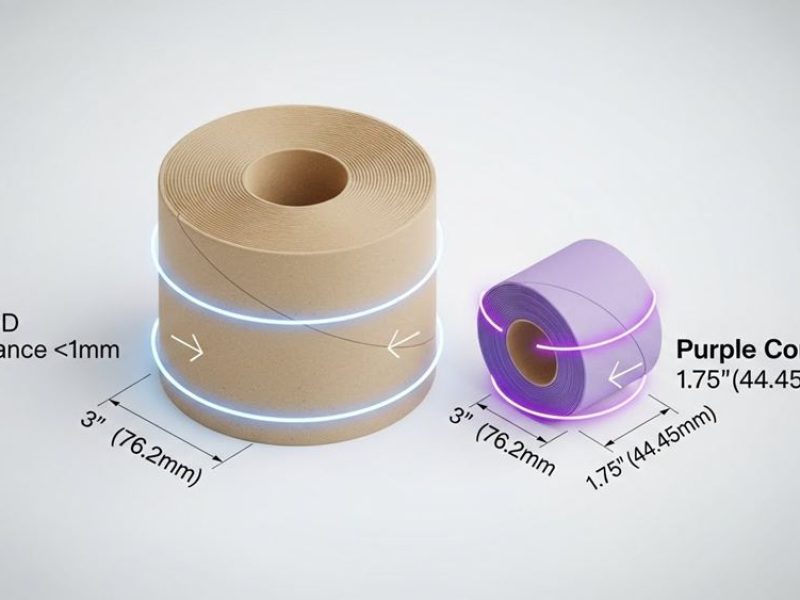
Custom core diameters like the 1.75-inch purple standard ensure dispenser compatibility, reduce maintenance labor by seven days annually, and prevent mechanical jams in high-capacity systems.
Compatibility Engineering: Solving the Proprietary Lock-In
Manufacturers engineer specific core sizes to secure their supply chain and guarantee that the dispenser mechanics function without interference. These proprietary dimensions serve as a physical handshake between the hardware and the consumable roll.
- Proprietary Standard: Scott® Essential manual dispensers utilize a 1.75-inch (44 mm) “Purple Core” to prevent the installation of off-brand, non-compatible refills.
- Labor Efficiency: High-capacity designs, such as 950-foot rolls, minimize changeouts and save approximately 7 days of maintenance labor per year.
- Dispenser Footprint: Strategic dimensions of 12.63″ x 16.13″ x 10.2″ accommodate specialized roll physics while maintaining noise levels below 60 dB during high-speed operation.
Standardizing on these proprietary footprints forces a closed-loop supply chain. This ensures the hardware meets its rated performance benchmarks and avoids the mechanical failures common with generic alternatives.
Technical Specifications: ID/OD Tolerances and Durability
Precision in core inner diameter (ID) and roll outer diameter (OD) dictates whether a system feeds reliably or triggers a sensor error. Deviations in these specs often lead to cutter jams or print misalignment.
- Core Dimensions: 3-inch (76 mm) ID cores are the standard for industrial labeling and jumbo rolls to support automated sensors and high-speed unwinding.
- Roll Capacity: External unwind systems support massive volumes with 8-inch (200 mm) to 11.8-inch (300 mm) Outer Diameters.
- Media Calibration: Thickness tolerances range from 5.7 mil (0.145 mm) to 10 mil (0.255 mm) to prevent guillotine cutter failure in automated systems.
- Engineering Standards: Small-core SRB systems holding up to 4,400 sheets adhere to ASTM D6978-05 for durability and high-volume performance.
- Positional Accuracy: Consistent roll winding specs maintain ±1 mm accuracy for perforation and print positioning.
Strict adherence to these technical tolerances prevents sensor blindness and cutter dulling. In high-volume environments, these millimeter-level specs are the difference between continuous operation and expensive downtime.
Case Study: Custom Specs for an RV/Marine Niche Brand
Custom RV and marine specs prioritize weight and resilience through rPETG GF composites, monocoque 3D printing, and aluminum frames to optimize towing efficiency and durability.
| Specification | Technical Metric | Operational Benefit |
|---|---|---|
| Material Base | rPETG GF (Glass Fiber Reinforced) | UV resistance and mechanical stress tolerance. |
| Total Shell Weight | 660 kg | Enhanced mobility and lower fuel consumption. |
| Manufacturing Speed | 92-hour print (Heron 400 HF) | Rapid prototyping and niche customization. |
| Resource Efficiency | 60% reduction in material waste | Cost savings versus subtractive CNC methods. |
Material Science for Harsh Environments
Marine and RV builds fail at the joints. Saltwater, humidity, and constant UV exposure destroy traditional adhesives and fasteners. We solve this by utilizing monocoque designs and high-performance polymers that thrive in extreme conditions.
- rPETG GF: This recycled PET-based polymer reinforced with glass fiber provides the structural rigidity of traditional composites with superior UV resistance.
- Aluminum vs. Steel: Marine trailers utilize lightweight aluminum to prevent corrosion while RV chassis prioritize steel where maximum load-bearing is required for rough terrain.
- Monocoque Design: Printing the entire shell as a single unit ensures 100% watertightness, eliminating the need for sealants that degrade over time.
Technical Specs: 3D Printing and Load Alignment
Speed and scale define modern niche manufacturing. We use Large Format Additive Manufacturing (LFAM) to produce oversized components that previously required expensive, slow-to-build molds and tooling.
- Print Metrics: The Heron 400 HF rail system uses an 8 mm nozzle to complete full-scale RV shells (4300 × 2100 × 2100 mm) in just 92 hours.
- Component Sizing: Massivit technology allows for single uninterrupted prints up to 6 feet (1.83 m) for kitchen and bathroom fixtures, ensuring zero leak points.
- Precision Alignment: Boat trailers feature adjustable bunks and keel rollers, optimized via simulated towing tests to minimize hull stress during high-speed transit.
These technical choices aren’t just about aesthetics. They directly impact the lifecycle of the vehicle. By reducing weight to 660 kg, we enable smaller towing vehicles to handle larger loads, expanding the market reach for niche brands.
Final Thoughts
Optimization requires balancing fiber mass against perceived value. Over-specifying GSM wastes margins, while under-specifying compromises your brand’s luxury positioning in competitive markets.
Audit your dispenser footprint and regional user data to select the lowest viable GSM. Execute a pilot run using “equivalent” matches to test supply chain resilience before committing to a full-scale contract.
Frequently Asked Questions
What is the standard GSM for premium toilet paper?
Premium toilet paper requires 35+ GSM. This weight distinguishes high-end products from standard bathroom tissue (20-30 GSM) and individual tissue plies that typically range from 10-16 GSM.
Can I customize the number of sheets on a roll?
Yes. By adjusting the roll diameter, paper GSM, and sheet width, production lines can hit specific targets ranging from 100 to 2,000 sheets per roll.
Does 1-ply toilet paper have the same strength as 2-ply?
No. 2-ply is demonstrably stronger because bonding multiple layers increases tensile strength and durability. While a high-quality 1-ply using long, tightly woven fibers can outperform poorly made 2-ply, the multi-layer structure is generally more tear-resistant.
Can you manufacture rolls that fit a 38mm core dispenser?
Yes. The 38mm core is an industry standard for commercial dispensers. Manufacturers produce rolls to this exact specification to ensure seamless fit and operation in existing dispenser hardware.
What is the impact of sheet size on consumer consumption?
Sheet size significantly impacts consumption volume. Technical research shows that doubling the surface area of a sheet increases the amount consumed by approximately 41%.
How is the tensile strength of custom-spec paper tested?
Tensile strength is verified using ASTM D828 or TAPPI T 494 standards. Labs use a constant-rate-of-elongation (CRE) tester on 15mm or 25mm wide samples to measure the force required for rupture in both the machine and cross directions.
