

Buying managers and travel-brand merchandisers: pocket tissues can be a high-margin, impulse SKU, but choosing the right manufacturer affects cost, compliance and speed to shelf. The pocket-tissue segment was worth about USD 3.5 billion in 2023 and is forecast to near USD 5.5 billion by 2032 (roughly 5.2% CAGR), while Asia Pacific is expanding fastest with an estimated CAGR around 6.0%, so supplier location, MOQ and lead times will change your landed cost and rollout timeline.
This article ranks the top 10 pocket tissue manufacturers for travel brands and breaks down the specs and commercial trade-offs you need: pack-size references (mini packs commonly measure about 2.6 x 1.93 inches and standard wallet inserts are typically 2.5 x 3.5 inches), packaging economics and automation that lower unit cost, plus private-label terms like MOQs (common starter: one 40’HQ), sample timing (custom samples ~10 days) and production lead times (15–25 days for a 40’HQ). Use the comparisons and quick scoring to shortlist suppliers and plan a faster, lower-risk launch for your travel assortment.
Top 10 Manufacturers Specializing in Mini Pocket Tissue Formats
| Manufacturer | Location | Core Strength | Verdict |
|---|---|---|---|
| Top Source Hygiene | Mancheng, Baoding, China (Global Shipping) | Pocket Tissues, Facial Tissues, Toilet Paper, Jumbo Rolls, Kitchen Towels | High-volume OEM/ODM partner with strong quality controls (ISO/FDA/FSC) and private-label flexibility; ideal for large orders—consider shipping lead times. |
| C&S Paper | China | Pocket Tissue, Soft Pocket Tissues, Pocket Tissue Paper | Established pocket-tissue specialist tailored to wholesalers and convenience stores; primarily China-focused distribution. |
| Shenzhen Telling Commodity Co., Ltd. | Shenzhen, China | Custom mini pocket tissue packs, Mini wallet tissue (printed/custom) | Specializes in custom printed mini pocket formats for brands and cosmetics; limited public web/contact details to verify. |
| Wide Wings Hygiene Private Limited | India | 2-Ply Pocket Soft Tissue Paper (10 tissues per pack) | India-based OEM producing competitively priced pocket tissue packs—well-suited for domestic convenience-store and wholesale channels. |
| Fujian Era Paper Products Co., Ltd. | Fujian, China | Virgin wood pulp printed soft customized mini pocket tissues | High-quality virgin pulp mini pockets with competitive bulk pricing and custom printing—best for large-volume orders (MOQs may be high). |
| Baoda Paper Enterprise Co. | China | Pocket Tissue Products (various formats) | Broad exporter with a wide product range for international wholesalers; good for general sourcing though less niche mini specialization. |
| IndiaMART Pocket Tissue OEM Manufacturers | India | Pocket Tissue Paper, Pocket Tissue Packs (multiple OEM suppliers) | Aggregator giving access to many local OEMs and quotes—useful for comparing suppliers locally but requires careful vetting. |
| Alibaba Mini Pocket Tissue Suppliers | Global (Primarily China) | Custom mini pocket tissues, Wholesale mini pocket packs | Large supplier pool with strong customization options for global buyers; significant quality variance—due diligence required. |
| Kleenex | Global | Facial Tissues (including pocket formats) | High brand recognition and proven tissue quality with wide retail availability; premium priced and limited private-label options. |
| Seventh Generation | Global | Eco-Friendly Facial Tissues | Strong sustainability credentials for eco-minded retail lines; appeals to green buyers but is premium and less flexible for private-labeling. |
Top Source Hygiene
Top Source Hygiene is a factory-direct OEM/ODM partner focused on pocket and facial tissues, operating from Mancheng, Baoding since 1995. The company runs two advanced factories with combined output of 2,860 tons per month and serves customers in 56+ countries. That production scale and direct-manufacturing model suit brands and retailers seeking private-label tissue products with predictable volume and factory-level oversight.
On the operational side, Top Source Hygiene highlights strict quality controls and compliance, including ISO 9001, FDA considerations, and optional FSC sourcing for sustainability. Their emphasis on high-volume, cost-effective private-label manufacturing reflects a focus on tight factory control and reduced intermediary risk, making supplier management simpler for buyers who prioritize consistency and documented standards.
At a Glance:
- 📍 Location: Mancheng, Baoding, China (Global Shipping)
- 🏭 Core Strength: Pocket Tissues, Facial Tissues, Toilet Paper, Jumbo Rolls, Kitchen Towels
- 🌍 Key Markets: Global (North America, Europe, Asia, Africa, South America, Oceania)
Why We Picked Them:
| ✅ The Wins | ⚠️ Trade-offs |
|---|---|
|
|
C&S Paper
C&S Paper is a China-based manufacturer focused on pocket-sized tissue products, including soft pocket tissues, pocket tissue paper and premier pocket tissue SKUs. Their product range targets wholesalers and convenience store operators, so offerings emphasize compact formats and shelf-ready presentations that suit bulk purchasing and retail replenishment. The lineup is tailored to channel needs, matching common demand patterns in convenience outlets and wholesale inventories without branching into unrelated product segments.
Because production is centered in China, C&S Paper can execute locally and maintain closer factory control over manufacturing and short-term scheduling, which helps tighten quality checks and manage lead times for large orders. That factory-focused setup supports more direct oversight and can reduce reliance on middlemen, lowering certain supply-chain risks for buyers who need consistent, high-volume supply. For wholesalers and convenience-store buyers seeking predictable pocket-tissue supply, the combination of local execution and factory control positions C&S Paper as a partner built around bulk and retail readiness.
At a Glance:
- 📍 Location: China
- 🏭 Core Strength: Pocket Tissue, Soft Pocket Tissues, Pocket Tissue Paper
- 🌍 Key Markets: Wholesale, Convenience Stores
Why We Picked Them:
| ✅ The Wins | ⚠️ Trade-offs |
|---|---|
|
|
Shenzhen Telling Commodity Co., Ltd.
Shenzhen Telling specializes in custom mini pocket tissue packs and wholesale mini wallet tissues, focusing on printed and customized pocket formats designed for brands and cosmetic lines. Their offering targets brand teams and wholesalers that need small-format, branded disposables for promotions and product lines. Located in Shenzhen, the company operates within a dense manufacturing and supplier ecosystem, which can help with local execution and clearer communication when aligning print and packaging requirements with brand guidelines.
The emphasis on tailored printed formats supports tighter control over visual branding, helping reduce the risk of mismatched artwork or off-spec prints during production. For brands that prioritize consistent packaging across SKUs or promotional runs, working with a Shenzhen-based supplier can reduce coordination friction and support closer factory oversight, which in turn lowers operational and quality risks associated with outsourced, custom-printed pocket tissues.
At a Glance:
- 📍 Location: Shenzhen, China
- 🏭 Core Strength: Custom mini pocket tissue packs, Mini wallet tissue (printed/custom)
- 🌍 Key Markets: Custom branding, Wholesale
Why We Picked Them:
| ✅ The Wins | ⚠️ Trade-offs |
|---|---|
|
|
Wide Wings Hygiene Private Limited
Wide Wings Hygiene is an Indian OEM producing competitively priced 2‑ply pocket soft tissue packs, each pack containing 10 tissues. Their setup emphasizes local execution for domestic wholesale and convenience-store channels, which keeps manufacturing and distribution close to end buyers. That proximity helps shorten lead times and makes coordination with small-format retailers more direct, while keeping the product design focused on pocket-sized convenience.
As a factory-oriented business, Wide Wings Hygiene keeps production control in-house, which supports consistent product specifications and predictable cost structures. The core offering — 2‑ply pocket packs in a 10-tissue format — targets grab-and-go retail and bulk domestic buyers, and the India-focused distribution reduces exposure to import delays and cross-border complications, lowering operational risk for wholesalers and convenience-store operators seeking reliable, cost-effective tissue supplies.
At a Glance:
- 📍 Location: India
- 🏭 Core Strength: 2-Ply Pocket Soft Tissue Paper (10 tissues per pack)
- 🌍 Key Markets: India Wholesale, Convenience Stores
Why We Picked Them:
| ✅ The Wins | ⚠️ Trade-offs |
|---|---|
|
|
Fujian Era Paper Products Co., Ltd.
Fujian Era produces mini pocket tissues from virgin wood pulp and offers printed and customized packaging options tailored for global wholesalers. Based in Fujian, China, they keep production local, which helps maintain consistent material quality and makes coordination on custom print runs more direct. That local execution supports clearer communication between buyer and manufacturer when specifying paper grade, print artwork, and packaging formats.
The company positions itself for volume buyers by offering competitive bulk pricing — cited example: US$0.042 per piece on large orders — which simplifies cost planning for large shipments. Factory-level control over production and customization reduces sourcing risk for wholesalers: buyers can lock in material (virgin wood pulp) and print specifications up front, helping avoid surprises during scalable production runs.
At a Glance:
- 📍 Location: Fujian, China
- 🏭 Core Strength: Virgin wood pulp printed soft customized mini pocket tissues
- 🌍 Key Markets: Global Wholesale
Why We Picked Them:
| ✅ The Wins | ⚠️ Trade-offs |
|---|---|
|
|
Baoda Paper Enterprise Co.
Baoda Paper is a prominent Chinese supplier and exporter focused on pocket tissue products, offering a broad range of formats for international wholesalers and exporters. As a China-based partner, they enable local execution by coordinating directly within regional manufacturing networks and aligning product specifications with export requirements. That local presence helps translate buyer needs into repeatable production runs and keeps communication channels close when managing order details or adjustments.
From a risk-management standpoint, Baoda’s exporter profile supports stronger factory control and more consistent quality oversight than working through distant intermediaries. Their emphasis on varied pocket tissue formats suits buyers who need flexibility across wholesale product lines, and working with an established exporter can reduce sourcing friction linked to compliance, packaging, and international logistics. Buyers should still plan for standard export lead times and confirm format specialization up front to match specific mini-pocket or niche requests.
At a Glance:
- 📍 Location: China
- 🏭 Core Strength: Pocket Tissue Products (various formats)
- 🌍 Key Markets: Export, Wholesale
Why We Picked Them:
| ✅ The Wins | ⚠️ Trade-offs |
|---|---|
|
|
IndiaMART Pocket Tissue OEM Manufacturers
IndiaMART operates as a large B2B directory that pulls together multiple Indian OEM manufacturers of pocket tissues and packs. If you need locally produced, 2-ply soft pocket tissue options, the site helps you compare available factories, see product ranges, and contact suppliers directly. It works well for brands, retailers, and procurement teams seeking bulk orders within India because listings typically include minimum order quantities, product photos, and direct supplier contact details.
On the operational side, expect to shortlist manufacturers using search filters, review supplier profiles, and request samples and bulk quotes. Quality and terms vary across vendors, so plan to vet suppliers, confirm lead times, and agree payment and logistics arrangements before committing. Arranging sample checks, factory visits, or third-party inspections can cut risk and give you better control over production and delivery for OEM pocket tissue orders.
At a Glance:
- 📍 Location: India
- 🏭 Core Strength: Pocket Tissue Paper, Pocket Tissue Packs (multiple OEM suppliers)
- 🌍 Key Markets: India Domestic, OEM
Why We Picked Them:
| ✅ The Wins | ⚠️ Trade-offs |
|---|---|
|
|
Alibaba Mini Pocket Tissue Suppliers
Alibaba is the behemoth of B2B marketplaces, hosting a large pool of primarily Chinese manufacturers that supply custom mini pocket tissues and wholesale mini pocket packs to buyers around the world. It suits importers, private-label brands, promotional-product companies and retailers who need turn-key sourcing for printed or branded mini tissue packs. The platform aggregates suppliers across price points and production capabilities, making it straightforward to compare offers, review factory profiles, and identify partners for custom packaging and bulk orders.
On the operational side, expect to run standard sourcing steps: request samples, confirm minimum order quantities and verify production timelines. Use Alibaba features like Trade Assurance and supplier verification as part of your risk-management toolkit, and plan for third-party inspections when needed to maintain Factory Control. Clear specifications, pre-production proofs and on-site checks support Local Execution and help with Risk Reduction. Factor in logistics options—sea, air, or express—plus customs and consolidated shipping when comparing total landed cost.
At a Glance:
- 📍 Location: Global (Primarily China)
- 🏭 Core Strength: Custom mini pocket tissues, Wholesale mini pocket packs
- 🌍 Key Markets: Global Wholesale
Why We Picked Them:
| ✅ The Wins | ⚠️ Trade-offs |
|---|---|
|
|
Kleenex
Kleenex is a globally recognized facial tissue brand commonly offered in pocket-sized formats, making it a go-to choice for everyday consumers on the move. Independent tests have repeatedly highlighted its strong tissue quality, which suggests consistent manufacturing standards across batches. That level of consistency supports reliable product performance at the store shelf and gives retailers confidence that the product will meet consumer expectations in local markets.
The brand’s wide retail presence helps with local execution: consumers can readily find pocket tissues where they shop, reducing friction for last-minute purchases. This accessibility, combined with the quality signals from independent testing, lowers sourcing and satisfaction risk for both retailers and buyers. Keep in mind the trade-offs: Kleenex typically commands a premium price and offers limited private-label or OEM flexibility, which can be a constraint for cost-sensitive or custom-volume buyers.
At a Glance:
- 📍 Location: Global
- 🏭 Core Strength: Facial Tissues (including pocket formats)
- 🌍 Key Markets: Retail, Convenience Stores
Why We Picked Them:
| ✅ The Wins | ⚠️ Trade-offs |
|---|---|
|
|
Seventh Generation
Seventh Generation focuses on eco-friendly facial tissues designed to fit sustainable pocket tissue lines, targeting brands and retailers that prioritize green materials and clear environmental credentials. For partners looking to keep production and supply close to their quality standards, choosing a recognized eco-focused supplier like this helps keep execution local and oversight direct. That local execution approach supports tighter factory control over material choices and manufacturing practices, which matters when buyers demand verified sustainability claims and consistent product performance.
The brand’s sustainability credentials appeal to green-focused buyers and sustain its premium positioning in specialty retail channels, but that positioning can limit deep private-label customization. Brands and retailers can reduce risk by aligning with a supplier known for eco materials, since clear environmental claims help avoid compliance gaps and retailer pushback. In practice, this means fewer surprises in sourcing and easier verification of materials, which cuts operational risk while delivering a product that meets the expectations of sustainability-minded consumers.
At a Glance:
- 📍 Location: Global
- 🏭 Core Strength: Eco-Friendly Facial Tissues
- 🌍 Key Markets: Sustainable Retail, Green-Focused Buyers
Why We Picked Them:
| ✅ The Wins | ⚠️ Trade-offs |
|---|---|
|
|
The Global Retail Demand for On-the-Go Pocket Facial Tissues
Pocket facial tissues are a fast-growing convenience segment valued at roughly USD 3.5 billion in 2023 and forecast near USD 5.5 billion by 2032 (about 5.2% CAGR). Packet/pocket formats show slightly faster growth than boxed formats, driven by hygiene awareness, urbanization and on-the-go lifestyles; Asia Pacific leads expansion while convenience stores, travel retail and impulse points capture most on-the-go purchases. Retailers should treat pocket packs as strategic small-format SKUs with targeted shelving, multi-pack offers and private-label travel options.
Market size and demand drivers
The pocket facial tissues segment is estimated at roughly USD 3.5 billion in 2023 and is projected to approach USD 5.5 billion by 2032, implying a compound annual growth rate near 5.2% for pocket-specific data.
Packet and pocket formats register above-average growth within the broader facial tissue market; packet facial tissues are projected at about a 5.3% CAGR through 2030, reflecting steady demand for portable hygiene items among commuters and travelers.
Primary demand drivers include heightened personal hygiene awareness following COVID-19, faster urban migration, rising disposable incomes in emerging markets, and more frequent travel and commuting that boost need for compact, single-use hygiene solutions.
Consumers pick pocket packs for convenience and compactness despite higher per-sheet costs, and pocket formats rank second in prevalence after boxed packs, making them a reliable impulse and travel-oriented offering for convenience retail.
Regional growth patterns and retail channels
Asia Pacific leads market expansion with an estimated CAGR around 6.0%, supported by large population bases, rapid urban migration and rising middle-class incomes in China and India that favor portable hygiene purchases.
North America maintains a significant share due to high living standards, widespread travel and well-developed convenience retail networks that convert on-the-go demand into repeat purchases.
Convenience stores, travel retail, kiosks and other impulse points deliver the strongest performance for pocket formats, with core user groups including travelers, office commuters and people engaged in outdoor or mobile activities.
Packaging economics and implications for retailers
Pocket packs carry higher per-sheet costs versus bulk boxed formats, yet they generate portability value and impulse-purchase appeal; that margin profile makes them a strategic SKU for convenience channels where turnover and margin per unit are both important.
Market reports vary by scope: Dataintelo treats pocket-specific sales at USD 3.5B → 5.5B (2023–2032), Grand View projects the broader facial tissue market toward ~USD 10.28B by 2030 with the packet segment at ~5.3% CAGR, Custom Market Insights reports a larger scope (USD 13.2B → 27.8B, ~7.7% CAGR), and KBV Research places pocket-pack contribution within growth to about USD 6.1B by 2030; these differences stem from how each source defines the product set and geographic scope.
Practical retailer actions include optimizing small-format shelving and facings for pocket SKUs, promoting multi-pack or travel-pack bundles, developing private-label travel SKUs to capture margin, and segmenting offers by ply and softness to differentiate on quality for travel-focused shoppers.
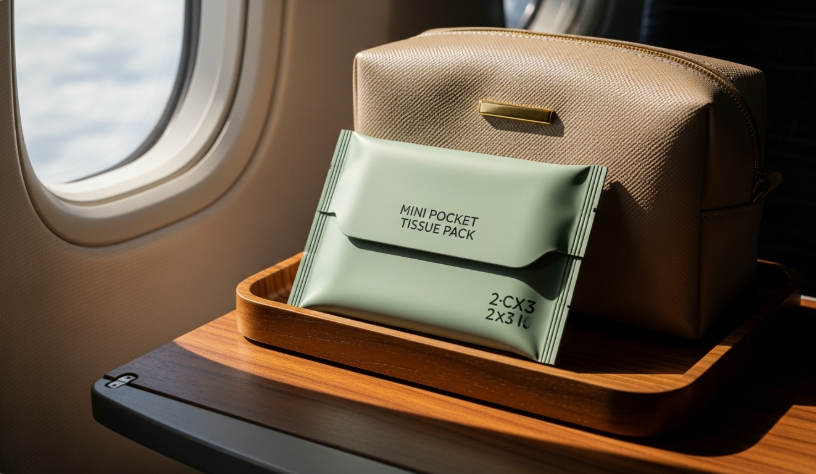
Standard vs Mini Wallet Packs: Dimensions and Sheet Counts Explained
Standard wallet packs use 2.5″ x 3.5″ inserts (7:5) and prioritize capacity and multi-item organization; mini wallet packs use 2″ x 3″ inserts (3:2) and prioritize a slim, front-pocket profile with vertical stacking and a modest sheet supply. Physical sheet capacity depends on pocket volume, internal layout and paper ply/GSM choices.
Core differences: format, insert sizes and aspect ratios
Standard Wallet Pack formats center on 2.5″ x 3.5″ inserts (7:5 aspect ratio). Designers allocate larger pocket openings and wider internal bays so users can store multiple cards, folded bills and several printed inserts without excessive tightness.
Mini Wallet Pack formats use 2″ x 3″ inserts (3:2 aspect ratio) sized for credit-card–style carry. The reduced footprint forces tighter tolerances for insert edge clearance and stitching or bonding placement to preserve usability while keeping the exterior slim.
Capacity trade-offs are explicit: standard formats aim for higher capacity ranges (commonly 4–12+ cards and multiple document slots), while mini formats focus on minimal bulk (typically 4–8 cards) achieved through stacked, vertical pocket geometry.
Dimensions, capacity and pack-thickness considerations
Key dimensional references: standard inserts at 2.5″ x 3.5″; mini inserts at 2″ x 3″. Typical mini pack outer footprints stay at or below roughly 4.5″ x 3″ with overall thickness targets around 1–2 cm to fit front-pocket constraints.
Card counts and stacking strategy directly affect thickness. Standard packs accommodate bifold or trifold layouts and wider card ranges by distributing volume across multiple pockets, while mini packs use vertical stacking and tight pocket spacing to keep thickness low for essential carry.
Sheet-count impact ties to pocket volume and paper specification: increasing pocket depth or internal volume raises the possible sheet count, while higher ply or GSM increases pack thickness per sheet. Engineers balance insert layout, pocket geometry and material GSM to meet target sheet capacity without exceeding thickness limits.
Use cases, product examples and target markets
Standard wallet packs suit daily carry, travel organization and cosmetic kits where capacity and multi-item organization matter. They work well for bifold/trifold wallets that accept 2.5″ x 3.5″ inserts and multiple document pockets.
Mini wallet packs target minimalist carry, front-pocket users and tight clothing use-cases that prioritize low profile and convenience. Typical implementations include 2″ x 3″ insert stacks, a cash clip or a slim card window for quick access.
Typical main products map to the format: 2.5″ x 3.5″ multi-card layouts for standard packs and 2″ x 3″ compact card stacks and cash-clip combos for mini packs. Product decisions should weigh user ergonomics, desired sheet counts and material choices against the acceptable external footprint.
Top Source Hygiene — Global OEM/ODM Toilet Paper Manufacturer
High-Speed Automatic Packaging: How Top Factories Drive Down Unit Costs
High-speed end-of-line automation cuts per-unit cost by removing manual steps, tightening material usage, and increasing uptime. Key gains come from predictable throughput at case sealing, consistent pallet wrapping, fast robotic palletizing, accurate high-speed bagging, and inline vision that reduces scrap and shortens problem diagnosis time.
How high-speed automation lowers per-unit costs
Replace manual tasks to cut labor cost and human error. Automated case sealers standardize case forming and taping, which reduces stoppages and can double or triple throughput versus manual lines, so labor spend per unit falls and operator variability is removed.
Reduce material waste and transit damage by using stretch wrappers and precise bagging equipment that maintain package integrity and steady line speed. Controlled film application and accurate bag seals cut material usage and lower rework or damage claims during shipping.
Boost yield and avoid recalls with inline vision systems that inspect products in real time. Early detection of defects reduces downstream sorting, keeps good product flowing, and limits the volume of removed inventory, improving effective yield.
Raise overall equipment effectiveness. Shorter cycle times and the ability to run continuously mean more units per shift at lower marginal cost, so fixed overhead spreads over higher output and cost-per-unit decreases.
Key machines on a high-speed packaging line and what each delivers
Automated case sealers provide precision and consistency in case sealing. They remove a common end-of-line bottleneck by delivering steady, predictable throughput and reducing stoppages caused by inconsistent manual taping.
Stretch wrappers deliver continuous, consistent pallet wrapping. They minimize film use through controlled pre-stretch and patterning, improving load stability and enabling faster, safer downstream handling and shipping.
Palletizers—typically robotic—stack thousands of items per hour and enable continuous operation during peak demand. By automating stacking, they free operators for value-added tasks and integrate with monitoring systems for predictive maintenance.
High-speed bagging machines handle hundreds to thousands of bags per hour with precise weighing and sealing. Integrated sensors and digital controls cut material waste and human error, producing uniform packs that lower returns and transport damage.
Inline vision systems perform automated quality inspection and feed structured data to analytics. They speed production by 25–60% through fewer manual checks and enable predictive models that reduce defect recurrence.
Operational metrics and integration steps to capture ROI
Target runtime efficiency gains: automated palletizers and end-of-line systems can lift runtime to roughly 97% versus about 74% for manual lines. Improving runtime directly lowers fixed-cost allocation per unit.
Track concrete KPIs: throughput (units/hour), downtime, scrap/waste rates, defect rates, and labor hours per thousand units. Use these metrics to quantify improvements and validate ROI for each equipment class.
Use real-time sensors and predictive maintenance to reduce unplanned stops and extend mean time between failures. Condition-based alerts and scheduled part swaps shift maintenance from reactive to planned, cutting downtime and spare-part cost spikes.
Design line flow so equipment matches capacity. Balance case sealers, baggers, palletizers, and stretch wrappers to avoid creating new bottlenecks when scaling up. Model takt time, verify changeover times, and stage buffer zones to preserve continuous flow as throughput increases.

Private Labeling Travel Packs for Cosmetic and Convenience Store Brands.
Private-label travel packs let cosmetic brands and convenience retailers offer compact, on-the-go SKUs that drive trial and impulse purchases. Expect clear regulatory labeling, durable packaging for humidity and handling, and OEM/ODM partners that support material and artwork customization, standard MOQs, sample programs, and 2–4 week lead times from production to shipped containers.
Branding and commercial benefits for cosmetics and convenience retailers
Private-label travel packs increase shelf visibility in checkout and grab-and-go displays and function as low-risk trial SKUs for cosmetic brands. In convenience channels they act as impulse items; in beauty they work as trial or sample formats that can convert repeat purchases.
Real-world results matter: Top Source Hygiene reports custom-branded amenities led to a 20% rise in guest satisfaction for a hotel client and a 30% uplift in sales for an FSC-certified facial tissue retail client. Use these outcomes when modelling expected ROI: label recognition and repeat purchase probabilities often scale with distribution points and visibility at point of sale.
Design choices—material grade, pack format, GSM and ply count, and packaging artwork—let brands position products across price tiers. Select materials and messaging that match channel expectations: premium cosmetics favor 100% virgin pulp or FSC-certified fiber and refined artwork; convenience stores often prioritize cost-per-unit and durability.
Labeling, packaging and regulatory checklist for travel-size cosmetic packs
Mandatory label elements for cosmetic travel packs include product name, full ingredient list using INCI nomenclature, net content (weight or volume), manufacturer or importer contact details, batch or lot number, manufacturing/expiry dates where applicable, and any required warnings or usage instructions. Keep ingredient lists legible at the chosen font size and ensure contrast for readability.
Packaging durability is critical: labels and wrappers must resist humidity, friction, and temperature swings encountered in transit and on-shelf handling. For liquid or semi-solid categories, incorporate tamper-evident seals or tamper-resistant closures. Validate label adhesion on film, paper, and laminated substrates through humidity and abrasion testing.
Follow region-specific rules: FDA requirements apply in North America for cosmetics and labeling; the EU Cosmetics Regulation (EC) No 1223/2009 governs European markets. Work with manufacturers that document compliance; Top Source Hygiene reports manufacturing to FDA and other international standards, which helps streamline cross-border distribution.
Manufacturing, MOQs, lead times and logistics with OEM/ODM partners
Factory profile and capacity affect scalability. Top Source Hygiene operates two modern factories in Mancheng, Baoding, with a combined monthly capacity of about 2,860 tons. Confirm factory throughput, line automation, and spare capacity before signing annual forecasts.
Customization scope typically includes raw material selection (100% virgin wood pulp and FSC-certified options), dimensions, GSM and ply counts, printed or plain wrappers, and bespoke secondary packaging. Request pre-production samples and material certificates (e.g., FSC chain-of-custody) when sustainability claims are part of your positioning.
Order terms and samples: a common MOQ is one 40’HQ container, though many suppliers offer flexibility for smaller initial runs in targeted regions. Stock samples usually ship within 2–3 days; custom samples take about 10 days after artwork and spec approval. Typical production lead time for a 40’HQ is 15–25 days.
Estimate sea transit times and plan inventory buffers: North America and Europe roughly 7–14 days; Asia/Oceania 10–20 days; Africa and South America 15–25 days, depending on port routing. Quality systems and payment: suppliers commonly hold ISO 9001, FDA audits, and optional FSC certificates. Standard payment terms are a 30% deposit with 70% balance by T/T or L/C at shipment.

Frequently Asked Questions
Who manufactures pocket facial tissues?
Multiple global and regional brands make pocket facial tissues. Notable names include Kleenex, New World, U.S. Cotton, C&S Paper and West Trading. Several Chinese manufacturers also supply pocket packs, for example Bobo Tissue and Boda Paper.
Where can I buy travel-size tissue paper wholesale?
Wholesale sources range from promotional suppliers to factory channels. Examples from the research: Nashville Wraps (bulk gift/packaging tissue), Alibaba factory suppliers (bulk pocket tissue lots, typical MOQ ~1,000, pricing around $0.04–$0.06 per pack), All Travel Sizes (recloseable pocket packs), AnyPromo (branded/promo pocket packs around $0.62 each with logo options), and Paper Mart (various tissue types for retail packaging).
What are typical dimensions for mini facial tissue packs?
Mini pocket packs commonly measure about 2.6 x 1.93 inches. That size is typical for small travel packs holding about six 4-ply sheets, designed for pockets or small purses.
Can I get custom printed pocket tissue wrappers, and what are typical costs and specs?
Yes. Custom printed wrappers are widely available with options for logo, full-color artwork and tailored imprint sizes. Typical specs include 4-color process printing and imprint areas near 3.5″ x 2.375″. Pricing and minimums vary: factory channels on Alibaba can offer roughly $0.06–$0.08 per unit at higher MOQs, mid-tier promo suppliers range about $0.27–$0.62 per unit, and minimums commonly start around 250 units. Production lead times usually run from five business days up to two or three weeks after art approval; some suppliers charge small setup fees for low-quantity jobs.
Which OEM factories are recommended for wallet tissues?
Research highlights several OEMs that specialize in wallet/wallet-style tissues: Telling Paper (OEM printing with factory prices and quick quotes), Foshan Ulive Paper Industry Co., Ltd (China-based, focused on customized wallet facial tissues), and Nanyang Gifts (offers logo printing across multiple pages, used for events and promotions). These vendors emphasize custom printing and bulk supply for promotional and retail channels.
Final Thoughts
Pocket facial tissues offer a clear growth opportunity for travel brands and convenience retailers. Choose manufacturers that match your scale and specs: look for flexible MOQs for pilot runs, typical 15–25 day production lead times for full containers, and documented certifications such as ISO 9001, FDA audit reports and FSC chain-of-custody when sustainability claims matter. Request pre-production samples, humidity and abrasion tests for wrappers, and on-line quality data or vision-inspection records; prefer partners with high-speed packaging lines if you need tight unit costs and fast replenishment. Match format choice—standard or mini—to customer carry habits and shelf placement so you balance sheet count, pack thickness and perceived value.
Treat pocket packs as strategic small-format SKUs: give them dedicated facings at checkout, promote travel multi-packs, and develop private-label travel SKUs to capture margin and build recognition. Plan inventory with sea transit and buffer stock in mind, monitor sell-through, defect rates and reorder points, and run short test assortments before scaling orders. With the right supplier, packaging specification and merchandising mix, compact tissues can become a dependable impulse-revenue line for travel retail and convenience channels.