
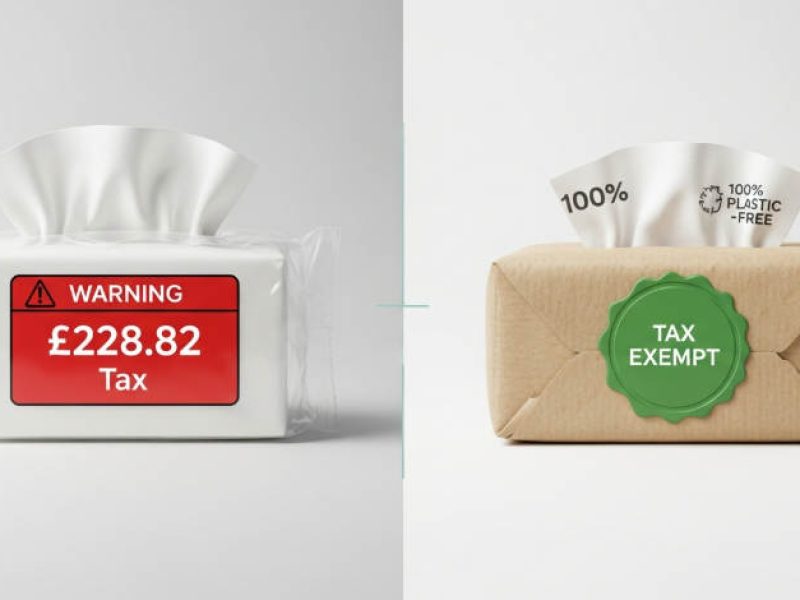
UK procurement teams face a complex landscape in 2026 as strict environmental mandates and volatile energy costs redefine the tissue market. Sourcing sustainable products has evolved into a legal necessity, especially with the UK Plastic Packaging Tax reaching £228.82 per tonne for materials with low recycled content. Managing these overheads while maintaining a reliable supply chain requires a strategic balance between domestic circularity and high-volume global sourcing.
We examine the top 10 facial tissue suppliers serving the UK, evaluating their capacity to meet plastic-free requirements and FSC standards. This report breaks down the trade-offs between local facilities—such as Essity’s Prudhoe site which processes over 100,000 metric tons of recovered paper—and factory-direct OEM models that offer price stability. You will find a detailed analysis of lead times, post-Brexit logistics compliance, and the economic benefits of switching to alternative fibers like bamboo and agricultural waste.
The 2026 Power List: Top 10 Facial Tissue Suppliers in the United Kingdom
Quick Comparison: Top Picks
| Manufacturer | Location | Core Strength | Verdict |
|---|---|---|---|
| Top Source Hygiene | China (Global Shipping) | Sustainable Facial Tissues, Bamboo/Virgin Wood Pulp | Best for high-volume OEM/ODM customization and factory-direct sustainable solutions. |
| Northwood Group (Northwood Consuma Tissue) | United Kingdom | Facial tissues, kitchen towels, toilet tissue | A vital domestic partner for UK retail and commercial sectors with local manufacturing. |
| WEPA Group | UK & Germany | Eco-friendly facial tissues, recycled hygiene products | Leading European competitor specializing in high-quality recycled material technology. |
| Essity AB | Sweden / UK Operations | Facial tissues, professional hygiene papers | A global innovation leader offering an extensive and highly sustainable product portfolio. |
| Kimberly-Clark Corporation | USA / Global | Kleenex facial tissues, premium 2-ply and 3-ply | The industry gold standard for brand trust and superior, high-absorbency softness. |
| Procter & Gamble Company | USA / Global | Facial tissues (Puffs), consumer paper goods | Unmatched distribution and availability for consistent high-volume consumer needs. |
| Georgia-Pacific LLC | USA / Europe | Facial tissues, commercial paper solutions | Reliable supply chain partner focused on high-performance commercial-grade contracts. |
| Sofidel S.p.A. | Italy / Europe | Facial tissues, eco-friendly paper products | Top choice for European manufacturing standards with a strong focus on sustainability. |
| Metsä Tissue Corporation | Finland / Europe | Facial tissues, premium hygiene paper | Utilizes premium northern wood pulp and advanced sustainable forestry practices. |
| Cascades Inc. | Canada / Global | Eco-friendly facial tissues, recycled paper | A pioneering firm in recycled manufacturing with strong green credentials for retail. |
Top Source Hygiene
Top Source Hygiene operates as a large-scale manufacturer specializing in high-capacity paper production for global retail brands. They provide UK businesses with access to factory-direct tissue solutions that prioritize sustainability and plastic-free packaging. By utilizing FSC-certified materials, the company caters to a growing market demand for environmentally responsible household products while maintaining the scale necessary for high-volume orders.
Their facility in Mancheng leverages thirty years of manufacturing experience to manage complex OEM and ODM requirements. We see a strong emphasis on quality control through adherence to ISO 9001 and FDA standards, which reduces the risks typically associated with international sourcing. They oversee the entire production cycle from raw pulp selection to final branding, ensuring that the finished goods meet the specific softness and durability benchmarks required by European and North American consumers.
At a Glance:
- 📍 Location: Mancheng, Baoding, China (Global Shipping)
- 🏭 Core Strength: Sustainable Facial Tissues, Bamboo/Virgin Wood Pulp Toilet Paper, Kitchen Towels
- 🌍 Key Markets: UK, North America, Europe, Oceania
Why We Picked Them:
| ✅ The Wins | ⚠️ Trade-offs |
|---|---|
|
|
Northwood Group (Northwood Consuma Tissue)
Northwood Group operates as a primary manufacturer within the United Kingdom, recently strengthening its market position through the acquisition of Consuma Paper Products. This expansion allows the organization to manage the full production cycle for essential paper goods like facial tissues and kitchen towels. By focusing on local facilities, the group provides UK retailers with a stable supply chain that removes the logistics risks and delays typical of international sourcing.
The company maintains direct control over its factory operations and distribution networks to ensure consistent quality across its domestic catalog. This vertical integration allows for precise inventory management and reliable delivery schedules, which are necessary for high-volume commercial needs. Partners benefit from a supplier that offers rapid domestic fulfillment while supporting the local economy and reducing the overall complexity of paper product procurement.
At a Glance:
- 📍 Location: United Kingdom
- 🏭 Core Strength: Facial tissues, kitchen towels, toilet tissue
- 🌍 Key Markets: UK retail and commercial
Why We Picked Them:
| ✅ The Wins | ⚠️ Trade-offs |
|---|---|
|
|
WEPA Group
WEPA Group stands as a significant force in the European hygiene market, primarily known for its commitment to sustainable manufacturing. The company uses recycled fibers to create high-quality facial tissues and hygiene products, directly addressing the environmental concerns of modern consumers. This focus on circular economy principles ensures that retailers and distributors can offer products that align with green procurement policies while maintaining high performance.
Operations center on a robust network of factories across Germany and the UK, where WEPA continues to expand its physical footprint. This strategy emphasizes local production to ensure supply chain stability and high-level factory control. By producing goods within the markets they serve, the group minimizes logistics risks and provides a more agile response to shifting demand in the UK and European hygiene sectors.
At a Glance:
- 📍 Location: UK & Germany
- 🏭 Core Strength: Eco-friendly facial tissues, recycled hygiene products
- 🌍 Key Markets: UK and European hygiene markets
Why We Picked Them:
| ✅ The Wins | ⚠️ Trade-offs |
|---|---|
|
|
Essity AB
Essity AB maintains a dominant presence across the European hygiene landscape through its robust manufacturing network in Sweden and the United Kingdom. This extensive footprint allows for precise factory control, ensuring that all tissue products meet rigorous quality standards before reaching retail shelves. By managing regional operations closely, the company provides partners with reliable local execution and a stable supply chain that minimizes logistical delays.
The company prioritizes innovation and sustainable development within its facial tissue and professional paper segments. This commitment to modern production methods contributes to significant risk reduction for retailers, as Essity consistently aligns with shifting environmental regulations and consumer expectations. Their position as a top regional player stems from this ability to deliver high-performance solutions while maintaining a responsible and secure manufacturing process across all core markets.
At a Glance:
- 📍 Location: Sweden (HQ) / UK Operations
- 🏭 Core Strength: Facial tissues, professional hygiene papers
- 🌍 Key Markets: UK and European retail
Why We Picked Them:
| ✅ The Wins | ⚠️ Trade-offs |
|---|---|
|
|
Kimberly-Clark Corporation
Kimberly-Clark manages the entire production cycle of its Kleenex brand to ensure every facial tissue meets strict quality standards. By maintaining direct oversight of their manufacturing facilities, they control the fiber selection and ply-bonding processes that create their signature soft yet durable texture. This hands-on factory control allows them to implement eco-friendly practices across their global supply chain, meeting the high expectations of UK retail partners who prioritize sustainable sourcing.
Retailers in the UK rely on Kimberly-Clark’s consistent product innovation to reduce the risks associated with shelf availability and consumer dissatisfaction. Their established logistics network ensures that premium 2-ply and 3-ply tissues remain stocked across major outlets, while their focus on hygiene standards provides a layer of trust that generic brands often lack. By focusing on constant improvement in material science, they provide a reliable supply of premium paper products that maintain a dominant position in the global hygiene market.
At a Glance:
- 📍 Location: USA (HQ) / Global
- 🏭 Core Strength: Kleenex facial tissues, premium 2-ply and 3-ply tissues
- 🌍 Key Markets: UK and Global retail
Why We Picked Them:
| ✅ The Wins | ⚠️ Trade-offs |
|---|---|
|
|
Procter & Gamble Company
P&G operates as a powerhouse in the facial tissue sector, utilizing well-known brands like Puffs to maintain a commanding presence across the UK. The company focuses heavily on consumer hygiene needs, ensuring every product meets rigorous standards before it enters the retail or commercial supply chain. This commitment to quality helped them capture a massive portion of the market, as shoppers and businesses alike trust their long-standing reputation for reliability and performance.
Their success stems from a highly efficient distribution network that provides unmatched product availability in various regions. By managing large-scale operations with factory-level precision, they reduce the risk of stockouts and maintain consistent quality across millions of units. While they excel in mass-market delivery, their primary strength lies in providing a stable, high-volume supply that serves the foundational needs of the UK paper goods market.
At a Glance:
- 📍 Location: USA (HQ) / Global
- 🏭 Core Strength: Facial tissues (Puffs), consumer paper goods
- 🌍 Key Markets: UK retail and commercial
Why We Picked Them:
| ✅ The Wins | ⚠️ Trade-offs |
|---|---|
|
|
Georgia-Pacific LLC
Georgia-Pacific LLC operates as a major force in the global hygiene and paper products industry, particularly known for its extensive facial tissue manufacturing. The company serves professional and commercial sectors that require consistent, high-volume supply chains across the UK and European markets. Its presence ensures that large-scale distributors and facilities managers have access to tissue products that meet strict hygiene standards and specific performance metrics required for diverse professional settings.
The organization maintains a sophisticated logistics network that bridges its North American origins with a strong European operational base. This setup allows for tighter factory control and streamlined distribution, reducing the risks typically associated with international sourcing in the paper industry. By focusing on commercial-grade solutions, the brand provides reliable inventory management for high-traffic environments where quality and supply stability remain the top priorities.
At a Glance:
- 📍 Location: USA (HQ) / Europe
- 🏭 Core Strength: Facial tissues, commercial paper solutions
- 🌍 Key Markets: UK and North American markets
Why We Picked Them:
| ✅ The Wins | ⚠️ Trade-offs |
|---|---|
|
|
Sofidel S.p.A.
Sofidel S.p.A. stands as a major player in the European tissue market, operating out of its headquarters in Italy to serve retail sectors across the UK and the continent. The company focuses on large-scale production of facial tissues and paper products, positioning itself as a primary supplier for retailers who prioritize ethical sourcing. By maintaining a strong presence in the European supply chain, the group ensures that its partners receive products manufactured under strict regional regulations and quality benchmarks.
The organization manages the entire production cycle through its own facilities, which allows for direct oversight and consistent quality control. This factory-led approach reduces the risks associated with third-party sourcing and ensures that eco-friendly standards remain high throughout the manufacturing process. Because the company maintains tight control over local execution and logistics within Europe, it offers reliable lead times and specialized product lines for the growing demand in sustainable household paper goods.
At a Glance:
- 📍 Location: Italy (HQ) / Europe
- 🏭 Core Strength: Facial tissues, eco-friendly paper products
- 🌍 Key Markets: UK and European retail
Why We Picked Them:
| ✅ The Wins | ⚠️ Trade-offs |
|---|---|
|
|
Metsä Tissue Corporation
Metsä Tissue Corporation operates as a primary producer in the European hygiene sector, focusing on the manufacturing of high-grade facial tissues and paper products. By utilizing their direct access to northern wood pulp, the company maintains strict oversight over its entire supply chain. This vertical integration ensures that every product meets rigorous quality benchmarks. UK buyers looking for premium alternatives to standard retail options often turn to Metsä because of their reputation for consistency and their ability to scale production according to market demands.
The company emphasizes sustainable forestry practices, which serves as a core part of its operational model. They manage the transformation from raw timber to finished tissue products within their own facilities, reducing risks associated with third-party sourcing. For UK-based distributors and retailers, this means receiving a product that aligns with modern environmental standards without sacrificing texture or strength. While the logistics involve transport from Northern Europe, the reliability of their manufacturing process provides a stable supply for businesses focused on long-term growth in the hygiene sector.
At a Glance:
- 📍 Location: Finland (HQ) / Europe
- 🏭 Core Strength: Facial tissues, premium hygiene paper
- 🌍 Key Markets: UK and European hygiene
Why We Picked Them:
| ✅ The Wins | ⚠️ Trade-offs |
|---|---|
|
|
Cascades Inc.
Cascades Inc. operates as a major Canadian player in the sustainable paper industry, successfully scaling its footprint across European territories like the UK. The firm specializes in converting recycled materials into high-quality facial tissues and paper goods to serve businesses that prioritize environmental responsibility. By maintaining strict control over manufacturing processes, the company ensures that every product meets rigorous green standards while providing reliable supply chain solutions for the commercial sector.
The organization builds trust through a proven track record in recycled tissue manufacturing, which reduces the risks often associated with sourcing eco-friendly alternatives. These operations bridge the gap between industrial-scale production and sustainable practice, allowing retail and commercial partners to meet ESG goals without compromising on quality. This focus on factory-level expertise maintains consistent output across their global network, supporting large-scale procurement needs in the UK market.
At a Glance:
- 📍 Location: Canada (HQ) / Global
- 🏭 Core Strength: Eco-friendly facial tissues, recycled paper
- 🌍 Key Markets: UK commercial and retail
Why We Picked Them:
| ✅ The Wins | ⚠️ Trade-offs |
|---|---|
|
|
UK Supply Chain Shifts: The Rising Cost of Local Production vs. Global Strategic Sourcing
UK tissue procurement involves a strategic choice between high-investment domestic recycling infrastructure and cost-effective international OEM sourcing. While local mills prioritize circularity and short lead times through facilities like Essity’s Prudhoe site, global partners offer the scale and price stability needed to mitigate rising UK energy and labor expenses.
Domestic Production and 2026 Infrastructure Upgrades
Essity completed a £36 million upgrade at its Prudhoe facility in 2026. This site now processes more than 100,000 metric tons of recovered paper every year, significantly increasing the capacity for circular manufacturing within the UK and reducing reliance on virgin pulp imports.
Local manufacturers like Fourstones utilize British recycled paper to provide FSC-certified facial tissues. These domestic operations focus on maintaining low lead times and consistent stock levels to support regional supply chain reliability for the away-from-home and retail sectors.
Progress Packaging serves the retail and hospitality markets by producing 17gsm high-quality white tissue sheets. Their facility uses flexo-print options to provide customized branding solutions, catering to the growing demand for premium unboxing experiences in the UK.
International OEM Models and Price Competition
Top Source Hygiene leverages a factory-direct model to supply UK wholesalers. By removing intermediary costs, the company maintains price stability for buyers facing volatile economic conditions and high domestic overheads.
Global suppliers provide a massive production capacity of 2,860 tons per month. This scale allows large-scale UK buyers to secure volumes that domestic mills may struggle to support during peak demand periods or during periods of local fiber scarcity.
Distributors like Tantum Trade and PG Paper supply imported disposable tissues to the UK market. These imports help businesses manage the increasing financial pressure of domestic energy and labor costs by providing competitive alternatives to locally produced goods.
Lead Times and Material Sourcing Strategies
Logistics play a major role in procurement decisions. UK mills generally offer four-week lead times for standard orders. Global shipping from manufacturing hubs in China typically requires between 15 and 25 days for transit, making offshore sourcing viable for well-planned inventory cycles.
Companies like envoPAP source agricultural waste instead of virgin wood fibers. This approach provides plastic-free paper products that meet strict UK environmental mandates and appeal to sustainability-focused brands looking to reduce their carbon footprint.
B2B buyers balance the immediate availability of local recycled paper against the scalability and custom branding options provided by international OEM partners. This dual-sourcing strategy helps mitigate risks associated with domestic supply constraints while keeping unit costs manageable.

The Green Mandate: Why Plastic-Free Packaging is Non-Negotiable for UK B2B Buyers
The transition to plastic-free packaging in the UK has shifted from a corporate preference to a legal necessity. With the full enforcement of Extended Producer Responsibility (EPR) and the Plastic Packaging Tax, businesses face escalating financial penalties for non-recyclable materials, making paper-based and high-PCR solutions the only viable long-term strategy for bulk procurement.
UK Packaging Regulations: EPR Mandates and Eco-Modulated Fees
Extended Producer Responsibility (EPR) shifts the financial burden of waste management directly onto producers and importers. By 2026, the UK will fully enforce eco-modulated fee structures, which charge higher rates for packaging materials that are difficult to recycle. Multilayered films and certain black plastics used in traditional tissue wrapping will attract the highest fees, while paper-based alternatives receive financial incentives for their ease of processing.
New Simpler Recycling rules complement these mandates by requiring businesses and local authorities to standardize separate collections for paper and card. This standardization maintains high material purity, ensuring that the paper wraps used in bulk tissue delivery remain within a high-value circular economy. B2B buyers who adopt these materials now avoid the logistical friction of managing mixed, hard-to-recycle waste streams.
Economic Consequences of Plastic Packaging Taxes for Bulk Buyers
The UK Plastic Packaging Tax penalizes any packaging containing less than 30% recycled content, adding a significant per-tonne cost to imported and domestic goods. For bulk buyers of tissue products, this tax drives up the landed cost of traditional plastic-wrapped rolls. Financial incentives favor brands that utilize 100% plastic-free paper wraps or post-consumer recycled (PCR) materials, as these products bypass the regulatory surcharges entirely.
Procurement teams are also facing increased administrative pressure. Under 2026 waste laws, companies must provide detailed packaging data to satisfy mandatory reporting requirements. Suppliers who offer plastic-free, paper-based packaging simplify this compliance process, providing the transparency needed for B2B buyers to report their environmental impact accurately without the risk of HMRC audits or penalties.
Sustainable Sourcing Strategies: FSC Standards and PFAS-Free Materials
FSC certification remains a cornerstone of green procurement in the UK. This standard ensures that wood pulp originates from responsibly managed forests, a requirement often specified by major retail and hospitality groups. By sourcing FSC-certified products, businesses align with domestic environmental benchmarks and secure their place in the supply chains of organizations that prioritize ethical land use and biodiversity.
Beyond fiber origin, the elimination of “forever chemicals” is a growing priority. Tightening restrictions on PFAS in packaging influence sourcing decisions for hygiene and food-safe products as we approach 2026. Adopting 100% virgin wood pulp products that eliminate fluorescent whiteners and chemical coatings ensures compliance with these health safety standards. These products offer a dual advantage: they meet rigorous sustainability targets while providing the high-performance softness and strength expected by professional end-users.
Build Your Unique Toilet Paper Brand with Our Global OEM Expertise

Profit Optimization: Comparing UK Local Wholesale vs. Direct Factory OEM Advantages
UK buyers optimize profits by balancing the rapid turnaround of local wholesalers with the high-margin scalability of direct factory OEM models. While local production offers agility for the private label sector—which holds 65% of domestic market volume—direct sourcing from facilities like Top Source Hygiene reduces intermediary costs and provides pricing as low as $0.95 per kilogram for high-volume commercial contracts.
Agility and Branding Focus in the UK Wholesale Market
UK wholesalers specialize in rapid fulfillment and 24/7 support structures, catering specifically to the fast-moving retail and e-commerce sectors. These providers prioritize flexibility, allowing brands to capitalize on the private label surge that now accounts for 65% of domestic tissue volume. By leveraging a diverse range of materials, from 17gsm high-quality white sheets to 100% recycled British paper from mills like Fourstones, local suppliers enable businesses to create distinctive unboxing experiences without the long lead times associated with international imports.
Local wholesale models effectively utilize a mix of virgin and recycled pulp to serve specialized gift wrapping and subcontract packing niches. This proximity to the market allows for lead times as short as 1-3 days for custom orders, a critical advantage for businesses managing seasonal demand spikes. Facilities like the Prudhoe site, which processes over 100,000 metric tons of recovered paper, highlight the domestic capability to support circular economy goals while maintaining stock availability for immediate distribution.
High-Volume Margin Gains via Direct Global OEM Models
Sourcing directly from global manufacturing facilities removes the intermediary markup, offering facial tissue pulp at competitive rates between $0.95 and $1.5 per kilogram. These factory-direct partnerships provide the supply chain stability required for high-traffic commercial venues, backed by monthly capacities exceeding 2,800 tons. Procurement teams gain granular control over product specifications, including ply count, GSM weight, and custom packaging, ensuring that supplies meet the rigorous standards of the hospitality and healthcare sectors while maximizing bottom-line margins.
Large-scale manufacturers provide the volume necessary to stabilize supply chains for the 2026 market, where commercial demand is expected to remain high. By working directly with factories, UK buyers bypass the friction of domestic stockouts and gain access to advanced production technology. This model is particularly effective for organizations that can manage container-sized shipments, as it significantly lowers the cost-per-unit compared to local wholesale purchases.
Eco-Innovation and Compliance in Material Selection
The transition toward sustainable materials like FSC-certified bamboo and plastic-free packaging is increasingly managed through direct OEM channels. Global manufacturers maintain strict adherence to ISO 9001 and FDA standards, verifying that products remain safe for food-contact applications in kitchens and clinics. By evaluating the performance of local recycled pulp against the sustainability profile of international bamboo options, UK buyers can align their procurement strategies with upcoming regulatory shifts, such as the Plastic Packaging Tax and Extended Producer Responsibility (EPR) requirements.
Direct sourcing facilitates a move toward plastic-free alternatives, championed by brands like Naked Paper that focus on reducing environmental impact. International facilities are often better equipped to process alternative fibers like agricultural waste or bamboo, which offer superior strength and antibacterial properties compared to standard recycled paper. This helps UK procurement managers balance carbon footprint targets with rigorous budget constraints, ensuring compliance with evolving eco-modulated fee structures entering enforcement in late 2025.
Post-Brexit Logistics: Ensuring Compliance and Avoiding Tariffs for Large-Scale Tissue Imports
Successful large-scale tissue importation after Brexit depends on strict adherence to the UK-EU Trade and Cooperation Agreement (TCA). Importers must verify that their products meet specific Rules of Origin (RoO) thresholds to maintain zero-tariff status, as failure to document local content correctly results in immediate 10% tariffs. Managing electronic customs declarations and identifying precise commodity codes for jumbo rolls and facial tissues are essential steps to avoid port delays and unexpected duty costs.
Compliance Strategies for the UK-EU Trade and Cooperation Agreement
Maintaining zero-tariff trade status requires importers to strictly follow the Rules of Origin (RoO) standards established under the post-Brexit trade framework. Businesses face a significant financial risk in 2026, where goods that fail to meet sufficient UK or EU content thresholds will trigger a 10% tariff. Beyond duty rates, the logistical burden has shifted toward digital compliance. Importers must manage mandatory electronic customs declarations and comprehensive paperwork to ensure that high-volume shipments do not face prolonged supply chain delays at UK ports.
Rules of Origin and Tariff-Rate Quota Management
Importers must carefully monitor non-EU content thresholds, particularly for tissue products manufactured using raw materials sourced from China or India. Exceeding these limits often results in the application of full Most Favoured Nation (MFN) tariffs plus additional friction costs. To mitigate these expenses, logistics managers should use the UK tariff look-up tool to track volume-limited Tariff-Rate Quotas (TRQ) for large-scale shipments. Precise classification is also required; assigning the correct commodity codes to facial tissues and jumbo rolls ensures accurate duty calculations and minimizes the risk of compliance audits.
Operational Efficiency and Strategic Sourcing Solutions
Strategic sourcing from EU or UK suppliers offers a clear path to bypassing origin-related friction, often reducing duties to a range of 3.5% to 4.5% when applicable. Partnering with experienced OEM manufacturers, such as Top Source Hygiene, provides a competitive advantage because they deliver the rigorous documentation needed for global shipping and hygiene standards. On the financial side, companies should optimize their logistics chains to handle VAT revenue adjustments based on CIF (Cost, Insurance, and Freight) values, which is a standard requirement for large-scale B2B imports entering the UK market.
Frequently Asked Questions
Who are the leading tissue manufacturers operating in the UK as of 2026?
Metsä Tissue and Essity represent the largest production capacities in the region. Metsä Tissue is currently scaling its Goole facility to reach a 240,000-tonne annual capacity, while Essity remains a primary player after expanding its recycled fiber capacity at the Prudhoe site in April 2026.
Is bamboo facial tissue more sustainable than recycled paper options?
Bamboo provides a superior sustainability profile due to its rapid regrowth and lack of pesticide requirements. While recycled paper reduces energy consumption by up to 70% compared to virgin wood pulp, bamboo avoids the intensive chemical de-inking processes often associated with recycled fibers.
How does the UK Plastic Packaging Tax influence bulk tissue pricing?
The tax rate rose to £228.82 per tonne in April 2026 for any plastic packaging containing less than 30% recycled material. Importers pass these costs to buyers, making plastic-free tissue products or those utilizing compliant recycled wraps more cost-effective for large-scale procurement.
What FSC certifications are necessary for UK retail distribution?
Retailers selling finished, pre-labeled goods usually require an FSC Promotional License to market the products. If the retailer intends to repackage or apply their own branding to the tissue, they must secure a Chain of Custody (CoC) certification to verify material traceability under the updated June 2026 FSC guidelines.
What are the expected lead times for bulk tissue orders from Asian factories?
Standard production and delivery cycles from Asian manufacturers like Top Source Hygiene typically range from 7 to 30 days. For UK buyers, sea freight logistics usually mean a total window of 14 to 25 days, though expedited production can reduce this timeframe for urgent inventory needs.
Final Thoughts
UK procurement teams now manage a landscape where domestic recycling capacity and international cost efficiencies must coexist. Choosing a supplier requires looking beyond unit price to include the hidden costs of plastic taxes and carbon reporting. While local mills provide immediate stock and lower transit emissions, direct global sourcing from partners like Top Source Hygiene offers the price stability needed to navigate the UK’s rising energy costs.
The 2026 regulatory environment makes plastic-free, FSC-certified products the standard for any scalable B2B operation. Businesses that move toward alternative fibers like bamboo or agricultural waste gain a competitive edge by avoiding the financial penalties of the Plastic Packaging Tax. Success in this market depends on securing transparent supply chains that satisfy both the UK’s environmental mandates and the rigorous quality demands of the hospitality and healthcare sectors.