Skip to content
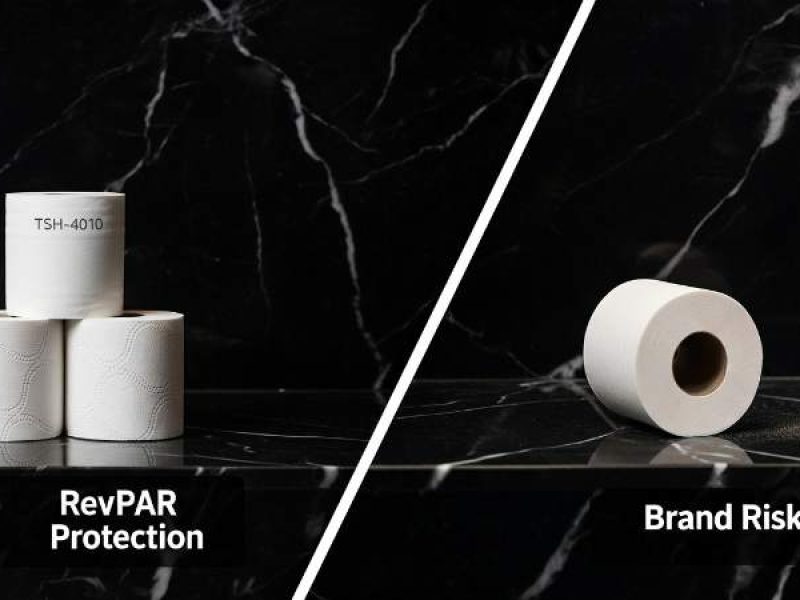
Wrapped vs. Poly-Packed ROI decides whether a packing choice stops cross-contamination in storage and prevents guest-facing quality issues that shave RevPAR, invite contract penalties, and increase housekeeping downtime. Supplies teams face a clear trade-off: pay about a 5% premium for individual wraps to protect brand and guest satisfaction, or accept lower unit cost and risk more complaints, replacements, and lost contract leverage.
This guide functions as a technical SOP for procurement and operations, laying out the precise levers you can pull: the 5% cost-versus-experience breakpoint, the hygiene moat that protects stock, why 4-star hotels prefer paper wraps over plastic film for branding, how automated primary wrapping lowers the labor surcharge, whether poly-bundled naked rolls can meet high-end expectations, and how secondary packaging affects 40HQ freight economics. You’ll get actionable decision rules, simple cost models for negotiations, and the FAQ answers sourcing teams need to align finance, operations, and brand risk.
Is the 5% Cost Premium of Individual Wrapping Worth the Guest Experience? [CORE]
Wrapped vs. Poly-Packed ROI decides whether a packing choice stops cross-contamination in storage and prevents guest-facing quality issues that shave RevPAR, invite contract penalties, and increase housekeeping downtime. Supplies teams face a clear trade-off: pay about a 5% premium for individual wraps to protect brand and guest satisfaction, or accept lower unit cost and risk more complaints, replacements, and lost contract leverage.
The Hygiene Moat: Protecting Stock from Cross-Contamination in Storage
Rigorous environmental and packaging controls cut contamination risk, reduce recalls, and preserve product integrity across 40HQ supply chains.
Storage environment controls: temperature, humidity, airflow and surface protection
Set and hold ambient temperature between 10–25°C and relative humidity at 45–55%; monitor continuously with calibrated data loggers and trigger automated alarms on excursions so staff can intervene before product damage. Keep the dew point below the paper surface temperature to prevent condensation and mold growth; when RH exceeds 55% add desiccant packs to long-term poly-lined bundles to protect coreless and wrapped rolls during extended storage or slow-moving SKUs.
Design airflow to avoid stagnation: target 4–8 air changes per hour in storage zones and filter recirculated air with MERV‑13 or HEPA systems in high-hygiene areas to remove particulate and odor sources. Keep stock at least 150 mm off the floor on pallets, use corner boards and stretch-wrap to protect carton corners and prevent dust ingress, and segregate toilet paper from chemicals, odorous goods, and wet storage with visible marking and a minimum 3 m separation to reduce transfer risk.
- Maintain temp 10–25°C and RH 45–55%; alarm on excursions.
- Keep dew point below paper surface; add desiccants if RH >55%.
- Target 4–8 ACH and use MERV‑13/HEPA in sensitive zones.
- Store stock ≥150 mm off floor; use corner boards and stretch-wrap.
- Segregate from chemicals/odors with clear markings and ≥3 m spacing.
Packaging and barrier strategies: wrap types, carton specs and sealing for contaminant control
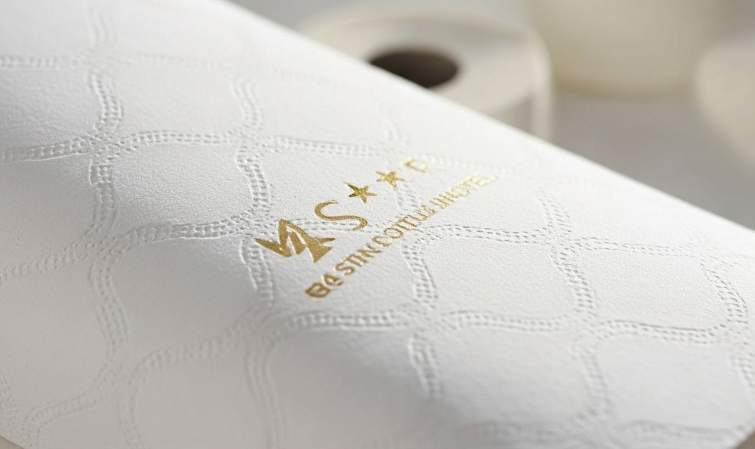
Match packaging format to channel: use Format A (individual wrap plus PE bag) for hospitality and luxury hotel-grade SKUs to deliver single-roll hygiene and branded presentation; use Format B (direct bundle plus master poly) for high-volume retail and warehouse clubs to maximize cube efficiency. Specify food-grade PE film, sealed by heat or ultrasonic methods, and pack into reinforced 5‑ply export cartons to resist crushing during 40HQ stacking and transit.
Apply poly-liners, tamper-evident seals, or shrink-wrap at the bundle and master carton level and verify seal integrity with routine pull tests on production samples. Control material specs strictly — ply density 13–22 g/m² per ply, brightness 85–92%, OBA-free labeling — and enforce batch color consistency checks. Allow space-saving compression only when mechanical settings preserve sheet loft and perforation integrity, and document compression settings per SKU for reproducible logistics performance.
- Format A: Individual wrap + PE bag for hospitality.
- Format B: Direct bundle + master poly for high-volume retail.
- Materials: food-grade PE, heat/ultrasonic seals, reinforced 5-ply export cartons.
- Quality checks: routine pull tests on seals; document compression settings per SKU.
- Specs: 13–22 g/m² per ply; brightness 85–92%; OBA-free labeling; batch color checks.
Handling, traceability and pre-shipment verification: protocols to detect and prevent contamination
Adopt FIFO rotation and enforce clear batch coding (barcode/QR) that links pallet → carton → production batch to enable fast recalls and root-cause analysis. Define required PPE and hygiene steps: require disposable gloves and masks when touching unwrapped product, keep accessible handwashing stations, and run quarterly staff training to keep handling practices consistent and auditable.
Inspect every production pallet visually for soiling, odor, damaged seals, and embossing or perforation defects, and sample 1% of cartons per container for more granular checks. Run technical pre-shipment tests on representative samples — septic-disintegration checks, GSM per ply verification, and brightness measurement against the 85–92% spec — and require photos/videos of finished goods and container loading tied to balance payment terms. Store certificates (ISO 9001, FDA, EU hygiene) and maintain documentation that reflects regulatory status current in 2026 to support compliance and buyer confidence.
- Traceability: barcode/QR linking pallet → carton → batch for recall readiness.
- PPE & training: disposable gloves/masks, handwashing stations, quarterly training.
- Inspection frequency: every production pallet + 1% of cartons per container.
- Technical tests: septic-disintegration, GSM per ply, brightness vs 85–92% spec.
- Pre-shipment: require photos/videos of finished goods and loading; link deliverables to payment terms.
- Records: retain ISO 9001, FDA, EU hygiene certificates and keep regulatory status current for 2026.
OEM Toilet Paper — Custom, Cost-Effective Supply
Why Do 4-Star Hotels Prefer Paper Wraps Over Plastic Film for Branding?
Paper wraps boost guest perception and compliance at modest cost while requiring tighter artwork, embossing specs, and pre-shipment verification.
Printability and tactile branding: paper wrap specs and artwork controls
Use uncoated or lightly coated paper wrap to enable high-quality flexographic printing, hot/cold foil and spot finishes, plus CNC-precision embossing. Point-to-point embossing raises absorbency by roughly 30% and delivers tactile cues that thin PE film cannot reproduce; that tactile difference directly supports a hotel-grade sensory signal at the moment a guest touches the roll.
Confirm roll and press parameters up front: standard wrap widths run 102–132 mm and the core versus coreless layout sets print repeat, registration and wrap length. Provide the supplier with production-ready artwork and quality checks to avoid mis-registration and color shifts on long runs.
- Deliver vector files (AI / EPS / PDF) and specify Pantone references or CMYK profile for process jobs.
- Set minimum type size and clear area around logos; include embossing pattern and logo in the spec sheet.
- Request a pre-production proof and batch-color-consistency checks; require pre-shipment photos and short video of wrapped rolls to verify print quality and registration.
Hygiene and compliance: material safety, disintegration, and guest-room placement
Segment packaging by use-case: Format A (individual wrap, paper or film) for guest-facing hygiene; Format B (direct bundle poly) for back-of-house and value channels. Specify 100% Virgin Wood Pulp, OBA‑free and septic-safe as the core product requirement so the paper meets guest-safety expectations and regional plumbing rules.
Paper wrap communicates single-use hygiene and premium presentation at the point of use, while film gives stronger moisture barrier and longer shelf protection for storage. Deploy paper-wrapped rolls in guest bathrooms and mini-bars and reserve film-wrapped or bulk-packed rolls for housekeeping stock rooms and utility dispensers.
- Include certificate requirements in the PO: ISO 9001, FDA and EU hygiene certificates, OBA-free declaration, and rapid-disintegration (septic) test results.
- Require supplier sign-off on the compliance checklist and withhold final balance payment until you receive photos/videos of finished goods and certificate copies.
Cost, logistics and sustainability: per-roll costing, container impact and pilot testing
Account for packaging as a material line-item: industry ranges show packaging can represent roughly 10–40% of unit cost, and paper wrap usually raises per-roll cost versus basic poly film. Optimize container loading—40HQ payloads typically run 7,000–9,000 kg—by using mechanical compression in bagging to increase rolls per cubic metre while protecting paper fluffiness and sheet integrity.
Set supply terms and test strategy: accept 1 × 40HQ as a trial/private‑label MOQ; expect in-stock dispatch in 10–15 days and production lead time of 20–25 days from Tianjin Xingang Port. Run a pilot shipment to measure guest feedback against the incremental cost and end‑of‑life impacts.
- Per-roll cost check: per-roll delta = (total supplier cost with paper wrap − total supplier cost with film) / number of rolls.
- Percent change = delta / baseline unit cost × 100. Use this to quantify the price premium before deciding on roll specification.
- Request material declaration (paper fiber source, recyclability/compostability), compare end-of-life impacts, and run a controlled trial order to collect guest satisfaction data versus cost increase.
- Protect shipments: require pre-shipment visual verification and pack in reinforced 5-ply export cartons to avoid damage during 40HQ stacking and long-haul transit.
Automated Primary Wrapping: How Modern Factories Lower the Labor Surcharge
Automated primary wrapping reduces per-roll labor surcharge by standardizing formats, raising throughput, and eliminating manual inspection and rework.
Primary wrap formats and material specifications for automation
Design primary wrapping around two production-ready formats: individual roll wrap (paper or plastic film) for hospitality-grade presentation and direct bundle poly-packing for high-volume retail. Match material spec to wrapper type: use 100% Virgin Wood Pulp, OBA-free, with ply options from 2 to 5 and target per-ply GSM between 13 and 22 g/m² to balance softness with wet-strength and rapid disintegration requirements.
Configure roll and wrapper hardware for size and weight variance: standard widths from 102–132 mm and bundle weights from 780 g up to 5,000 g. Support coreless, high-density rolls (for example, 5,000 g/28-roll cores) to eliminate tube handling and speed roll loading. Select film thickness and sealing parameters based on roll diameter and bundle weight to prevent crush while preserving paper fluff.
- Supported formats: Individual roll wrap (paper or film) and direct bundle poly-packing per packaging strategy.
- Material specs: 100% Virgin Wood Pulp, OBA-free; 2–5 ply; 13–22 g/m² per ply.
- Roll dimensions: widths 102–132 mm; bundle weights 780 g–5,000 g; enable coreless 5,000 g/28 roll handling.
- Actionable setup: choose film gauge and sealing time by measuring roll diameter and testing crush at target compression settings.
Throughput, compression and container optimization to lower per-roll labor cost
Use mechanical compression at the primary wrapper to increase cubic utilization and reduce per-roll handling. Target bundle profiles that let loading teams reach 40HQ payloads of roughly 7–9 tons; that payload range minimizes landed cost per meter and spreads fixed labor across more units. Match automated line speed and batch sizes to your MOQ strategy—Top Source Hygiene practices a 1 × 40HQ MOQ—so each packing cycle maximizes container fill rather than producing frequent partial loads that increase handling steps.
Prioritize high-density models for freight efficiency: TSH-3396, TSH-3082, and TSH-3099 deliver more paper per kilogram and lower shipping cost per meter. Calibrate compression pressure and bagging cadence to protect roll geometry while maximizing rolls per cubic meter; run small incremental tests and record roll deformation, then set pressure to the highest value that keeps perforation and emboss patterns intact.
- Cube target: configure bundles to support 40HQ loads of 7–9 tons.
- Line matching: align line speed and batch size to 1 × 40HQ MOQ to lower per-roll handling costs.
- Product selection: favor high-density SKUs (TSH-3396, TSH-3082, TSH-3099) for freight efficiency.
- Tuning checklist: calibrate compression pressure, validate bagging cadence, and document roll-shape tolerance limits.
Inline quality, compliance checks and integration steps that replace manual labor
Embed inline QC to remove routine manual checks: monitor brightness consistency at 85–92%, verify clean-cut perforations, inspect emboss pattern integrity, and run rapid-disintegration tests to ensure septic safety. Preserve certification compliance (ISO 9001, FDA, EU hygiene) by routing OBA-free material handling through dedicated conveyors and keeping traceability records tied to each batch.
Integrate vision systems and reject logic directly on the primary wrapper line and add automated photo/video checkpoints for batch color consistency and loading documentation. Document SOPs for Format A (individual wrap) versus Format B (direct bundle) so operators and maintenance technicians follow the same verification steps; that documentation cuts manual inspection time and lowers the labor surcharge through consistent automated audit trails.
- Inline QC parameters: brightness 85–92%, perforation integrity, emboss checks, rapid-disintegration for septic safety.
- Certifications to protect: maintain ISO 9001, FDA, and EU hygiene standards and OBA-free handling on-line.
- Pre-shipment verification: use automated photo/video checkpoints for batch color consistency and loading evidence.
- Integration actions: add vision systems with reject logic and publish SOPs for Format A vs Format B to eliminate manual sign-off steps.
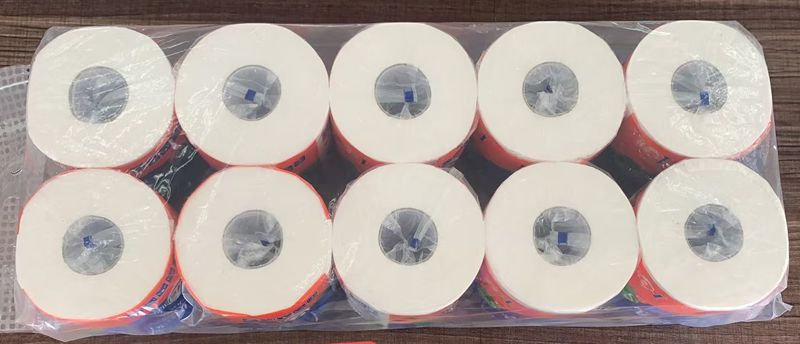
Can Poly-Bundled “Naked” Rolls Effectively Serve the High-End Market?
Packaging format drives landed cost, brand perception, and measurable guest metrics—choose the format that meets hotel specs while protecting margin and operations.
Match product specs to high-end buyer expectations
High-end outlets expect technical parity with hospitality-grade standards: offer 5-ply options, 165 mm wide formats where requested, 100% virgin wood pulp, OBA-free whitening, 85–92% brightness, and septic-safe rapid disintegration. Position TSH-4010 (Luxury Hospitality) and TSH-2269 (Premium Wide-Format) as baseline SKUs for proposals: TSH-4010 for classic luxury properties and TSH-2269 when 165 mm width and wider comfort drive guest perception.
Build a concise spec sheet for each buyer segment that lists the functional attributes buyers care about and the wrapping option you recommend—individually wrapped (paper or film with hygiene seal) for luxury hotels, poly-bundled for value-focused premium buyers who accept minimalist presentation tied to a sustainability narrative.
- Core spec fields: Ply (2–5), Width (102–132 mm; include 165 mm option), Roll weight (e.g., 780 g–5,000 g), Sheets per roll, GSM per ply (13–22 g/m²).
- Embossing: point-to-point patterns (floral, dot, custom logo) and expected absorbency uplift (~+30%).
- Material: 100% Virgin Wood Pulp, OBA-free, brightness 85–92% and septic-safe disintegration.
- Wrapping option: Format A — individual paper or film wrap with hygiene seal; Format B — master poly-bundle with compressed bagging and reinforced export cartons.
- Model recommendation: TSH-4010 for luxury; TSH-2269 for wide-format premium outlets.
Operational and logistics trade-offs for poly-bundled vs individually wrapped rolls
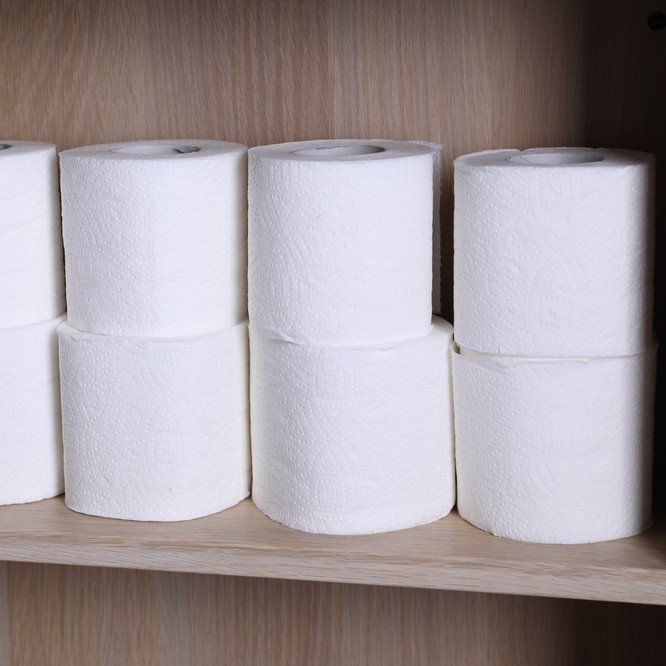
Poly-bundled packs reduce per-unit packaging cost and maximize cube efficiency, but you trade visual presentation and immediate hygiene perception. Individually wrapped rolls raise packaging cost and handling complexity yet deliver clear operational benefits for hotels that require sealed hygiene and branded presentation. Use mechanical compression, master poly bundles, and reinforced 5-ply export cartons to preserve product integrity while maximizing payload in a 40HQ; typical container payloads run 7,000–9,000 kg.
Set clear lead-time and MOQ rules in commercial terms: standard MOQ equals 1 × 40HQ; in-stock dispatch 10–15 days; production lead time 20–25 days. Maintain payment terms of T/T 30% deposit with 70% balance before shipment and provide pre-shipment photos and loading videos to protect buyer cash flow and trust.
- Bundle examples: customizable from 780 g up to 5,000 g (coreless 5,000 g / 28 rolls); roll widths 102–132 mm to match dispenser profiles.
- Logistics scenario — Poly-bundled quote: palletize compressed bundles, use master poly film, stack to container height to hit 7–9 tonnes, maximize units per 40HQ; lower landed cost per roll.
- Logistics scenario — Individually wrapped quote: add carton dividers, secondary corrugated reinforcement, fewer units per pallet, higher per-container volume consumption; quantify unit count and palletization differences per quote.
- Protection differences: poly-bundles rely on film and carton strength; individual wrap requires additional master carton protection and careful pallet stretch-wrap to prevent crushing and moisture ingress.
Cost and revenue model to test willingness-to-pay for premium wrapping
Use packaging cost benchmarks to model scenarios: flexible packaging typically costs ~$0.25–0.75 per unit, folding cartons $0.09–2.25, and corrugated $2–4 per unit. Packaging can account for roughly 10–40% of product cost. Run landed-cost math per roll: factory unit cost + packaging cost + freight per unit + duties + local handling = landed cost per roll, then compare poly-bundle versus individually wrapped variants.
Automate primary wrapping where volume justifies capital: automated lines reduce labor surcharge, handle hundreds of units per minute, and cut error and rework—this lowers the incremental cost of individual wrapping and improves margin capture on premium pricing tests.
- Step 1 — Calculate incremental per-roll cost of individual wrapping using supplier quotes for material and machine time (include labor delta if manual).
- Step 2 — Define price-test bands (e.g., +3%, +5%, +10%) and run A/B tests with hospitality partners, alternating poly-bundled and individually wrapped SKUs across matched properties.
- Step 3 — Track KPIs: guest satisfaction score, repeat bookings, unit sell-through, and incremental margin per roll.
- Decision rule: accept individual wrapping when incremental price premium covers added packaging and handling costs and when guest KPIs exceed predefined thresholds that justify the margin impact.
Logistics Impact: Does Secondary Packaging Increase Your 40HQ Costs?
Secondary packaging shifts the cube/weight trade-off; measure CBM and gross weight to decide if packaging raises or lowers landed cost per roll.
Measure pack geometry and convert to CBM to estimate units-per-40HQ
Capture finished-pack external dimensions (L×W×H) for every SKU and every packaging option. Convert mm to cubic metres using m³ = L × W × H ÷ 1,000,000. Do this for a single finished pack (for example, a TSH-2559 retail 10-roll pack ≈ 1,800 g) and for heavy solid bundles (for example, a TSH-3396 solid 5,000 g / 28-roll bundle). Record carton internal dimensions separately and compute carton_CBM = carton_L × carton_W × carton_H ÷ 1,000,000 so you compare single-unit volume against carton volume accurately.
Calculate units_per_carton = floor(carton_internal_volume ÷ unit_volume) and use usable 40HQ volume (~76–78 m³) plus payload range (7,000–9,000 kg) to find the binding constraint. Use loaded_units = min(floor(usable_CBM ÷ carton_CBM) × units_per_carton, floor(payload_limit ÷ gross_unit_weight)). For example, if gross_unit_weight for a 28-roll solid bundle (including carton) equals 5.2 kg and your payload limit is 8,000 kg, payload limits you to floor(8000 ÷ 5.2) = 1,538 bundles even if CBM would allow more cartons. Track both CBM-limited and payload-limited outcomes so you see which packaging option wins on effective throughput.

Quantify added tare and packaging cost, then compute per-roll freight delta
Weigh the complete logistics unit: net_product_weight (for example, 5,000 g for a TSH-3396 bundle) plus inner wrap, poly bundle, and the 5‑ply export carton tare. Convert to gross_unit_weight in kg for freight math and capture carton-level tare so you can attribute packaging to per-carton weight. Request supplier quotes for individual wrap film, PE bags, and 5‑ply export cartons and calculate packaging_cost_per_carton; treat that amount as a discrete cost line. Industry guidance places packaging at roughly 10–40% of product cost, but run supplier quotes to get your actual number.
Compute freight per roll with simple formulas: per_roll_freight = total_freight_rate_per_40HQ ÷ loaded_units. Add packaging_cost_per_40HQ ÷ loaded_units to get the per-roll delta from packaging. Example: if freight for a 40HQ = $4,500 and loaded_units = 20,000 rolls, per_roll_freight = $0.225; if packaging materials on that load cost $500 total, packaging adds $0.025 per roll, yielding $0.25 per roll. If a new packaging option raises gross_unit_weight so payload binds earlier, recalc loaded_units = floor(payload_limit ÷ gross_unit_weight) and recompute per-roll costs — the per-roll delta can jump quickly when units per container fall. Declare HS code 4818.1000 on documents to avoid customs delays, demurrage, or rework that distort landed cost.
Run targeted packaging trade-off tests and specification changes to reduce 40HQ cost
Design a controlled test matrix that measures CBM, gross weight, packaging cost, and projected loaded_units for each format. Compare Format A (individually wrapped rolls in retail bags), Format B (direct bundle poly + master carton), and coreless/solid bundles (for example, TSH-3396 or TSH-3082). Record every variable so you can calculate landed cost per roll across scenarios and segment results by channel (hospitality, retail, wholesale). Coreless or solid bundles often maximize paper meters per kg and reduce CBM per usable paper length, which improves freight economics where plumbing rules permit their use.
- Run a packing trial and pre-shipment verification: take photos and video of packing, measure carton_CBM and stacked height, then log gross weights per carton and per pallet.
- Compute delta_cost_per_roll = new_landed_cost − baseline_landed_cost and map that to channel tolerance (hospitality often accepts higher per-roll costs for hygiene/branding; discounters prioritize lowest landed cost).
- Apply mechanical compression during bagging to reduce CBM while preserving product integrity; standardize carton footprints to improve palletisation and reduce voids.
- Use MOQ = 1×40HQ for packaging trials to validate assumptions without large upfront spec commitments; update spec only after the trial meets cost and damage-rate targets.
Follow this discipline: measure precisely, model both cube and weight constraints, test in-market channels, and standardize the packing footprint. That approach lets you convert packaging choices from opinion to quantified savings or acceptable premiums for brand value.
Conclusion
Choosing individual wrap or poly-bundle is a straightforward procurement trade‑off: a small cost premium can improve guest perception, strengthen hygiene control, and keep brand presentation consistent across rooms. Proper primary and secondary packaging also reduces cross‑contamination in storage, cuts damage during international shipping, and supports hotel hygiene requirements.
Start by auditing your current roll packaging across properties and quantifying the landed cost difference per 40HQ. Contact Top Source Hygiene for sample packs and a tailored cost comparison so procurement and marketing can make a clear, data‑driven decision.
Frequently Asked Questions
Why is individual wrapping considered a non-negotiable for hospitality?
The provided research does not include hospitality-specific studies that establish individual wrapping as a universal requirement for guest experience. What the sources do provide are general packaging price ranges (corrugated boxes $2-$4, folding cartons $0.09-$2.25, rigid boxes $4-$5, flexible packaging $0.25-$0.75) and a reminder that packaging often represents roughly 10%-40% of product costs. To determine whether individual wrapping is effectively “non-negotiable” for your operation you will need hospitality-focused research: hospitality industry studies on packaging perception, food/beverage packaging comparisons, retail psychology on perceived value, and brand case studies that show guest behavior and ROI.
Is paper wrapping more eco-friendly and cost-effective than plastic film?
The research does not contain a direct comparison of environmental impact or total cost between paper wrapping and plastic film. The only directly relevant figures are general packaging unit-cost ranges (not lifecycle or externality data), for example flexible packaging $0.25-$0.75 per unit. To answer eco-friendliness and cost-effectiveness conclusively you will need material-specific lifecycle analyses, hospitality or food-packaging research comparing materials, and supplier cost quotes or case studies that include end-to-end costs and environmental metrics.
How much does individual wrapping add to the final unit price of a roll?
The provided content does not give a precise per-roll uplift for individual wrapping in a hospitality context. Useful reference points from the research: flexible packaging unit pricing is shown at roughly $0.25-$0.75, and packaging in general can account for about 10%-40% of product costs. Use those ranges only as preliminary guides. To calculate an accurate per-roll addition, obtain supplier quotes for the specific wrapping, include labor and secondary materials, and compare that total to your product cost; ideally complement that with hospitality-specific ROI studies.
Can I get custom-printed foil wrapping for a luxury boutique brand?
The research dataset does not list specific vendors or confirm availability of custom-printed foil, but it does identify flexible packaging as a category with unit-cost ranges ($0.25-$0.75) and catalogs other packaging types and price bands. Custom-printed foil is a specialty option that typically falls under flexible or specialty packaging services; to proceed, request samples and quotes from flexible-packaging and specialty print vendors and look for packaging case studies for luxury brands to validate quality and pricing.
Does bulk naked packing lead to more roll damage during international shipping?
The provided search results do not contain empirical data on damage rates for bulk naked packing versus individually wrapped items in international shipping. The research focuses on packaging cost ranges and general cost-share (packaging = ~10%-40% of product costs) but not damage statistics. To evaluate risk you should run transport tests or pilot shipments, consult logistics or packaging performance studies, and review case studies that record damage rates under comparable shipping conditions.
How to market “Sustainability” when using individual secondary packaging?
The research does not provide marketing strategies or validated messaging for sustainability claims tied to individual secondary packaging. The sources instead point to gaps you should fill: seek hospitality industry studies on packaging perception, food/beverage packaging research, retail psychology on perceived sustainability, and brand case studies. Use that evidence to substantiate any sustainability messaging—eg, supplier data, comparative studies, or case-study outcomes—before making claims.