 Skip to content
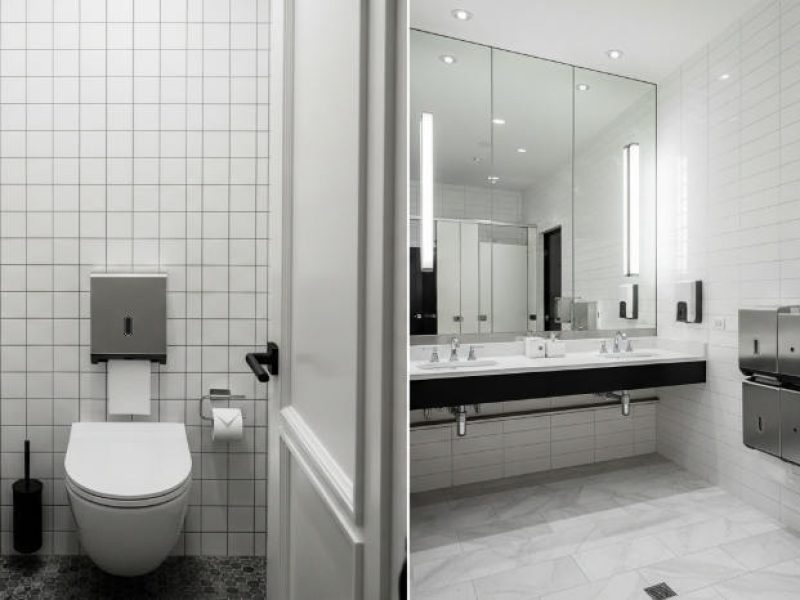
Mini Jumbo vs Standard determines how you fit dispensers into tight, older stalls, drives restocking frequency, and raises the risk of ADA noncompliance and related fines that eat into operations budgets and service-level metrics.
This guide works as a technical SOP: we cover ADA protrusion limits for wall-mounted dispensers, exact dimensions and sheet capacity for the 9-inch standard jumbo and the Tork 7.5-inch mini jumbo, and a repeatable method to calculate restocking intervals so facilities, procurement, and maintenance teams can choose the right dispenser, set mounting clearances, and lock down service schedules for executive washrooms and small cafes.
The Space Constraint of Older, Narrow Bathroom Stalls
Saving 2–3 inches of wall projection by switching from a standard 9-inch jumbo dispenser to a 7.5-inch mini jumbo frequently determines whether a dispenser fits in an older narrow stall without obstructing the door or user movement.
Typical dimensions and clearances in older narrow stalls
Many legacy buildings used compact stall footprints to maximize restroom counts. Those stalls commonly measure roughly 30–36 inches (76–91 cm) wide with variable depth, which leaves little margin for fixtures that project into the usable width. When you evaluate retrofit options, treat a few inches as critical tolerances rather than negotiable space.
- Common stall widths in older buildings: roughly 30–36 inches (76–91 cm); depth also varies and may be constrained.
- Limited clear floor space increases the risk of door interference and reduces options for wall-mounted dispensers.
- Small differences matter: a 2–3 inch reduction in available wall clearance can prevent use of standard 9-inch jumbo dispensers.
- Always verify local code and accessibility requirements before retrofit; many jurisdictions and accessibility standards set minimum clearances and allowed protrusions.
How dispenser size affects usable space: mini jumbo vs standard
Dispenser diameter and projection directly reduce usable stall width. A standard jumbo (approximately 9-inch roll diameter) gives longer service intervals but projects farther from the wall, increasing the chance of door contact or occupant interference. A mini jumbo (about 7.5-inch diameter) cuts projection and makes mounting options more flexible, at the expense of roll capacity.
- Standard jumbo dispensers (around 9-inch roll diameter) provide higher capacity but project farther from the wall and need more clearance.
- Mini jumbo dispensers (around 7.5-inch roll diameter) occupy less wall space and lower the chance of door or user interference.
- Capacity trade-off: mini jumbo holds less paper than standard jumbo; expect more frequent refills in medium-to-high traffic locations.
- Choose dispenser style (surface mount, recessed, vertical-feed) based on available depth and door swing to minimize intrusion into the stall.
Measuring a stall for dispenser retrofits
Run a quick, repeatable measurement routine before ordering dispensers. Measure absolute clearances and functional clearance that accounts for door swing and user position. Record all values on a single sketch so installers can reproduce the layout on-site.
- Measure stall width at multiple heights and note any obstructions (coats hooks, handrails, grab bars).
- Check distance from toilet centerline to side wall and position relative to door swing to avoid interference.
- Measure usable wall depth from finished wall to the plane of travel or door swing; subtract any trim or tile thickness.
- Record vertical mounting zones (typical dispenser center heights) and verify they don’t conflict with grab bars or accessibility clearances.
Practical retrofit solutions and installation tips
When space is tight, combine lower-profile hardware with strategic placement to preserve function and compliance. Recessing dispensers yields the largest reduction in projection, but where wall construction prevents recessing, choose mini jumbo or vertical-feed units and place them to avoid the door swing and primary user path.
- Prefer recessed or semi-recessed dispensers where wall construction allows; they save several inches of projection.
- If recessing isn’t possible, select a low-profile mini jumbo or vertical-feed dispenser to reduce horizontal intrusion.
- Mount dispensers on the wall opposite the door swing or on the same wall but forward of the toilet to avoid contact with users entering or exiting.
- Balance capacity and service: use higher-capacity rolls in adjacent stalls or adopt staggered refill schedules if mini dispensers increase restocking frequency.
- Pilot a single-stall retrofit and collect simple metrics (refill frequency, user complaints, maintenance time) before rolling changes across multiple restrooms.
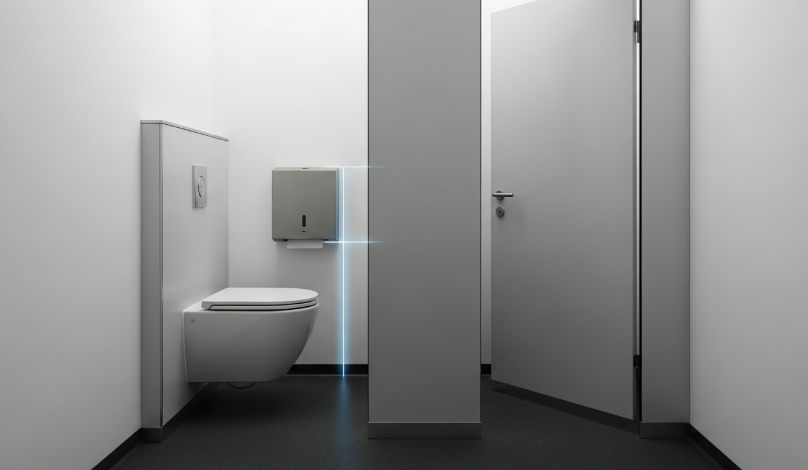
ADA Protrusion Limits for Wall-Mounted Dispensers
Objects with leading edges between 27 and 80 inches above the finished floor must not project more than 4 inches from the wall, and dispenser operable parts should sit within 15–48 inches for usable reach.
Primary 4-inch Protrusion Rule
Any fixture whose leading edge falls between 27 and 80 inches above the finished floor cannot project more than 4 inches horizontally from the finished wall. Measure projection from the finished wall to the farthest physical point of the dispenser; if that distance exceeds 4 inches within the regulated band, the unit creates a hazard for people using long canes and fails the requirement.
| Requirement | Where to Measure | Typical Fixes |
|---|---|---|
| Leading edge between 27–80 in: max 4 in projection; dispenser controls must be within 15–48 in; toilet paper outlet typically 7–9 in forward of toilet. | Measure horizontally from finished wall to farthest dispenser point; measure vertically to the operable part or outlet centerline. | Use recessed or semi-recessed dispensers, low-profile units, or relocate controls to compliant heights; document placement with photos. |
Mounting Height Requirements for Dispenser Controls
Place operable parts and controls between 15 and 48 inches above the finished floor so users of varied height and mobility can reach them without assistance. Measure to the operable part or the highest point a user must reach to dispense product, not to the unit’s top or decorative flange.
Keep controls reachable from the required clear floor space adjacent to the fixture. Prioritize models that require minimal force and allow one-handed operation to reduce transfer time and improve usability for assisted users.
Fixture Types Covered by the Rule
The protrusion and height limits apply across standard restroom fixtures and most wall-mounted dispensers used in commercial settings. You must treat manual and automatic models the same for projection limits—the presence of electrical components does not change the measurement.
- Soap dispensers (manual and automatic)
- Paper towel dispensers and hand dryers
- Toilet tissue dispensers, including jumbo and mini-jumbo formats
- Combined units, shelves, or accessory holders that add projection
Practical Compliance Tips for Installers and Facility Managers
Follow a simple, repeatable checklist during planning and installation. Mark critical heights on the wall, confirm projection and reach with real tools, and choose recessed solutions where corridor or stall clearance is tight.
- Before installation, mark the 27-inch and 80-inch band and limit projection to 4 inches within that band.
- Measure to the operable part to confirm controls fall between 15 and 48 inches above the floor.
- Test installed fixtures with a long cane to ensure detection and with staff for reach and operation.
- Prefer recessed or low-profile dispensers where corridor or clearance space is narrow.
- Keep installation records and photos to document compliance for inspections or audits.
Global OEM Toilet Paper Manufacturer
Standard 9-Inch Jumbo Roll Dimensions and Capacity
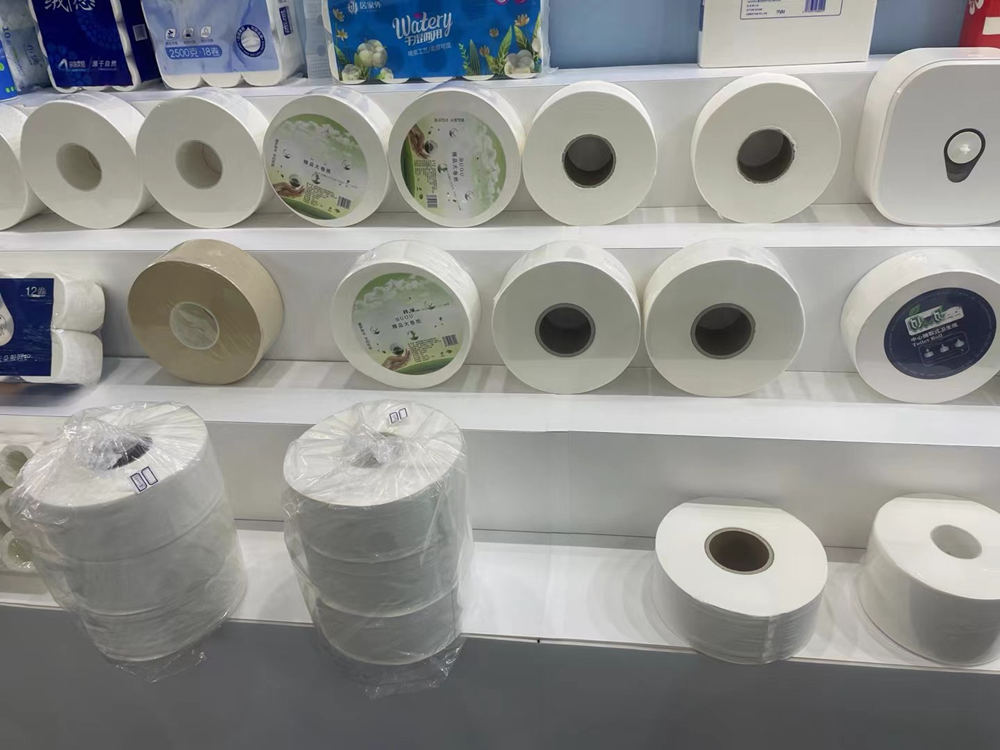
A nominal 9-inch jumbo roll (≈229 mm OD) is defined by outer diameter and web width but capacity depends most on core diameter and paper caliper—specify OD, core, web width, ply and GSM when ordering to predict refill intervals.
Typical Physical Dimensions
Manufacturers call these rolls “9-inch” because the outer diameter measures about 9 in (≈229 mm) with small tolerances. Web (paper) width commonly falls between 3.5 in and 4.5 in (≈90–115 mm) to match regional dispenser designs. Core diameters vary: 1.5 in (≈38 mm), 2.25 in (≈57 mm) and 3 in (≈76 mm) are typical; core choice alters usable length and dispenser fit. Producers offer 1‑ply to 3‑ply options and set sheet length (for example 3.5–4.5 in sheets) rather than a fixed sheet-count standard across markets.
| Parameter | Typical Value / Range | TSH Reference / Notes |
|---|---|---|
| Outer diameter (OD) | ≈229 mm (9 in) nominal | Use OD to confirm dispenser cover clearance; TSH lists commercial jumbo models (e.g., TSH-JRT08). |
| Web / roll width | ~90–115 mm (3.5–4.5 in) | Specify width at order; TSH offers 102–132 mm widths for custom lines. |
| Core diameter | 38 mm, 57 mm, 76 mm common | Match dispenser spindle or use adapter inserts; TSH notes core options for dispenser compatibility. |
| Sheet format & ply | Sheet length 89–115 mm; 1–3 ply | Ply and perforation set usable sheets per roll; TSH controls ply GSM per ply (13–22 g/m²). |
Core Diameter and Dispenser Compatibility
Match core diameter to the dispenser spindle—don’t assume all jumbo dispensers accept every core size. Many high-capacity dispensers accept 38–76 mm cores or include adapter inserts; confirm spindle bore and adapter availability before switching stock. Also check the dispenser’s tray/cover clearance against the roll OD and web width so the roll rotates freely and the outlet aligns with the cover opening.
When you change suppliers, specify outer diameter, core diameter and web width on the purchase order. That reduces on-site refits and prevents returns. If you plan recessed dispensers, verify cover depth; surface-mounted units require additional clearance for larger ODs or thicker ply constructions.
Capacity: Linear Length, Sheet Count, and Weight (Calculation Method)
Use the roll-geometry formula to estimate linear length: L = (π/(4·t))·(D² − d²), where D = outer diameter, d = core diameter, and t = single-sheet thickness (caliper). This gives the total linear meters of paper on the roll; divide by sheet length to get sheet count. Apply web width and GSM to convert area into mass.
Worked example with typical inputs: D = 229 mm, d = 38 mm, t = 0.12 mm yields roughly 333 m (≈1,095 ft) of paper. At a 102 mm (4 in) sheet length that equals about 3,270 sheets. For mass: area = length × web width; for 333 m × 0.10 m area ≈ 33.3 m²; at GSM 20 the roll mass ≈ 667 g. Expect a 30–40% capacity change if caliper falls from 0.12 mm to 0.09 mm; core diameter and ply also change capacity materially.
Practical Usage and Restocking Estimates
Translate sheet counts into service intervals by using average sheets per visit. Example: at 30 sheets per visit, a 3,200‑sheet jumbo roll supports ~100 daily uses or ~32 days for a single-use toilet in lower-turnover settings. For transit hubs or stadiums, choose larger cores and higher-capacity rolls to cut maintenance rounds and labor costs.
Plan storage and ordering by roll weight and carton dimensions—higher GSM increases freight and pallet weight. When you place orders, include: outer diameter, core diameter, web width, ply, GSM and sheet length. That checklist reduces mismatches and makes restocking intervals predictable across buildings and dispenser types.
The Tork Mini Jumbo 7.5-Inch Roll Solution
A 7.5-inch mini jumbo roll reduces dispenser footprint while preserving meaningful sheet capacity, making it the practical middle option for narrow stalls and moderate-traffic restrooms.
Product overview and specifications
The Tork Mini Jumbo 7.5-inch roll targets installations where full 9-inch jumbo rolls create fit or protrusion problems. Manufacturers trade diameter for a smaller profile while keeping enough meters of paper to extend intervals versus household rolls. You can find the format in multiple ply counts and paper grades so facilities can match softness, strength, and budget objectives.
Design highlights prioritize dispenser fit and operational efficiency: reduced overhang, compatible core options, and sheet counts sized for commercial refill cycles. This format sits between retail household rolls and full-size 9-inch jumbos for a balance of capacity and compactness.
- Designed for compact jumbo dispensers that fit narrower roll housings and stall spaces.
- Available in different ply counts and paper grades to balance softness, strength, and cost.
- Core and roll dimensions prioritize dispenser fit and reduced waste from overhang.
- Serves as a middle ground between small retail rolls and full-size 9-inch jumbo rolls.
Compatibility and dispenser fit
The 7.5-inch format works with purpose-built mini jumbo dispensers and many universal mini-jumbo holders. Selecting the correct housing matters: a matched dispenser ensures smooth feeding, reduces paper jams, and minimizes user frustration during peak periods.
Choose compact, low-profile dispensers to free wall space and keep the roll within ADA protrusion limits in narrow stalls. Verify whether your chosen roll is cored or coreless, because that determines the mounting method and spare-parts needs for maintenance staff.
- Fits Tork-branded mini jumbo dispensers and many universal mini-jumbo holders; confirm dispenser model before ordering.
- Compact dispensers free up wall space and reduce protrusion into narrow or ADA-constrained stalls.
- Dispenser selection affects accessibility, tamper resistance, and ease of roll replacement for staff.
- Coreless versus cored roll options change mounting needs—verify dispenser mounting type.
Capacity, cost and restocking implications
A 7.5-inch mini jumbo contains fewer sheets than a 9-inch jumbo, so high-traffic sites will see shorter refill intervals. Still, it extends service time considerably compared with household rolls, and it reduces in-stall clutter and the frequency of staff interruptions in moderate-traffic environments.
Evaluate total cost per use by combining paper grade, ply, and labor minutes per refill. Use a simple estimate: (daily visitors × average sheets per use) ÷ sheets per roll = days between refills. That result drives staffing schedules, storage needs, and order cadence.
- Holds fewer sheets than a standard 9-inch jumbo, so restocking intervals are shorter where traffic is high.
- Smaller rolls cut storage volume per unit and can lower per-order transport costs for tight back-of-house space.
- Total cost per use depends on paper grade and ply; stronger, softer papers raise unit cost but can improve guest perception.
- Estimate restocking frequency from daily visitor counts and average sheets-per-use to set staff schedules.
Best use cases and venue recommendations
Use 7.5-inch mini jumbo rolls where stall width, dispenser protrusion, or aesthetics matter more than maximizing time between refills. The format delivers a cleaner visual and reduces obstruction in compact layouts while still giving maintenance teams a practical refill cadence.
Avoid the format in very high-traffic public facilities where maintenance intervals should be minimal; in those locations, full-size 9-inch jumbos reduce labor touchpoints and stock turnover. For executive areas and boutique venues, the mini jumbo hits the right compromise between form and function.
- Executive washrooms and boutique hotels: delivers a tidy, premium look without large dispensers.
- Small cafes and boutique retail: matches limited wall space while reducing frequent refills compared with household rolls.
- Offices and meeting rooms with moderate traffic: offers convenient capacity while keeping dispensers unobtrusive.
- Public facilities with very high traffic should consider full-size jumbo rolls for fewer interruptions to maintenance routines.
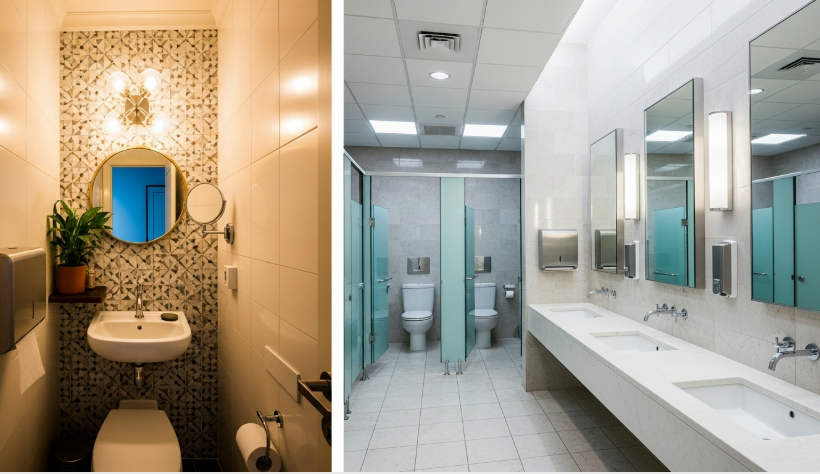
Calculating Restocking Frequencies: Mini vs Standard
Sheets-per-roll, user throughput, refill policy, lead time and safety stock together set reorder cadence—switching from mini to standard rolls reduces refill events but increases dispenser and storage requirements.
Key Variables That Drive Restocking Frequency
You can predict refill frequency once you quantify the core inputs: dispenser capacity (sheets per roll), average daily consumption, foot traffic profile, refill threshold, supplier lead time, and safety stock policy. Each input changes the math: smaller rolls raise consumption events; longer lead time increases required on-hand days.
- Dispenser capacity: sheets or metres per roll (mini = lower capacity, standard/jumbo = higher capacity).
- Average daily consumption: measured in sheets/day or rolls/day from actual usage patterns.
- Foot traffic and usage profile: number of users, sheets per use, and peak periods.
- Service policy and refill threshold: refill at 25% vs 10% remaining changes frequency.
- Lead time and resupply cadence: supplier production + transit time sets minimum reorder interval.
- Safety stock and variability: account for demand variability and supply delays when setting reorder points.
Estimating Turnover Rates: Mini vs Standard Rolls
Convert usage into roll turnover with a simple ratio: monthly sheet demand divided by sheets per roll. That gives rolls/month and drives ordering cadence and handling workload. Use the Reorder Point formula to lock in timing: Reorder Point = (Daily usage × Lead time days) + Safety stock.
| Metric | Mini roll (example) | Standard roll (example) |
|---|---|---|
| Sheets per roll | 800 sheets | 3,600 sheets |
Apply safety stock to cover lead-time variability: for stable environments use 1–2 days of average demand; for volatile sites increase that to cover peak events. Inventory trade-offs are clear: more frequent replenishment raises labor and handling costs, while larger rolls reduce events but require compatible dispensers and more storage space per unit.
30-Day Example Calculation
Assume average daily usage of 1,200 sheets. Monthly demand = 1,200 × 30 = 36,000 sheets. Using 800-sheet mini rolls requires 36,000 ÷ 800 = 45 rolls per month; using 3,600-sheet standard rolls requires 36,000 ÷ 3,600 = 10 rolls per month.
Operational effect: mini rolls produce roughly 4.5× more handling events than standard rolls. If a single dispenser services the traffic, expect a mini roll change roughly every 0.67 days versus a standard roll change roughly every 3 days. That translates directly to labor minutes, service visits, and risk of stockouts without tighter monitoring.
Operational Recommendations for Restocking Cadence
Set refill schedules by location and format. High-traffic restrooms demand daily checks with mini rolls and at least twice-weekly checks with standard rolls; low-traffic locations may stretch to weekly or monthly depending on chosen roll size. Always align reorder points with supplier lead times and maintain safety stock that matches your variability profile.
- Set refill policy by location: high-traffic restrooms = daily checks for mini, twice-weekly for standard; low-traffic = weekly or monthly depending on roll size.
- Align reorder point with lead time: if supplier lead time is 15–25 days, maintain that many days of cover plus safety stock.
- Use par levels and automated alerts: track real-time usage or conduct daily visual checks to trigger orders before stockouts.
- Standardize dispensers where possible: a consistent dispenser type simplifies logistics and reduces wrong-roll incidents.
- Monitor cost trade-offs: calculate total cost of ownership including product, labor to refill, storage, and service interruptions when choosing roll size.
- Pilot and measure: run a 4–8 week pilot when switching formats, track refill events, labor minutes, and stockouts, then adjust cadence and safety stock.
Best Use Cases: Executive Washrooms and Small Cafes
Match roll format to traffic pattern and stall geometry: pick mini jumbo for compact, premium washrooms where dispenser footprint and guest experience matter, and standard jumbo for cafes that need maximum uptime and lowest cost-per-use.
Mini jumbo rolls: executive washrooms
Mini jumbo formats give you commercial capacity without a large visible dispenser. For executive or private washrooms, the objective is to preserve an upscale aesthetic while reducing refill frequency versus household rolls. Choose lockable, low-profile dispensers and softer high-ply tissue to meet guest expectations without sacrificing neat presentation.
- Compact dispensers preserve a clean, upscale look that aligns with executive interiors.
- Moderate foot traffic in private or semi-private washrooms means less frequent restocking than public restrooms.
- Lockable mini jumbo dispensers reduce pilferage and support a consistent branded presentation.
- You can choose softer, higher-ply tissue to match guest expectations without large dispenser bulk.
- Smaller roll diameter simplifies installation in narrow stalls or behind partitions where a full 9-inch jumbo won’t fit.
Standard jumbo rolls: small cafes
Small cafes face steady customer turnover and peak periods that tax maintenance staff. Standard 9-inch jumbo rolls and heavy-duty dispensers cut intervention time and lower operating cost per sheet. Accept a more utilitarian dispenser look and mitigate it with tidy styling and clear signage to keep your brand perception intact.
- Larger roll capacity reduces the frequency of staff intervention during busy service periods.
- Durable, high-capacity dispensers handle frequent use and reduce the chance of run-outs during peak hours.
- Bulk purchasing and fewer replacements lower operating cost per sheet compared with smaller consumer rolls.
- Standard jumbo dispensers are robust for unstaffed or semi-public restrooms often found in cafes.
- The trade-off is a more utilitarian look, so pair with tidy styling and signage to preserve brand image.
Operational trade-offs: restocking, storage, and cost
Make decisions on roll format by modelling total cost of ownership: labor for restocking, on-site storage footprint, and per-use material cost. Higher-capacity rolls reduce labor but require more storage space and higher single-unit cost. Run a simple cost-per-use calculation using average footfall and roll sheet counts to compare formats on an apples-to-apples basis.
- Higher-capacity rolls cut labor time for refills but require more storage space per unit.
- Smaller rolls or mini jumbo may fit tighter stock rooms and still extend intervals between refills versus household rolls.
- Consider theft and waste: lockable dispensers and higher-capacity rolls reduce handling and loss.
- Calculate cost per use based on roll capacity and average footfall to compare true value.
- Factor in supplier lead times and minimum order quantities to avoid stockouts during busy periods.
Design and guest perception: branding, comfort, and sustainability
Tissue choice influences guest experience and brand positioning. Match ply, softness, and environmental claims to the venue: premium softness and subtle branding for executive washrooms; durable, certified options for cafes that want visible sustainability credentials. Standardize specifications across sites so guests receive a consistent feel and buyers simplify procurement.
- Executive washrooms benefit from softer, higher-ply options and subtle branded packaging or logo impressions.
- Cafes can emphasize durability and cost-effectiveness while offering visible eco labels to align with customer values.
- FSC certification and options without fluorescent whiteners support sustainability claims and meet regional buyer preferences.
- Consistent product feel across locations helps maintain brand standards for multi-site operators.
- Ask suppliers about custom sizing, GSM, and packaging to balance comfort, cost, and environmental impact.
Conclusion
Choosing the correct roll size and mounting method protects users and makes the most of narrow stalls. Proper dispenser installation ensures ADA and OSHA compliance and extends equipment life, while mini jumbo rolls reduce restocking without exceeding protrusion limits. That mix lowers maintenance time and keeps small restrooms reliable.
Survey your stalls and dispenser mounts to verify clearances and roll compatibility, or request certified dispenser specs and Tork Mini Jumbo samples. Contact Top Source Hygiene for technical data, sample packs, and OEM options tailored to small businesses and architects.
Frequently Asked Questions
What is the difference between a mini jumbo and standard jumbo roll?
Mini jumbo rolls are a compact commercial format with a smaller overall diameter and smaller core than standard jumbo rolls. Typical mini jumbo diameters are roughly 4.5–6 inches versus about 9–12 inches for standard jumbo rolls. Mini jumbos hold less linear feet than standard jumbos but still offer longer service intervals than household rolls. The two are not universally interchangeable because they require different dispensers; choice depends on dispenser compatibility, stall space and desired service interval.
How big is a mini jumbo toilet paper roll?
A typical mini jumbo roll measures about 4.5–6 inches in diameter and is usually 3.5–4.5 inches wide. Core diameters commonly fall around 1.25–1.5 inches. Linear length varies by manufacturer and ply but commonly ranges from roughly 300 to 900 feet per roll.
ADA protrusion limits for commercial toilet paper dispensers?
Under ADA guidance, objects mounted between 27 inches and 80 inches above the finished floor may not protrude more than 4 inches into circulation paths. Objects mounted below 27 inches may protrude up to 12 inches. Toilet paper dispensers should also be installed within required reach ranges for accessible fixtures, and you should verify local code for any additional placement specifics.
What is Tork mini jumbo toilet paper?
Tork mini jumbo is Tork’s compact jumbo toilet paper format and associated dispenser system. It offers smaller-diameter, higher-capacity commercial rolls intended for space-constrained restrooms and is available in multiple grades and plies to balance comfort and cost. The product is designed for use with Tork mini-jumbo dispensers.
Best commercial toilet paper for small bathroom stalls?
For small stalls use compact formats and space-saving dispensers: mini jumbo or coreless mini-jumbo rolls paired with a recessed or slimline dispenser are ideal. Prioritize roll formats that maximize capacity without increasing projection into the stall, and choose paper grade based on your balance of budget and user comfort (high-strength 1-ply for cost and performance or quality 2-ply for comfort). Also consider dispensers that mount close to the toilet and lock to reduce nuisance.
Do mini jumbo rolls fit on standard dispensers?
Generally no. Mini jumbo rolls have a smaller core and diameter and are designed for mini-jumbo dispensers. Standard jumbo dispensers are built for larger-diameter rolls and larger cores, so a mini jumbo will typically not fit unless the dispenser is specifically adjustable or marketed as compatible with both sizes.
