Skip to content
Shelf Life & Storage mistakes in bulk tissue inventory cause tissue weakening, unexpected stockouts, and operational downtime that drives emergency restock costs and risks lost contracts.
This guide functions as a technical SOP for warehouse teams: it debunks the myth of infinite paper shelf life, explains how warehouse humidity destroys tissue tensile strength, details UV-driven yellowing of virgin pulp, outlines pest control for cardboard cores and pallets, prescribes a strict FIFO approach, and lays out pallet shrink-wrapping methods for long-term climate protection, followed by concise FAQs and inspection checkpoints to preserve supply continuity and contract compliance.
Paper products don’t spoil like food, but storage conditions and handling systematically reduce tensile strength, absorbency, whiteness, and overall user performance over time.
Common Misconceptions About Paper Shelf Life
Many buyers treat toilet tissue and towel paper as effectively immortal because the material won’t rot like perishable goods. That belief ignores functional aging: softness, tensile strength, absorbency, and appearance degrade through repeated exposure to moisture, light, mechanical stress, and contaminants. Manufacturers’ long-storage claims assume controlled warehouses and intact packaging; real-world distribution introduces variables that shorten usable life.
Packaging masks early signs of decline. Once wrappers split or cartons crush, humidity and dust reach edges and cores quickly, and performance drops faster. Marketing language like “long shelf life” usually refers to resistance to rapid spoilage, not preservation of original product metrics indefinitely.
Environmental Factors That Accelerate Degradation
Three categories of stressors drive measurable decline: physical (mechanical damage, compression), chemical (oxidation, heat-driven aging), and biological (mold, insects). Each one targets different failure modes—tensile loss, yellowing, reduced absorbency, and visible staining.
- Humidity: Repeated high relative humidity (RH) and RH swings let fibers swell and weaken. Keep RH below 60% and aim for 30–50% RH for extended storage.
- Temperature: Higher temperatures accelerate chemical aging and yellowing; store between 10–22°C where practical to slow degradation.
- UV and visible light: Direct or prolonged light exposure causes yellowing, especially on virgin pulp without UV stabilizers.
- Pests and contamination: Rodents and insects gnaw cores and cartons; dust and grime stain edges and reduce perceived quality.
- Mechanical stress: Poor stacking, compression, and damaged pallets deform rolls and damage cardboard cores, lowering integrity at the point of use.
Practical Storage and Handling Practices to Extend Usable Life
Apply simple, measurable controls in warehousing and transit to preserve product performance. Climate control and disciplined handling yield the best return on investment: slower aging, fewer customer complaints, and less rework.
- Climate control: Maintain 10–22°C and 30–50% RH for most tissue products; install RH sensors with trend logging and alerts for excursions.
- FIFO inventory: Label pallets with production dates and batch IDs and rotate strictly so older stock ships first.
- Pallet and packaging protection: Keep rolls on pallets, maintain 10–15 cm clearance from walls, and use shrink-wrap or stretch film to limit moisture ingress during storage and transit.
- UV protection: Store cartons in opaque areas and avoid direct sunlight on racks and trucks.
- Pest control: Use integrated pest management—regular inspections, sealed storage, and preventive traps—to protect cores and cartons.
- Handling care: Use roll lifters or forklifts with pallet clamps, avoid crushing stacks, and limit exposure of opened packs on the dock.
Testing, Monitoring, and Quality Indicators for Stored Paper
Set objective acceptance criteria and monitor routinely. Small, frequent checks identify trends before batches leave the warehouse. Use a retained-sample program and environmental logging to make decisions based on data, not guesswork.
- Physical tests: Measure tensile strength, burst strength, and ply integrity on retained samples monthly or per batch to detect mechanical degradation.
- Absorbency and softness checks: Run simple absorbency tests and tactile evaluations against baseline samples to confirm performance.
- Visual and olfactory inspection: Inspect random cartons and opened packs for yellowing, stains, mold spots, or off-odors during each receiving and pre-shipment check.
- Environmental monitoring: Log temperature and RH with sensors and alarms; review trends weekly and investigate excursions immediately.
- Acceptance and corrective action: Define internal ‘best-by’ windows from your test data. Quarantine batches that fall below criteria, adjust storage settings, and notify sales to prevent distribution of substandard goods.
How Warehouse Humidity Destroys Tissue Tensile Strength
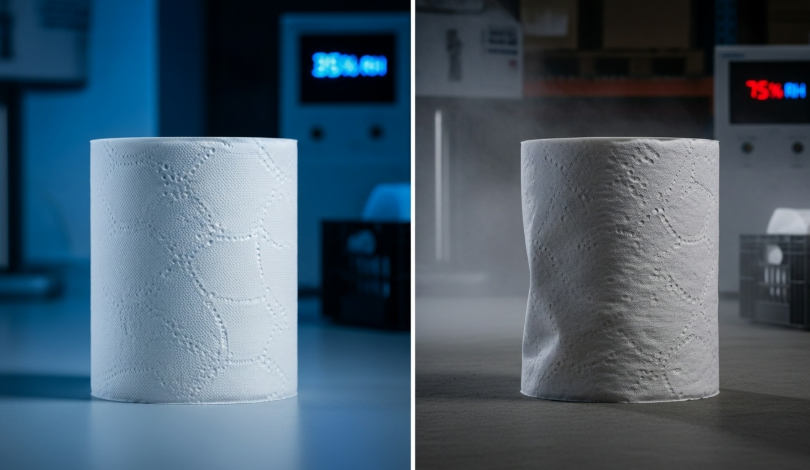
Sustained relative humidity above ~65% drives moisture into cellulose fibers, reducing interfiber hydrogen bonding and cutting tissue tensile strength by double-digit percentages within days to weeks.
Moisture sorption and fiber swelling
Cellulose fibers in tissue paper absorb water vapor from humid air because they are hygroscopic. As fibers take up moisture they swell, change geometry, and lose the close surface contacts that transfer stress between fibers. That process directly weakens the hydrogen-bond network that provides dry tensile strength.
- Cellulose fibers are hygroscopic; RH swings drive moisture into and out of the fiber network and change equilibrium moisture content.
- Water molecules interrupt and displace intermolecular hydrogen bonds, lowering interfiber bonding strength.
- Swelling alters fiber geometry and reduces contact points where stresses transfer, so tensile strength falls.
- Fillers, additives, and wet‑strength agents change sorption behavior; some formulations pick up more moisture and lose strength faster.
- Some swelling reverses after drying, but repeated or prolonged humidity cycles cause permanent structural damage.
Hydroplasticization and reduced mechanical resistance
Water acts like a plasticizer inside the cell wall, so fibers soften and deform under normal handling loads. As the effective stiffness drops, tissue elongates more and breaks at lower loads; the product shows lower tensile and burst resistance even when ambient handling stresses stay the same.
| Warehouse Condition | Expected Tensile Impact | Recommended Controls & Top Source Hygiene Spec |
|---|---|---|
| Stable 35–55% RH, 10–25°C; pallets off concrete; sealed packaging | Minimal measurable loss; strength remains within spec for standard dwell times | Maintain RH setpoints, use shrink-wrap or laminated barrier film, desiccants for long storage; prioritize TSH products (100% Virgin Wood Pulp, OBA‑Free) and rotate stock with FIFO. |
- Water lowers fiber-wall stiffness so tissue yields earlier and shows reduced wet and dry tensile values, especially in non–wet-strength grades.
- Under sustained loads—stacking or pallet compression—humidified tissue creeps faster and deforms permanently.
- Wet‑strength chemistries mitigate damage but do not stop humidity-driven plasticization entirely.
Critical humidity and exposure time thresholds
Strength loss depends on RH level, temperature, and exposure time. Short RH spikes cause mostly reversible changes. Sustained RH above ~65% produces rapid, measurable degradation within days to weeks and raises mold risk. Condensation or direct wetting produces near‑immediate, often irreversible tensile loss.
- Target and maintain roughly 35–55% RH and 10–25°C to preserve mechanical properties.
- Short spikes above target produce limited, often reversible changes; sustained RH >65% accelerates strength loss.
- Condensation events or direct water exposure cause rapid, often irreversible damage.
- Daily RH swings compound damage faster than a steady, moderately elevated RH.
Detecting tensile degradation: testing and inspection
Run routine sampling with standardized tensile and burst tests to quantify storage damage. Condition samples to a defined RH and temperature before testing so results remain comparable across time and locations. Track trends and correlate them with warehouse environmental logs to catch problems before returns or complaints escalate.
- Condition samples to a fixed RH/temperature (follow TAPPI/ISO variants) prior to tensile testing for repeatable results.
- Track dry tensile, wet tensile where relevant, and elongation to spot early degradation patterns.
- Inspect pallets for sagging rolls, soft edges, increased lint/dust release, and discoloration; these visual cues correlate with reduced strength.
- Use statistical trending from periodic tests to link warehouse conditions to product performance and set alarm thresholds.
Practical warehouse controls to prevent strength loss
Control the microclimate around palletized tissue and use protective packaging to limit vapor exchange. Combine HVAC stability with barriers and operational rules—pallet elevation, stock rotation, and pre-shipment checks—to keep tensile performance within spec during storage and transit.
- Maintain stable HVAC setpoints and avoid large RH swings; place RH sensors with alerts in storage zones and near loading doors.
- Keep pallets off concrete floors, provide air gaps between stacks, and use sealed or shrink-wrapped packaging to limit vapor exchange.
- Use desiccant packs, moisture-barrier films, or laminated outer wraps for long storage or humid destinations.
- Apply FIFO and rotate stock to avoid long dwell times; inspect inbound loads for elevated moisture and quarantine affected lots.
- Plan shipments to avoid high‑humidity routes or seasons and coordinate container ventilation or dehumidification during transit when needed.
Custom OEM Toilet Paper — Factory Pricing
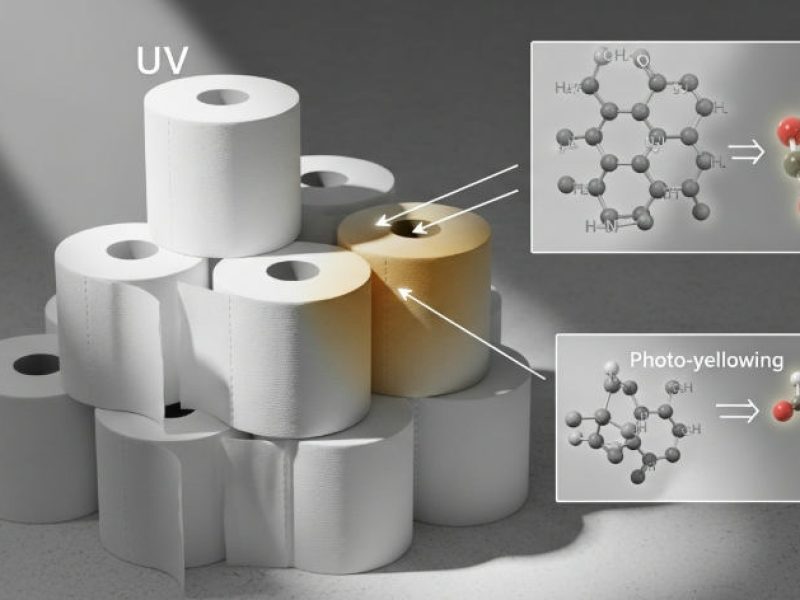
UV photons break cellulose and pulp impurities into radicals that oxidize into carbonyl- and conjugated systems; lignin, hexenuronic acids and trace metals amplify that chemistry, so material choice plus UV-blocking packaging and alkaline buffering deliver the fastest reduction in yellowing risk.
Photochemical Mechanisms: How UV Alters Cellulose
Ultraviolet photons (mainly UV-B, with cumulative UV-A contribution) deliver enough energy to cleave glycosidic and side-chain bonds in cellulose and accessory components. Those bond breaks generate free radicals that react quickly with oxygen and rearrange into carbonyls and conjugated double-bond systems; those chromophores absorb blue light and produce the familiar yellow-brown cast.
During the earliest exposure stages some chromophores revert in darkness or under reducing conditions, but sustained irradiation converts labile intermediates into stable, light-fast chromophores that resist simple reversal.
- UV photons (mainly UV-B and UV-A) provide energy that cleaves chemical bonds in cellulose and associated molecules, creating free radicals.
- Free radicals react with oxygen to form carbonyl and conjugated double-bond structures; these chromophores absorb blue light and make paper appear yellow-brown.
- Early-stage photoyellowing can show partial reversal in the dark or under chemical reduction, but prolonged exposure creates stable chromophores that persist.
- Residual impurities from pulping and bleaching act as sites for photochemical reactions and increase the rate of yellowing.
Key Chemical Drivers: Lignin, Hexenuronic Acids and Chromophores
Different virgin pulps show different yellowing kinetics because non-cellulosic components supply the fastest routes to chromophore formation. Lignin dominates UV absorption and, when photolyzed, yields phenoxy radicals that convert into quinone- and carbonyl-type chromophores. Hexenuronic acids and residual hemicelluloses also form light-sensitive groups after UV attack.
Trace transition metals accelerate radical cycles; controlling metal loads and reducing residual chromophores through deeper delignification or targeted bleaching lowers yellowing risk even for kraft pulps.
- Lignin absorbs UV strongly and produces phenoxy radicals that form quinone- and carbonyl-type chromophores; pulps with higher lignin content yellow fastest.
- Hexenuronic acids (formed during kraft pulping) and residual hemicelluloses can create chromophoric structures under UV exposure.
- Trace metal ions (iron, copper) catalyze radical formation and speed photodegradation; strict control of metal contaminants reduces this effect.
- Even well-bleached kraft pulps can yellow if trace chromophores or bleaching by-products remain; lower kappa number and deeper bleaching reduce risk.
Exposure Conditions That Accelerate Yellowing
Yellowing rate scales with spectral content and dose: shortwave UV-B produces more photochemical damage per joule than longer wavelengths, while accumulated UV-A adds steady, long-term damage. Temperature and humidity raise reaction rates by increasing molecular mobility and promoting oxidative and hydrolytic pathways.
Continuous lighting with UV leakage produces a steady net increase in chromophores, while intermittent exposure and dark storage let some reversible changes relax. Surface contamination and acidic atmospheres provide extra reactive species and lower local pH, accelerating color change.
- Shortwave UV (UV-B) causes faster photochemical damage per unit energy than longer wavelengths, but cumulative UV-A also drives yellowing over time.
- Higher temperature and relative humidity accelerate oxidative reactions and hydrolytic pathways that produce chromophores.
- Continuous exposure to daylight or fluorescent lighting with UV leakage produces steady yellowing; intermittent light with dark storage slows net change.
- Surface soiling and acidic atmospheres increase yellowing by supplying additional reactive species and lowering local pH.
Mitigation Strategies: Manufacturing, Additives and Storage
Manufacturers and warehouse operators cut yellowing by controlling feedstock chemistry, minimizing catalytic contaminants, and choosing stabilizers that interrupt radical chains. Keep paper chemistry neutral to slightly alkaline and avoid unnecessary chromophores in the furnish.
On the logistics side, use opaque or UV-filtering films, store away from windows and direct light, and apply dark storage for long-term inventory. Run accelerated light-exposure tests and routine colourimetric checks to detect early yellowing and tune controls.
- Select low-lignin pulps (bleached kraft) and reduce hexenuronic acids through extended delignification or targeted bleaching sequences.
- Control metal contaminants in water and furnish to limit catalytic radical formation.
- Use alkaline papermaking and buffering agents to keep paper pH neutral to slightly alkaline; acidic papers yellow faster.
- Incorporate stabilizers where appropriate: UV absorbers and hindered amine light stabilizers (HALS) reduce photochemical chain reactions; antioxidants trap radicals.
- Avoid over-reliance on optical brightening agents (OBAs); OBAs mask yellowing but can degrade under UV and then fail to hide chromophores.
- Protect finished goods with opaque or UV-filtering films, store pallets away from windows and direct light, and implement dark storage for long-term inventory.
- Monitor and test with accelerated light-exposure assays and periodic visual/colourimetric checks to catch early yellowing and adjust controls.
Pest Control Strategies for Cardboard Cores and Pallets
Proactive inspection, strict environmental control, and rapid quarantine cut product loss from rodents, stored‑product insects, and mold across palletized tissue operations.
Common Pests and Damage Patterns
Rodents, stored‑product insects, cockroaches, and fungal growth represent the primary threats to cardboard cores and palletized tissue. Rodents chew cores and pallet edges, pull paper fibers into nests, and leave droppings that contaminate products. Stored‑product beetles, moths, and silverfish target starches, sizing agents and adhesives; they create boreholes, frass, and localized weakening that shows up as holes or shredded sheets.
Cockroaches accelerate soiling in humid, food‑contaminated zones, while mold and mildew form where humidity and condensation persist, producing staining, off‑odors and measurable loss of tensile strength. Inspect for these early warning signs:
- Irregular chew marks along cores and pallet skids
- Boreholes, powdery residue or frass near bundles
- Nesting material made from torn paper fibers
- Staining, mold spots or persistent musty odors
- Sightings of live insects, droppings or shed skins
Inspection and Monitoring Protocols
Implement a documented inspection cadence: inspect high‑risk zones weekly and lower‑risk storage monthly. Position traps and stations strategically at entry points, under racking and along walls, and record counts and locations to build trend data. Use pheromone and light traps to detect stored‑product insects early and map hotspots by SKU and season.
Keep a centralized inspection log with timestamped photos, trap counts, corrective actions and follow‑up deadlines. Set clear action thresholds—for example, any evidence of chewing on hygiene product cores triggers immediate quarantine, root‑cause review and intensified monitoring.
Environmental Controls: Humidity, Temperature, and Ventilation
Control the microclimate to make the warehouse unattractive to pests and hostile to mold. Target relative humidity below 60% and aim for 40–55% where feasible; many insects and mold thrive above 60%. Keep temperatures consistent and avoid cold exterior walls or drafts that produce condensation on cardboard surfaces.
Design airflow to eliminate stagnant zones and improve drying after any moisture events. Practical steps include:
- Stack pallets with spacers to allow cross‑flow of air between layers
- Avoid blocking vents, windows or HVAC returns with inventory
- Install temp/RH sensors with alerting to maintenance teams for excursions
- Schedule HVAC and dehumidifier maintenance to preserve setpoints
Physical and Chemical Treatment Options
Quarantine suspect pallets immediately and run a rapid risk assessment before returning product to stock. Prioritize non‑chemical treatments that avoid residue: steam cleaning, hot‑air desiccation and surface sanitation remove insects and eggs without contaminating tissue. Use physical exclusion and sanitation as first‑line measures.
Apply chemical measures only where necessary and in compliant ways: place inert dusts like food‑grade diatomaceous earth in pallet voids and under skids where paper contact is unlikely. Reserve fumigation or aerosol treatments for severe infestations and coordinate all chemical work with certified pest control operators who log products used, application points, dwell times and re‑entry intervals.
Storage and Handling Best Practices for Pallets and Cardboard Cores
Reject or isolate incoming shipments that show contamination and inspect cores at a dedicated receiving area away from bulk storage. Store pallets off the floor on racks or blocks and keep at least 30 cm clearance from walls to allow inspection and deter rodents. Wrap pallet loads tightly—shrink‑wrap or stretch‑wrap—to reduce access and limit dust and moisture ingress during storage and transit.
Maintain cleanliness and operational discipline to reduce attractants: sweep daily, remove food waste, and control packing debris. Rotate stock with strict FIFO, label pallet tags with inspection dates and outcomes, and train handlers to report pest signs immediately and follow hygiene protocols when moving cores intended for hygiene products.
Implementing a Strict FIFO (First-In, First-Out) Inventory System
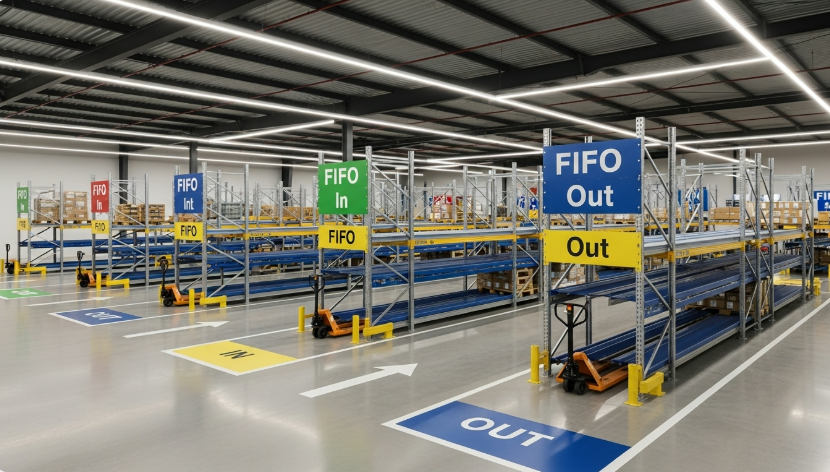
A strict FIFO system combines physical flow engineering, clear lot identification, WMS enforcement, and short audit cycles to keep average days-on-shelf low and FIFO compliance ≥98%.
Warehouse layout and stock flow for FIFO
Design the warehouse so stock physically moves from inbound to pick face without manual reshuffling. Force rotation with storage types and pick paths that make the oldest pallet the easiest to access — do not rely on memory or ad hoc moves.
Use single-deep lanes or gravity/flow racks where possible, and reserve front positions for the earliest arrival dates. Maintain consistent clearance and pallet handling rules so staff can inspect and rotate without blocking aisles.
| Key Control | Industry Target | Top Source Hygiene Guidance |
|---|---|---|
| Slotting, staging, and flow | Dedicated FIFO lanes; 0.5–1 m clearance; receive-to-storage 8–24 hrs; FIFO compliance ≥98% | Use single-deep or flow racks, fixed slots by SKU/lot, marked inspection bay for inbound, quarterly layout reviews; align with 40HQ container cadence |
- Design dedicated FIFO lanes (single-deep or gravity/flow racks) so pallets enter from one side and exit from the other.
- Assign fixed slots by SKU/pack type and lot; reserve front positions for items with earliest arrival dates.
- Require inbound staging in a marked inspection bay before putaway to capture arrival date and lot on labels.
- Keep pallets off the floor, stacked uniformly on standard pallets, and leave 0.5–1 m clearance for inspection and handling.
- Review layout quarterly to match SKU mix and seasonal volumes; adjust lanes when product mix or order profiles change.
Identification, labeling, and lot tracking
Make lot age visible at a glance and machine-readable at every touchpoint. Standardize labels so receiving, putaway, picking, and shipping operate from the same data fields: SKU, lot, manufacture and arrival dates, and a scannable code.
Use color coding for quick visual checks while keeping barcodes or QR codes for system validation. Place labels on multiple pallet faces and on inner cartons where practical to avoid blind spots during picking and audits.
- Use a standardized label template: SKU, lot number, manufacture date, arrival date, shelf-life or ‘use-by’ if applicable, and barcode/QR.
- Apply a color-coded FIFO sticker system for immediate visual cues (e.g., month-coded colors) while keeping barcodes for scans.
- Mark partial pallets with an ‘open/closed’ tag and record remaining quantity in the WMS to avoid accidental mixing.
- Place labels on at least two visible pallet faces and on each inner carton when practical; use moisture-resistant labels for humid warehouses.
- Record container and vessel references for imported 40’HQ shipments to enable fast cross-checking during putaway.
Digital systems: WMS, barcode/RFID, and integrations
Configure your WMS to enforce FIFO allocation rules and to block manual overrides unless a manager authorizes them. Capture timestamps at receipt, putaway, pick, and ship to build an auditable trail of lot movements.
Add automated aging alerts and integrate the WMS with order management so the oldest lot reserves at order creation. Track KPIs such as average days on shelf and FIFO compliance to drive continuous improvement.
- Implement WMS rules that default to oldest-arrival-lot when allocating picks; prevent manual overrides without manager approval.
- Use handheld barcode scanners or RFID for receipt, putaway, pick, and ship scans to create an auditable trail of movements.
- Set automated aging alerts (e.g., 30/60/90 days) for lots that approach thresholds so teams can prioritize transfers or promotions.
- Integrate WMS with order management to reserve the oldest lot at the time an order is created and lock it for shipping.
- Track KPIs in the system: average days on shelf, FIFO compliance rate target (suggested ≥98%), and % exceptions per month.
SOPs, roles, and staff training
Document simple, step-by-step SOPs that specify scans, label checks, and time targets. Assign ownership for each process so staff know who enforces rules and who resolves slotting conflicts.
Train teams on the operational impact of FIFO: fewer expired lots, lower write-offs, and more predictable replenishment. Reinforce behavior with visual aids and short competency tests tied to onboarding and quarterly refreshers.
- Create short SOPs for receiving, putaway, picking, replenishment, returns, and partial-pallet handling; include required scans and label checks.
- Set time-to-putaway targets (example: receive to storage within 8–24 hours) and require arrival-date capture at receipt.
- Assign FIFO champions per shift to audit compliance and resolve slotting or congestion issues in real time.
- Run onboarding training and quarterly refreshers that combine classroom, on-floor demos, and a short competency test.
- Use visual aids (floor markings, signage, color labels) and daily checklists to reinforce correct behavior.
Exception handling, quality control, and audits
Define clear workflows for damaged, returned, expired, or mis-picked stock and isolate those items in a quarantine zone pending QA release. Link QC results to lot records in the WMS so you trace issues back to receipt and origin.
Run spot-checks and cycle counts based on turnover: daily for high-turn, weekly for medium-turn, and monthly for slow-turn SKUs. Conduct monthly FIFO audits, document exceptions, and close corrective actions quickly so the system learns and improves.
- Establish a quarantine zone with strict tagging for damaged or suspect lots; require QA release before returning to FIFO lanes.
- Perform incoming quality checks on a sample of pallets (e.g., 1–2 cartons per pallet) and record results linked to the lot in the WMS.
- Schedule regular spot-checks and cycle counts: daily spot-checks for high-turn SKUs, weekly checks for medium-turn, monthly for slow-turn.
- Conduct monthly FIFO audits measuring true FEFO/FIFO adherence and document exceptions, root cause, and corrective actions.
- Tie audit findings to operational metrics and to lead times (e.g., production 20–25 days); use findings to adjust reorder points and safety stock.
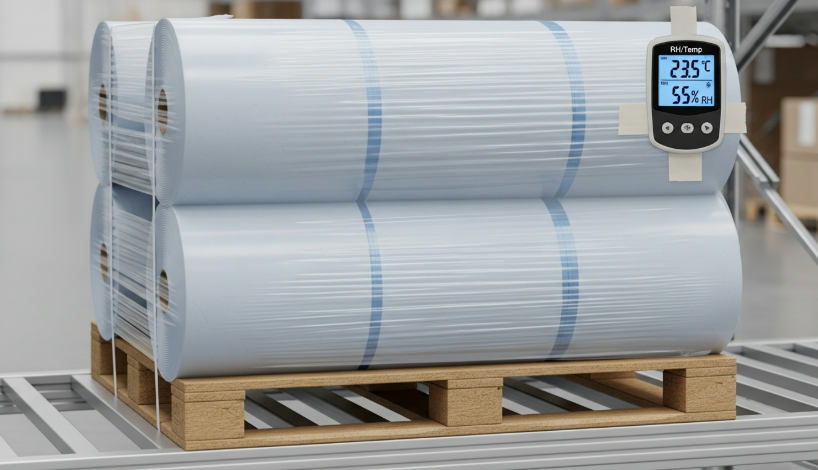
Shrink-Wrapping Pallets for Long-Term Climate Protection
Proper film selection, correct pallet prep, and active moisture control together prevent the two main failure modes for palletized tissue: moisture-driven strength loss and UV/oxidative discoloration.
Selecting shrink-wrap films for climate resistance
Choose film by mechanical and barrier performance, not price alone. Use LLDPE/LDPE blends where you need stretch and cling; move to multi-layer co-extruded films when you need puncture resistance and improved moisture barrier. Reserve PVC for narrow, low-temperature use cases only. Specify UV-stabilized or opaque films when light exposure or solar gain can yellow product or heat the pallet.
| Parameter | Common Industrial Practice | Top Source Hygiene Guidance |
|---|---|---|
| Film type | LLDPE/LDPE stretch films; co-extruded multi-layer for better puncture/moisture resistance; PVC used rarely. | Specify co-extruded LLDPE with a dedicated barrier layer or foil-lamination for hygroscopic tissue. Avoid PVC for export pallets; use only when cold-chain data justify it. |
| Thickness (micron) | Short-term protection: 15–25 μm; heavier-duty: 35–50 μm. | For long-term climate protection use 50–100 μm or laminated barrier films in humid sites; pair thickness spec with WVTR target and puncture resistance data. |
| Performance metrics | Buyers commonly request tensile, elongation and basic WVTR numbers; UV-stabilized grades used where needed. | Require manufacturer test data: WVTR, tensile strength, % elongation at break and recommended temp/RH range. Target low WVTR for humid warehouses and UV-stabilized or opaque film where light risks yellowing. |
Preparing pallets and stabilizing loads before wrapping
Start with sound pallet fundamentals. A damaged pallet or an off-centered stack creates point loads that puncture film and let moisture intrude. Every pallet you send to long-term storage must be inspected, square-stacked and internally reinforced where needed.
Use mechanical restraints before you wrap on larger or taller loads. Straps carry shear forces that would otherwise stress the film and promote slippage over time.
- Inspect and reject broken pallets; use plastic pallets where moisture and pests are recurring problems.
- Stack squarely with no overhang; place heavier items inboard to lower topple risk.
- Add internal reinforcement: corner boards, top sheets and anti-slip pads to spread point loads.
- Strap heavy or tall loads before wrapping to reduce film stress and limit slippage.
- Anchor film at the base, overlap by 50% or more, spiral up with uniform tension and finish with 3–5 wraps at top and base.
Moisture control: desiccants, liners and condensation management
Do not rely on film alone for moisture control in humid warehouses. Use desiccants and vapor-barrier liners to manage internal RH and stop condensation when temperatures swing. Design your wrap system around the expected climate cycle, not just current conditions.
- Place desiccant packs or hygroscopic pads inside wrapped loads, especially for porous goods such as tissue.
- Use heat-sealed vapor-barrier liners or foil-laminated sheets in high-humidity sites and pair them with desiccants to avoid trapped moisture.
- Anticipate condensation when warm humid air cools; avoid tightly sealed microclimates without desiccants if you expect wide temperature swings.
- Seal pallet tops and skirting to reduce floor-level moisture ingress and keep pallets off the ground using racks or base pallets.
- Install humidity data loggers in representative pallets to monitor RH and trigger corrective action when thresholds exceed set limits.
Long-term storage protocols, inspection and maintenance
Treat wrapped pallets as active assets. Schedule recurring inspections and document findings; film will degrade from UV exposure, abrasion and micro-punctures. Plan rewrap and corrective actions before product quality declines.
Combine environmental monitoring with simple physical checks and sample testing so you catch moisture ingress and pest issues early.
- Maintain controlled storage conditions: target 10–25°C and RH 40–55% for paper-based products; tighten targets for sensitive SKUs.
- Adopt a documented inspection schedule: check wrapped pallets every 4–12 weeks for film integrity, moisture, pests and load shift.
- Rewrap or reinforce when you find punctures, UV degradation, loss of tension or visible moisture; set a planned rewrap interval (for example annually) where conditions are harsh.
- Use FIFO and date-stamp pallets; log environmental data and corrective actions in a simple storage record.
- Conduct periodic sample testing for moisture content, odor and discoloration and coordinate pest control around storage racks.
Conclusion
Proper storage and handling protect product quality, reduce returns, and extend on-shelf life—controlling humidity, light exposure, pests, and inventory rotation preserves tensile strength, brightness, and septic-safe performance of bulk tissue. Following these steps also cuts waste, protects margins, and helps maintain regulatory and OSHA safety standards for your warehouse operations.
Start by auditing humidity levels, FIFO procedures, and pallet protection across your current stock, then schedule corrective actions where needed. Contact Top Source Hygiene for a warehouse storage checklist, sample packs, or pre-shipment verification to protect your bulk tissue investments.
Frequently Asked Questions
Does commercial toilet paper expire?
No. Commercial toilet paper does not have a chemical “expiration date”—it can remain usable for years if kept dry and protected. Over time however quality (brightness, softness, tensile strength) can decline from exposure to humidity, light, heat, oxidation, pests or packaging failure. Rotate stock FIFO and aim to use typical warehouse inventory within 3-5 years for peak quality; inspect older rolls before deployment.
How long can you store jumbo toilet paper?
Stored correctly (cool, dry, low-humidity, protected from light and pests), jumbo toilet rolls can be stored for several years. In non-climate-controlled warehouses plan for 2-3 years; in climate-controlled, sealed conditions rolls can retain acceptable quality for 5-10 years. Always rotate stock, inspect for mold, yellowing or compression damage before use.
Does humidity ruin stored toilet paper?
Yes. High humidity weakens paper, causes loss of strength, promotes mold and mildew, produces odors and can make rolls stick together or discolor. Keep relative humidity below 60% (ideally 30-50%), avoid condensation, provide airflow, and use desiccants or climate control in storage.
Why does old toilet paper turn yellow?
Yellowing is caused by oxidation and breakdown of residual lignin and cellulose, exposure to light (UV), heat and airborne pollutants; adhesives, packaging off-gassing or mold can also cause yellow or brown staining. Controlled storage (dark, cool, low-humidity) minimizes yellowing.
How to protect palletized tissue from warehouse mice?
Use integrated pest management: seal building entry points, keep storage areas clean and free of food or debris, store pallets off the floor and away from walls, use metal shelving or rodent-resistant pallet covers, employ mechanical traps and monitored bait stations per regulations, regularly inspect inventory, and consider rodent-proof containers or metal crating for long-term storage. Avoid leaving gaps under stretch-wrap and repair damaged packaging promptly.
What is the best way to store bulk janitorial paper?
Best practices: store on pallets at least 6 inches off the floor and away from walls, keep temperature stable (roughly 50-77°F / 10-25°C) and RH 30-50% (below 60%), use original packaging and stretch-wrap pallets, label with receipt/rotation dates and use FIFO, avoid stacking so high that rolls are crushed (follow manufacturer’s stacking limits; keep pallet heights reasonable, typically under 1.2-1.5 m), protect from sunlight and chemicals, maintain good housekeeping and pest control, and monitor storage conditions regularly.