Skip to content

toilet paper gsm ply specification is the first checkpoint buyers should lock before they approve a supplier, budget, or production slot. You’re sourcing a private-label toilet paper contract for a 200-room hotel. The RFQ asks for “3-ply premium.” Three suppliers quote back. One ships a roll that feels like sandpaper. Another delivers a roll that disintegrates on the first touch. The third one nails it. Same ply count. Same price point. Totally different guest experience. That gap is where the toilet paper gsm ply specification becomes the single most important document in your procurement file.
Ply tells you how many layers are glued together. It doesn’t tell you how much fiber is in each layer, how airy the sheet is, or how it feels in a guest’s hand. GSM — grams per square meter — measures the actual fiber mass. Bulk measures the thickness relative to that weight. A 2-ply roll at 40 GSM with high bulk can outperform a 3-ply roll at 36 GSM with low bulk in every softness and absorbency test. That’s not marketing. That’s physics. And it’s the difference between a guest complaint and a five-star review.
Most procurement managers default to ply because it’s easy. It’s one number. But that one number is a trap. It hides the real variables that determine cost, feel, and consistency across a multi-property contract. A manufacturer with 30 years of converting experience — like the one operating out of Mancheng, Baoding — can hit a locked GSM and bulk target batch after batch. The ones who can’t will hide behind ply count and hope you don’t ask for the parent roll data. This guide gives you the language to ask the right questions before you sign.
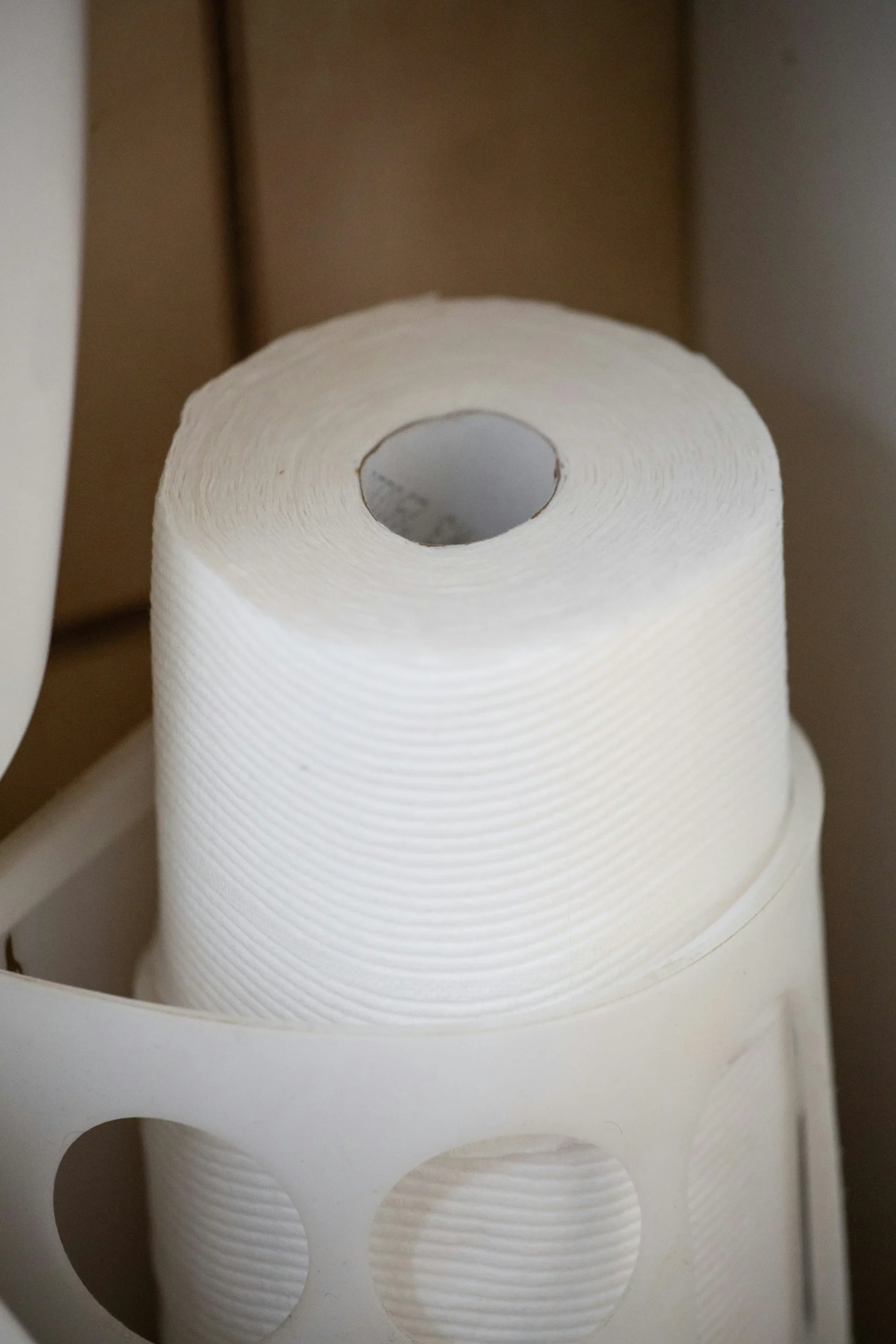
The GSM Ply Trap: Why More Layers Don’t Mean Better Quality
A 3-ply 36 GSM roll can feel thinner than a 2-ply 40 GSM roll with high bulk.
Most buyers assume higher ply equals better quality. That assumption costs you money. A 3-ply 36 GSM toilet paper with low bulk (6.5 cm³/g) will feel thin, flat, and less absorbent than a 2-ply 40 GSM paper with high bulk (7.5 cm³/g). The guest touches the sheet, not the spec sheet. For a private-label hotel program, the wrong spec means inconsistent feel across properties and brand damage.
- GSM per ply threshold: Industry standard for commercial tissue: 16-18 gsm per ply. A 3-ply 36 gsm paper uses 12 gsm per ply — below the threshold for a premium feel.
- Bulk target limits: For private-label hotel grade, target 7.0-7.5 cm³/g. A 2-ply 40 gsm paper at 7.5 cm³/g outperforms a 3-ply 38 gsm paper at 6.5 cm³/g in softness and absorbency tests.
- Embossing compression depth: A 0.75 mm embossing depth can effectively reduce the ‘active ply count’ by 15%, reducing material usage without reducing softness. This is the industry secret competitors don’t share.
The financial impact is direct. Focusing on GSM and bulk instead of ply alone can reduce material cost by 15-20%. For a 40′ container, shifting from 3-ply 38 gsm bulk 6.0 to a 2-ply 40 gsm bulk 7.5 increases sheet count by 15% while cutting landed cost by 8-10%. You are paying for fiber and air — the bulk is the air that makes the roll feel premium.
Real Cost Breakdown: GSM, Bulk, Embossing & Container Math
Granular cost modeling across bulk paper tissue specifications shows that fiber mass directly commands contract margins.
Sourcing teams evaluating procurement parameters must analyze how individual cell weight, interlocking web patterns, and container capacity limits intersect. The cost-analysis matrix below structures these variables against realistic 2026 logistics baselines cleanly:
| Cost Driver | Specification & Range | Impact on Quality & Cost | Container Math & Logistics |
|---|---|---|---|
| GSM (Grams per Square Meter) | 16-18 gsm per ply; 40-44 gsm for 2-ply hotel grade | Higher GSM increases fiber cost but improves softness and absorbency. Optimizing GSM can cut material cost by 15-20% vs. focusing on ply. | Higher GSM reduces sheet count per roll, lowering container efficiency. A 40′ container holds ~15% fewer rolls at 44 gsm vs. 38 gsm. |
| Bulk (cm³/g) | Target: 7.0-7.5 cm³/g for premium hotel feel | High bulk (7.5+) delivers a plush feel at lower fiber weight. Low bulk (6.5-) feels thin and flat, even at high ply. | High bulk increases roll diameter, reducing rolls per container by 10-15%. But it lowers freight cost per roll due to lighter weight. |
| Ply Count | 2-ply, 3-ply, 4-ply, 5-ply available | Ply alone is misleading. A 2-ply 40 GSM with high bulk outperforms a 3-ply 36 GSM with low bulk in guest perception. | Higher ply (4-5) reduces sheet count per roll and increases container volume by 20% vs. 2-ply. Cost per roll rises without proportional quality gain. |
| Embossing Depth | 0.5 mm – 1.0 mm; 0.75 mm recommended | Deeper embossing (0.75 mm) reduces active fiber by 15% while maintaining softness. It can lower material cost by 8-10% without sacrificing feel. | Embossing increases roll bulk slightly, reducing container loading by ~5%. The cost savings from fiber reduction outweigh the freight impact. |
Private Label Supplier Quotes Are Not Equal: The Baseline Gap
A blind RFQ for ‘premium 3-ply’ is a race to the bottom — lock specs before you send.
Send five suppliers the same RFQ for ‘premium 3-ply toilet paper’ and you will get five different products. One ships 18 gsm per ply at 5.5 cm³/g bulk — dense, low cost, low feel. Another hits 18 gsm per ply at 7.5 cm³/g bulk — soft, absorbent, but more volume per container. Both quote ’18 gsm premium grade.’ The buyer pays the same price for a radically different guest experience.
- The Specification Disconnect: Without a locked GSM and bulk target, ‘premium 3-ply’ means nothing. A 3-ply 36 gsm at 6.0 cm³/g bulk feels thin and boardy. A 2-ply 40 gsm at 7.5 cm³/g bulk feels plush.
- The RFP Fix: Before sending bids, write: ‘2-ply, 40 ±2 gsm, bulk 7.0–7.5 cm³/g, embossing depth 0.75 mm, roll diameter 110 mm, sheet count 380 sheets.’ This completely eliminates supplier interpretation.
- The Parent Roll Verification: Request a 30 cm × 100 m sample reel from the parent roll. Calculate gsm = weight / (length × width). A 10% variance is an immediate red flag. Measure thickness with a caliper: Bulk = thickness (mm) / gsm × 1000.

How Heavy GSM + High Bulk Defines Your Hotel Brand
GSM and bulk, not ply, determine how guests perceive your brand.
A 2-ply 40 GSM toilet paper with bulk at 7.5 cm³/g and 0.75 mm embossing depth will feel softer and more absorbent than a 3-ply 38 GSM paper at 6.5 cm³/g. That is not theory — it is production data from our converting lines. For a hotel chain sourcing 100,000 rooms, specifying the wrong bulk means every guest feels the difference.
- GSM Sourcing Ranges: Specify 38-42 gsm for 2-ply hotel toilet paper. Industry standard per ply is 16-18 gsm. At 40 gsm total, you get 18-20 gsm per ply — enough fiber mass for softness without waste.
- Bulk Density Targets: Lock bulk at 6.5-7.5 cm³/g. Below 6.5, the sheet feels flat and dense — guests complain of ‘cardboard’. Above 7.5, container loading efficiency drops 8-10% but freight cost per roll drops.
- Embossing Pattern Depth: Specify 0.6-0.8 mm embossing depth. At 0.75 mm, you effectively reduce active ply count by 15% — less fiber, same feel. Too shallow (<0.5 mm) and plies delaminate; too deep (>1.0 mm) and the sheet weakens.
- Roll Diameter Parameters: Standard hotel roll is 100-110 mm diameter. For jumbo rolls in public areas, go to 200-250 mm. Diameter directly affects container payload parameters and housekeeping swap intervals.
We recommend a pilot run. Ship the target GSM and bulk spec. A test batch is produced from the parent roll. You approve the feel before committing to a container. That is how you lock in your brand feel — not guess. We run 100% virgin pulp, 2-ply to 5-ply, adjustable GSM and bulk. Our converting line can hit your target bulk at ±0.2 cm³/g tolerance. No supplier variance. No surprise on property.
Conclusion
GSM and bulk — not ply — determine whether your toilet paper delivers a premium guest experience or a budget-eating miss. A 2-ply 40 GSM spec at 7.5 cm³/g bulk matches a 3-ply feel at 15% lower fiber cost. That math protects both your brand and your bottom line.
Take this spec framework to a manufacturer that locks it. Review current pricing and custom packaging options on the catalog page to match your spec to your next container.
Frequently Asked Questions
What’s better, 2-ply or 3-ply toilet paper?
A 2-ply toilet paper with high GSM (40+) and high bulk (7.5+ cm³/g) can feel and perform significantly better than a 3-ply with lower GSM and flat bulk parameters. Ply alone doesn’t determine quality; always specify exact fiber GSM and bulk metrics in your primary brief to avoid costly errors.
What toilet paper do gynecologists recommend?
Gynecologists generally recommend unscented, dye-free, soft, absorbent toilet paper. For private-label healthcare lines, specifying 100% virgin wood pulp with no fluorescent whiteners meets this clinical standard perfectly. Confirm raw material purity and lot-level COAs before production runs.
What toilet paper ply is best?
There is no single best ply count. For cost-conscious commercial jumbo rolls used in public facilities, 1-ply is structurally efficient. For guest accommodations, high-bulk 2-ply or premium 3-ply provides the required balance. Match ply and fiber mass to your exact use case and budget matrices cleanly.
What toilet paper do plumbers not recommend?
Plumbers recommend avoiding toilet paper that is too thick (such as consumer 4-ply with low sheet count) or has heavy multi-layered embossing that resists rapid breakdown. These cause clogs and plumbing blockages in commercial systems. Test water dissolvability before committing to a high-ply spec.
How do I verify supplier GSM claims without a lab?
Request a small sample reel (30 cm x 100 m) from the parent roll. Weigh it on a calibrated scale, measure dimensions, and calculate GSM using the formula: weight (g) / (length (m) x width (m)). Cross-check against the supplier’s spec sheet before ordering bulk lots.