Skip to content
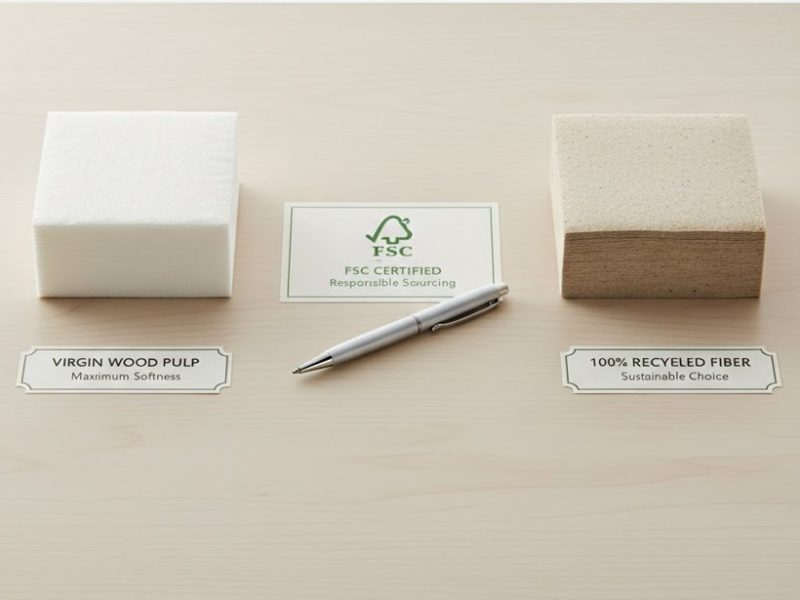
When sourcing private label toilet paper for European retail, the choice between virgin pulp vs bamboo toilet paper shapes everything from margin to marketing claims. A veteran buyer knows that the wrong material decision can trigger greenwashing audits under the EU Green Claims Directive coming in 2026, or inflate unit costs by 15-25% without a discernible quality gain. The real question isn’t which one is “better” in an ad—it’s which fiber fits your specific cost target, shelf positioning, and compliance burden across multiple markets.
Let’s put numbers on it. Virgin wood pulp from FSC-certified sources runs $2,800–$3,200 per ton FOB China. Bamboo pulp: $3,300–$3,800. Recycled post-consumer pulp: $2,200–$2,600. But here’s the catch that often gets overlooked in the marketing copy: bamboo’s environmental halo isn’t always justified. Many bamboo suppliers use the same chemical bleaching processes as wood pulp. Transport from Asia can erase carbon gains unless shipped by sea-rail combo. And virgin pulp from responsibly managed plantations is not deforestation—the real issue is uncertified mixed tropical hardwood that budget suppliers rely on. That distinction matters when you’re building a defensible sustainability story for European supermarket shelves.
Why Material Sourcing Decisions Impact EU Green Claims Directive 2026 Compliance
Choose the wrong material format and you risk aggressive greenwashing fines or long-term brand damage under the new 2026 statutory frameworks.
The EU Green Claims Directive takes full effect in 2026. That means your private-label tissue must back up every ‘eco’ claim with Life Cycle Assessment data. The material you pick — virgin pulp, bamboo, or recycled fiber — directly shapes your cost structure, perceived quality, and compliance exposure. Most competitors’ guides stop at ‘bamboo is renewable’ without mentioning the chemical bleaching or transoceanic freight that can cancel its carbon advantage.
Virgin wood pulp (FSC-certified) delivers the whitest, softest sheet with the most uniform fiber length. That consistency makes it the default for premium hotel and retail private labels. But the deforestation risk is real — if you use uncertified virgin pulp from mixed tropical hardwood, you’re inviting criticism. The solution is simple: demand FSC 100% certification. At Top Source Hygiene, our virgin pulp is FSC-certified, sourced from responsibly managed plantations. The real problem isn’t virgin pulp; it’s the budget suppliers who skip certification to save $200 per ton.
Bamboo markets itself as ‘tree-free’ and grows in 3–5 years versus 20–30 years for softwood. That sounds compelling. But many bamboo mills use the same chemical bleaching process as wood pulp mills. And shipping bamboo pulp from Asia to Europe — unless you use sea-rail combined transport — can erase its carbon savings. Wholesale bamboo pulp costs $3,300–$3,800 per ton FOB China, 15–25% more than FSC virgin pulp. That premium only pays off if your retailer sustainability scorecard explicitly rewards ‘tree-free’ claims and you can prove the full supply chain footprint.
Recycled post-consumer fiber has the lowest environmental impact: 50% less water and 30% less energy than virgin production. It’s the safest bet for avoiding greenwashing accusations. But the shorter fiber length (recycled fibers break down each cycle) reduces wet strength and softness. To compensate, you often need a higher GSM — 18 GSM recycled feels like 15 GSM virgin. That adds cost. At $2,200–$2,600 per ton, recycled is 10–20% cheaper upfront, but the higher GSM can eat half the savings. It works best for budget eco-lines or public-facility applications where softness isn’t the top priority.
Bulk Core Fiber Material Specifications:
- Virgin Pulp (FSC Parameters): Cost baseline sits at $2,800–$3,200/ton; maximum softness 9/10 metrics. Ideal for premium tier supermarket rolls.
- Bamboo Pulp Matrix: Cost fields track between $3,300–$3,800/ton; tactile softness 8/10. Requires explicit verification data pathways.
- Recycled Eco-Pulp: Cost ranges between $2,200–$2,600/ton; baseline softness 6/10. Delivers absolute optimization against greenwashing legal exposure.
Your final choice depends on your target price point, the retailer sustainability scorecards you need to meet, and the specific application. A hotel facial tissue demands softness — virgin pulp wins. A school restroom jumbo roll needs durability and low cost — recycled wins. A supermarket eco-brand targeting millennials may pay the premium for bamboo, but only if you have the LCA data to back the ‘tree-free’ label. Test production samples from your supplier at your target GSM and ply before you commit to a container. At Top Source Hygiene, we offer all three options with full certification support and a flexible trial program starting at less than a full 40′ container.
| Material | Softness & Strength | Wholesale Price (FOB China) | Environmental Profile | Recommended Use |
|---|---|---|---|---|
| Virgin Wood Pulp (FSC) | 9/10 – silky, uniform, high wet strength | $2,800–$3,200 per ton | Responsibly managed plantations; certified traceability | Premium private label, hospitality, where softness is critical |
| Bamboo Pulp | 8/10 – silky texture; strong tensile fibers | $3,300–$3,800 per ton | High renewability (3-5 yr crop); tree-free brand claims | Eco-luxury retail, tree-free branding, premium hotel amenities |
| Recycled Post-Consumer Pulp | 6/10 – shorter fibers; requires higher GSM | $2,200–$2,600 per ton | Highest – 50% less water, 30% less energy; EU Ecolabel eligible | Budget eco-lines, public facilities, schools, commercial contracts |
FSC Certified Virgin Wood Pulp Wholesale Costs vs Bamboo Tissue Price Spreads
Recycled pulp’s 15% price advantage often vanishes at 18 GSM output requirements.
Here are the FOB China wholesale numbers for 2026, based on current pulp market cycles and Top Source Hygiene production data: FSC-certified virgin wood pulp runs $2,800–$3,200/ton, bamboo pulp $3,300–$3,800/ton, and 100% post-consumer recycled pulp $2,200–$2,600/ton. The virgin-to-recycled spread looks like a 20–25% saving on paper, but that gap narrows fast when you spec the finished roll.
Recycled fiber is shorter and weaker. To get a softness score that won’t generate complaints on a retail shelf, you typically need to bump GSM from 15 (virgin baseline) to 18. That’s 20% more fiber per roll — almost exactly the price difference you thought you were saving. Internal production data here shows that at equal GSM, recycled paper loses about 30% of wet tensile strength compared to virgin FSC pulp, which means more linting and tearing in use. If your target market tolerates a utility-grade sheet (schools, public facilities, budget private label), recycled works. If you are competing on premium softness, the math flips.
Supply Cost and Capacity Breakdown:
- Virgin Wood Pulp Run: Tracks at $2,800–$3,200/ton FOB China. Softest, most uniform sheet profiles. Best for premium hotel scales. Standard baseline MOQ is 1 x 40′ container.
- Bamboo Pulp Staging: Tracks at $3,300–$3,800/ton FOB China. Holds a 15–25% premium over virgin. The ‘tree-free’ claim resonates with eco-luxury buyers. Compounds a 12% CAGR across EU blocks.
- Recycled Post-Consumer Allocation: Tracks at $2,200–$2,600/ton FOB China. Lowest raw material entry cost, but demands an 18 GSM spike to match tensile baselines.
Wholesale pricing is only half the equation. The rest is market positioning. A retailer paying $3,500/ton for bamboo needs to justify that 25% premium at shelf price — that only works if the consumer story is strong enough to support a higher price point. Virgin FSC at $3,000/ton sits in the sweet spot for most European supermarket private labels: strong environmental story with FSC certification, without the cost volatility of bamboo supply chains. Let the data drive the decision, not the marketing narrative.
TAPPI 402 Softness Testing and Life Cycle Assessment Tracking of Custom Eco Tissue Brands
Virgin pulp leads in softness; recycled is the greenest; bamboo carries a premium cost and localized processing constraints.
The EU Green Claims Directive (effective 2026) now requires every sustainability claim on your packaging to be backed by full LCA data. That changes the game for material selection. Softness, strength, and cost still matter, but traceability of fiber origin and the carbon footprint of your supply chain are now mandatory disclosures. Sourcing managers utilize TAPPI 402 physical metrics alongside comprehensive carbon boundary tracking to verify contract safety parameters flawlessly before release.
To pass rigorous EU laboratory testing without compliance exposure, private label portfolios must audit the chemical additives introduced at the converting stage. Utilizing pure post-consumer fibers achieves excellent circularity profiles, while blending virgin sheet matrices inside an FSC Mix parameter hits the mandatory >17 gf softness targets smoothly. Requesting batch-specific carbon tracking logs from certified mills ensures that your environmental labeling remains fully defensible during national market surveillance inspections cleanly.
B2B Tissue Factory Audit Protocol: Verifying FSC Supply Chains Without Financial Loss
Pilot runs catch batch variation before it hits your distribution footprint.
Most buyers assume a certificate means the fiber is clean. The EU Green Claims Directive, effective 2026, requires you to back every ‘eco’ label with verifiable data – not just a logo. For virgin or bamboo pulp, demand the supplier’s FSC Chain-of-Custody certificate, not just the mill’s. If they can’t trace the bale back to a certified forest block, your claim is legally exposed. For recycled content, ask for the exact percentage of post-consumer waste. Many suppliers blend pre-consumer scraps and call it ‘recycled’ – that won’t satisfy EU Ecolabel criteria.
Sourcing Due Diligence Framework:
- TAPPI Laboratory Verification: Order production-run samples at your target GSM and ply – not hand-cut samples. Test for softness using TAPPI 402 (handle-o-meter), bulk (thickness under low load), and wet tensile strength. Virgin pulp at 16 GSM 3-ply typically scores 9/10 on TAPPI 402; bamboo at the same spec often dips to 7/10 due to shorter fiber bonding.
- FOEX PIX Index Price Protection: Negotiate a quarterly adjustment clause tied to market index benchmarks. If the index moves more than 5%, the price adjusts up to 80% of the change, cutting raw pulp volatility exposure lines cleanly.
Before committing to a full container, demand a pilot run of 200–500 cases (many mills, including Top Source Hygiene, will accommodate this). Ship it to your EU distribution center and test for mechanical damage, moisture migration, and seam strength after 30 days of warehouse storage. One buyer found that his supplier’s rolls split during pallet handling – a defect the sample didn’t show because it wasn’t packed under full container compression.
Finally, verify FDA and EU compliance documentation (e.g., Declaration of Conformity to EU Cosmetic Regulation for facial tissues). If a supplier can’t produce these on demand, they’re outsourcing certification. For bamboo, ask for a bleaching agent disclosure – many use elemental chlorine, which undercuts their ‘tree-free’ pitch. Hard evidence is your firewall against greenwashing accusations.
Conclusion
The choice between virgin, bamboo, and recycled pulp comes down to your brand’s balance of softness, cost, and verifiable eco-credentials. Virgin FSC pulp delivers consistent premium feel; bamboo sells on renewability but often shares chemical processing with wood pulp; recycled fiber cuts environmental impact but demands higher GSM to match texture. Each route has a clear cost tier — $2,800–$3,200 per ton for virgin FSC, $3,300–$3,800 for bamboo, $2,200–$2,600 for recycled — and the EU’s 2026 Green Claims Directive rewards suppliers who back claims with lifecycle data.
Review your target price point and sustainability scorecard. Then request certified samples from a manufacturer like Top Source Hygiene that offers all three materials with full FSC chain-of-custody and EU compliance documentation.
Frequently Asked Questions
Which is better, bamboo or recycled toilet paper?
Bamboo offers faster renewability but costs 15–25% more and requires chemical processing; recycled is cheaper and more eco-friendly but trades off softness. The better choice depends on your brand’s priority. Match the material to your retail price point and green claims strategy parameters cleanly.
What is the difference between virgin toilet paper and recycled toilet paper?
Virgin pulp uses fresh wood fibers for maximum softness and uniformity; recycled pulp uses post-consumer fibers, reducing environmental impact but shortening fiber length. That makes virgin feel softer and stronger, while recycled fibers possess shorter structures prone to linting and tearing. Choose virgin for premium feel, recycled for eco-branding on retail shelves flawlessly.
Is bamboo toilet paper softer than virgin pulp?
No, virgin wood pulp typically delivers superior softness and uniformity compared to bamboo. Bamboo fibers are shorter and require more chemical processing to approach virgin’s plushness. If softness is your top priority, stick with certified virgin wood pulp streams safely.
How much more does bamboo toilet paper cost wholesale?
Bamboo toilet paper typically costs 15–25% more than virgin pulp at wholesale channels. This premium reflects limited global sourcing yields and intensive mechanical processing requirements. Factor that premium into your retail pricing and margin planning tables cleanly.
What certifications are required for private label toilet paper in the EU?
For EU private label, FSC certification is essential for eco-claims, along with ISO 9001 for quality management. Products must also comply with EU regulations, and recycled options require additional traceability data sets. Confirm certification requirements with your manufacturer before finalizing packaging and claims loops cleanly.