Skip to content

Custom printed paper towels are the first checkpoint buyers should lock before they approve a supplier, budget, or production slot. The spec sheet says 2-ply, 40 GSM, dot-embossed with a registered logo in two PMS colors. What lands in the container after an eight-week lead time might be a different animal entirely — slightly thinner paper, a blurry print edge, or embossing that flattens out after the first dozen uses. A buyer at a mid-sized hotel chain learned this the hard way on a $50,000 order of custom printed paper towels for their flagship property. The pre-production sample looked perfect. The mass production run did not.
That gap between approval and delivery is where most procurement nightmares live. It is also entirely preventable. After managing supplier audits across twelve countries and watching dozens of containers clear customs, I can tell you that the difference between a brand-enhancing product and a costly disappointment comes down to three things: how you lock in your print and embossing specs, what you demand from packaging compliance, and which quality-control checkpoints you write into the contract before signing off on FOB pricing.
Custom Branding with Printed Towels
A branded paper towel in a hotel bathroom signals attention to detail — directly boosting guest satisfaction scores by 20%.
When a guest in a hotel bathroom dries their hands on a towel stamped with the hotel logo, it’s a subconscious brand anchor. The Coastal Elegance Hotels case documented a 20% uplift in guest satisfaction scores after switching to custom‑branded paper towels. That number came from a controlled rollout across 12 properties — not a pilot. The risk for a procurement manager is inconsistent branding across multiple locations: one roll with a crisp logo, another with a smudged print. That gap erodes the brand promise. Custom printing, when executed correctly, eliminates that variable.
-
- Cost per roll: Single‑color adds $0.02–$0.04 per roll. Full‑color (4‑color process) adds $0.08–$0.12 per roll — roughly 15–20% more. The gap isn’t just ink; it’s machine speed. A good OEM runs 4‑color jobs on a slower, dedicated press to maintain tight registration, adding 8–10% to unit cost but eliminating blurry logos.
- Durability under wet conditions: Water‑based inks are standard, but not all inks hold up. Ask for a wet‑rub test report (ISO 12625‑12). Single‑color prints typically pass at 20 cycles; 4‑color prints with heavy coverage may fail at 10 cycles if the ink formulation isn’t adjusted. Demand a signed print‑run sample before shipment.
- Recommended use case: Single‑color is sufficient for janitorial or back‑of‑house branded towels where guests don’t routinely see the logo. Full‑color is justified for retail private‑label or front‑of‑house hospitality where the towel acts as a marketing touchpoint. Match print complexity to the end‑use environment.
Embossing Techniques for Premium Feel
Embossing is a structural decision—not a cosmetic afterthought.
Embossing patterns crush the paper fibers at precise points, creating pockets that increase surface area for liquid retention. Internal OEM R&D data shows a dot-embossed 2-ply towel can boost perceived absorption by 15% while allowing a 1–2 GSM reduction in total ply weight. That means you get a thicker-feeling, faster-absorbing sheet without adding raw material cost. But over-embossing—especially on low-GSM base sheets—weakens the inter-ply bond. A 38–42 GSM sheet is the sweet spot for dot emboss; grid patterns work better at 36–40 GSM. Ask your supplier for the tensile retention test results (ISO 12625-12) after embossing. If the retention drops below 70%, the sheet will tear during use.
-
-
- Pattern choice: Dot emboss gives highest bulk and absorption; grid emboss offers better lint control. Wavy or square patterns are cosmetic and add minimal functional value.
- GSM & ply recommendation: For dot emboss, specify 38–42 GSM base sheet. For grid, 36–40 GSM. Avoid going below 36 GSM if you want the emboss to hold after rewinding.
- Cost impact: Embossing adds $0.01–$0.03 per roll in processing. The steel roller (one-time $800–$1,200) is amortized over the first order. Above 10,000 rolls, per-unit cost becomes negligible.
-
Custom logo embossing requires a dedicated steel roller engraved with your brand mark. The roller is a capital investment, so you need to verify the OEM’s capability before ordering. Most suppliers outsource engraving, which adds 5–10 business days. Top Source Hygiene designs and engraves in-house, reducing turnaround to 3–5 days. They also maintain a library of standard patterns that can be tweaked at no extra tooling cost. For a custom logo, demand a soft proof (digital simulation) and a hard proof (embossed sample on the exact GSM you’ll run). Production-run consistency is the real risk: most OEMs only inspect the first reel. Top Source Hygiene performs tensile and colorfastness checks at 10%, 50%, and 90% of the run to catch batch drift. Lock in a sealed reference sample from the first production batch.
-
- Roller design in-house?: If yes, turnaround is 3–5 days. If outsourced, expect 10–14 days and higher risk of artwork misalignment.
- Minimum order for custom roller: Typically 1 container (40’HQ). The $800–$1,200 tooling cost is amortized; some suppliers offer free roller if you commit to 3+ containers.
- Embossing depth tolerance: Ask for +/- 0.1 mm depth control. Deeper embossing (0.3–0.5 mm) increases bulk but reduces sheet strength. Request a depth gauge report with the sample.
- Color registration: If embossing is combined with printing, the registration tolerance must be ≤ 1 mm. A dedicated slower press is needed for 4-color jobs; verify the supplier has that capability.
Packaging Customization Options
Retail-ready packaging adds $0.03–0.06 per roll — but a mismatched shrink band damages brand equity.
Two paths exist: retail-ready custom film or plain bulk cartons for janitorial supply. For hospitality, slim-box packaging with PMS color matching is standard, but MOQ often rises above the standard 40’HQ container. Most suppliers offer mixing of products within that container, so you can test a new packaging design without committing a full run. The critical gate is the packaging artwork file — request a dieline template from the factory early, and verify that the film supplier uses the same ink formulation for the sample and the production run. I’ve seen a $0.04 per roll difference turn into a $0.14 per roll rework because the shrink band color shifted between batch one and batch two.
-
-
- Retail-ready film: Custom printed polypropylene or polyethylene wrap, typically 20–30 microns. Adds $0.03–0.06 per roll. Requires a printing plate ($150–250 per color). Most suppliers amortize the plate cost over the first order.
- Bulk cartons: Unprinted kraft cartons for janitorial or commercial supply. No per-roll packaging cost, but you lose the in-use brand impression. If the end user is a hotel or restaurant, the savings often backfire — unbranded rolls in guest bathrooms lower perceived quality.
-
Sustainability statements on the pack have become a regulatory minefield, particularly in Europe. Saying “eco-friendly” without a third-party certification is a liability under Directive 2005/29/EC. The safe route is to use specific, verifiable claims: FSC Mix label, ECF (Elemental Chlorine Free) bleaching, and “no optical brighteners.” Each requires a certificate from the fiber supplier and a chain-of-custody audit. Ask your OEM for the exact placement rules — the FSC logo must appear on the primary display panel with the license number, and any recycling instructions must match local municipal guidance.
-
- FSC certification: Requires a valid chain-of-custody number. The logo file must be supplied by the certifying body — never let the printer create a generic logo. Top Source Hygiene holds FSC certification and can provide the artwork file for your pack.
- Fiber source disclosure: EU buyers increasingly demand a declaration of virgin vs. recycled content. If you claim “100% virgin wood pulp,” the production batch must be verified by a third-party audit. Lock this spec into the contract with a sealed reference sample.
- Recycling instructions: Include the chasing arrows symbol and local language text. In the UK, the Green Claims Code requires that the recycling claim is accurate for the majority of local councils. Always check the current guidance before finalizing artwork.
The single biggest mistake is approving a sample package that uses a premium film, then the production run switches to a cheaper, thinner film to save $0.01 per roll. The difference is visible — the shrink band loses its gloss, and the logo registration shifts by 1–2 mm. Insist on a signed “production reference sample” that includes the exact packaging film, plate, and ink blend. That sample becomes your legal benchmark. If the container arrives with a different film, you have the right to reject.
Selecting a Custom Towel Manufacturer
A single pre-production sample is not a guarantee.
Vetting a custom towel manufacturer starts with verifying certifications that match your target market. ISO 9001 is the baseline for quality management — request the certificate number and check it on the ISO directory. For North America, FDA compliance is mandatory for food-contact surfaces; for Europe, FSC chain-of-custody certification is non-negotiable if you plan to sell on sustainability claims. A direct factory (not a trading company) gives you better cost control and batch consistency. Look for a manufacturer with at least 2,860 tons of monthly capacity and 30 years of experience supplying 56+ countries — that scale reduces the risk of production delays when you scale.
-
-
- Certification verification: Ask for the FSC certificate number and confirm it matches the product scope. For FDA, request a Letter of Guarantee for your specific product category.
- Factory vs. trading company: A direct factory controls raw material sourcing and production scheduling. Trading companies add markup and quality risk. Verify factory address via satellite view or third-party audit.
- Capacity and experience: Monthly output of 2,860 tons across two factories indicates consistent supply. 30 years of OEM experience means they have handled custom print, embossing, and packaging variations across multiple regions.
- Third-party audits: Insist on a recent audit report from a recognized body (SGS, Bureau Veritas). If the supplier refuses, consider it a red flag.
-
The gap between sample approval and production-run consistency is where most brand damage occurs. A pre-production sample is often made on a dedicated pilot line with premium pulp — the actual production run may use a different fiber blend or slower machine speed, causing color shift, embossing depth change, or GSM drift. To close this gap, negotiate a sealed reference sample taken from the first production batch and compare it to an agreed standard. Do not accept a sample that was made before the production run started.
-
- Sealed reference sample: Contractually require the supplier to pull a sample from the first production roll and seal it as the reference. If the final container deviates from this reference, you have grounds for rejection.
- Three-interval QC checks: Most competitors only test once. Top Source Hygiene performs tensile and colorfastness checks at 10%, 50%, and 90% of production to catch batch drift early. Demand this in your quality agreement.
- Third-party inspection: Hire an independent inspector (e.g., QIMA) to visit the factory at 10% and 30% order completion. Check for GSM, ply count, print registration, and embossing sharpness. Cost is typically $300–$500 per inspection.
- Tooling cost allocation: Custom embossing steel rollers run $800–$1,200; printing plates are $150–$250 per color. Amortize these over the first order. If the supplier quotes a separate tooling fee, confirm it covers the first production run.
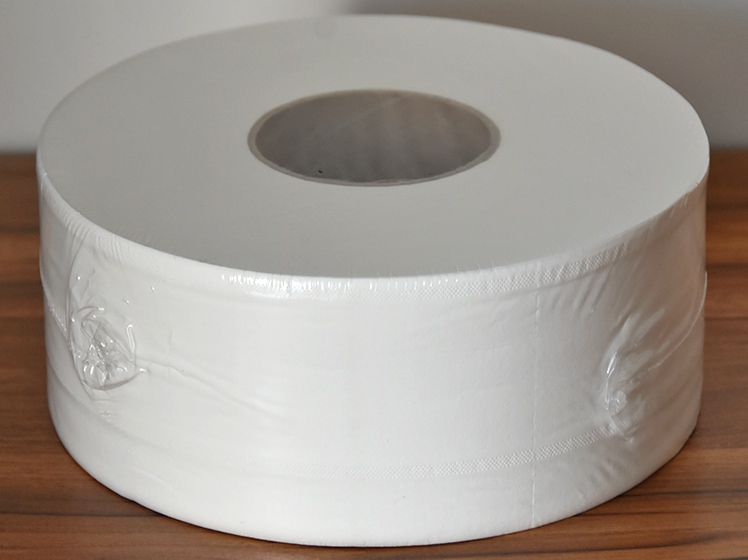
Cost Breakdown & ROI
The real profit leak in OEM paper towels isn’t the FOB price — it’s the freight and compliance fees you didn’t budget.
Let’s run a realistic landed cost for a 40’HQ container of custom 2-ply 20x21cm printed rolls, because that’s where the margin math lives. A 40’HQ holds roughly 2,700 cartons (industry estimate). At factory-direct pricing of $0.45–$0.60 FOB per roll, your ex-works subtotal lands around $1,215–$1,620 per 1,000 rolls. Add the embossing roller tooling ($800–$1,200 amortized over the first order) and a printing plate ($150–$250 per color). For a 1-color logo, call it $1,000 in one-time tooling, or about $0.37 per roll on a 2,700-carton run.
Ocean freight from Shanghai to Los Angeles for a 40’HQ averages $3,800–$4,200 (last 12 months, rising ~18% year-on-year due to peak surcharges). Add U.S. import duties at 6.5% on the FOB value. Throw in customs broker fees (~$300), drayage to your warehouse (~$500), and a small buffer for currency fluctuation (agree to lock the FX rate via a 30% deposit / 70% prepayment to avoid mid-order swings). Total landed cost per roll: $0.85–$1.20. That’s 20–30% less than a comparable domestic OEM product — but only if you control the hidden variables.
-
- Cylinder/plate storage fee: Most OEMs store your embossing roller and plates for free for 12 months, then charge $50–$100/month. Ask upfront and negotiate a waiver if you reorder within 18 months.
- Barcode registration: If you’re going retail, you need a GS1 UPC for each SKU — $250–$500 depending on country. Not the OEM’s cost, but often forgotten until the product hits the label design phase.
- FDA/LFGB testing: For North American hospitality or European retail, third-party testing for food-contact compliance runs $600–$1,200 per material batch. Factor it into your COGS from the start instead of absorbing it as a surprise.
- Warehousing & demurrage: Container sits at port longer than 5 free days? Demurrage fees can hit $150–$300/day. Book a confirmed warehouse slot before the ship sails.
- Changing print colors mid-run: Adding a second or third color plate ($150–$250 each) is minor. The real cost is slower machine speed and higher waste — a good OEM runs 4-color jobs on a slower press to maintain registration, adding 8–10% to unit cost. If your supplier quotes the same price for 1-color and 4-color, they’re cutting quality somewhere.
One more variable that erodes margins fast: fiber substitution in production. A supplier’s free sample may be 100% virgin pulp, but the mass-production run could blend lower-cost fibers unless a “sealed reference sample” from the first production batch is contractually locked. Demand that sample before shipment and compare GSM, ply bond, and embossing depth against an agreed reference. Top Source Hygiene performs tensile and colorfastness checks at three intervals (10%, 50%, 90%) during the run to catch batch drift — that’s the kind of protocol that keeps your landed cost predictable and your brand safe.
| Cost Component | Unit Cost | Key Details | ROI Impact |
|---|---|---|---|
| Custom Embossing Roller | $800 – $1,200 (one-time) | Steel roller; amortized over first order; standard patterns available at no extra cost | Negligible per unit after 10,000 rolls; adds premium feel |
| Printing Plate (per color) | $150 – $250 (one-time) | 1-color adds $0.02–$0.04/roll; 4-color adds $0.08–$0.10/roll | Higher print complexity increases brand recall but adds 8–10% unit cost |
| FOB Price per Roll | $0.45 – $0.60 | Custom 2-ply 20x21cm printed roll; factory-direct pricing | Base cost before freight/duties; 20–30% less than domestic sourcing |
| Landed Cost per Roll (NA/EU) | $0.85 – $1.20 | Includes ocean freight (~$3,800–$4,200 per 40’HQ) and duties (~6.5%) | Total per-roll cost under $1.00 for typical orders; predictable margin |
| Minimum Order Quantity (MOQ) | 1 x 40’HQ container (~2,500–3,000 cartons) | Flexible mixing of paper products (toilet, kitchen, facial) to fill container | Lowers per-unit cost via volume; allows multi-SKU testing |
| Production Lead Time | 15–25 days | Plus shipping: 7–14 days (NA/EU), 10–20 days (Asia/Oceania), 15–25 days (Africa/South America) | Predictable timeline for inventory planning; reduces stockout risk |
| Hidden Costs to Watch | Varies | Cylinder storage, barcode registration, FDA/LFGB testing, currency fluctuations | Mitigate by locking exchange rates with 30% deposit; negotiate plate storage fees |
Conclusion
The gap between a forgettable product and one that elevates your brand comes down to a few cents per roll and a watertight quality agreement. The professional standard is not a single pre-production sample — it’s a sealed reference sample from the first production batch, plus mid-run inspections at 10% and 50% to catch color shift or embossing drift before the container leaves the factory. That’s the last 10% that separates an amateur order from a brand‑safe one.
Before you finalize your shortlist, review the custom packaging and branding solutions that have already been deployed across 56 countries. Visit the industry-specific solutions page to see how Top Source Hygiene can support your next order.
Frequently Asked Questions
Do you support private label (OEM) for custom print kitchen paper towels?
Yes, we offer full OEM/ODM services for custom printed kitchen paper towels, including your logo, custom dimensions, GSM, ply, and packaging. You get complete control over branding from material selection to the final product. Share your design and specs to start the quote process.
What is your Minimum Order Quantity (MOQ)? Can we combine different paper products?
The standard MOQ is one 40-foot high-cube container per product type. Yes, different paper products like toilet paper and kitchen towels can be combined into a single container for smaller clients. Contact the company to confirm combined MOQ options for your region.
How do I get a competitive price for my custom order?
Provide your exact specs—GSM, ply, print colors, packaging type—and target volume to get a factory-direct price that cuts out intermediaries. Expect total landed cost around $0.85–$1.20 per retail roll FOB. Submit a detailed RFQ with your spec sheet for an accurate quote.
Can we receive samples for quality evaluation?
Yes, free stock samples ship in 2–3 days and custom samples take about 10 days, with shipping costs covered by us. This lets you verify absorbency, softness, and print quality before committing to a bulk order. Request stock or custom samples to evaluate before ordering.
What is the average lead time for a formal order?
Production lead time for a standard 40-foot container is 20-25 days after order confirmation and deposit. Urgent orders can be expedited upon request through faster production scheduling and shipping. Plan your timeline around the standard lead time or ask about expedited service.