Skip to content


Private-Label Diapers: Why a Tissue Buyer’s Usual Supplier Checklist Is Not Enough
Short answer: a diaper is not a bigger tissue product; it is a different category with a different regulatory identity, a different bill of materials, and a different way to fail. A tissue buyer’s standard file, sample check, GSM and roll count, will miss almost everything that matters. What a diaper program actually needs is written classification guidance from your own customs broker and health authorities before the contract, a component-level bill of materials with change control, finished-product performance testing on pilot production (absorbency, rewet, strike-through, leak resistance, fit) and safety testing on the exact construction you will receive, and a supplier audit aimed at a diaper line, not a trading office. In most African and Middle-East markets the regulatory classification, tariff line and any registration obligation differ from paper tissue, so the paperwork runs on a separate track from day one.
The call usually comes after a successful tissue program. A retailer in Lagos, Nairobi or Riyadh that has imported private-label toilet paper for two years decides to add diapers to its shelves, and assumes its existing Chinese supplier, or any tissue factory, can simply extend the relationship. The factory says yes. The buyer, riding the confidence of prior containers, moves fast. That is the moment the program is most exposed, because every habit that made the tissue order safe, comparing samples, checking GSM, verifying packing, is insufficient for a product whose core is a superabsorbent polymer, whose failure mode is a leaking diaper on an infant, and whose regulators may not classify it as paper at all.
Start at Customs and the Health Authority, Not the Catalog
The first task is not product selection; it is classification, and you own it, not the factory. Diapers may sit under a sanitary-towels or articles-of-fiber classing rather than the paper-tissue heading your tissue shipments used, which changes duty, restrictions, and documentation obligations in ways that shift by market and get amended without warning. Have your broker confirm the exact current code for your destination before the purchase contract is signed. In parallel, get written guidance from the national authorities on whether your product as specified is a plain hygiene article or anything else: infant diapers versus adult incontinence products, tape diapers versus pull-up pants, plain versus antibacterial, therapeutic or skin-protection claims, finished goods versus raw components. The moment a diaper makes a skin-health claim, in some jurisdictions you are in a health-product registration process rather than an import process, and that is a different year, not a different week. The US Commercial Service country commercial guide for Nigeria is a free, neutral way to see how restricted and regulated categories are structured, including where a health-product registration path diverges from an ordinary import process. The binding answer for your shipment still comes from your own broker and your authorities, obtained in writing, before the deposit is paid.
The Bill of Materials Is Where Diapers Differ Most from Tissue
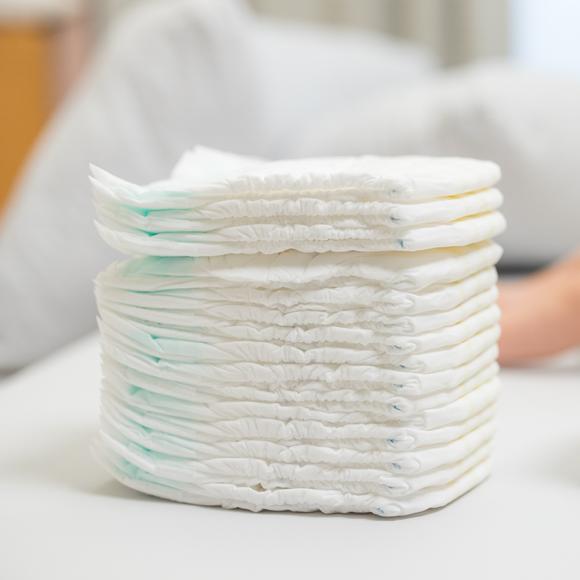
Tissue has a furnish; a diaper has a parts list. The minimum documentation a private-label buyer should hold is a component-level bill of materials naming the top sheet and nonwoven, the acquisition and distribution layer, the fluff pulp, the superabsorbent polymer, the back sheet film, the elastics, every adhesive, the fastening tapes or hook-and-loop closures, the waistband, any fragrance, lotion or aloe additive, and the packaging materials. Each entry should have a source and a specification, because the performance of the finished diaper is the behavior of that assembly, and the common failure pattern in second-year programs is silent substitution: the SAP supplier changes grade, the back sheet film becomes thinner, the adhesive reformulates, and the factory says nothing because the diaper still looks like a diaper on a shelf. The purchase order needs change control language at component level: notification and buyer approval before any raw material, supplier, machine, formulation or site change, with the right to re-test. This is the diaper equivalent of locking the approval sample before mass production, a discipline that applies to tissue as much as to absorbency products, and the reason serious private-label programs build the brand around fixed specifications rather than loose descriptions. Applied to diapers, it means the chemistry you cannot see in a sample is still contractually frozen. The buyer who treats the bill of materials as the real product specification, and the sample as only its visible surface, is the buyer whose second order looks like the first.
Testing: Finished Product, Pilot Production, Both Axes
Two families of tests, done on samples from a pilot production run rather than hand-made prototypes, cover most of the risk. Performance on every size: total absorbency, absorption speed, rewet under load, strike-through, leakage resistance, core integrity after wetting, elastic recovery, fastener strength repeated through a full open-close cycle, leg and waist opening dimensions, fit against representative body forms from your market, and odour or visible defects. A diaper that passes a lab absorbency test can still leak in real use because the cut, elastic tension or sizing is wrong for the children, or the adults, actually wearing it. Safety and hygiene on the finished article: microbial counts, specified pathogens, pH of relevant extracts, formaldehyde, heavy metals, residual solvents, restricted plasticizers, fragrance allergens if fragrance is used, and latex if any component contains natural rubber. The governing principle is that a raw-material certificate is not a finished-product guarantee; the report must identify the exact brand, size, construction and lot you are accepting. This is the same evidentiary logic that governs skin-contact paperwork in tissue, where dermatological validation for sensitive-skin products teaches the discipline of testing what ships, not what was designed.
The Supplier You Know May Not Be the Supplier You Think

Tissue factories frequently offer diapers because hygiene-paper buyers keep asking; that does not mean the same walls make them. The audit questions are identity questions: the business license and the actual manufacturing address, not a trading-company office; ownership and which line produces your product; the number, age and throughput of diaper lines; export history to your market and your region; which processes are subcontracted; product liability insurance; and the management systems behind them, quality certification, a documented complaint and recall procedure, batch traceability, calibrated test equipment on site. Verify certificates directly with the issuing body rather than accepting PDFs. A tissue exporter that is honest about subcontracting its diaper production can still be a good partner, but the relationship must then cover two supply chains, and your change-control, testing and recall obligations attach to both. The broader supplier-verification logic is familiar from any first tissue container, and the specific failure modes of paper-sourcing fraud, trading fronts and fake certificates, are catalogued in the site’s sourcing fraud verification protocol; diapers raise the same stakes with more components.
Build the Program, Not the Order
Sequence the first diaper project as a program with gates. Classification confirmed in writing; supplier verified at line level; bill of materials locked with change control; pilot run tested for performance and safety; sizing trial in your market with a defined acceptance list; conformity or registration documents scheduled like a production milestone; and a launch that keeps the first purchase order deliberately small. The retailer that orders one container, shelves it, sells it and measures complaints before ordering five is running the diaper category professionally. The one that orders five because the tissue math felt easy is running a recall rehearsal. Keep a complaint log from day one of shelf life, categorized by size, lot and failure mode, because diaper complaints arrive in patterns, leaks at night correspond to core capacity, red marks correspond to elastics or fit, and rash complaints correspond to chemistry or fragrance, and that pattern is the fastest feedback loop back to the factory when a second iteration is ordered.
Frequently Asked Questions
Can my existing tissue factory just add diapers to the container?
Sometimes, but verify what that sentence means. Ask which line makes your diapers, where the core components come from, and what is subcontracted. If the factory trades in diapers rather than producing them, you have a second supplier relationship with its own audit, change-control and recall obligations.
Are diapers regulated like paper products?
Often not. The tariff classification is usually different from tissue, and products making skin-health, antibacterial or therapeutic claims may enter a health-product registration path. Get written classification guidance from your broker and the national authority before signing anything, and do not let the factory choose your code.
What single test matters most before the first order?
Finished-product performance on pilot production across your size range, including rewet and leak resistance plus fit against representative test forms from your market, backed by safety testing on the exact construction. Shelf-appearance samples prove nothing about the assembly.