

Bulk sourcing math acts as the final gatekeeper between a profitable wholesale operation and a balance sheet filled with hidden logistical deficits. Relying on simple unit costs often leads to a distorted view of ROI, especially when sea freight fluctuations and last-mile delivery fees remain unaccounted for. Failing to master these calculations puts your cash flow at risk and leaves your margins vulnerable to the slightest shift in the global supply chain.
We examine the technical components of a successful procurement strategy, including landed cost breakdowns and the mechanics of pallet density optimization. This analysis covers how to detect discrepancies in sheet count through weight verification and the trade-offs between inventory turns and high minimum order quantities. By auditing every step from the factory floor to the final delivery, you can protect your margins against pulp price volatility and inefficient container utilization.
Why Is the “Price per Roll” the Most Dangerous Metric in Bulk Sourcing?
Fixating on unit pricing in 2026 frequently obscures a 15% to 30% surge in hidden operational expenses, secondary logistics fees, and working capital inefficiencies.
Total Cost of Ownership vs. Simple Unit Price
Traditional unit pricing fails as a primary metric because it ignores variables like quality consistency and supplier reliability. A low “per roll” quote often masks the risk of product variance, which leads to higher secondary costs through customer returns or machine downtime during conversion. At Top Source Hygiene, we prioritize a holistic framework that accounts for the total landed cost. This includes the base product price, ocean freight, customs duties under HS Code 4818.1000, and insurance. Analysis of current procurement data suggests that the cheapest unit price often correlates with higher long-term expenditures due to poor fiber performance or lack of 100% OBA-Free certification.
- Unit pricing overlooks the impact of material integrity on final customer satisfaction and brand reputation.
- Landed cost calculations must factor in the 15-30% addition for sea freight and accessorial charges.
- Strategic buyers evaluate the supplier’s ability to maintain batch color consistency across multiple 40HQ containers.
Working Capital Impacts and Cash Flow Stability
Bulk sourcing decisions directly influence a company’s liquidity. Large inventory investments tie up capital that firms could otherwise use for operational expansion or emergency reserves. While a 40HQ container offers the best volume discount, the strain on credit lines can be counterproductive. Procurement officers in 2026 balance these discounts against cash flow stability. In some scenarios, frequent smaller orders or trial 40HQ containers provide better financial agility than massive bulk purchases that sit in a warehouse for months, draining interest and limiting the ability to respond to wood pulp price fluctuations.
Storage Overhead and Inventory Management Risks
Holding massive quantities of paper products introduces significant physical and financial risks that per-roll metrics ignore. Warehouse square footage, insurance premiums, and the labor required to manage slow-moving stock add substantial hidden expenses. Tissue products are also susceptible to environmental degradation or obsolescence if regional demand patterns shift toward higher ply counts or coreless designs unexpectedly. Organizations now utilize demand predictability models to align procurement volume with actual storage capacity, ensuring that every pallet of 100% Virgin Wood Pulp rolls moves through the system before storage costs erode the initial bulk discount.
- Hidden warehouse costs include climate control and protection against moisture-induced degradation.
- Inventory turnover rates must be weighed against Minimum Order Quantities (MOQs) to maintain liquidity.
- High-density rolls (like the TSH-3396) maximize transport and storage efficiency by reducing “hidden air” in the container.

Hidden Costs: Analyzing Sea Freight, Duties, and Last-Mile Delivery
Total landed cost for bulk tissue sourcing often exceeds initial factory quotes by 25-45% once accessorial fees, port equipment penalties, and destination handling are fully audited.
Identifying Accessorial Surcharges in Ocean Freight
Sea freight base rates rarely tell the whole story. Accessorial charges, including port congestion surcharges and fuel price adjustments, frequently add 15-30% to the total shipping bill. These fees often appear as non-disclosed items in complex tariff documents, making them difficult to identify without a detailed cost audit. Handling charges alone typically account for 30% of total ocean freight expenses.
| Cost Category | Est. Impact (%) | Primary Driver |
|---|---|---|
| Accessorial Surcharges | 15% – 30% | Fuel volatility & port congestion |
| Terminal Handling | ~30% of Freight | Port infrastructure & labor costs |
| Compliance & Admin | 3% – 5% | Customs clearance & documentation |
Top Source Hygiene provides transparent fee structures to help distributors anticipate these expenses before production begins in the Mancheng factories. By identifying these “hidden” costs early, buyers maintain budget accuracy and avoid the margin erosion common in high-volume tissue procurement.
Impact of Demurrage and Detention on 2026 Shipping Budgets
Time-sensitive logistics fees like demurrage and detention significantly erode profit margins if not managed proactively. Port storage fees and equipment usage penalties accrue rapidly when containers exceed the allotted “free time” at the terminal. This is a critical risk for high-volume 40HQ container shipments, where a single day of delay can cost hundreds of dollars per container.
- Establish efficient clearance protocols to minimize port dwell time.
- Submit all documentation early to ensure smooth transitions from vessel to inland transport.
- Audit carrier-specific “free time” allowances before booking to match local warehouse capacity.
Regional Import Duties and Regulatory Compliance Fees
The cost of entry varies by destination, influenced by local trade agreements and specific product certifications. North American markets require FDA compliance, while European orders often necessitate FSC-certified paper to meet green consumer demands. Customs duties for 100% virgin wood pulp products vary significantly between regions like Oceania and South America. Non-compliance with local hygiene standards leads to costly shipment delays or rejections at the port of entry, adding a layer of risk that goes beyond the per-roll price.
Managing Last-Mile Delivery and Destination Handling Expenses
The final leg of the supply chain involves localized costs that buyers often overlook during the initial sourcing phase. Transporting thousands of tons of monthly capacity from ports to commercial warehouses involves varying drayage and fuel surcharges. Bulk orders for high-traffic venues like malls and airports require specialized unloading equipment and scheduled delivery windows. Factoring in destination terminal handling charges (DTHC) ensures the landed cost per roll remains competitive for the end user.
Build Your Unique Toilet Paper Brand

Does Pallet Density Optimization Give You a 5% Edge Over Competitors?
Maximizing cubic utilization in a 40HQ container directly offsets raw material price hikes, allowing distributors to maintain a 15% lower landed cost per roll compared to inefficiently loaded shipments.
Maximizing Vertical Cube Utilization in Regional Warehouses
Managing a production capacity of 2,860 tons per month at our Baoding facilities requires advanced vertical racking systems to prevent facility bottlenecking. By utilizing the full height of regional warehouses, Top Source Hygiene keeps large-scale OEM orders ready for immediate dispatch to 56+ countries. High-density storage ensures that 100% Virgin Wood Pulp rolls remain protected from ground-level moisture while reducing the overhead costs typically associated with facility expansion and climate control.
| Loading Method | Volume Capacity (40HQ) | Primary Sourcing Benefit |
|---|---|---|
| Loose-Loaded (Manual) | ~67.7 CBM | Maximum roll count; lowest freight per unit. |
| Standard Palletized | ~59.0 CBM | Rapid forklift unloading; minimal labor hours. |
| Optimized BFD Loading | 85–92% Space Utilization | Balanced volume with 15-minute dock turnaround. |
Impact of Standardized Palletization on International Freight Costs
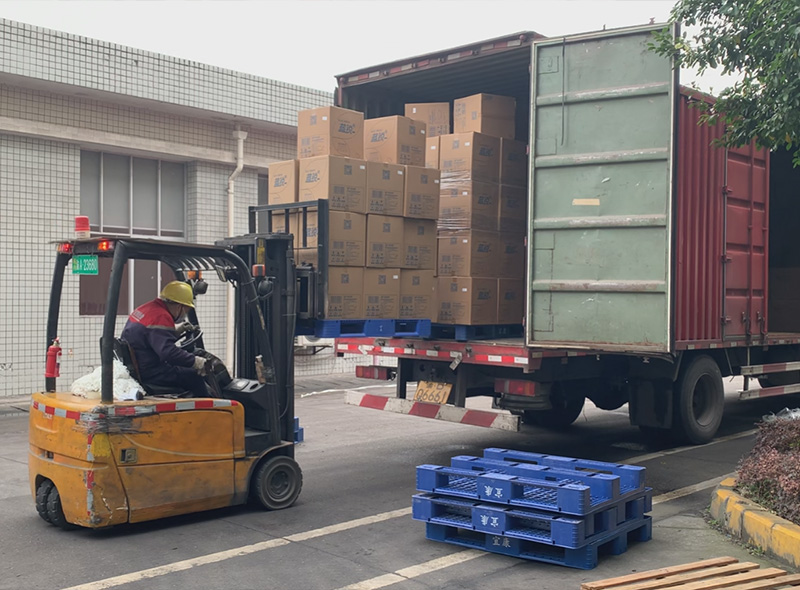
Standardized pallet sizes and precision load planning minimize the “paid-for air” that plagues inefficient supply chains. For shipments heading to South American or African routes, where transit times reach 15-25 days, stabilized palletization prevents product shifting and crushing. When every 40HQ container reaches its weight limit—typically between 7,000kg and 9,000kg for tissue products—clients spread fixed port fees and sea freight across a larger volume of jumbo rolls, directly lowering the per-roll landed cost.
Reducing Labor Overhead Through Optimized Load Planning
Systematic pallet organization streamlines forklift operations, moving goods faster from the factory gate to the container. This efficiency is why we maintain a reliable 20-25 day production lead time for 40HQ orders. Beyond the factory, organized pallet layouts simplify inventory auditing for procurement managers in high-traffic hospitality and retail sectors. Improved load stability also minimizes the need for manual restacking during the “last mile,” eliminating a significant source of hidden labor costs.
Strategic Advantages of High-Density Loading for 2026 Supply Chains
- Companies leveraging optimized pallet configurations gain a measurable pricing edge over competitors who still rely on loose-loading methods in high-labor cost regions.
- Density optimization aligns with 2026 sustainability goals by reducing the total number of shipments required for large-scale institutional procurement.
- Protecting margins during wood pulp price fluctuations becomes possible when retail groups lower the landed cost per unit through superior volume utilization.

The Inventory Turn: Balancing MOQ with Cash Flow Stability
Effective bulk sourcing in 2026 requires a shift from chasing the lowest unit price to optimizing the inventory turnover ratio through precise MOQ alignment and manufacturing lead-time synchronization.
Strategic MOQ Selection for Liquidity Control
Sourcing at scale often forces a compromise between unit price and liquidity. We maintain a standard MOQ of one 40’HQ container because it maximizes manufacturing throughput and minimizes shipping overhead. For distributors in Africa and South America, managing this volume requires a clear understanding of monthly burn rates. While bulk purchasing lowers the per-unit cost, procurement teams must ensure that inventory does not turn into stagnant capital.
- Top Source Hygiene uses the 40’HQ standard to maintain the lowest landed cost for international buyers.
- Regional flexibility helps smaller distributors manage cash flow without overextending credit lines.
- Robust analysis of monthly sales ensures that high-volume orders remain profitable and move quickly through the warehouse.
Synchronizing Production Lead Times with Demand Cycles
Predictable manufacturing cycles provide the backbone for a lean supply chain. Our 20-25 day production window for full containers allows procurement teams to implement just-in-time delivery strategies. By coordinating production with market demand spikes, you avoid the costs associated with holding excess safety stock. We time the dispatch from our Hebei facility to Tianjin Xingang Port to match your specific shipping schedules.
- Reliable 20-25 day cycles for full containers enable precise scheduling for peak demand periods.
- Short transit windows to Europe and North America facilitate faster replenishment than competitors with longer lead times.
- Consistent lead times directly improve the company’s inventory turnover ratio and working capital health.
Inventory Velocity and High-Capacity Product Solutions
High-capacity products like the TSH-3396 coreless rolls maximize paper volume within the same storage footprint. Commercial hospitality clients use these solutions to cut maintenance labor by 15% and extend the interval between restocking. This efficiency translates to higher inventory velocity at the warehouse level. Our manufacturing process utilizes mechanical compression technology to ensure every 40’HQ container carries up to 9,000kg of product rather than air.
- Jumbo roll tissues reduce maintenance overhead for commercial facilities and airports.
- Pallet density optimization ensures every cubic meter in the 40’HQ container contributes to sales volume.
- Data-driven forecasting for 2026 aligns our 2,860-ton monthly output with global hospitality and retail demand.

How to Detect “Hidden Air” in Sample Rolls via Weight Verification?
Weight-based auditing serves as the primary empirical defense against suppliers who use loose winding and oversized cores to inflate roll volume while reducing actual paper mass.
Identifying Loose Winding and Volumetric Discrepancies
Loose winding is a common tactic used to create the illusion of a high-capacity roll while using significantly less raw material. Manufacturers often adjust tension during the rewinding process to trap air between the plies, resulting in a roll that looks thick but lacks density. You should inspect the roll diameter relative to its total mass to identify these discrepancies. A roll that appears premium but feels soft or “squishy” when squeezed usually indicates a lack of structural integrity and a lower sheet count than advertised.
We verify density by comparing physical samples against 2026 industry benchmarks for commercial dispensers. High-quality rolls from facilities like Top Source Hygiene maintain a firm profile, ensuring they do not collapse or jam when placed in high-traffic restroom fixtures. If a roll loses its shape under moderate hand pressure, the manufacturer has likely substituted volume for fiber density, which increases the frequency of roll changes and total cost of use for the end client.
Calculating the Core-to-Paper Weight Ratio
Substandard suppliers frequently use heavy cardboard cores to artificially inflate the total weight of a shipment. Since bulk toilet paper is often priced by weight or bundle, a thicker core allows the factory to reduce the amount of 100% virgin wood pulp while keeping the scale reading high. To detect this, you must remove the core and weigh it separately. The core should provide structural support without accounting for a disproportionate percentage of the total product weight.
| Verification Metric | Substandard Supplier | Top Source Hygiene Standard |
|---|---|---|
| Roll Firmness | Low (Trapped Air) | High-Density Compact Winding |
| Core Weight Impact | 25g+ (Heavy Cardboard) | 10g – 15g (Optimized Strength) |
| Paper-to-Air Ratio | 15-20% Voids | <3% (Maximum Fiber Payload) |
By focusing on the net weight of the pulp, you confirm the client receives the actual GSM (grams per square meter) promised in the procurement contract. We compare core thickness across different samples to detect attempts to mask lower sheet counts. If the net weight of the paper does not match the technical specifications despite the roll dimensions appearing correct, you are paying for “hidden air.”
Applying Precision Grammage Audits for 2026 Quality Standards
Precision grammage audits are the most reliable way to confirm paper ply and absorbent capacity. You should measure the weight of a single sheet and multiply it by the total sheet count to cross-reference the result with the total roll weight. Small variances can indicate inconsistent production across a factory’s monthly capacity. We utilize high-precision scales to detect variances as small as 0.5 grams, which prevents the shipment of substandard batches that fail to meet softness or durability requirements.
- Calculate theoretical weight: (Sheet Area x GSM x Sheet Count) and compare to actual scale readings.
- Audit random samples from 2026 production runs to ensure batch consistency across the 40HQ payload.
- Verify that the 100% virgin wood pulp provides the specified tensile strength without added chemical weight or fillers.
Risk Mitigation: Navigating Global Pulp Price Fluctuations in 2026
Procurement success in the 2026 pulp market requires moving away from reactive purchasing toward a model centered on mill utilization benchmarks and regional supply diversification.
Anticipating Price Shifts through Global Operating Rate Analysis
We track global pulp mill operating rates as they approach the 91% threshold. Historically, crossing this line signals a definitive shift in pricing power from the buyer to the producer. In the 2026 market, we observe a distinct regional divergence where North American markets maintain a structural oversupply while Asian demand remains resilient despite logistics volatility. By monitoring these utilization benchmarks, we forecast potential price surges and help distributors adjust order volumes before mill capacity constraints trigger peak-price sourcing.
- Monitor the 91% utilization benchmark to forecast potential price surges in the 2026 market.
- Identify regional supply-demand imbalances between the North American oversupply and resilient Asian demand.
- Adjust order volumes based on mill capacity constraints to avoid peak-price sourcing.
Diversifying Sourcing to Hedge Against Geopolitical and Tariff Risks
Global trade tensions and regional tariff policies create sourcing uncertainty that requires a diversified supply chain approach. We mitigate these risks by leveraging Top Source Hygiene’s established global shipping network to bypass localized geopolitical disruptions affecting major pulp export hubs. Analyzing regional divergence allows us to shift procurement focus when specific trade routes face high volatility, protecting client margins from the 15-30% cost spikes often hidden in sea freight and accessorial charges.
- Analyze regional divergence in pulp markets to shift procurement focus when specific trade routes face high volatility.
- Mitigate tariff-driven cost increases by utilizing Top Source Hygiene’s established global shipping network.
- Maintain flexible vendor relationships to bypass localized geopolitical disruptions affecting pulp export hubs.
Securing Raw Material Stability Amidst Global Wood Chip Scarcity
Rising input costs from wood chip shortages, particularly in major production bases like China, necessitate a focus on raw material security. We evaluate the impact of wood chip scarcity on 100% virgin wood pulp production costs throughout 2026 to ensure price transparency for our partners. By leveraging long-term partnerships with certified pulp suppliers, we maintain consistent material access during shortages. We also utilize FSC-certified and eco-friendly material alternatives to ensure supply chain continuity if traditional fiber sources tighten.
- Evaluate the impact of wood chip scarcity on 100% virgin wood pulp production costs throughout 2026.
- Leverage long-term partnerships with certified pulp suppliers to ensure consistent material access during shortages.
- Utilize FSC-certified and eco-friendly material alternatives to maintain supply chain continuity if traditional sources tighten.
Adopting Dynamic Procurement Windows for Volatility Management
Fixed-price stability is no longer a viable long-term strategy in a volatile market; instead, we employ data-driven procurement timing to capitalize on market dips. We execute bulk purchases during identified pricing troughs rather than following rigid quarterly schedules that may coincide with peak costs. Using real-time market data allows us to manage currency fluctuations affecting international pulp transactions. We offer flexible OEM/ODM contract terms that reflect current market realities while strictly protecting the profit margins of our B2B distributors.
- Execute bulk purchases during identified pricing troughs rather than following rigid quarterly schedules.
- Use real-time market data to manage currency fluctuations affecting international pulp transactions.
- Offer flexible OEM/ODM contract terms that reflect current market realities while protecting client margins.
Conclusion
Successful paper sourcing relies on analyzing total landed costs and pallet density rather than surface-level unit prices. Accurate material verification and logistics planning protect wholesale margins from fluctuating pulp prices and hidden freight expenses. These calculations ensure that every 40HQ container delivers predictable ROI and consistent product quality for your distribution network.
You can evaluate your current procurement strategy by reviewing the technical specifications of our primary inventory models. Contact Top Source Hygiene for a detailed logistics quote or to request weight-verified samples from our Hebei production facility.
Frequently Asked Questions
How do I calculate the total landed cost of bulk toilet paper from China?
To calculate the total landed cost, you must aggregate the factory EXW/FOB price, ocean freight, marine insurance, customs duties (HS Code 4818.10), port handling fees, and inland trucking to your warehouse. Beyond these basics, a holistic assessment must include “hidden” variables such as the cost of tied-up working capital during the 30-45 day transit and inventory holding expenses. Use the formula: (Unit Price + Freight + Duties + Logistics + Insurance) / Total Units = Landed Cost per Unit.
What is the most cost-effective way to pack a 40HQ container with tissue?
The most cost-effective strategy is “Floor Loading,” which involves manually stacking the product without pallets to utilize the full 76.4 CBM capacity of a 40HQ container. To maximize density, utilize nested stacking patterns for individual rolls or vacuum-compressed bundles for folded products. This reduces the “shipped air” ratio, allowing you to fit more product per cubic meter and significantly lowering the per-unit freight cost.
How do global wood pulp prices directly impact my wholesale profit margins?
Wood pulp accounts for approximately 60% to 70% of the manufacturing cost of tissue. Fluctuations in global indices (such as NBSK or BEK pulp) have a direct, linear impact on your Cost of Goods Sold (COGS). When pulp prices rise, your wholesale margins will contract unless your procurement strategy includes price-escalation clauses or you have secured long-term fixed-rate contracts. Monitoring market timing is essential to avoid purchasing during peak volatility.
Is it more profitable to import parent rolls or finished products?
Importing finished products is typically more profitable for businesses without local converting machinery, as it avoids high capital expenditure and labor costs. However, importing parent rolls (jumbo rolls) becomes more profitable at high volumes if you have local conversion facilities. Parent rolls are more efficient to ship in terms of raw weight, but they require significant operational capacity to transform into retail-ready units.
What are the common hidden costs in international toilet paper logistics?
Common hidden costs include demurrage and detention fees caused by port congestion, customs examination fees (X-rays), and currency exchange rate fluctuations between the deposit and final payment. Additionally, “volumetric weight” surcharges can apply if the cargo is light but bulky, and local palletization fees may be charged if the goods must be palletized at the destination port for delivery to a specific warehouse.
How to verify the GSM and sheet count of a bulk order before shipping?
To verify GSM (Grams per Square Meter), use a precision circular sample cutter and a digital scale to weigh a 100cm² area. To verify sheet count, you should perform a manual count on random samples or use the “weight-based verification” method: (Gross Roll Weight – Core Weight) / (Sheet Length x Sheet Width x GSM x Number of Plies). It is highly recommended to hire a third-party inspection service (like SGS) to perform these tests at the factory before the final balance is paid.