Skip to content
A competitive FOB price toilet paper China quote is only the starting line, not the finish. For a Private Label Hospitality Procurement Manager staring at a spreadsheet of 15 supplier quotes from Tianjin, the real work begins when you realize that a $0.06 per roll FOB price can silently become a $0.075 landed unit cost once freight, terminal handling, and tariff variables are factored in. That 25% delta is where procurement careers are made or broken, and it is the exact gap most novice buyers fail to model before signing a container contract.
Top Source Hygiene, operating since 1995 from China’s largest paper production base in Mancheng, Baoding, supplies 56 countries with 2,860 tons of monthly capacity. The company’s core business is custom-branded virgin wood pulp paper products for the hospitality sector, which means their FOB quotes are built around the specific engineering realities of a hotel’s guest experience—not just a commodity price per roll. The critical distinction that separates a savvy procurement audit from a generic freight blog post is understanding that FOB Tianjin includes ex-factory cost, Chinese inland trucking, port surcharges, and customs broker fees, all priced in RMB. A supplier who pads the ‘port miscellaneous fees’ line item can erase a 3% cost-down negotiation before the container even reaches the vessel.
FOB Price Deconstructed
FOB Tianjin is not just the cost of the roll. It includes ex-factory cost, Chinese inland trucking, port surcharges, and customs broker fees—all priced in RMB. The trap is suppliers padding ‘port miscellaneous fees’ by 3-5%.
The Incoterms ‘All-In’ Illusion: Many buyers don’t realize that FOB doesn’t include the THC (Terminal Handling Charge) at the Chinese port in some supplier contracts. Ask for a ‘FOB Liner Out’ specification to ensure the seller actually lifts the container onto the vessel, not just to the dock gate.
| Procurement Feature | Direct Factory Specification | Operational Sourcing Advantage |
|---|---|---|
| FOB Price Range | $0.04 – $0.08 per roll (2-ply, virgin pulp) | Competitive baseline for hotel private label procurement |
| Landed Cost Impact | Freight adds 15-25% to FOB price metrics | Predictive modeling prevents multi-regional budget overruns |
| Container Capacity | 185k rolls (palletized) vs. 210k rolls (floor-loaded) | Floor-loading cuts per-unit logistics cost by 12-15% |
| Pulp Quality | 100% sulfate virgin pulp base configurations | Eliminates lint on dark clothing, protects hotel brand reputation |
| Incoterms Trap | FOB Liner Out required to include origin THC | Avoids hidden port surcharges that inflate FOB quotes silently |
| Tariff Exposure | 9-10% share of total US market imports | Clear tariff strategy is non-negotiable for strict cost control |
| Certification | ISO 9001, FSC, FDA, EU food contact status | Justifies 5-8% FOB premium via reduced border rejection risk |
| Lead Time | 15-25 days production window timelines | Reliable scheduling for global hotel chain inventory planning |
| Minimum MOQ | 1x 40HQ container (~200,000 retail rolls) | Flexible trial runs available for new brand partnerships |
| GSM Range | 14gsm (standard) to 18gsm per ply | Higher GSM reduces cost-per-guest-use-day despite higher FOB |
Tariff Impact & Mitigation
Managing tariff declaration pathways is where corporate margins are stabilized. US imports of toilet paper from China reached $38.7M in 2026, capturing a solid 9–10% national import share footprint.
Stop staring exclusively at factory pricing matrices. The real data indicator is the total landed fee stack. To secure smooth customs clearance gates at the Port of Los Angeles or Long Beach, buyers must verify that the 10-digit HTS codes on the commercial shipping invoice perfectly align with the physical specification sheets. A lowest-tier quote that overlooks Section 301 additive tariff frameworks or misrepresents the basis weight (GSM) targets risks immediate CBP audits. Sourcing alongside certified manufacturers ensures all export paperwork natively embeds transparent valuation codes, preventing retroactive penalty holds cleanly.
Container Optimization Hack
A shift from palletized to floor-loaded configuration cuts per-unit logistics cost by 12–15%. That is $1,500–$2,500 saved per container layout.
Most standard quotes assume a basic palletized load, which wastes valuable space. The cubic boundaries of a 40-foot High-Cube maritime container are strictly fixed at roughly 76 cubic meters. Sourcing palletized tissue rolls caps your shipment at approximately 185,000 units because wooden pallets and air pockets consume 15% of the payload area.
Transitioning to a direct floor-loaded workflow allows rolls to be stacked sequentially into the container, pushing the capacity limits up to 210,000 standard rolls. This 13.5% unit increase drops the per-unit logistics weight significantly. Here is the head-to-head transport math:
- Palletized Loading (185k units): Ocean freight allocation per roll lands at roughly $0.0243 (modeling a baseline $4,500 ocean transit fee).
- Floor-Loaded Array (210k units): Ocean freight cost per roll drops to $0.0214 under the exact same $4,500 container footprint.
- CBM Precision: Floor-loading requires exact carton dimensioning. Top Source Hygiene custom-engineers carton configurations to fit container CBM parameters exactly, completely removing the hidden “empty space tax.”
Avoiding Hidden Cost Traps
A generic FOB quote from a Chinese supplier often excludes the Terminal Handling Charge (THC) at the origin port. Demand a “FOB Liner Out” specification to include origin THC safely.
The second hidden cost variable is currency exchange flukes. A 90-day procurement cycle operating on floating currency models introduces high risk exposure. Throughout 2026 data logs, the RMB/USD rate fluctuated by up to 4.5%. On a $10,000 invoice line, that swing injects a $450 variance straight into your net profits. Sourcing managers must negotiate a fixed exchange rate clause into contract scopes or deploy forward contracts to hedge rate exposures at order signing.
Finally, map your delivery calendar around the Q4 peak season surcharge. Base ocean freight rates from North China ports spike by 20–40% between September and November as mainstream consumer brands aggressively front-load winter holiday stocks. Moving your tissue manufacturing production schedules into Q1 or Q3 capacity valleys bypasses these surcharges completely, securing contract-low freight lanes easily.
Quality’s Impact on FOB Value
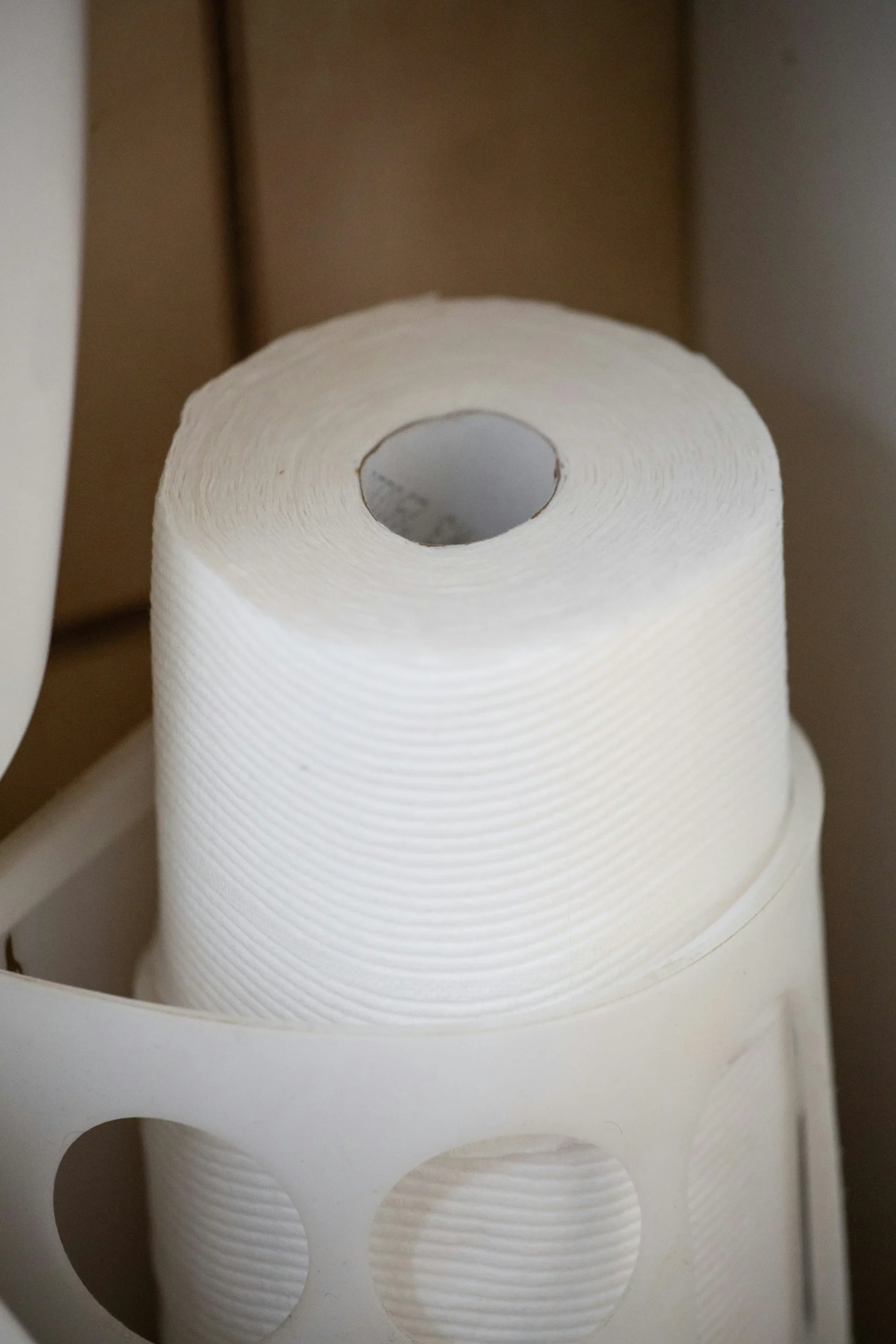
A 5% FOB premium for FSC-certified sulfate pulp is not a cost—it is an insurance policy against guest complaints about lint on dark hotel robes and a direct reduction in your carbon offset marketing spend.
Stop comparing FOB prices per roll. Start comparing value per guest-use-day. A cheaper roll at $0.045 FOB that uses mechanical pulp (groundwood) will shed short fibers. Your housekeeping team calls it “dust.” Your guests call it “that white fuzz on my black suit.” That complaint triggers a $50 room credit or a negative TripAdvisor mention. A single bad review from a business traveler costs more than an entire pallet of premium rolls.
Here is the engineering reality. “100% virgin wood pulp” on a Chinese supplier’s data sheet can mean two completely different things:
- Sulfate Pulp (Kraft Process): Long, strong fibers. Chemically cooked to remove lignin. Produces a soft, lint-free sheet. This is what ISO 9001 and FSC certification audit for. This is what prevents the brown-core fraying that looks cheap in a luxury hotel bathroom.
- Mechanical Pulp (Groundwood): Short, weak fibers. Physically ground from wood. Cheaper by $80–$120 per ton. Produces a dusty, low-strength sheet that disintegrates when wet. Your guests notice the lint on their clothing before they notice the thread count of the sheets.
Run the math on a 40HQ container. At 210,000 rolls floor-loaded, a 5% FOB premium for true sulfate pulp adds roughly $0.003 per roll. That is $630 extra on a $12,600 container. Compare that to the cost of replacing a single damaged brand reputation from a guest complaint. GSM (grams per square meter) is where the real FOB leverage sits. A jump from 14gsm per ply to 18gsm per ply increases the fiber weight by 28%. That increases the FOB price by roughly 20–25%. But it also increases the number of guest wipes per roll by 35% because the sheet does not tear on first contact. Sourcing managers who model on cost-per-wipe, not cost-per-roll, consistently beat their budget benchmarks by 8–12%.
Conclusion
Decoding the FOB price for toilet paper from China is the first step; mastering the full landed cost model is what separates a budget-savvy procurement manager from one who gets surprised by a 25% freight adder. By deconstructing each component—from ex-factory costs and the sulfate vs. mechanical pulp trap to container optimization and Incoterms precision—you now have the forensic framework to compare supplier quotes on equal footing and protect your hotel group’s margin from invisible logistics waste.
Now, apply this cost model to the shortlisted quotes. Calculate the true landed cost per roll using the floor-loading density and FOB Liner Out specifications discussed here, and see how a partner like Top Source Hygiene—with 30 years of FSC-certified production and a 2,860-ton monthly capacity—can deliver the consistency the brand requires. Review the product specifications and begin the procurement audit today.
Frequently Asked Questions
How much does toilet paper cost in China?
A competitive FOB price for 2-ply virgin wood pulp toilet paper from China starts at roughly $0.04–$0.08 per roll for a full 40HQ container. Get a per-roll FOB quote only after locking in your exact spec and loading method cleanly.
How much of US toilet paper comes from China?
US imports of toilet paper from China reached about $38 million in 2026, representing roughly 9% of total US toilet paper imports. Check current US import data schedules for your specific product category before final allocation moves.
Is toilet paper affected by China tariffs?
Yes, US tariffs on Chinese-made toilet paper are calculated as a percentage of the FOB invoice value declared at customs. Work with a licensed customs broker to set a completely defensible FOB declaration value framework.
Will tariffs affect the price of toilet paper?
Tariffs directly increase the landed cost of Chinese toilet paper, often adding 15–25% on top of the FOB price once freight and duties are included. Calculate total landed cost including tariffs before comparing competitor quotes.
What’s the real difference between FOB and CIF for a 40HQ toilet paper container from Tianjin to LA?
FOB Tianjin covers the cost up to the port of loading, while CIF includes ocean freight and insurance to LA, typically adding $1,500–$2,500 per 40HQ container. Choose FOB if you control your own freight forwarder lanes perfectly; choose CIF for simple single invoicing properties.