
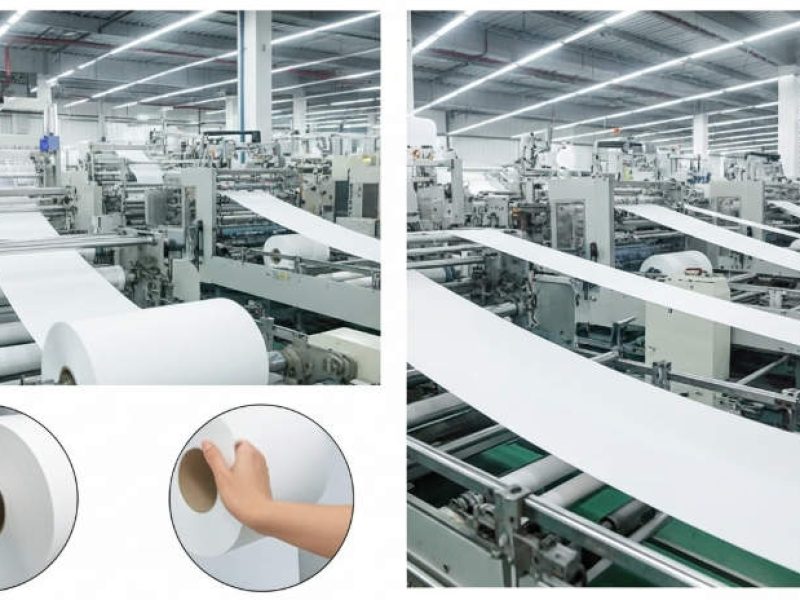
Optimizing your JRT Coreless Dispensing (Setup) determines if your facility captures real savings or simply replaces one maintenance bottleneck with another. High-traffic restrooms often bleed budget through constant cardboard disposal and labor-intensive restocking cycles that drive up operational costs. Failing to align your hardware with modern coreless standards results in wasted storage space and frustrated janitorial staff who struggle with incompatible mounting systems and increased downtime.
This guide provides a clear roadmap for transitioning your infrastructure, from selecting universal adapters to implementing staff training protocols. We look at specific hardware adjustments required for different dispenser models and how to maintain cross-brand compatibility. Use these steps as a standard operating procedure to reduce your facility trash volume while keeping maintenance costs predictable and your restrooms fully stocked.
What Hardware Changes Are Needed for Coreless Jumbo Rolls?
Upgrading to coreless JRT systems eliminates the reliance on traditional cardboard-core spindles in favor of high-density side-grip hardware that reduces both mechanical footprint and maintenance downtime.
Mandrel-Free Spindle Systems
Traditional 2-inch or 3-inch plastic tubes serve no purpose for coreless rolls. Modern hardware utilizes specialized nubs or prongs that grip the solid paper cylinder from the sides. Top Source Hygiene hardware integration relies on these internal brackets to provide a friction-fit, allowing the roll to rotate smoothly without a central support beam. Facilities often find that retrofit kits offer the most cost-effective transition, as these allow the conversion of existing cored dispensers into coreless-compatible units by swapping out the internal spindle assembly rather than replacing the entire shell.
Compact Dispenser Housings
By removing the dead space occupied by cardboard cores, manufacturers create rolls with a significantly higher paper-to-diameter ratio. This density allows for smaller dispenser housings that still maintain ADA accessibility compliance. These compact units work well in high-traffic commercial environments where restroom stall space remains limited. The smaller footprint reduces the outward protrusion from the wall, which minimizes the risk of accidental damage in crowded airport or shopping mall facilities.
- New hardware designs utilize a smaller footprint, making them ideal for space-constrained restroom stalls in older commercial buildings.
- Compact housings maintain ADA accessibility compliance by reducing the outward protrusion from the wall.
- Smaller dispensers allow for easier installation in high-traffic areas like airports and shopping malls where space is at a premium.
Twin-Roll Sliding Mechanisms
High-capacity hardware for coreless jumbo rolls often employs twin-roll configurations. These systems use a sliding door mechanism that only exposes the reserve roll once the first roll reaches total depletion. This hardware design directly supports zero-waste initiatives by preventing the disposal of “stub rolls”—the partially used rolls that janitorial staff often discard prematurely to avoid run-outs. For commercial distributors, moving to a twin-roll setup can cut maintenance rounds by up to 50% while ensuring every foot of paper is used.
Tool-Free Loading Infrastructure
Efficient roll replenishment depends on hardware that simplifies the workflow for cleaning crews. Modern coreless dispensers feature snap-in loading systems that bypass the need for keys or complex internal latches. Eliminating cardboard cores removes a significant step from the janitorial process, as crews no longer need to collect and recycle empty tubes. Streamlined loading mechanisms also reduce the number of moving parts, which leads to fewer mechanical failure points compared to traditional spring-loaded spindles.
- Modern coreless dispensers feature snap-in loading that does not require keys or complex latches, speeding up the replenishment cycle.
- Removing the need to manage and discard cardboard cores simplifies the workflow for cleaning crews in large-scale facilities.
- Streamlined hardware reduces the mechanical failure points often associated with traditional spring-loaded spindles.
Can You Use Coreless Adapters in Your Current JRT Dispensers?
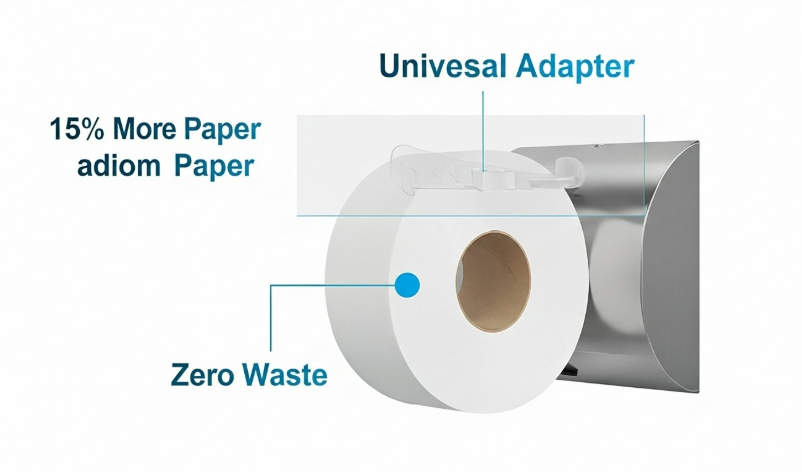
Retrofitting existing JRT cabinets with coreless adapters eliminates cardboard waste and increases usable paper volume by roughly 15% without requiring full hardware replacement.
Facilities often modernize their current restroom infrastructure by using specialized retrofit kits. These kits convert standard cored JRT dispensers into coreless-compatible systems. Major manufacturers provide hardware updates that allow older stainless steel or plastic cabinets to house coreless rolls, preventing the capital expenditure of a full fleet replacement. This conversion typically involves swapping the internal spindle or adding side-mounted brackets that grip the roll from the center dimples rather than a tube.
Retrofit Kits for Existing Cored Dispensers
Retrofitting enables the use of Top Source Hygiene’s high-capacity rolls, which maximize paper volume within a fixed dispenser footprint. By removing the bulky cardboard center, we can pack more linear feet of 100% virgin wood pulp into the same diameter.
- Hardware updates extend the life of existing dispenser cabinets while improving hygiene metrics.
- The conversion process remains simple, usually requiring only a screwdriver to replace the spindle mechanism.
- High-capacity rolls like the TSH-JRT08 series fit perfectly once the adapter is seated.
Universal Compatibility and Size Conversions
Current adapter technology addresses the variety of core diameters found in global markets, facilitating transitions between different paper formats. Most modern solutions support conversions between 1-inch and 3-inch core standards, ensuring that a single dispenser shell can adapt to changing supply chain availability.
| Performance Metric | Standard Cored Spindle | Coreless Adapter System |
|---|---|---|
| Waste Generation | High (Cardboard core per roll) | Zero (100% paper utilization) |
| Paper Capacity | Standard 1,000-2,000 ft | Up to 15% more tissue per roll |
| Refill Frequency | High (Every 1-2 days) | Reduced (15% longer life) |
Modular Hardware for Recessed Wall Units
Modular “E” kits and similar specialized hardware allow for the integration of coreless technology into space-constrained recessed dispensers. These units are common in high-end office buildings where external wall space is limited. The adapters maintain a flush appearance while significantly increasing roll capacity.
Using coreless technology in these units eliminates the need for janitorial staff to manage cardboard waste in tight maintenance closets. These modular components are engineered for quick installation to minimize facility downtime during upgrades.
Maintenance Impacts on Facility Operations
Switching to coreless adapters directly influences labor efficiency and operational costs in high-traffic commercial environments. Evidence from facility managers indicates that coreless systems reduce maintenance costs by approximately 15% through longer roll life. Janitorial teams spend less time collecting and recycling empty cardboard tubes, which streamlines waste management workflows.
- Removing the core allows for more usable paper per roll, decreasing the frequency of refill cycles.
- Laborers focus on cleaning rather than gathering discarded cores from restroom floors.
- Reduced delivery frequency for rolls lowers the overall carbon footprint of the facility.
Scale Your Brand with Premium OEM Solutions
How to Train Janitorial Staff on Loading Coreless Rolls Correctly?
Transitioning to coreless jumbo rolls requires a shift from simple replacement to technical alignment, as improper loading leads to increased dispenser downtime and avoidable hardware fatigue.
Standardized loading and alignment procedures serve as the first line of defense against dispenser malfunctions. Precise mechanical alignment prevents jams and ensures the tissue dispenses smoothly for the end user. When staff fail to align the center dimple or ignore the unwinding direction, the resulting friction often leads to paper tearing inside the housing, forcing secondary maintenance calls.
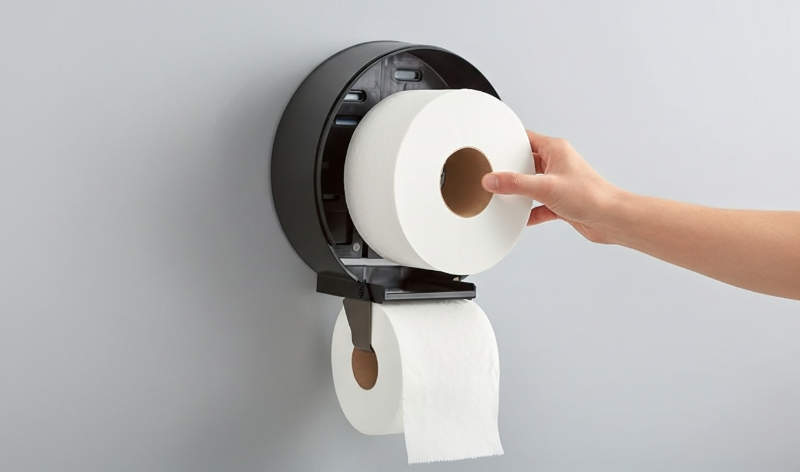
- Align the center dimple of the coreless roll with the dispenser’s internal arrows or locking mechanisms to ensure a secure fit.
- Ensure the tissue unwinds in a clockwise direction to prevent unnecessary friction against the dispenser housing.
- Follow specific sequences for multi-roll systems, such as loading the primary side first before engaging angle plungers for the backup roll.
- Verify the roll locks into place with an upward push rather than forcing it onto the spindle to avoid damaging the internal mount.
Implementing a Three-Phase Onboarding Model
A tiered training approach moves staff from basic safety awareness to independent equipment mastery. We recommend a structured curriculum that combines classroom safety with high-repetition physical practice. By 2026, facilities management teams must treat dispenser maintenance as a technical skill rather than a general task to protect the lifespan of expensive restroom hardware.
| Training Phase | Primary Activity | Mastery Requirement |
|---|---|---|
| Phase 1: Orientation | Hazard communication and PPE safety review. | 100% score on safety protocol quiz. |
| Phase 2: Familiarization | Hands-on practice with various coreless dispenser models. | Successful load in under 30 seconds without forcing parts. |
| Phase 3: Supervised Practice | Live restroom maintenance with real-time feedback. | Zero jams or mounting errors during a 5-day audit period. |
Developing Written Standard Operating Procedures (SOPs)
Documented standards eliminate guesswork and maintain service quality during periods of high staff turnover. These SOPs should act as a visual anchor for teams, particularly in facilities utilizing a mix of legacy cored dispensers and modern coreless retrofits. Institutional memory depends on accessible documentation rather than the verbal instructions of veteran employees.
- Create visual loading guides that display the exact sequence for every coreless dispenser type in the facility.
- Include quality checkpoints in the SOP to confirm that rolls are seated correctly before closing the dispenser cover.
- Maintain a centralized repository of manufacturer-specific instruction videos for quick reference by janitorial teams via mobile devices.
- Update documentation regularly to reflect any hardware upgrades or changes in roll specifications from suppliers like Top Source Hygiene.
Safety Protocols and Ongoing Performance Audits
Correct removal and handling techniques protect facility assets and sustain high hygiene standards. Over-aggressive removal of depleted rolls often snaps internal plastic tabs, requiring a full dispenser replacement. We advocate for a “gentle-touch” policy where mechanical force is never the solution for a stuck roll. Weekly audits help identify common loading errors early, allowing for targeted coaching before bad habits become established routines.
- Teach staff to use a rocking motion when removing depleted rolls to prevent damage to internal dispenser components.
- Perform weekly audits to identify common loading errors and provide targeted coaching to specific team members.
- Emphasize the importance of clearing any paper dust or debris from the dispenser interior during each roll change to prevent mechanism clogging.
- Recognize and reward staff who consistently maintain zero-damage records for restroom hardware to incentivize technical precision.
Why Does Coreless Technology Reduce Your On-Site Trash Volume?
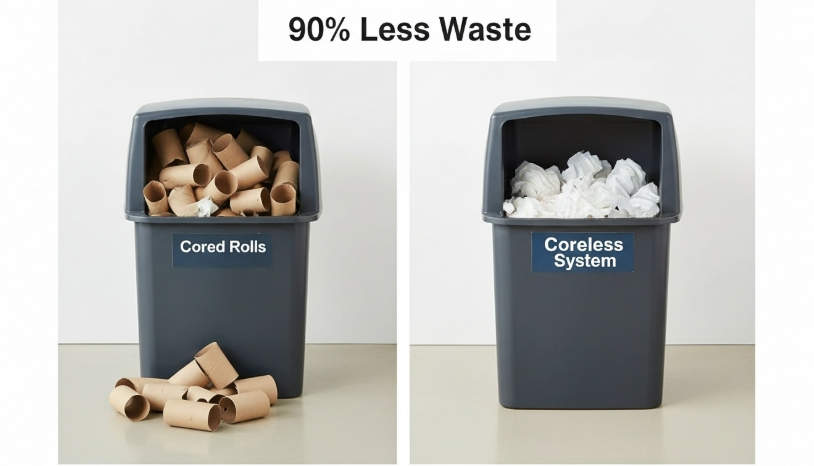
Transitioning to coreless systems removes the dead weight of cardboard tubes, slashing restroom debris by over 90% while maximizing product density in high-traffic commercial environments.
Traditional jumbo rolls center on cardboard or plastic tubes that serve no purpose other than structural support during shipping. These cores inevitably clutter facility waste bins, creating unnecessary bulk that janitorial staff must handle daily. Coreless technology removes this component entirely, which simplifies the waste stream at the source.
Elimination of Cardboard and Plastic Core Waste
Standard jumbo rolls rely on internal cores that add significant volume to trash collections. By eliminating the center tube, facilities see an immediate reduction in loose debris. This change cuts cardboard waste by more than 90% per case, allowing restroom bins to hold more actual waste like paper towels rather than empty structural components.
- Removing the core prevents empty tubes from rolling across restroom floors or being flushed down toilets.
- Facility managers report a cleaner aesthetic in stalls as the “last-inch” debris common with cored rolls disappears.
- The volume of recycled cardboard is reduced, lowering the frequency of heavy bin pickups.
Higher Product Density and Reduced Secondary Packaging
Since coreless rolls lack a center hole, we wind more usable paper into the same physical dimensions. This increased density allows for significantly higher sheet counts per roll. At Top Source Hygiene, we design high-capacity models like the TSH-3396 to maximize the product-to-packaging ratio. This means one shipment of coreless rolls contains more tissue and less air than a standard pallet of cored JRT.
- High-density winding reduces the total number of outer shipping cartons entering the site.
- Fewer rolls are required to meet the same demand, which cuts down on plastic wraps and pallet waste.
- Optimized roll capacity minimizes delivery frequency, indirectly reducing the carbon footprint of logistics.
Complete Consumption and Zero Leftover Scrap
Coreless technology ensures that users consume 100% of the purchased material. Traditional rolls often leave “stubs”—small amounts of paper stuck to the cardboard core with adhesive—that janitorial staff must strip away and discard. Coreless rolls utilize a solid winding process that allows the very last sheet to be used, ensuring no material is wasted.
- Eliminating adhesives means there is no sticky residue left on the dispenser or the final sheets.
- Zero-waste consumption means 100% of your procurement budget goes toward usable product rather than discarded scrap.
- Staff spend less time manually cleaning “paper nests” out of dispenser housings.
Simplified Waste Streams and Recycling Processes
Removing mixed materials from the restroom environment makes waste sorting more efficient for commercial facilities. When the core is removed, restroom waste consists primarily of paper towels, creating a more uniform stream. This helps janitorial teams work faster, as they no longer need to separate cardboard tubes from general trash.
- Cleaner waste streams reduce contamination in recycling processes, supporting higher facility sustainability rates.
- Fewer roll changes lead to less frequent bin emptying, which directly lowers the consumption of plastic trash liners.
- Operational efficiency improves as staff focus on cleaning rather than managing bulky cardboard debris.
What Are the Best Coreless JRT Brands for Universal Compatibility?
Selecting the right coreless jumbo roll system requires balancing proprietary dispenser footprints with universal refill accessibility to maximize restroom uptime and minimize waste volume.
Top Source Hygiene: Custom OEM Solutions for Global Markets
Top Source Hygiene operates as a high-volume source factory in Hebei, producing 2,860 tons of paper products monthly. We specialize in ODM and OEM services for distributors and hospitality groups requiring high-capacity coreless jumbo rolls (JRT). Our manufacturing process utilizes 100% virgin wood pulp to ensure 2-ply and 3-ply configurations meet 2026 durability and softness standards for international markets.
- Produces high-density rolls like the TSH-JRT08, engineered for maximum paper length and transport efficiency.
- Maintains international compliance with ISO 9001 and FSC certifications for seamless global distribution.
- Provides 100% OBA-Free material, guaranteeing no fluorescent whiteners for skin-safe commercial use.
- Offers mechanical compression technology during packaging to increase 40HQ container payload up to 9 tons.
| Brand / System | Compatibility Spec | Primary B2B Advantage |
|---|---|---|
| Top Source Hygiene | Universal OEM / ODM | Factory-direct pricing; 100% Virgin Pulp; 5-ply options. |
| Scott Essential (Kimberly-Clark) | 9.38″ Diameter Coreless | 15% more tissue per roll; 28% smaller dispenser footprint. |
| Tork OptiServe (Essity) | T2 & T7 Series Refills | 2x paper capacity; zero-waste cardboard elimination. |
| GP Pro Compact | Multi-roll Configurations | Space-saving 2-to-4 roll vertical/horizontal setups. |
Scott Essential by Kimberly-Clark: High-Capacity Efficiency
Scott Essential coreless systems target high-traffic environments where maintenance frequency remains a bottleneck. By removing the center core, these rolls provide 15% more tissue than standard jumbo rolls in the same physical space. The Scott Essential 09602 dispenser occupies a smaller footprint than traditional JRT units, making it effective for airports and malls where ADA compliance and space efficiency are critical.
- Keyless, one-handed reloading system eliminates the need for doors or keys.
- Dispenser design holds the equivalent of six standard commercial rolls.
- Lifetime warranty on hardware ensures long-term reliability for office facilities.
Tork Coreless Systems by Essity: Sustainable High-Traffic Options
Tork focuses on zero-waste architecture through the T2 and T7 series. These systems eliminate cardboard waste entirely, simplifying the janitorial disposal process and reducing the carbon footprint associated with core production. The OptiServe coreless system uses compact roll winding to fit significantly more paper into standard dispenser volumes, catering to healthcare and retail settings that cannot risk run-outs.
- The 2-roll horizontal dispenser serves up to 156 guests per refill cycle.
- Automatic roll shift mechanisms ensure guests have access to a fresh roll once the primary roll is depleted.
- Enclosed designs protect tissue from splashes and stains in public restrooms.
GP Pro Compact: Space-Saving Coreless Designs
GP Pro’s Compact line utilizes coreless technology to maximize storage and dispenser efficiency in tight restroom stalls. These systems often employ multi-roll configurations—ranging from 2-roll to 4-roll setups—to ensure a continuous supply of tissue. By removing bulky inner cores, facility managers maximize warehouse storage capacity, fitting more usable product into every cubic meter of shelf space.
- Aligned with universal coreless dispensers designed for high-density commercial use.
- Offers soft, multi-ply tissue options that maintain a premium feel for office environments.
- Reduces roll change frequency by up to 50% compared to standard cored rolls.
Conclusion
Transitioning to coreless jumbo rolls reduces waste and lowers maintenance costs by maximizing paper volume per roll. Simple adapters allow facilities to upgrade existing dispensers without the expense of full hardware replacement. This switch streamlines janitorial workflows while meeting sustainability goals.
Review your current dispenser inventory to determine which adapter kits fit your facility needs. Contact Top Source Hygiene for technical specifications or to request bulk samples for your next maintenance cycle.
Frequently Asked Questions
How do you hang coreless toilet paper?
Coreless toilet paper is hung by sliding the roll directly onto a specialized mandrel or spindle. Unlike standard rolls that rely on a cardboard tube, coreless rolls feature a small, reinforced center hole that fits snugly onto the dispenser’s mounting hardware, ensuring smooth rotation and consistent tension.
Do coreless rolls need a special holder?
Yes, coreless rolls require a specific dispenser or a compatible adapter. Because they lack a hollow 1.5-inch cardboard core, they will not fit on traditional spring-loaded spindles. Coreless dispensers are engineered with thinner, reinforced prongs designed to hold the tightly wound paper securely and reduce the overall footprint of the unit.
How to use an adapter for coreless TP?
To use an adapter, first remove the standard spindle from your current dispenser. Insert the coreless adapter (typically a slim mandrel or specialized insert) into the dispenser’s mounting brackets. Once the adapter is locked in place, simply slide the coreless roll over the adapter. This allows facilities to upgrade to high-capacity coreless paper without replacing entire dispenser units.
Are coreless rolls more difficult to load?
On the contrary, coreless rolls are designed to simplify maintenance. Since there is no cardboard core to remove and discard, the loading process is faster and produces zero waste. Modern dispensers often feature “no-door” or simplified latch designs, allowing janitorial staff to slide a new roll on in seconds, which significantly increases operational productivity.
Can Tork dispensers use coreless rolls?
Yes, Tork offers a comprehensive range of dispensers specifically designed for coreless rolls, such as the T7 and T6 systems. These units are highly efficient, often holding the equivalent of several standard rolls in a compact space, and are specifically engineered to eliminate core waste while providing reliable, high-capacity dispensing for commercial restrooms.
Best coreless JRT for office use?
For professional office environments, twin-roll coreless Jumbo Roll Tissue (JRT) systems are the industry standard. These systems maximize capacity and ensure a “never-out” experience by allowing the second roll to be accessed only after the first is depleted. Leading options like the Tork Coreless or Georgia-Pacific Compact systems are preferred for their space-saving design and high-quality paper texture.