
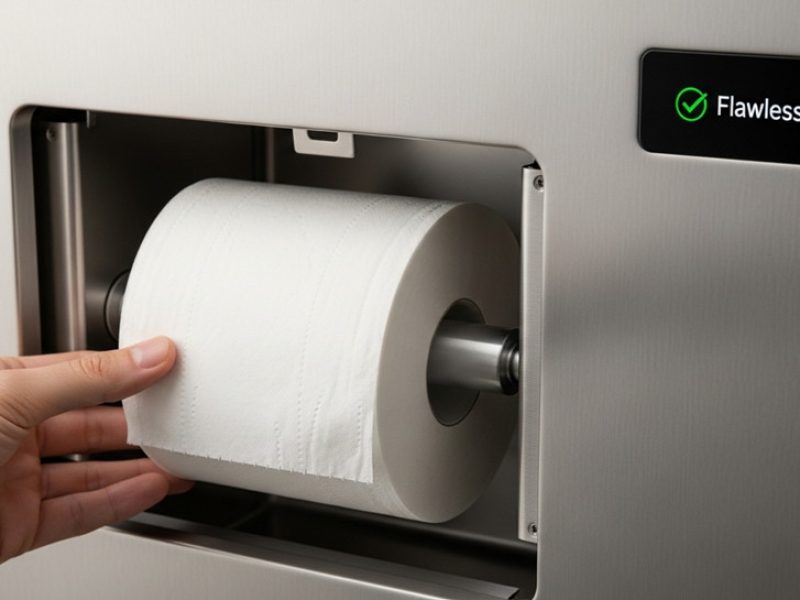
Roll Dimensions Guide mistakes around roll width, core diameter, and tightness create palletization errors, spike dimensional-weight fees, and put your shipping ROI and on-time delivery performance at risk.
This technical SOP walks through the 4.5″ x 4.5″ baseline, maps US versus EU size requirements, and focuses on the core logistics question of how roll width drives pallet count, container cubic utilization, and carrier dimensional-weight billing. You’ll get clear checks for core-diameter fit on commercial mandrels, step-by-step methods to measure roll density for private-label tenders, packing strategies for mega versus standard rolls, and worked examples you can plug into palletization and container-load calculations.
The 4.5″ x 4.5″ Standard: Navigating US vs. EU Size Requirements
Standardising a 4.5″ (114.3 mm) roll drives dispenser compatibility, compliance testing, and container-level cost efficiency across US and EU channels.
Dimensional conversions and dispenser compatibility (4.5 in → 114.3 mm)
Use the exact conversion 4.5 in = 114.3 mm and produce a nominal width of 114 mm for US-targeted SKUs to match prevailing market practice while staying inside common production ranges. Hold roll width tolerance tight — target ±1.0–1.5 mm — so rolls clear popular dispensers without retooling. That tolerance protects fit across small variation in slot dimensions and prevents rubbing or jamming during unwinding.
Measure dispenser geometry before finalising specs: usable slot width, maximum allowed outer roll diameter, and acceptable core inner diameter. Validate perforation placement and lead margin in millimetres on sample runs to confirm clean-tear performance, particularly for EU dispensers that demand precise alignment. Confirm core vs coreless compatibility with a physical sample test; common household core inner diameters sit around 38–42 mm, so confirm buyer preference or dispenser capability in writing.
- Dispenser-fit checklist: measure slot usable width, outer roll diameter, core inner diameter.
- Fit rule: specify roll width ≤ slot width − 1.5 mm for reliable insertion and clearance.
- Perforation control: state pitch and lead margin in mm; run samples and confirm tear quality under dispenser loading.
- Core decision: confirm buyer core ID (~38–42 mm) or supply coreless samples and verify holder support.
Regional regulatory, plumbing and material requirements affecting roll sizing
Tailor documentation and test results by region. For North America, prioritise septic-safe rapid disintegration reports, OBA-free certification, and any FDA-relevant material safety documentation that importers request. For the EU, provide EU hygiene compliance evidence plus sustainability paperwork such as FSC or equivalent where buyers emphasise eco-credentials. Prepare region-specific lab test reports on disintegration and microbiological safety when importers request them.
Compile a standard certification pack to speed approvals and customs clearance: ISO 9001 certificate, material composition statement (for example, 100% Virgin Wood Pulp), OBA-free certificate, and documented septic/disintegration tests. Use HS code 4818.1000 on commercial paperwork, and state material, ply, weight per bundle, and country of origin clearly to avoid delays. Run both US and EU sample compliance tests before full production and attach the reports to pre-shipment documentation.
- Required documents: ISO 9001, material composition (e.g., 100% Virgin Wood Pulp), OBA-free certificate, septic/disintegration test reports.
- Customs labeling: HS code 4818.1000 plus clear statements of material, ply, bundle weight, and country-of-origin.
- Action item: schedule and complete both US and EU compliance tests on pre-production samples; attach test reports to pre-shipment paperwork.
Manufacturing, packaging and logistics impacts of choosing a 4.5 in roll
Keep production specs within typical factory ranges to avoid costly tooling: choose 114 mm width inside the existing width range (102–132 mm) and set ply GSM between 13–22 g/m² per ply to balance softness and wet strength. That approach lets you preserve current die sets and minimise setup time while delivering a product compatible with North American expectations for septic-safe, OBA-free tissue.
Decide packaging format by end market: Individual Wrap for hotel and premium retail, Direct Bundle for value retail. Adjust compression settings as a merchandising lever — higher compression improves container utilisation but reduces perceived plushness. Plan container loads for 40HQ optimisation with typical payloads of 7–9 tons and set MOQ at 1 × 40HQ for private-label or first-run orders. Provide photos and videos of packing and loading plus dispenser-fit samples as standard pre-shipment verification to protect buyer margins and avoid disputes on dimensions.
- Production specs: width 114 mm, ply GSM 13–22 g/m² per ply, keep within 102–132 mm production envelope to avoid tooling changes.
- Packaging choices: Individual Wrap (hotel/high-end) or Direct Bundle (value/retail); set compression for cubic efficiency versus perceived softness.
- Container planning: optimise for 40HQ (payload 7–9 tons); set MOQ and private-label minimums at 1 × 40HQ for cost-efficiency.
- Pre-shipment verification: supply photos/videos of packing and loading and include dispenser-fit samples before releasing the final payment.
- Buyer checklist to specify: target width (mm), core type (inner diameter or coreless), ply count, GSM, bundle weight, packaging format, required certifications, and sample approval protocol.

Why Do Roll Dimensions Vary So Much Between Countries?
Roll width, outer diameter and bundle weight determine dispenser fit, shipping cost and customer satisfaction—specify them up front to avoid field failures and freight waste.
Regional roll-width and outer-diameter norms (dispenser and plumbing compatibility)
Manufacturers produce household and commercial rolls to regional preferences: common widths run from 102 mm, 104 mm and 105 mm up to 132 mm, while the US market uses a de facto 4.5″ (≈114 mm) width across many brands. GCC hospitality and premium channels push much wider formats—Top Source’s TSH-2269 at 165 mm targets guest comfort—so specify width to match local expectations and dispenser geometry.
Commercial and jumbo applications require large outer diameters (examples include TSH-JRT08-style jumbo rolls and commercial ODs commonly in the 8–12″ range). Measure dispenser throat width and the dispenser’s maximum acceptable OD before you set product specs, and include both numbers in RFQs to prevent returns and on-site retrofits.
- Measure dispenser throat width and maximum OD (mm or inches) and record core holder type.
- Specify roll width and max OD in RFQs and supplier drawings to force fit checks.
- For private-label dispensers, request custom-width options and minimum order quantities from the dispenser vendor.
Material, ply and core choices that alter roll diameter, sheet count and weight
Paper construction drives OD and meterage. Typical products use 2–5 plies with per‑ply GSM held between 13–22 g/m²; total GSM equals number of plies multiplied by per‑ply GSM and determines web thickness. Manufacturing choices such as high‑pressure ply‑bonding and CNC point‑to‑point embossing raise perceived thickness and absorbency (point‑to‑point embossing increases absorbency by ~30%), which increases OD for the same linear length.
Coreless or solid rolls (examples: TSH-3396, TSH-3082 at heavy bundle weights like 5000 g) pack more paper per bundle by eliminating the tube volume, altering roll OD and improving container packing density. Use the quick formula below to estimate linear meters per roll so you can predict sheet count and OD from weight and ply.
- Formula: linear meters ≈ (roll mass in grams) ÷ (total GSM × roll width in meters).
- Example: a 2,000 g bundle, 3‑ply with 16 g/m² per ply → total GSM = 48 g/m². For 0.11 m width: meters ≈ 2000 ÷ (48 × 0.11) ≈ 379 m.
- Use this to estimate sheets by dividing linear meters by sheet length (m) to set expected sheet count and select target OD tolerances with your supplier.
Logistics, standards and commercial packaging drivers that determine optimal roll size
Container economics and regulations shape roll specification. Top Source optimizes 40HQ loading with typical payloads of 7–9 tonnes and bundle weights configurable from 780 g up to 5000 g; common pack counts include 10, 12, 18, 28 and 32 rolls per pack. Freight-sensitive markets (SEA, Africa) prefer heavy, high‑density bundles for best cost‑per‑meter, while hospitality and premium retail prefer individually wrapped rolls for presentation.
Declare regulatory and certification needs early: North American and European buyers require rapid disintegration (septic‑safe), OBA‑free material and certifications such as ISO 9001, FDA and EU hygiene compliance. Use HS code 4818.1000 on customs paperwork. Tell your manufacturer target market, required certifications and preferred bundle weight so they can optimize roll width, OD and packing for container efficiency and regulatory compliance.
- Declare target market and required certifications (ISO 9001, FDA, EU hygiene) in RFQs.
- Specify preferred bundle weight and pack count to let the factory optimize 40HQ payload and carton layout.
- Balance freight vs. presentation: choose heavy bundles for lowest landed cost or individually wrapped formats for hospitality retail appeal.
Scale Private-Label Toilet Paper Profitably

Does Roll Width Directly Impact Your International Logistics ROI?
Roll width controls container density, dispenser fit, and landed cost per meter—small width changes can shift 40HQ yield and ROI materially.
Set measurable ROI KPIs and capture baseline production data
Start by defining precise KPIs you will measure across the supply chain: landed cost per roll, landed cost per linear meter, rolls per 40HQ, cubic meters utilized, and stock turns per month. Capture SKU baselines for each reference roll: roll width (mm), roll mass (g), rolls per pack, pack weight (g), and ply/GSM (set ply density between 13–22 g/m² per ply). Use HS code 4818.1000 for duty lookup and record current freight rate (USD/container) and any estimated duties so your cost model uses real inputs.
Compute linear meters per roll with a simple formula: meters ≈ roll_mass_g / (GSM_total * roll_width_m). For example, a 180 g roll at 2-ply with 15 g/m² per ply gives GSM_total = 30 g/m²; width 0.105 m yields ≈57 m. Run a one-batch sample (produce 50 rolls) at the target width and log outer diameter, mass variance, and dispenser fit checks to validate assumptions before scaling orders.
Specify roll width and production parameters that affect yield
Select widths from the standard range (102 mm, 104 mm, 105 mm up to 132 mm) and note US market compatibility at ~4.5 in (114.3 mm). Choose material and ply explicitly: 100% Virgin Wood Pulp, OBA-free, and set per-ply GSM inside 13–22 g/m² so final GSM matches strength and unwind behavior targets. Decide between core and coreless: coreless increases paper meters per cubic meter and reduces empty tube volume—TSH-3396 (coreless 5000 g/28 rolls) shows that approach improves freight efficiency on high-density bundles.
- Document tooling and machine settings: mandrel diameter, winding tension, perforation pitch, embossing depth, and allowable roll diameter tolerance.
- Validate production: test tensile strength, perforation integrity, emboss retention, and rapid disintegration (septic-safe) to meet North American and EU plumbing standards.
Design packaging and compression strategy around chosen width
Choose a packaging format that aligns with target channels: Format A (individual wrap for hotel/high-end) or Format B (direct bundle for value/retail). Map pack counts (10, 12, 18, 28, 32) to roll widths and expected carton yield; wider rolls may force lower pack counts to avoid obese cartons and lost container density. Calibrate bagging-line compression to reduce bulk but preserve sheet loft and maintain roll diameter tolerance for dispenser compatibility.
Specify export-ready master carton and pallet specs: reinforced 5-ply export cartons, target master bundle weight per carton, and pallet stacking height limits for 40HQ loading. Estimate single-roll footprint by measuring roll diameter and width, pick axial or radial packing orientation, and run a packing simulation to decide rolls-per-carton; adjust pack counts if wider rolls reduce carton yield. Before shipment, check batch color consistency, verify weight per carton, and add protective secondary packaging to prevent crushing under high stacking.
- Pack format mapping: match Format A to hospitality verticals and Format B to supermarket/warehouse club channels such as TSH-3266 or TSH-2559.
- Compression control: set percent compression limits so final roll diameter stays within specified tolerances.
- Pre-shipment checklist: color consistency, carton weight, bundle integrity, video evidence of loading.
Plan 40HQ container loading and payload calculations
Use standard 40HQ planning parameters and a realistic payload target (typically 7,000–9,000 kg). Map cartons per pallet and pallets per container to maximize volumetric efficiency. Build a stepwise yield model from roll_mass_g → rolls_per_pack → packs_per_carton → cartons_per_pallet → pallets_per_40HQ to produce total_rolls and total_weight, and cross-check against the 7–9 ton payload cap.
Model trade-offs explicitly: wider rolls increase perceived user comfort but reduce rolls per container and raise landed cost per roll; coreless and higher-density bundles increase meters per cubic meter and can offset width penalties. Aim for container fill percentage > 90% by both volume and weight and run scenario comparisons (for example, 102 mm vs 132 mm) to quantify changes in rolls-per-40HQ and cost-per-meter. Coordinate with the loading team on stacking pattern, mechanical compression tolerances, and record loading photos and videos for buyer verification.
- Stepwise container calc: roll_mass_g → rolls/pack → packs/carton → cartons/pallet → pallets/40HQ → total_rolls, total_linear_meters, total_weight.
- Scenario testing: compare rolls-per-40HQ and landed cost per meter for widths at 102 mm, 114.3 mm, and 132 mm.
Verify shipment metrics and compute post-delivery ROI with troubleshooting steps
On arrival, validate shipment metrics: count actual rolls in the container, weigh sample pallets, and compare results to the pre-shipment plan and bill of lading. Compute landed cost per roll and per meter using: (FOB + freight + insurance + duties + inland distribution + packaging) / total_rolls or / total_linear_meters. Compare actual KPIs against targets and isolate variance drivers such as chosen width, pack count, compression loss, or unexpected freight/duty changes.
If ROI misses targets, apply corrective actions: change roll width, switch to coreless or alternate pack counts, renegotiate freight or move to a higher order size to dilute fixed costs. Document lessons learned and update the spec sheet with final roll width, production settings, carton and pallet counts, expected rolls per 40HQ, and a revised break-even price for the next run so commercial teams can act on concrete, tested data.
- Post-shipment checks: physical count, pallet weight sampling, B/L reconciliation.
- Corrective actions: width change, coreless conversion (e.g., TSH-3396), pack-count adjustment, freight renegotiation, increase order size.
- Update spec sheet: final width, tooling settings, carton/pallet configuration, expected rolls per 40HQ, revised break-even price.

Core Diameter Engineering: Ensuring a Flawless Fit for Commercial Mandrels
How to Accurately Measure Roll Density for Private Label Tenders?
Accurate roll density quantifies material use, validates supplier claims, and protects freight and pricing decisions on private-label tenders.
Compute roll density from measured mass and cylindrical volume
Calculate roll density as mass per roll (g) divided by roll volume (cm³): density (g/cm³) = mass per roll ÷ [π × width (cm) × (R_outer² − R_core²)]. For coreless rolls set R_core = 0 and use the full cylinder volume. Convert units before you compute: mm → cm (divide by 10) and mm² → cm² (divide by 100); keep mass in grams and volume in cm³ for consistency.
Use the bundle example to apply the formula: TSH-3396 bundles weigh 5,000 g for 28 rolls, so mass per roll = 178.57 g. Measure outer diameter (OD) and core OD with digital calipers to ±0.01 cm, and measure width to ±0.1 mm. Insert those measurements into the cylindrical shell formula and compute density to three significant figures to match lab precision.
Standardized sampling protocol and environmental controls for tenders
Define sample size as the greater of 5 rolls or 1% of the batch, and stratify picks across pack positions (inner and outer bundles). Condition samples in the lab at 20–25°C and 45–55% relative humidity for at least 24 hours to remove moisture bias before weighing or diameter measurement. Use a calibrated precision scale with ±0.1 g accuracy and digital calipers for diameter; record calibration status and last calibration date in the tender record.
- Required tools: precision scale (±0.1 g), digital calipers (±0.01 cm), tape measure for width (±0.1 mm), paper moisture meter, camera for visual record.
- Repeatability protocol: measure each sampled roll three times for mass and OD, report the mean and standard deviation, and calculate coefficient of variation (CV). Flag CV > 2% for investigation.
- Tender tolerances (2026 practice): set allowable density deviation by market—retail ±5%, premium hospitality ±3%, industrial/bulk ±7%—and require supplier baseline data tied to Top Source reference models.
Tender reporting fields, packaging adjustments, and acceptance actions
Require a standardized report with these fields: product model, ply, declared mass per roll, measured mass per roll, OD, core OD (or coreless), width, calculated density (g/cm³), moisture %, sample size, measurement date, lab technician, and photos showing caliper and scale readings. Record whether mechanical compression occurred during bagging and capture both uncompressed roll dimensions and post-compression bundle external volume.
Adjust for packaging compression by reporting uncompressed roll volume and bundle external volume; compute bundle density = total bundle mass ÷ bundle external volume and state the compression ratio. For coreless rolls use full cylinder volume in calculations and note any packing machinery settings that altered outer dimensions. Perform a container-level sanity check against Top Source loading norms (40HQ payload 7,000–9,000 kg) and flag payload or container-density anomalies for review.
- Acceptance workflow: if measured density falls outside allowed range, retest a second independent sample; if failure repeats, require rework/rebagging, apply contractual price adjustments, or arrange pickup per contract terms.
- Make pre-shipment visual verification and the calculation workbook mandatory tender attachments; include clear photo evidence and the raw measurement log.
- Use the reported density, moisture, and bundle-density figures to issue formal acceptance, conditional acceptance with corrective actions, or rejection with remediation steps.

Mega Rolls vs. Standard: Which Size Maximizes Your Storage Square Footage?
Choose roll size by measured sqft per roll, pallet payload, and cost-per-meter to minimize warehouse footprint and landed cost.
Compute floor area per SKU: use carton footprint and rolls-per-carton
Start from the carton footprint (L × W in meters) and convert that area to square feet using 1 m² = 10.7639 ft². Divide the carton footprint by rolls-per-carton to get the storage square footage consumed per roll; that gives you an apples-to-apples metric for floor planning. Account for aisle clearance and pallet overhang by increasing usable floor area by a local factor (typically 5–20% depending on racking and handling patterns) before comparing SKUs.
- Formula — carton sqft per roll: sqft_per_roll = (L × W × 10.7639) / rolls_per_carton.
- Include layout allowance — add a fixed percentage for aisles/pallet overhang based on your warehouse layout (measure locally).
- Action — collect carton dimensions after mechanical compression (packed product), then run the formula for each SKU to compare standard vs mega roll floor use precisely.
Maximise pallet and 40HQ efficiency: calculate rolls-per-pallet and container footprint
Compute rolls-per-pallet from carton layout on the pallet and then translate pallet counts into 40HQ loading scenarios. Use the pallet footprint to calculate layering and stacking, then test container mixes against the 40HQ payload constraint (typically 7,000–9,000 kg) and available cubic capacity to optimize both weight and m³ utilisation. Prefer coreless or heavy solid bundles (for example Top Source 5000 g/28-roll bundles) where the goal is lowest cost-per-meter per 40HQ, but verify carton strength and stacking rules to prevent crushing at high stacks.
- Formula — rolls_per_pallet = (pallet_length / carton_length) × (pallet_width / carton_width) × layers_per_pallet × rolls_per_carton.
- Container constraint — test SKU mixes for best kg and m³ utilisation using the 40HQ payload range 7,000–9,000 kg and your container’s internal cubic metres.
- Packaging checks — require reinforced 5-ply export cartons and validate master-carton stacking for heavy bundles (e.g., 5000 g/28 rolls) to avoid crushing.
- Action — run two scenarios (standard rolls: more cartons, smaller diameters vs mega/solid: fewer, heavier cartons) and compare rolls_per_40HQ and the resulting warehouse square footage after deconsolidating pallets.
Select roll size by warehouse KPIs: turnover, shelving dimensions, dispenser fit, and cost-per-meter
Calculate meters-per-roll from material specs so you can compare cost-efficiency across SKUs. Use total_gsm = gsm_per_ply × plies, convert roll mass to area by area_m² = roll_mass_g / total_gsm, then compute roll length by dividing area by roll width. Use the GSM band 13–22 g/m² per ply and Top Source product weights (examples: 5000 g bundles, 2500 g hotel grades) and widths (102–132 mm) to produce reliable length estimates.
- Core formulas — total_gsm = gsm_per_ply × plies; area_m² = roll_mass_g / total_gsm; length_m = area_m² / roll_width_m.
- Worked example — 5000 g, 3-ply with 16 g/m² per ply → total_gsm = 48 g/m²; area = 5000 / 48 ≈ 104.17 m²; with 114 mm width (0.114 m) length ≈ 913 m.
- Cost metric — cost-per-meter = cost_per_roll / length_m; compute this for each SKU to inform trade-offs between floor space and price-per-use.
- Dispenser fit — US consumer rolls commonly center near 4.5 in (≈114 mm); Top Source supports 102–132 mm widths. Verify dispenser opening and shelf bin depth before selecting SKU.
- Action — rank SKUs by three KPIs: square footage per roll, cost-per-meter, and expected inventory turns per period. Choose mega rolls when floor space is constrained and turnover remains high; choose standard rolls when dispenser compatibility or faster retail velocity matters more.
Conclusion
Accurate roll specifications and proper dispenser fit directly affect handling safety, compliance, and equipment longevity. Getting dimensions wrong causes dispenser jams, reduces container efficiency, and can complicate adherence to workplace standards such as OSHA where applicable.
Start by auditing your current palletization, dispenser profiles, and dimensional-weight assumptions against the core logistics metrics to find quick wins. Contact Top Source Hygiene for certified product specifications, container loading examples, and physical samples to validate fit before placing a 40HQ order.
Frequently Asked Questions
1. What are the standard toilet paper roll dimensions for commercial use?
Based on the provided research, a 4.5‑inch (≈11.4 cm) roll width is consistently used across many U.S. roll products—including standard toilet paper, mega/double rolls, and several medical/gauze roll types—so 4.5″ is a common industry de facto dimension; however, the search results did not identify a formal published U.S. vs. EU regulatory standard or a definitive standards document, so for formal specification or regional equivalence you should consult standards bodies (e.g., ASTM in the U.S. or CEN in the EU).
2. How does roll diameter affect the number of rolls per shipping container?
The provided research does not include container‑packing or logistics data; qualitatively, roll outer diameter (which depends on sheet count and winding tightness plus core size) determines the space each roll occupies, so larger diameters will reduce the number of rolls that fit in a given container volume; exact counts require the product’s outer diameter, core dimension, packaging configuration, and container/pallet geometry from the manufacturer or logistics planner.
3. Can I customize the roll width to fit a proprietary dispenser system?
The research shows 4.5″ is a common industry width but does not provide information about manufacturer capabilities for custom widths or proprietary dispenser compatibility; if you require a nonstandard width for a proprietary dispenser, you should contact manufacturers or converters for feasibility, minimum order quantities, tooling requirements, and any applicable standards or certifications.
4. Why are “Mega Rolls” becoming a storage challenge for retailers?
The search results confirm mega/double rolls commonly retain the 4.5″ width but do not include retailer storage studies; conceptually, mega rolls typically have larger outer diameters and different packaging formats, which increases per‑unit volume and can reduce shelf and pallet density—retailers need to account for changed pallet patterns, shelf depth, and aisle storage when stocking larger‑diameter products.
5. Does the sheet size (4×4 vs 4.5×4.5) affect consumer usage rates?
The provided research does not include consumer usage or behavioral study data comparing sheet sizes like 4×4 versus 4.5×4.5; while sheet area and ply can logically influence perceived value and usage, conclusive statements require controlled consumer usage studies or third‑party market research, which are not present in the search results.
6. What is the impact of roll tightness on the final dimension measurements?
The research provided does not address winding tightness; in practice, winding tension affects outer diameter and sheet count per roll (tighter winding generally reduces outer diameter for the same sheet count), so measurements should specify winding/compression conditions and measurement method; for formal specifications, reference testing protocols from standards organizations (e.g., ASTM/CEN) or the manufacturer’s measurement procedures.