

Wet-Strength Resins in paper manufacture are the unseen cause of costly pipe blockages, forcing unexpected downtime, emergency repairs, and sewer compliance fines that eat into facilities’ operating margins. When staff flush paper towels or other products engineered to hold strength when wet, those fibers resist disintegration, mat together and turn a minor stoppage into a full-scale plumbing outage that disrupts operations, drives service calls and raises liability exposure.
This guide acts as a technical SOP for facilities managers, procurement and plant engineers: we define what wet-strength resins do, map the chemistry of polyamide-epichlorohydrin (PAE) as the common binder, explain why commercial toilet paper deliberately omits permanent resins, and break down how hydrogen bonding controls rapid dissolution. You’ll also get a lab-style protocol for measuring disintegration rates of wholesale jumbo rolls, pass/fail criteria for septic and sewer systems, and concise answers to the operational FAQs so teams can set material specs, audit suppliers and prevent costly blockages.
The Catastrophic Mistake of Flushing Paper Towels
Flushing paper towels introduces durable, wet-strength materials into plumbing systems that resist fragmentation and quickly form blockages at bends, traps, pumps, and screens.
Why Paper Towels Don’t Break Down in Sewers
Manufacturers build paper towels for wet performance: heavier basis weight, longer or multiple plies, and treatments that keep sheets intact when wet. These design choices raise wet tensile strength and prevent the rapid fragmentation toilet paper relies on to travel safely through drainlines.
When a towel enters a plumbing system it usually arrives as a cohesive sheet or large fragment. Those pieces snag on pipe elbows, toilet traps, and pump intakes, where they trap fats, wipes, and other debris and grow into persistent obstructions.
- Higher GSM and multiple plies give towels greater wet tensile strength than toilet paper.
- Surface treatments and binding agents increase absorbency and durability, preventing fast disintegration.
- Some towels include non-cellulosic additives or synthetic fibers that further reduce breakup in water.
- When flushed, intact sheets snag on pipe bends, traps, and pump intakes and combine into large clogs.
Wet-Strength Resins: What They Are and Why They’re Used
Wet-strength resins create chemical bonds between cellulose fibers to preserve sheet structure under moisture. Paper-towel makers add these chemistries so a towel keeps wiping performance and handling when saturated, which customers expect for cleaning tasks.
Those same cross-links stop the mechanical breakup toilet paper depends on to disperse in flowing water, so wet-strength treatments directly translate into reduced flushability and increased risk to wastewater infrastructure.
- Resins create covalent or long-lasting bonds between fibers, preserving sheet integrity under moisture.
- Producers apply wet-strength treatments to improve handling, reduce linting, and boost absorbency for cleaning tasks.
- Those treatments slow or prevent the mechanical breakup that toilet paper undergoes in water, so wet-strength products remain intact in sewers.
- Because of this, wastewater systems face greater risk when wet-strength products enter the network.
Plumbing and Sewer System Risks from Flushing Paper Towels
Paper towels cause immediate household clogs and escalate to municipal failures when they accumulate. They bind with fats, wet wipes, and other solids to form rope-like masses that restrict flow and raise the pressure on pumps and mains.
Maintenance teams see faster screen fouling, more frequent pump pulls, and heavier disposal loads. Those operational impacts increase labor, chemical use, and the chance of sanitary sewer overflows during peak flows or storm events.
- At the household level, towels often block traps, bends, or toilet outlets, requiring professional clearing.
- In sewer mains, towels tangle with fats and wipes to form large blockages that restrict flow and cause backups.
- Pumping stations and treatment plant screens foul faster, raising maintenance time, labor, and disposal costs.
- Chronic ragging and blockages increase the chance of sanitary sewer overflows and environmental discharge during heavy flows.
Safe Disposal and Alternative Practices
Treat paper towels as solid waste. Put used towels in a lined trash bin and empty that bin into the regular waste or the specified waste stream. That simple change cuts household plumbing incidents and reduces load on municipal systems.
For public and commercial restrooms pair product choice with user guidance: provide clearly marked receptacles, post short instructions near fixtures, and train staff to maintain bins. Choose dispersible or certified flushable options only for toilet use and verify supplier claims when septic or sewer compatibility matters.
- Dispose used paper towels in a lined trash bin; empty bins into normal waste or the designated waste stream.
- Provide clearly marked receptacles in restrooms and train staff to maintain them regularly.
- Use toilet paper or products explicitly labeled dispersible or flushable for toilet use; confirm flushability claims with suppliers.
- For high-risk sites, consider signage and product selection policies that reduce improper flushing and lower maintenance needs.

What Are Wet-Strength Resins in Paper Manufacturing?
Wet-strength resins form covalent or ionic cross-links between resin and cellulose so sheet tensile survives wetting, at the expense of slower disintegration and more complex recycling.
How wet-strength resins work in paper
Wet-strength resins typically carry a cationic charge that adsorbs onto the naturally anionic cellulose surface. During drying/curing the resin reacts—either with itself or with hydroxyl groups on the fiber—to form cross-links that restrict fiber swelling and maintain fiber-to-fiber bonding when the sheet contacts water. That chemical network prevents the hydrogen-bond network from fully breaking and preserves tensile strength under wet conditions.
Performance depends on the resin chemistry, dosage, cure profile and on the furnish: pulp species, fiber length, fillers and pH. You control wet-strength through formulation and process variables: raise dosage or cure energy for more permanent bonds, or select hydrolytically labile chemistries when you need the sheet to disintegrate after a short exposure to water.
Common types of wet-strength resins
The industry groups resins into permanent and temporary systems. Polyamide-epichlorohydrin (PAE) dominates the permanent class for high wet tensile. Older permanent systems—melamine-formaldehyde and urea-formaldehyde—deliver strong wet performance but carry residual-formaldehyde concerns and are declining in use. Temporary chemistries use glyoxalated polyacrylamide or glyoxal-based cross-linkers that hydrolyze over time, letting strength fall after extended soaking.
Manufacturers choose between these classes based on required wet tensile, effect on softness and absorbency, regulatory limits on residual monomers and unit cost of strength. For toilet tissue that must pass flushability metrics, formulators often prefer temporary systems or very low PAE dosages to balance handling with sewer compatibility.
| Resin Class | Performance / Wet Tensile | Applications / Notes |
|---|---|---|
| PAE (Polyamide‑Epichlorohydrin) | High permanent wet tensile; resists prolonged wetting; stable across pH ranges | Used for towels, industrial wipes, some specialty tissues; slows disintegration and complicates repulping—temporary chemistries preferred for septic‑safe toilet tissue (Top Source Hygiene focuses on formulations that balance rapid disintegration with strength using low‑resin dosages). |
Applications and trade-offs in tissue and towel products
Wet-strength resins let products perform where moisture and mechanical stress coincide: kitchen towels, industrial wipers, medical papers and specialty toilet papers that must resist brief wetting or abrasion. In those applications the resin preserves handling strength and reduces linting during use.
The trade-offs matter: higher wet strength can raise stiffness and reduce perceived softness and absorbency unless you offset with pulp selection, creping and embossing. For B2B product design (hospitality or janitorial), choose resin class and dosage to match use case—maximum durability for industrial wipes, but low or temporary wet strength for retail and septic‑sensitive tissue lines.
Measuring wet strength and assessing flushability
Producers measure wet strength with standardized wet tensile tests that report wet vs dry tensile retention as absolute values or percentages under defined wetting conditions. Lab conditioning—interval between wetting and testing, pH and temperature—affects results, so repeatable protocols matter for formulation control and supplier specs.
Flushability and disintegration use industry or municipal protocols (many reference INDA/EDANA or regional standards) that simulate plumbing and sewer conditions. Manufacturers set target metrics: enough wet tensile for intended handling, but low enough disintegration resistance for toilet tissue to pass drainline and wastewater compatibility tests. Use test outcomes to tune resin chemistry, dosage and paper structure before scale production.
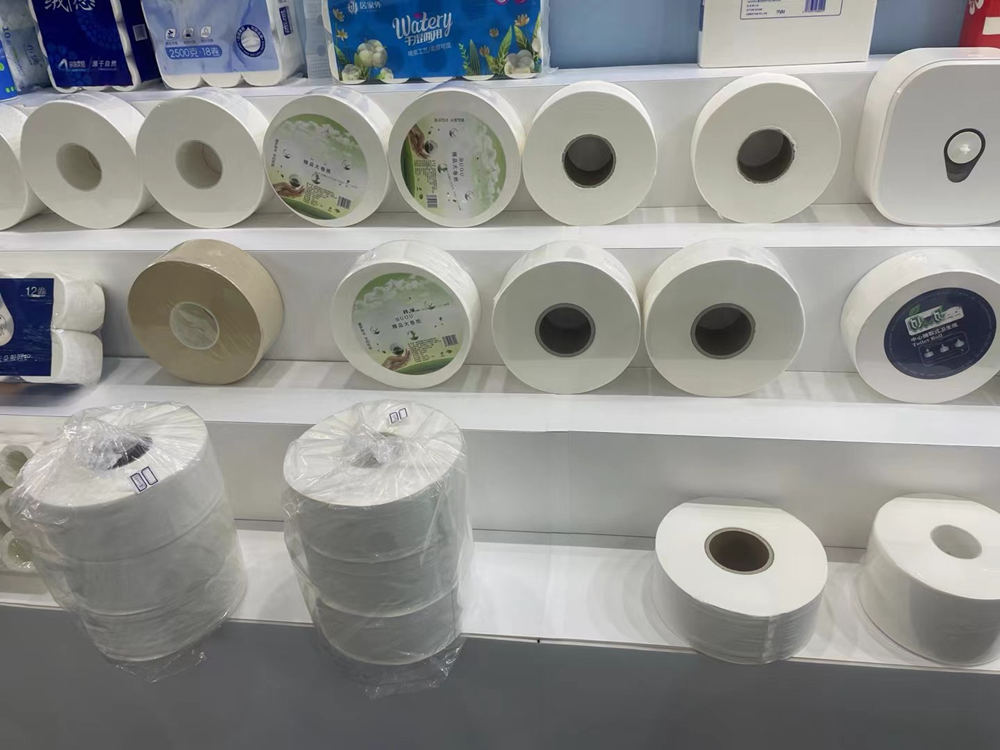
Factory-Direct OEM Toilet Paper Supply
Polyamide-Epichlorohydrin (PAE): The Chemical Binder
PAE wet-strength resins form covalent crosslinks with cellulose during drying, delivering durable wet integrity at the cost of reduced repulpability and higher process cationic load.
PAE composition and molecular properties
PAE resins are cationic polymers produced by reacting polyamide or polyamidoamine prepolymers with epichlorohydrin to introduce azetidinium and related reactive groups. The cured azetidinium moiety reacts with cellulose hydroxyls and with other polymer chains to form stable covalent bonds. Manufacturers supply PAE as water-dispersible solutions or soluble salts and adjust solids and viscosity to match wet-end dosing systems.
Performance depends on three levers: degree of substitution (number of reactive sites per polymer chain), molecular weight, and cationic charge density. Higher charge improves adsorption to negatively charged fibers and fillers, while molecular weight and substitution control crosslink density and the resin’s wet-strength efficiency versus required dosage.
Mechanism of wet-strength in paper
PAE delivers wet strength by creating a three-dimensional covalent network that replaces or supplements the hydrogen-bonding structure that collapses on wetting. During drying and a mild curing step, azetidinium groups open and form covalent links with cellulose hydroxyls or with neighboring PAE chains, locking the sheet’s mechanical integrity in wet conditions. Uniform adsorption and distribution in the wet end determine whether those crosslinks form where the fiber network needs reinforcement.
| Parameter | Typical Industry Range / Character | Practical Impact |
|---|---|---|
| Cationic charge density | High (designed to adsorb to anionic cellulose and fillers) | Improves retention and lowers required dosage; incompatible mixes can cause flocculation if not optimized. |
| Molecular weight | Low to medium–high, supplier dependent | Higher MW raises wet-strength but increases solution viscosity and may require different metering equipment. |
| Typical dosage (on dry fiber) | ~0.1% to 1.0% | Controls final wet-strength; tissue and hygiene grades sit at the low end to preserve disintegration and softness. |
Applications, dosing, and process considerations in papermaking
Mills add PAE in the wet end, upstream of sheet formation, to maximize fiber adsorption and retention. Typical product dosing falls between 0.1% and 1.0% on dry fiber depending on furnish, targeted wet-strength, and grade. Drying and a controlled curing profile activate azetidinium reactivity; insufficient curing leaves latent reactive groups and reduces performance.
PAE interacts with retention aids, sizing agents, and fillers, so formulators run compatibility trials to avoid flocculation and poor sheet formation. Designers balance wet-strength against softness and repulpability: raising PAE improves durability for towels and industrial wipes but undermines rapid disintegration needed for toilet tissue and septic-safe products.
Environmental, regulatory, and safety considerations
Epichlorohydrin (ECH) forms part of PAE chemistry as a precursor and carries regulatory and occupational hazards. Resin producers control residual ECH in finished resins and test finished paper where markets demand limits for food-contact or sanitary products. Buyers should request residual monomer certificates and supplier safety data sheets as part of procurement.
Covalent crosslinks reduce repulpability and complicate recycling; mills manage wastewater for cationic loads and resin fragments using biological treatment, coagulation, or targeted coagulation aids. Market pressure for better recyclability pushes formulators toward lower-impact alternatives such as modified starches, polycarboxylic chemistries, or process changes when product requirements allow.

Why Commercial Toilet Paper Omits PAE Resins Intentionally
Manufacturers avoid PAE in toilet tissue because its covalent fiber bonds deliver durable wet strength that prevents the rapid fragmentation required for reliable flushability and low-maintenance plumbing performance.
PAE delivers wet strength that prevents rapid disintegration
Polyamide-epichlorohydrin (PAE) crosslinks cellulose fibers with durable, covalent bonds. Those bonds keep sheets cohesive and tear-resistant when wet — the exact trait you want in hand towels, but the wrong trait for toilet tissue, which must break apart quickly after flushing.
- PAE forms durable bonds that maintain sheet integrity in water, so paper resists tearing and remains cohesive.
- Commercial toilet tissue needs to fragment rapidly to pass through plumbing and treatment systems; PAE slows that breakup.
- Products containing PAE raise the risk of blockages in high-use settings where fixture capacity and maintenance windows are limited.
- Manufacturers avoid PAE to meet customer expectations for flushability and to lower downstream maintenance costs.
Sewer, septic, and treatment-plant compatibility concerns
Paper that resists disintegration increases clog risk and operational load on pump stations and septic systems. Facility managers and procurement teams prioritize tissue that minimizes routine plumbing calls and prevents emergency interventions in high-traffic locations.
- Large-volume commercial sites want products that reduce routine plumbing calls and avoid emergency interventions.
- Slow-disintegrating paper contributes to accumulations that, combined with grease and non-flushable wipes, form costly blockages.
- Specifiers often require ‘septic-safe’ or industry-tested disintegration performance when selecting commercial toilet paper.
- Avoiding strong wet-strength chemistries aligns product performance with standard plumbing designs and municipal discharge rules.
Regulatory, safety, and consumer-perception drivers
Epichlorohydrin—the reactive precursor in some PAE systems—carries toxicology and regulatory attention. Manufacturers remove contentious chemistries from toilet tissue formulations to streamline compliance, reduce perceived risk, and protect brand reputation in sensitive sectors like food service and healthcare.
- Regulators flag epichlorohydrin and related compounds; minimizing their use reduces scrutiny and simplifies compliance.
- Retail and institutional buyers prefer materials labeled ‘sewer-friendly’ or ‘biodegradable,’ so manufacturers avoid contentious chemistries.
- Omitting PAE helps prevent negative publicity or customer complaints about environmental or health risks.
- Keeping formulations free of strong wet-strength resins simplifies certification and flushability claims.
How manufacturers meet strength needs without PAE
Producers tune raw materials and process settings to deliver dry strength and a premium hand without persistent wet bonds. They combine fiber choices, mechanical engineering, and reversible dry-strength chemistries so tissue performs when used but disperses after flushing.
- Select longer or higher-quality virgin fibers and optimize fiber mix to give dry tensile strength while still fragmenting when wet.
- Use mechanical treatments — controlled creping, embossing, and ply construction — to tune hand feel and perceived strength without adding persistent wet bonds.
- Apply dry-strength additives (modified starches or cationic dry-strength polymers) that boost tensile strength when dry but lose effectiveness when wetted.
- Offer product tiering: commercial and jumbo rolls prioritize rapid disintegration; paper towels and specialty products use wet-strength where needed.

The Hydrogen Bond: Breaking Down Rapidly in Water
Hydrogen bonds in liquid water last on the order of 0.1–10 picoseconds, so any material that depends mainly on H‑bonding will lose cohesive strength as soon as it wets.
Defining the hydrogen bond in aqueous systems
A hydrogen bond in water forms when a hydrogen covalently bound to an electronegative donor (typically an O–H) interacts with an acceptor lone pair on another oxygen. The interaction remains noncovalent and directional, which gives liquid water a transient, networked structure rather than a fixed lattice.
- Typical strength: roughly 1–10 kcal/mol, so thermal motion at room temperature disrupts bonds frequently.
- Geometry matters: favorable O–H···O distances (~1.7–2.0 Å) and near‑linear angles stabilize the bond.
- Role in structure: each water molecule can form up to four hydrogen bonds, creating a fluctuating, tetrahedral‑like network.
- Function: hydrogen bonds control bulk properties—surface tension, high heat capacity, and water’s effectiveness as a solvent for polar species.
Why hydrogen bonds in water break and reform on ultrafast timescales
Thermal energy and molecular motion constantly rearrange partners in the hydrogen‑bond network. Bonds rupture and re‑form in cascades, not as isolated single‑pair events, which produces an extremely dynamic solvent environment.
- Thermal fluctuations: room‑temperature kinetic energy competes with bond energy, causing rapid bond rupture.
- Librational and vibrational motions change molecular orientation and distance, triggering exchange.
- Collective rearrangements: hydrogen‑bond switching often involves concerted movements of several molecules rather than a single pair.
- Solutes and interfaces modify lifetimes: ions, polymers, or surfaces can either order the local network and lengthen lifetimes or disrupt it and shorten them.
How researchers measure hydrogen-bond lifetimes
Researchers combine ultrafast experiments with atomistic simulations to map timescales and mechanisms. Different techniques target complementary windows: femtosecond spectroscopy resolves the fastest vibrational events, scattering measures structural correlations, and simulations translate observations into explicit bond‑exchange statistics.
- Ultrafast IR and 2D‑IR spectroscopy resolve femtosecond–picosecond vibrational dynamics tied to H‑bond making and breaking.
- Neutron and X‑ray scattering probe structural correlations and time‑dependent rearrangements at atomic length scales.
- NMR relaxation and pump–probe variants provide complementary information for slower, ensemble‑averaged processes.
- Molecular dynamics simulations produce atom‑level trajectories and autocorrelation functions; researchers typically report lifetimes from ~0.1 to 10 ps depending on temperature, pressure, and local environment.
Why rapid H‑bond dynamics matter for wet-strength and product performance
Hydrogen bonds give dry paper its initial cohesion, but they fail almost immediately when water floods the fiber network. Manufacturers therefore add wet‑strength chemistries that create stronger, longer‑lived crosslinks so products retain function under wet use while balancing downstream disintegration requirements.
- Dry strength vs wet strength: H‑bonding provides dry sheet integrity, but wet‑strength resins (for example, polyamide‑epichlorohydrin) introduce covalent or persistent ionic crosslinks that resist water.
- Design trade‑offs: stronger, irreversible crosslinks improve wet performance but can slow disintegration and biodegradability; reversible chemistries offer a middle path.
- Implications for tissue and toilet‑paper disintegration: rapid H‑bond breakage helps flushability, so manufacturers tune resin type and dosage to meet both strength and regulatory targets.
- Testing relevance: disintegration tests, wet tensile strength assays, and real‑world flushing trials measure how hydrogen‑bond dynamics and added chemistries affect product function and infrastructure compatibility.

Testing the Disintegration Rate of Wholesale Jumbo Rolls
Disintegration test results translate directly into maintenance frequency, clog risk, and dispenser uptime for high-traffic facilities.
Why disintegration testing matters for jumbo rolls
Disintegration testing measures how quickly a jumbo roll breaks into small fragments under water and mechanical shear. Facility operators use those numbers to forecast drain-blocking risk, schedule line cleaning, and choose dispensers that won’t force replacement or create maintenance incidents. Procurement teams that ignore disintegration data pay for emergency plumbing, lost restroom availability, and customer complaints.
Not all paper products share the same target. Household toilet paper prioritizes rapid water breakup; commercial jumbo rolls need a balance between usable wet strength and flushability; paper towels prioritize wet durability and therefore rarely belong in the sewer stream. Include disintegration thresholds in specs so suppliers cannot trade away downstream reliability with high wet-strength formulations.
Standard test methods and metrics
Laboratories combine disintegration, wet tensile, and simulated-flush protocols to create a performance profile. Reported metrics should include time-to-disintegrate, percent residue retained on a defined sieve, and wet tensile strength under a stated test method; simulated-flush loops confirm whether lab outcomes hold in plumbing conditions.
| Metric | Industry Target / Method | Top Source Hygiene Standard |
|---|---|---|
| Core lab metrics: time-to-disintegrate; residue mass (%); wet tensile (N/100 mm); simulated-flush behavior | Specify test method, water volume/temperature, agitation/shear, sieve cutoff (e.g., 2 mm), and replicate count; report numeric time and residue percentage for traceability | Condition samples at defined RH/T; GSM per ply 13–22 g/m²; require “rapid disintegration” claim supported by simulated-flush pass and low residue on defined sieve; include wet tensile targets to balance usability and drainability |
Always record environmental and machine settings. Labs must state temperature, pH, agitation speed, and the particle-size cutoff used to declare a pass. Without those details, time and residue numbers lose comparability across suppliers.
Sample preparation and test setup
Prepare specimens the same way every time. Conditioning and consistent specimen geometry remove batch-to-batch noise and make results actionable for procurement and quality assurance teams.
- Condition samples at a controlled temperature and relative humidity before testing to remove variability.
- Cut standard specimen sizes from the roll and remove the core consistently when relevant.
- Use a defined water volume, temperature, and agitation protocol for immersion tests; document machine settings.
- Run at least three replicates per variant and include a known control sample to validate the setup.
- Record start and end criteria clearly: particle-size cutoff, visual breakup, or predefined sieve retention thresholds.
Interpreting results and setting acceptance criteria
Convert lab outputs into pass/fail limits tied to the installation type. Municipal sewer systems and high-volume public restrooms require stricter residue and disintegration limits than enclosed single-use dispensers that route waste to dedicated collection systems.
- Define numeric pass/fail for residue percentage and maximum disintegration time based on plumbing risk and dispenser type.
- Compare wet tensile values to target ranges to balance usability with drainability; require supplier-provided wet tensile data.
- Use simulated-flush outcomes to confirm that accepted lab results work in real systems before large orders.
- Specify sampling frequency and batch acceptance rules in contracts to maintain consistent performance over time.
- Document trade-offs explicitly so facilities and procurement agree whether durability or sewer compatibility takes priority.
How wet-strength resins affect disintegration and trade-offs
Wet-strength resins increase sheet integrity when wet but often slow disintegration. Testing gives you the quantitative impact so you can set resin type and dosing that meet both user expectations and disposal requirements.
- Run side-by-side tests of treated and untreated samples to quantify changes in disintegration time and residue.
- Consider resin chemistry and dosage: different resins produce different wet-strength profiles and biodegradability outcomes.
- Select higher-resin formulations for heavy-use dispensers and lower-resin options for sewer-sensitive installations.
- Check regional regulatory or environmental limits for specific resins and capture compliance requirements in specs.
- Include test data and procurement rationale in product specifications so facilities and sourcing teams understand the trade-offs and service implications.
Conclusion
Choosing the right tissue and making sure dispensers and fixtures are installed correctly protects plumbing, prevents costly blockages, and keeps systems running as intended. Proper materials and installation help meet building and safety codes, including OSHA, and extend equipment life. For plumbers and property managers, that means fewer emergency repairs and longer service intervals.
Start by auditing your facilities’ paper products and dispenser setups to identify clog risks, and request technical specification sheets or septic-safe sample rolls for on-site testing. Contact Top Source Hygiene to arrange samples, dispenser recommendations, or a brief consultation.
Frequently Asked Questions
Why does paper towel clog pipes but toilet paper doesn’t?
Paper towels clog because they are engineered for absorbency and wet strength: they use heavier, longer fibers, tighter bonding and often wet‑strength additives so the sheet holds together when wet; toilet paper is formulated with short fibers, low basis weight and minimal or no wet‑strength chemistry so it rapidly disintegrates under water and sewer turbulence.
What are wet strength resins in commercial toilet paper?
Wet‑strength resins are chemicals added during papermaking that create covalent crosslinks between cellulose fibers so the paper retains tensile strength when wet; common types include polyamide‑epichlorohydrin (PAE), glyoxylated polyacrylamides and some starch‑based systems — they improve handling and dispenser performance but reduce dispersibility and slow biodegradation.
How does commercial tissue dissolve in water?
Commercial tissue dissolves because it is engineered to disintegrate: manufacturers use short fibers, low bonding strength, creping and mechanical structures that allow sheets to separate quickly when agitated in water; disintegration is driven by water, mechanical shear (turbulence in pipes) and later microbial cellulase activity, and products that are truly flushable are tested against industry dispersibility standards.
Are jumbo toilet paper rolls septic safe?
Jumbo rolls can be septic safe, but size alone doesn’t determine safety; what matters is formulation and dispersibility testing — choose rolls labeled septic‑safe or that meet recognized flushability standards (IWSFG/INDA/EDANA) and avoid flushing large amounts at once to prevent overloading a septic system.
Can you flush commercial hand towels?
No, commercial hand towels (paper towels) should not be flushed; they are thicker, often wet‑strength treated and do not break up in water, which leads to blockages in household plumbing and municipal sewer systems — dispose of them in the trash or compost where accepted.
What chemical makes toilet paper break down?
There isn’t a single chemical that makes toilet paper break down; toilet paper is designed to disintegrate by using short fibers, low bonding and avoiding wet‑strength resins so water and mechanical shear cause rapid dispersion, and microbial cellulase enzymes then biodegrade the cellulose over time.