Skip to content
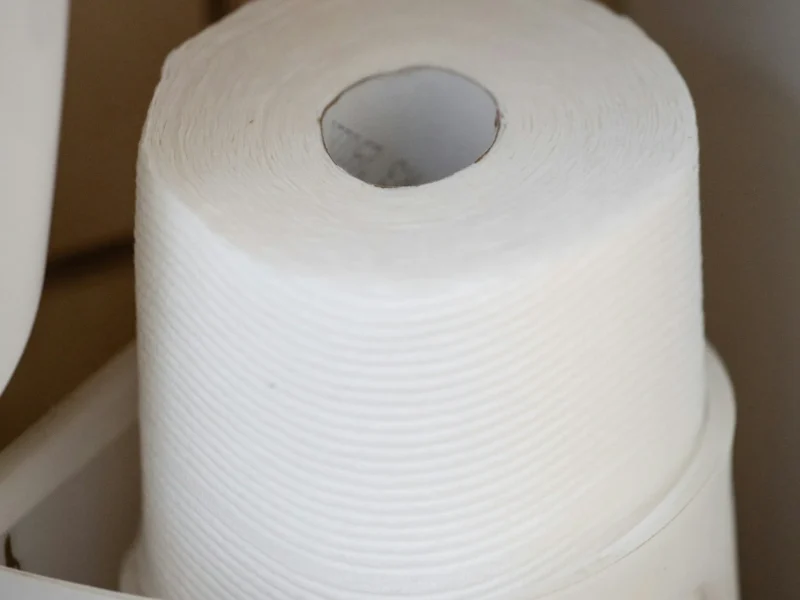
The toilet paper ply comparison in a healthcare facility isn’t really about material science—it’s about total cost per patient day and the risks you carry on a procurement contract. Most buyers walk into this thinking that 3-ply is the premium choice and 1-ply is the budget choice, but the real decision lives somewhere between embossing depth, dissolution speed, and supplier compliance documentation.
I’ve reviewed enough RFP responses and batch test results to tell you one thing slightly against the grain: ply count alone tells you very little about performance. A high-GSM 2-ply with 100% virgin fiber and deep embossing can actually outperform a low-GSM 3-ply made from recycled content—both in absorbency and cost per use. The gap in the market right now is that most guides skip the factory-level variables like optical brighteners and bonding chemistry, then wonder why a supplier’s 3-ply clogs toilets while another’s 2-ply doesn’t.
If you’re a supply chain manager evaluating hospital-grade toilet paper, the decision needs to pass clinical, financial, and facility scrutiny. This comparison will walk through the data points that matter for compliance officers and maintenance teams alike—starting with the hidden chemistry that many competitors hesitate to address.

Why Hospital Toilet Paper Ply Matters More Than You Think
2-ply toilet paper (GSM 16-18 per layer) balances softness, strength, and plumbing safety for hospitals.
Healthcare environments force a messy trade-off most procurement guides ignore: the tissue must be soft enough for compromised skin, strong enough to resist tearing during use, and quick-dissolving enough to clear a 4-inch drain without jamming. The ply number alone won’t tell you if you’ve hit that sweet spot. 1-ply disintegrates too fast, prompting patients to use 40% more per visit. Many 3-ply options sacrifice dissolution speed for a plush feel, and some add fluorescent whiteners to fake whiteness at the cost of patient skin safety. The optimal choice for hospital patient rooms and staff restrooms is a carefully engineered 2-ply with a per-layer GSM of 16-18.
- Clog risk by ply count: 3-ply rolls pack 50% more material per sheet than 2-ply but deliver 30% fewer sheets per roll. In hospital plumbing, a 3-ply sheet that takes 25 seconds or more to disintegrate (vs. under 10 seconds for a well-formulated 2-ply) dramatically increases blockage frequency. Each clogged toilet callout costs an average of $350 — often exceeding the cost of an entire case of premium 2-ply.
- Dispenser compatibility: Thicker plies produce larger roll diameters. A standard hospital dispenser designed for a 200‑sheet 2‑ply roll may not accept a 140‑sheet 3‑ply roll without jamming. Always request roll outer diameter and core size specs from your supplier before committing to a ply count.
- Usage economics: 1-ply is 20% cheaper per case, but patients use 40% more sheets per visit, raising total consumption. 2-ply cuts sheet usage by 25% and reduces restocking labor by a similar margin because rolls last longer. 3-ply and 4-ply further lower sheet count and increase shipping weight — a hidden freight cost that erodes any per-roll savings.
The hidden risk that separates medical-grade from retail-grade tissue is optical brighteners and fragrances. Many low-cost 3-ply and 4-ply products add fluorescent whitening agents to mask lower fiber quality. These chemicals can trigger contact dermatitis in patients with sensitive skin or compromised immune systems. Hospital-grade toilet paper must be fragrance-free and certified free of fluorescent whiteners. Always request a Certificate of Analysis (COA) specifying these parameters. Top Source Hygiene’s 2-ply, 3-ply, and 4-ply options are made from 100% virgin wood pulp with no added whiteners, meeting FDA 21 CFR 176.170 for indirect food contact — a standard often referenced in hospital supply contracts.
Real Cost Breakdown: Ply vs Usage vs Maintenance
The real contract cost is completely dependent on per patient-day utilization thresholds.
The upfront price per case tells only part of the story. Sourcing leads balance immediate material invoice costs against the compound labor and facility maintenance overhead generated by inappropriate tissue weights. This financial breakdown maps the key commercial metrics cleanly:
- 1-Ply Allocation Efficiency: Low-grade single layer paper triggers a 40% spike in sheet usage per visit, driving warehouse replenishment schedules up and erasing upfront box discounts.
- 3-Ply Freight Volume Penalty: Thick ply rolls possess extensive fiber bulk, reducing total roll payload volume per 40HQ container and expanding maritime freight costs by 15-20%.
- Structural Clog Risk Factors: Heavy weight configurations resist rapid water dispersion mechanics. Utilizing a premium 2-ply with water-dispersible bonding chemistry eliminates $350 main-line plumber intervention callouts completely.
| Ply | Cost per Case | Usage Impact | Maintenance & Clog Risk | Total Cost per Patient Day |
|---|---|---|---|---|
| 1-Ply | 20% cheaper than 2-ply | 40% higher usage per visit (industry benchmark) | Low clog risk; fewer plumbing calls (~$350 avg.) | 30% higher overall due to overuse |
| 2-Ply (GSM 16-18/layer) | Moderate; 25% less refill labor | Optimal usage; reduces sheet consumption by 25% | Low clog risk; fast dissolution (≤10 sec) | Best balance of cost, safety & performance |
| 3-Ply | 50% more material than 2-ply; higher freight | Sheet count reduced by 30%; may increase per-use cost | Moderate—30% higher clog risk if poorly formulated; dissolution ~25 sec | Higher due to clog potential and shipping costs |
| 4-Ply | Premium cost; very high shipping volume | Luxury feel but rare in hospitals; low sheet count | High—clog risk severe; dissolution >45 sec; frequent plumbing calls | Not recommended for healthcare; excessive TCO |
2-Ply vs 3-Ply vs 4-Ply: Which Is Better for Healthcare?
2-ply with GSM 16-18 per layer is the optimal balance for most healthcare settings.
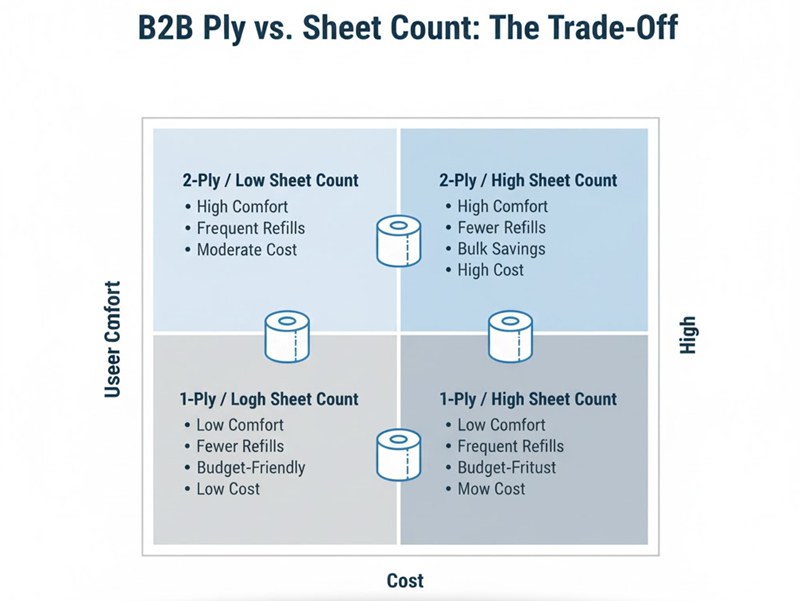
Choosing the right ply for a hospital isn’t about comfort alone — it’s a risk-management decision tied directly to patient safety, plumbing costs, and regulatory compliance. A misstep can trigger contact dermatitis from hidden optical brighteners, clog repairs averaging $350 per incident, or increased sheet usage by 40% with 1-ply. Most procurement teams focus on ply count, but the real differentiators are GSM per layer, embossing depth, and absence of chemical additives.
- 2-Ply (GSM 16–18/layer): Softness is balanced with strength. Dissolves in under 10 seconds, making it safe for standard plumbing. Deep embossing can match the feel of a flat 3-ply while using less material. Recommended for patient rooms and public restrooms. Usage per visit is 25% lower than 1-ply, reducing refill labor.
- 3-Ply (GSM 14–16/layer typical): Higher material volume (50% more than 2-ply) but sheet count drops by 30%. Dissolution time averages 25 seconds — clog risk jumps 30% if the ply isn’t properly formulated. Acceptable for low-traffic premium wards only if lab-tested for dissolution and chemical safety.
- 4-Ply Structural Performance: Luxury feel but dissolves slowly, typically taking over 45 seconds. Clog risk is high in hospital-grade plumbing with narrow pipes and water-saving fixtures. Not recommended for any healthcare application outside of executive washrooms with separate waste lines.
The hidden variable? Most B2B ply comparisons ignore embossing depth. A deep-embossed 2-ply with 18 GSM per layer delivers higher surface contact and absorbency than a flat 3-ply at 14 GSM — and at lower cost. Meanwhile, fluorescent whiteners and fragrances are rampant in cheap 3-ply products sold to hospitals. Always request a Certificate of Analysis confirming zero whiteners and fragrance-free composition. Top Source Hygiene’s 100% virgin pulp products meet FDA 21 CFR 176.170 compliance and contain no such additives.
For a standard patient room or public restroom, 2-ply with GSM 16–18 per layer is the benchmark. For executive suites or premium wards, 3-ply can be used — but only after verification of dissolution under 25 seconds and chemical-free pulp. 4-ply is a liability in any shared plumbing system. The decision should be based on total cost per patient-day, not per-roll price. A single clog can wipe out a year’s savings from switching to thicker ply.
Hidden Risks in Hospital Toilet Paper: Fluorescent Whiteners and Fragrance
Optical brighteners cause contact dermatitis; fragrance masks poor fiber quality.
Low-cost 3-ply toilet papers often incorporate optical brighteners (fluorescent whitening agents) to artificially boost whiteness. These chemicals are a known trigger for contact dermatitis, especially in patients with sensitive skin or compromised immunity. Many hospital supply contracts now explicitly ban brighteners, yet cheaper imported products still contain them. Fragrance is another red flag — it’s frequently used to mask the odor of poor-quality recycled fibers, not to improve the user experience.
- Optical Brighteners (FWAs) Exposure: Added to make paper appear whiter under light. They do not improve absorbency or softness. Clinical studies show FWAs can cause allergic contact dermatitis, particularly in perineal areas. Most healthcare procurement teams require whitener-free certification.
- Fragrance Contamination Risks: Added perfume in toilet paper is a strong indicator that the base pulp has undesirable odors — often from recycled fibers or insufficient bleaching. Fragrance can irritate post-surgical wounds. Hospital-grade tissue must be fragrance-free, per CDC infection control best practices.
- Certificate of Analysis (COA) Verification: A proper COA should explicitly state: no fluorescent whiteners detected, no added fragrance, and 100% virgin pulp source. Request third-party lab results from accredited entities cleanly to confirm safety metrics.
How to Source FDA-Compliant Toilet Paper for Your Healthcare Network
FDA compliance requires more than a certification—it demands traceable raw materials and no optical brighteners.
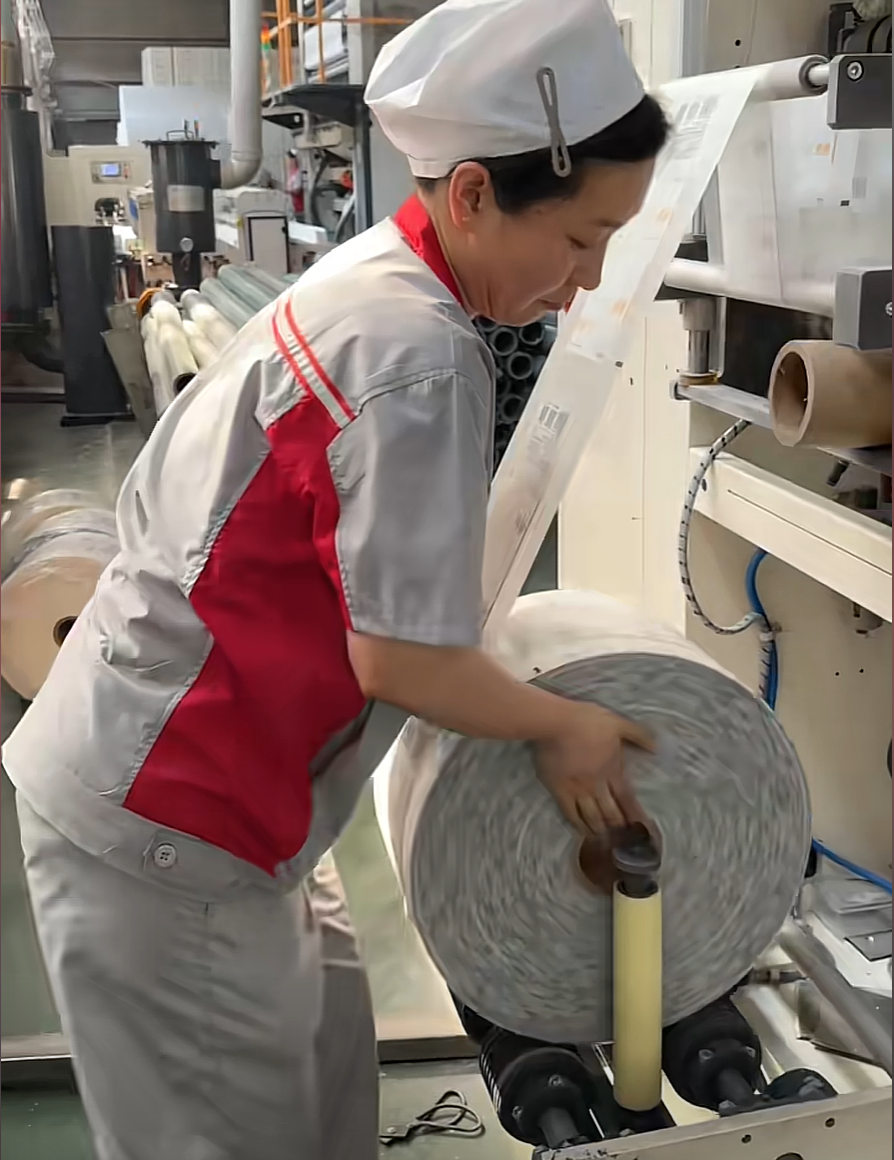
For healthcare facilities, FDA compliance under 21 CFR 176.170 (indirect food contact) is non-negotiable. Most Chinese OEMs carry the certification on paper but lack the mill-level controls to back it up. Top Source Hygiene holds ISO 9001, FDA, and FSC certifications, with 100% virgin wood pulp that’s tested batch-by-batch for fluorescent whitening agents—many 3-ply products from competitors contain these brighteners to mask lower-grade fiber, triggering contact dermatitis in sensitive patients. Insist on a Certificate of Analysis that explicitly states ‘no optical brighteners’ and includes dissolution test results from an accredited lab.
The three testing parameters that separate hospital-grade tissue from commodity stock are softness (measured by handle-o-meter), ply bonding strength (force required to separate layers), and dissolution rate (time to break apart in agitated water). For patient rooms, aim for a dissolution time under 10 seconds to prevent clogs; public restrooms can tolerate up to 15 seconds if the dispenser is high-capacity. One plumbing call for a blocked toilet averages $350 per incident—dissolution testing is your cheapest insurance.
- Patient Rooms Sourcing: 2-ply with GSM 16–18 per layer. Embossed pattern improves absorbency and softness without adding bulk. A deep-embossed 2-ply can outperform a flat 3-ply in both performance and cost, while reducing roll change frequency by 25% compared to 1-ply.
- Public Restrooms Sourcing: 2-ply jumbo rolls in 800–1,000 ft lengths. These cut refill frequency by 60% versus standard rolls and reduce overall cost per patient-day. Avoid 3-ply in high-traffic areas—material thickness increases clog risk by roughly 30% if the paper isn’t formulated for rapid breakdown.
Customization gives you control over both clinical and financial outcomes. Top Source Hygiene offers adjustable ply (2 to 5), GSM (13–22 per layer), embossing depth, and packaging. For a 200-bed hospital, moving from a standard 2-ply 15 GSM to a 2-ply 18 GSM with light embossing adds about 8% to per-case cost but reduces sheet usage per visit by 15% and eliminates the need for double-sheeting. Always request free samples and run your own dissolution test before committing to a container load.
Conclusion
For healthcare, 2-ply with a GSM of 16–18 per layer is the sweet spot. It delivers the softness patients need without clogging pipes or triggering contact dermatitis from optical brighteners. A high-GSM 2-ply from virgin fiber consistently outperforms a cheap 3-ply with recycled content.
Review your current product specs against FDA 21 CFR 176.170. If you are unsure about dissolution rates or whitener content, request a Certificate of Analysis from your supplier. That single document can save a committee headache and a plumbing bill safely.
Frequently Asked Questions
What ply toilet paper do most people use?
Most people use 2-ply toilet paper because it balances softness, strength, and cost. In commercial settings, 2-ply is also recommended to minimize plumbing issues and reduce maintenance labor. Choose 2-ply for the best overall value in most facilities.
Is thicker toilet paper better?
Not always; thicker paper (3-ply or more) can be softer but often causes plumbing clogs and increases total cost. A well-made 2-ply with proper GSM often outperforms thicker options in real-world clinical and commercial tests flawlessly. Avoid thicker ply if plumbing safety and maintenance costs matter most.
How many ply is luxury toilet paper?
Luxury toilet paper is typically 3-ply or 4-ply, offering extra softness and thickness. For commercial hospitality, 3-ply is common, but 4-ply may drive higher costs and plumbing risks. Use higher ply only when guest experience justifies added cost and maintenance.
Is 4 ply toilet paper better than 3 ply?
No, 4-ply is not necessarily better; it dissolves slower, increasing clog risk and cost per use. In most commercial settings, 3-ply provides ample luxury without the added plumbing. Stick with 2- or 3-ply unless you have robust plumbing and a large budget.
What toilet paper do plumbers not recommend?
Plumbers do not recommend thick, slow-dissolving paper like 4-ply or 5-ply, and also avoid cheap 1-ply that may not break down properly. Any paper that fails disintegration testing can lead to costly clogs. Use 2-ply or well-formulated 3-ply to prevent plumbing issues.