Skip to content

Mismatching jumbo roll dispenser dimensions is the kind of operational headache that shows up on a quarterly P&L review and stays there. For a healthcare supply chain manager, the immediate concern isn’t just the roll jamming mid-shift—it’s the accumulated cost of extra changeouts, the patient complaint about a bare dispenser in a critical care hallway, and the quiet risk of stocking a roll that doesn’t seat properly on the spindle. The three numbers that matter are roll diameter, core ID, and face width.
Standard commercial dispensers—like the Metpar TTD-120-10 or the PJT jumbo unit—top out at a 10-inch OD, accept either a 1.5-inch or 2.25-inch core, and expect a width of 4-5/16 inches (110 mm). That seems straightforward. But spec sheets from hardware manufacturers publish those dimensions and stop there. They don’t mention that a standard jumbo roll from Supplier A can be a full 0.2 inches larger in actual diameter than the identical headline spec from Supplier B. That variance causes binding inside the dispenser and drives up maintenance calls.
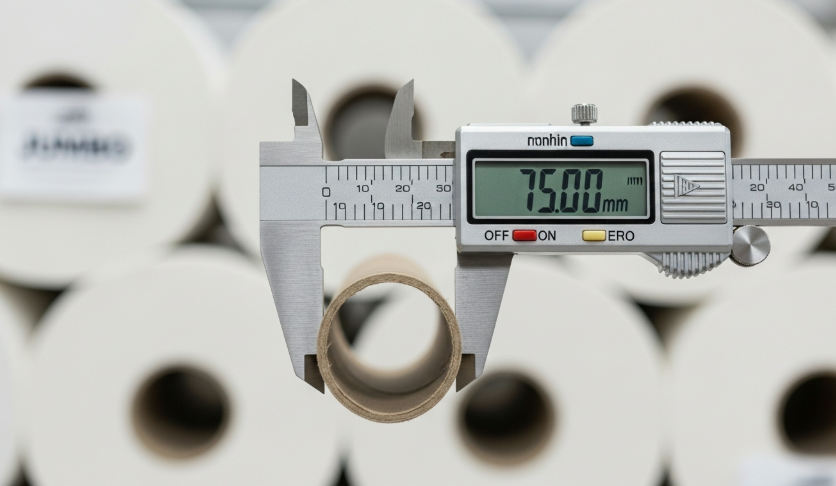
Why Dispenser Compatibility Matters for Healthcare
A single incompatible jumbo roll can cascade into stockouts, complaints, and regulatory citations across ward levels.
In a hospital, a jumbo roll that doesn’t seat properly triggers unscheduled maintenance, patient complaints about empty dispensers, and can even invite scrutiny during Joint Commission inspections. The root cause is almost always dimensional: the roll exceeds the dispenser’s maximum outer diameter (OD), uses the wrong core inner diameter (ID), or has a face width that doesn’t match the cabinet opening.
Most healthcare facilities rely on surface-mounted stainless steel dispensers from brands like Metpar (model TTD-120-10) or American Specialties (0046). These units are engineered to accept rolls with an OD ≤ 10 inches (254 mm), a core ID of either 1.5 inches (38 mm) or 2.25 inches (57 mm), and a face width of 4-5/16 inches (110 mm). Deviate from any of those three numbers and the roll either jams, tears, or fails to rotate — creating a downstream problem for every restroom in that wing.
- Roll Diameter Caps: Hard limit at 10” in most healthcare dispensers. A 12” roll physically cannot fit; cutting it on-site wastes 15–25% of landed cost and voids the dispenser warranty safely.
- Core ID Choice Options: Common variants include 1.5” (household standard) and 2.25” (jumbo-specific). Sourcing direct exact core dimensions eliminates unstable spindle wobble issues.
- Face Width Tolerances: Standard width sits at 4-5/16”. A wider roll crushes against the dispenser housing sides; a narrower one slides laterally, causing frayed tearing.
The financial impact is measurable. Industry benchmarks show that mismatched roll dimensions can increase janitorial labor costs by up to 18% due to more frequent changeouts and stuck rolls. Conversely, selecting the correct OD and core combination reduces changeout frequency by 40%, freeing staff for higher-priority tasks. Healthcare supply chain managers tracking cost per patient-day and maintenance calls see those numbers move immediately when a batch of incorrectly sized stock arrives.
There is also a compliance angle most dispenser spec sheets ignore. While they list hardware tolerances, they never address tissue quality — yet healthcare buyers need both dimensional precision and hypoallergenic materials (no fluorescent whiteners). A roll that fits perfectly but triggers allergic reactions or fails FDA absorbency standards still creates patient incidents. The only way to avoid this is to source from a manufacturer that controls both the physical dimensions and the pulp composition, like those offering FSC-certified, FDA-compliant jumbo rolls with automated quality checks holding diameter tolerances to ±0.05 inches.

Real Cost Breakdown of Dispenser Roll Dimensions
One wrong dimension can cost $300 per dispenser in warranty void alone.
The Metpar TTD-120-10 dispenser, standard in many North American hospitals, accepts rolls with a maximum outer diameter of 10 inches, a face width of 4-5/16 inches, and a core ID of either 1-5/8 or 2-1/4 inches. Deviating from these specs by even a few tenths of an inch — for example, ordering a 10.5-inch OD roll — guarantees the roll will not seat correctly, triggering jams or spindle lock-up. That mismatch doesn’t just annoy janitorial staff; it creates three direct financial hits.
- Wasted Shipping Cost: Shipping alone accounts for 15–25% of landed cost, so a 40-foot container of non-fitting jumbo rolls effectively burns $2,000–$4,000 in freight before the product even reaches a bathroom.
- Warranty Void: Using a roll that violates the dispenser manufacturer’s published dimensions voids the unit warranty. Replacing a stainless steel commercial dispenser runs $150–$300 per unit, plus installation labor. In a 50-bathroom facility, that’s a $7,500–$15,000 unplanned capital outlay.
- Adapter Degradation: Many dispensers come with rubber O-ring adapters to accommodate different core IDs. Those rings dry out and crack within 1–2 years, causing spindle wobble and uneven paper pay-out. Instead of relying on consumable adapters, specifying rolls with the exact core ID — 1.5 or 2.25 inches — eliminates that failure point entirely.
| Dimension Factor | Mismatch Example | Cost Consequence | Cost Savings with Correct Spec |
|---|---|---|---|
| Roll Diameter | 12″ OD roll in 10″ max dispenser | Wasted shipping (15-25% landed cost) + urgent reorder fees + warranty void ($150-300/unit) | Eliminates 40% of changeouts; reduces labor cost by 18% |
| Core ID | 1″ core on 1.5″ spindle | Paper waste, roll wobble, increased janitorial calls (18% labor cost increase) | Exact core ID eliminates adapters, reduces waste, extends dispenser life |
| Face Width | 5″ roll in 4-5/16″ dispenser | Paper crushing, jamming, unscheduled maintenance, patient complaints | Matching width ensures smooth operation, reduces stockout risk |
| Adapter Wear | Degraded O-rings after 1-2 years | Spindle wobble, paper waste, dispenser replacement ($150-300/unit) | Order rolls with required core ID to eliminate adapters |
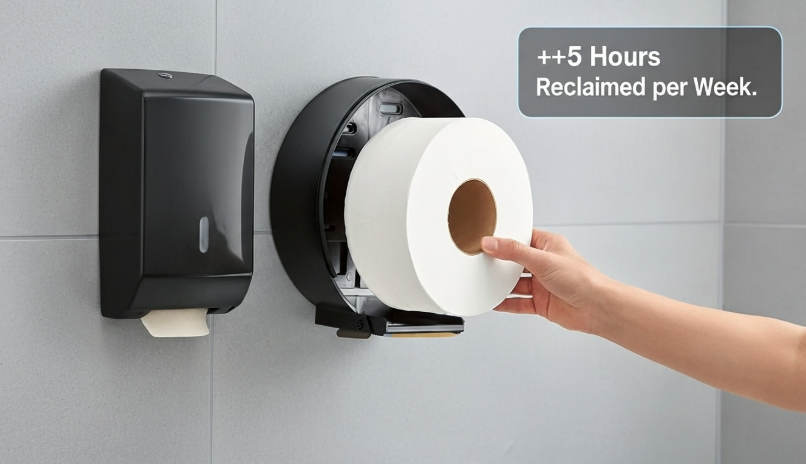
Jumbo Roll vs. Standard Dispenser: Which Fits Your Facility?
Selecting the wrong jumbo roll dimensions increases labor costs 18% and voids dispenser warranties.
Most healthcare facilities use dispensers that cap the roll outer diameter at 10 inches (254 mm) and accept only 1.5-inch or 2.25-inch core IDs with a face width of 4-5/16 inches (110 mm). Ordering a 13.5-inch OD roll for a standard Metpar unit means the roll physically won’t seat — the only fix is a return shipment and an urgent reorder. The exact same mismatch applies to core size and width: a 3-inch core spins freely on a 1.5-inch spindle, wasting paper, while a roll that is 5 inches wide crushes against the dispenser sides.
- Roll Diameter Limits (10″ vs 13.5″ OD): Standard healthcare dispensers accept max OD of 10″. Specialty high-capacity units handle 13.5″ OD but require 30% more hardware wall space profiles.
- Core ID Sizing Options (1.5″ vs 2.25″): Universal 1.5-inch cores fit household and light-commercial lines. Dedicated 2.25-inch cores support core ID precision benchmarks smoothly.
- Face Width Structural Clearance: Standard jumbo roll width is calibrated at 4-5/16″ (110 mm). Custom门幅 runs are available from 3.5″ to 5″ to match any stainless cavity precisely.


How to Source Compatible Jumbo Rolls for Your Dispensers
Executing early dimension audits blocks lot-level conversion failures across multi-property networks smoothly.
Before placing a jumbo roll order, pull a tape measure on your installed dispensers. You need three numbers: maximum roll diameter (OD), core inner diameter (ID), and face width. Sourcing managers utilize precise physical limits to insulate corporate supply lines from unexpected restocking blockages flawlessly:
- Calibrated Tolerances: While competitor sheets omit it, standard bulk lots drift by ±0.2 inches, enough to cause internal cabinet binding. Integrated manufacturing equipment holding an extreme ±0.05-inch threshold via automated quality checks solves this.
- Biocompatibility Compliance: Clinical environments require both geometric precision and lot-level chemical safety. Sourcing 100% virgin pulp tissue with documented OBA-free compliance satisfies FSC-certified criteria securely.
- Pre-Production Fit Testing: Order free stock prototypes (2–3 day dispatch). Verify spindle clearance inside live restrooms before committing capital blocks to a full container cargo run cleanly.
Conclusion
Matching jumbo roll dimensions—diameter, core ID, and face width—to your dispensers is the single most effective step to reduce janitor labor costs and prevent stockout risk. Standard ±0.2-inch diameter tolerances from many suppliers cause fit issues; custom rolls with tighter control eliminate the need for degrading rubber O-ring adapters and extend dispenser life.
Check your current dispensers’ maximum OD and core specs, then compare them against the dimensions available from manufacturers that hold tighter tolerances and offer FDA-compliant, FSC-certified materials. That comparison often reveals a direct path to lower maintenance frequency and fewer compliance worries.
Frequently Asked Questions
What are the standard jumbo roll core sizes?
Standard jumbo roll cores come in 1.5-inch (38mm) or 2.25-inch (57mm) inner diameters, with a width of 4-5/16 inches (110mm). Choosing the wrong core can prevent the roll from seating properly in the dispenser cabinet. Always match core ID to your dispenser model’s specification loops cleanly.
How do I measure the diameter of a jumbo roll?
Measure across the roll’s face from one outer edge to the opposite outer edge, not including the core. Most standard dispensers accept rolls up to 10 inches (254mm) in diameter. Verify your dispenser’s max OD before ordering container lots.
Does a larger roll diameter always mean lower maintenance costs?
Not if it exceeds your dispenser’s maximum diameter—a roll that jams increases labor costs by up to 18%. Choosing the correct OD for your dispenser reduces changeouts by 40% and avoids $300 warranty void liabilities completely. Match OD to dispenser specs to realize real cost savings loops.
Can I use FSC-certified jumbo rolls in any dispenser?
Yes, as long as the roll diameter and core size match your dispenser’s requirements. FSC certification relates to the paper source, not the physical dimensions—Top Source Hygiene can customize dimensions per contract smoothly. Confirm both core ID and OD with your supplier when ordering FSC rolls.
What happens if I buy rolls with the wrong core size?
The roll won’t seat properly, causing jamming, tearing, or failure to spin—forcing unscheduled maintenance. Some dispensers use rubber O-ring adapters, but removing them can void the warranty on certain models. Always cross-check core ID against your dispenser’s manual before purchasing bulk allocations flawlessly.