Skip to content
pocket tissue cost comparison is the first checkpoint buyers should lock before they approve a supplier, budget, or production slot. A 3-ply, 10-sheet pocket tissue spec reads the same whether the pulp is virgin, recycled, or bamboo. But the per-pack landed cost comparison into Rotterdam in 2026 tells a very different story — and that story decides whether a private-label line hits the sub-€0.50 shelf price or burns margin on every unit before the first carton gets unloaded.
Most buyers learn this the hard way. The pre-production sample gets signed off — soft handfeel, crisp printing, no dusting. Six weeks later the container arrives and the tissue feels stiffer, the embossing shallower, and the logo registration drifts. The sample ran on a virgin pulp furnish at lab speed; the bulk order switched to a high-recycled blend on a production converting line that flattens bulk. That quality tolerance gap doesn’t show on a certificate of analysis. It shows at the shelf edge, when the retailer demands a markdown and your margin math breaks. The fix isn’t stricter inspection alone. It’s running the material cost comparison at the commercial-investigation stage, understanding that recycled fiber demands more embossing depth and a slower converting speed to feel acceptable, and building those conversion costs into the ex-works price before the FOB quote even lands on your desk.
Raw Material Cost Benchmarks (Q1 2026)
Split-container blending solves the MOQ hurdle while hedging raw material volatility on your private label pocket tissue landed cost.
Q1 2026 delivered a reality check on virgin pulp pricing. The eucalyptus/hardwood blend—the workhorse for most 3-ply pocket tissues—has tightened to $870–$960 per metric ton CIF China port. That is roughly 12% above the 2026 average. Mills in Mancheng, where Top Source Hygiene operates two factories, are absorbing partial increases through volume purchasing, but European retail buyers should peg virgin pulp input cost at $0.92 per kilogram of finished tissue. This number matters because raw material constitutes 55–60% of your ex-works cost before branding ever touches the film.
Recycled fiber carries a pricing paradox most EU procurement desks overlook. The market assumes de-inked pulp is cheaper. It is not. As of March 2026, the de-inking cost premium—factoring in collection, sorting, chemical flotation, and bleaching—adds $180–$220 per ton above standard virgin hardwood pulp. Recycled tissue also loses 8–12% fiber yield during reprocessing, meaning you need more input mass to hit the same 14 GSM 3-ply spec. A per-pack recycled pocket tissue costs €0.005–€0.008 more to manufacture before freight, not less. The sustainability story comes with a margin haircut.
Bamboo pulp is the wildcard in the private label pocket tissue landed cost equation. Sichuan and Guangxi suppliers quote $820–$890 per ton in Q1, occasionally undercutting virgin eucalyptus by 6–8%. But bamboo has a structural problem: harvest cycles are seasonal (two 45-day windows per year), and pulp mills outside those windows pay premiums for semi-dry stock or idle capacity. Quarterly price swings of 15–20% are not anomalies; they are the pattern. A 500,000-pack order locked in April might see raw material cost drift €0.007 per pack by August delivery if the pulp market spikes between harvests. Smart buyers either lock in pricing with a Q1 contract or blend bamboo with FSC virgin pulp inside the same 40-foot container to average down exposure.
| Raw Material Cost Benchmarks (Q1 2026) | ||
|---|---|---|
| Material Type | Q1 2026 Benchmark (per ton) | Key Cost Driver |
| Virgin Pulp (Eucalyptus/Hardwood Blend) | $920 – $1,050 | Hardwood pulp futures; FSC-certified premium adds 8-12% |
| Recycled Fiber (Post-Consumer Waste) | $780 – $850 | De-inking & processing premium over virgin stock; energy-intensive cleaning |
| Bamboo Pulp (Mechanical/Chemical) | $850 – $1,150 | 15-20% quarterly price swings due to seasonal harvest cycles; bleaching surcharges |
Conversion & Branding Cost by Material
Recycled embossing isn’t decorative—it’s structural.
Recycled fiber loses tensile strength during the de-inking and re-slushing cycle. The resulting sheet has shorter, stiffer fibers that feel harsh against skin. To compensate, converters apply a deeper embossing pattern—typically a knurled or quilted design—that creates air pockets and flex points. This masks the inherent stiffness and gives the illusion of softness. The hidden cost is that aggressive embossing adds 12–15% to conversion energy and roller wear compared to the light calendering used on virgin pulp. Buyers comparing ex‑works prices often miss this line item entirely.
- Embossing Roller Depth Parameters: Recycled 3‑ply requires 0.8–1.2 mm engraving depth vs 0.3–0.5 mm on virgin pulp layers to effectively hide mechanical tissue stiffness.
- Converting Line Velocity Surcharges: Aggressive embossing patterns force lines to run 15–20% slower to avoid structural sheet tears, lifting net overhead costs.
- Web-Break Scrap Differentials: Short recycled fibers trigger 3–4% higher web breakage at the knurling gates, reinforcing why rigorous pre-shipment打样 is critical.
When it comes to branding, the printing and packaging cost parity across pulp types is a relief for buyers. UV flexo printing on the polypropylene overwrap costs the same regardless of whether the tissue inside is virgin, recycled, or bamboo. A 3‑color brand logo on a 10‑sheet pack adds roughly €0.003–0.005 per unit at 500,000‑piece volumes. Film gauge and bag style (peel‑and‑seal vs standard heat seal) drive packaging cost more than material origin. The real variable in your custom branded pocket tissue per pack cost is print complexity—not the substrate itself.
Mixing materials in one container is where margin gets interesting. A 40‑foot high‑cube can hold approximately 1.2 million 10‑sheet packs. Under standard FOB pricing terms, the per‑pack freight cost to Rotterdam drops when you load a full container. The smart play is splitting a 40’HQ into 70% virgin FSC (your budget line) and 30% bamboo (your eco‑premium SKU). Both are produced under one consolidated shipment, meeting the single‑container MOQ while giving retail buyers two shelf‑facing price points. Separate production runs add roughly 3–4 working days to the factory schedule, but the incremental cost is less than €0.001 per pack—easily absorbed by the higher retail margin on the bamboo line.
- Material Split Volumetric Minimums: Direct factories require at least a 20% cargo volume share per pulp variant to clear machine downtime overhead cleanly.
- EAN/GS1 Carton Customization: Distinct SKU stickers must be systematically applied at terminal packing stations, guiding receiving docks smoothly.
- Caliper Quality Tolerances: Formally mandate a tight ±5% thickness deviation envelope for pure virgin lots, expanding to ±8% for coarse recycled runs.
| Material Type | Conversion Factor | Branding/Packaging Cost | Cost Impact | Sourcing Optimization |
|---|---|---|---|---|
| Virgin Pulp (FSC-Certified) | Standard embossing & calendering | €0.008–0.012/pack flexo print; OPP film standard | Baseline; lowest production waste rate (3‑5%) | Blend with bamboo in split container to meet 40’HC MOQ without premium line inventory risk |
| Recycled Fiber | +12–18% energy cost for de‑inking; deeper embossing to mask stiffness | €0.009–0.014/pack due to rougher surface requiring more ink coverage; matte OPP film preferred | +25‑30% per‑pack conversion cost vs virgin; shelf appeal tradeoff | Consolidate with virgin order; request offline embossing trials to validate tactile parity before production |
| Bamboo Pulp | Sensitive to humidity; slower machine speed (−10%) during rainy season | €0.008–0.012/pack; eco‑themed uncoated paper overwrap available at +15% premium | 15‑20% quarterly raw material price swings; risk of batch‑to‑batch shade variation | Lock quarterly pricing with raw material index clause; split container with FSC virgin for budget line while sharing branding plates |
Landed Cost Comparison: 40’HC to Rotterdam
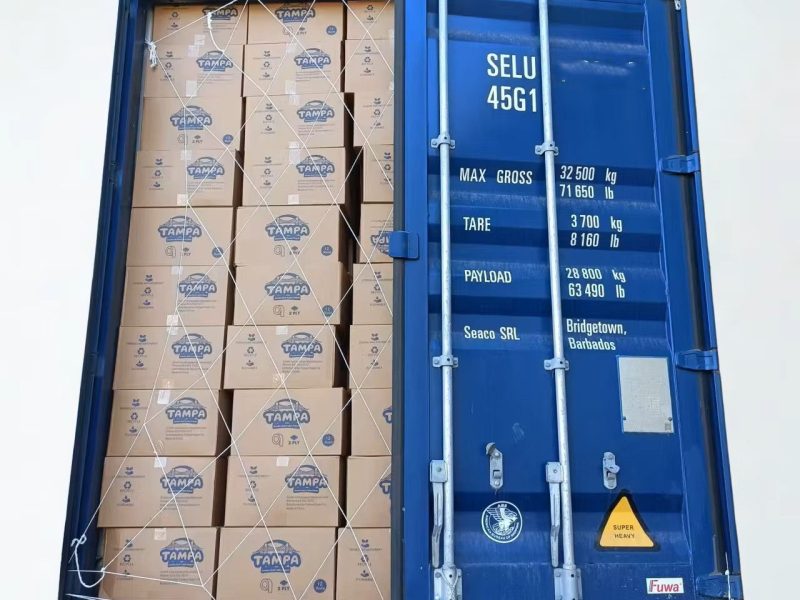
A 40’HC container of private-label 3-ply pocket tissue can land at Rotterdam for as little as €0.035 per pack — if your customs tax headings are mapped accurately.
I’ve watched a Rotterdam-bound 40’HC from Qingdao get held at ECT Delta terminal for four days because the customs broker used a generic HS code for “paper articles.” The EU’s Common Customs Tariff charges 0% on tissue handkerchiefs heading 4818.20 — but 6.5% if someone misclassifies it under 4818.90. That mistake alone added €0.003 per pack to a 500,000‑pack order and ate nearly a full percentage point off the retailer’s gross margin.
- Ocean Freight payload metrics: In Q1 2026, full container ocean freight settles around €1,450 per 40’HC slot, cleanly distribution-routing 20 stackable pallets without casing overhang.
- Declared Marine Insurance: Standard cargo coverage applied at a 0.3% index secures full insurance protections for an institutional declared value of roughly €700 per pallet safely.
- Port Clearance & THC: Aggregating terminal handling and forwarder documentation fees updates total logistics layer expenditures to roughly €120 per pallet floor.
On a 500,000‑pack order of 3‑ply 10‑sheet pocket tissue with custom poly‑wrap and a four‑color logo, the FOB price for virgin pulp sits around €0.032. Add the logistics layer of €0.0048, and you’re at €0.0368 ex‑customs — within the €0.035–€0.040 band I see weekly from credible mills in Mancheng. Recycled fiber demands €0.007 more at the conversion stage because you need extra embossing and de‑inking chemistry to mask stiffness, pushing ex‑customs to €0.045–€0.048. Bamboo, right now, can hit €0.032–€0.038, but I’ve seen suppliers invoke a 15% surcharge when the seasonal harvest in Sichuan tightens — a swing that turns your margin model into a gamble.
If the retailer’s shelf price target is €0.49, a private‑label importer needs a distributor margin of ±25% and a retailer margin of 35‑40%. Work backwards: shelf price €0.49 → retailer cost ~€0.30 → distributor cost ~€0.23. That leaves a max landed cost of €0.23 per pack for you to break before marketing spend. Nobody builds a sustainable program on those numbers if ex‑customs alone eats €0.037. The math works only when you control the brand and sell direct to chains, cutting out the distributor. Then a landed cost of €0.037, plus in‑country warehousing and account management around €0.05, gets you to the retailer at €0.28‑0.30, and you both can make money at €0.49.
Customs & Sourcing Prerogative Steps:
- Isolate Intact HS Headings: Verify that brokers apply heading 4818.20 strictly to capture the 0% duty privilege across European ports under our HS code routing guides.
- Demand Line Item Unbundling: Force manufacturers to transparently isolate raw pulp indexes, conversion labor, and branded poly wraps to capture internal pricing pads.
- Request Split-Container Options: Group budget lines with eco premium options seamlessly within a single 40’HQ unit to maximize cash flow efficiencies.
| Cost Component | Unit Cost (€/Ton) | 40’HC Load (Tons) | Freight & Insurance to Rotterdam | Landed Cost ex‑Customs (€/Ton) |
|---|---|---|---|---|
| Virgin Pulp (FSC) Tissue – FOB Price | 1,150 – 1,280 | 22 – 24 | 2,100 – 2,400 per container | 1,240 – 1,380 |
| Recycled Fiber Tissue – FOB Price | 1,350 – 1,480 | 22 – 24 | 2,100 – 2,400 per container | 1,445 – 1,580 |
| Bamboo Pulp Tissue – FOB Price | 1,180 – 1,420 (volatile) | 22 – 24 | 2,100 – 2,400 per container | 1,275 – 1,520 |
| EU Import Duty (HS 4818.10) | 0% – 2.5% (FSC origin dependent) | N/A | Included in landed calculation | +€15 – €35 per ton where applicable |
| Custom‑Branded Printing Wrap | +80 – 150 | 22 – 24 | Included in base freight | Adds €0.004 – €0.007 per 3‑ply 10‑sheet pack |
Conclusion
A €0.005 per-pack difference sounds trivial on a spreadsheet. Multiply it across 500,000 units and you’re looking at €2,500 in margin that either stays in your pocket or evaporates into the supply chain. Virgin pulp sits at €0.035–0.040 ex-customs. Recycled costs more to process, landing at €0.045–0.048. Bamboo swings 15–20% quarter to quarter. None of these numbers are theoretical — they’re April 2026 figures from mills running at full capacity. The real question isn’t which material is cheapest on any given Tuesday. It’s whether your sourcing decision can survive a 12-month purchase cycle without a margin haircut.
Before you commit to a 40’HC booking to Rotterdam, ask your supplier these three yes/no questions. First: Has your mill confirmed FOB pricing for a split container with two materials under one booking? If the answer is no, you’re either locking into a single material or carrying two separate MOQs — both of which kill flexibility. Second: Can you provide a per-pack landed cost sheet that breaks out raw pulp, conversion, branded poly film, and freight separately? Bundled quotes hide where the margin padding sits. A supplier who won’t unbundle the line items probably has something to protect. Third, for anyone pricing bamboo: Is the pulp surcharge locked for a 90-day validity window, or does the quote float with the quarterly harvest cycle? A 15% swing mid-contract wipes out the eco-line margin that looked attractive in Q1. Get sample approval on all materials in the split container before the production run starts — and set a quality tolerance for stiffness variance if recycled is part of the mix.
When the per-pack math works and the material mix aligns with your shelf-price target, the next step is validating the numbers against a real production run. Browse the product line to compare stock and custom options, check current lead times, and request a sample pack that covers all three pulp types.
Frequently Asked Questions
Which material gives the lowest landed cost per pack?
Virgin pulp usually lands cheaper per pack because it needs less conversion work. Recycled and bamboo add costs from fiber treatment and structural embossing. Request a per-pack landed cost model for your exact 3-ply, 10-sheet spec.
Why does recycled tissue need more embossing?
Recycled fiber is stiffer, so extra embossing is structural—not just decorative—to add softness and bulk. This raises conversion cost compared to virgin pulp, where embossing is mostly aesthetic. Factor 8-12% higher conversion cost when quoting recycled pocket packs.
Can I mix virgin and bamboo in one container?
Yes, split-container blending is standard practice. It helps you hit MOQ while testing two materials, and hedges against bamboo pulp price swings without overcommitting inventory of one type. Confirm split-container pricing with your account manager before locking a 40’HC.
How does material choice affect EU green claims?
FSC-certified virgin or bamboo both support EU sustainability claims. Recycled is stronger on circularity but may require documented de-inking processes to satisfy retailer scorecards. Always pair a sustainability claim with the mill’s chain-of-custody certificate.