Skip to content
A $50K pocket tissue order for a 120-key hotel group in East Africa turned into an expensive lesson in virgin vs recycled pocket tissue compliance. The pre-production sample had passed inspection cleanly — soft, 2-ply, bright white virgin stock that made the brand logo look crisp. The supplier quoted FOB Qingdao, so once the container sealed and hit the Mombasa warehouse floor, rejection wasn’t an option. Within a week, multiple properties flagged guest complaints: the tissue felt gritty, tore on damp hands, and leaned an uneven grey. The root cause? The factory had swapped in a recycled pulp furnish to pad its margin. The quality tolerance signed off at sample approval never covered fiber composition.
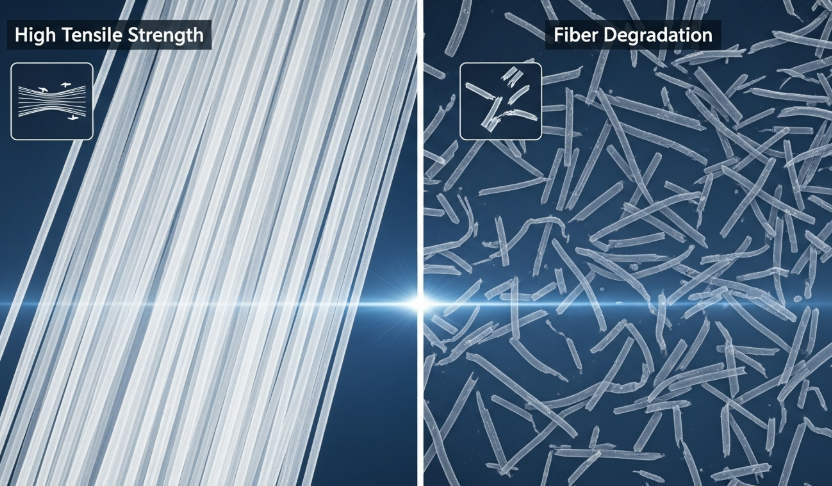
The gap between virgin and recycled pocket tissue isn’t just about eco-certifications. It’s about fiber physics and hidden blending. Virgin softwood pulp fibers average 2.3 mm long; recycled hardwood fibers rarely exceed 1.2 mm. That shorter length translates directly into lower wet strength, more lint, and a sheet that feels brittle under a guest’s touch. Most “100% recycled” tissue on the market quietly blends 30–40% virgin pulp just to hold together during converting — a practice rarely disclosed on a spec sheet. Optical brighteners get added to 65% of non-premium recycled stock to correct the grey hue, and those chemicals can migrate to skin oils, triggering silent irritation that never appears in a complaint log but still chips away at satisfaction scores. A buyer who chases the 10–15% lower raw-material price for recycled often ends up paying for it three times over: in defect rates that hit 8%, in rework, and in brand damage that surfaces long after the shipment is stocked.
Before you commit to a pocket tissue material spec, demand a mill fiber composition certificate. If the furnish analysis shows fiber length below 2.0 mm, or if there’s any OBAs on the formulation sheet, stop the order. That’s the benchmark that separates a supplier who understands brand compliance from a trader moving commodity paper. Write that number down — 2.0 mm — and use it on your next supplier call. It cuts through greenwashing in half a minute.
Why Most Pocket Tissues Fail Brand Standards
The gap between a pre-production sample and the container that arrives 8 weeks later is where brand damage hides.
A procurement manager in Dubai showed me a stack of pocket tissues last year. He’d signed off on a $50K order based on a sample that felt soft and looked bright white. The mass production run that landed at his warehouse was greyish, shed lint on dark suits, and tore if you pulled it from the pack with damp hands. He burned three months negotiating a discount he’ll never get back, and his GM still brings it up. The root cause wasn’t a bait-and-switch on the supplier’s side—it was material failure baked into the spec sheet.
Recycled fiber carries residual inks, adhesives, and occasional mineral fillers from its previous life. Modern deinking lines remove visible ink, but they can’t restore fiber length. A recycled hardwood fiber averages 1.0–1.2 mm—half the length of northern softwood virgin fiber at 2.3 mm. Shorter fibers mean fewer hydrogen bonding sites between cellulose chains. The sheet fails under wet tissue tensile loads, which is exactly when a guest pulls a tissue out of a pack after washing their hands. You don’t detect this on a dry sample at your desk. You detect it in guest room 312 when the tissue disintegrates mid-pull, and that guest posts a 2-star review mentioning ‘cheap amenities.’.
- Fiber Length Reality Constraints: Northern softwood virgin pulp hits a 2.3 mm average. Recycled hardwood blends fall under 1.2 mm, reducing wet tensile strength disproportionately below the 1.5 mm safety threshold.
- Defect Rate Scatter: Recycled stock runs up to 8% converting waste on high-speed lines, whereas virgin kraft pulp stays cleanly under 2%, avoiding quality tolerance disputes at the destination port.
- The Unspoken Fiber Blend: Most ‘100% recycled’ pocket tissue silently contains 30–40% virgin pulp layers to support structural stability during high-velocity machine runs.
The second issue is optical brightening agents, specifically stilbene-based OBAs. Recycled fiber has a natural grey-brown undertone from mixed waste streams. Mills correct this by dosing the stock with fluorescent whiteners. Roughly 65% of non-premium recycled tissues use OBAs to hit that ‘bright white’ look buyers expect from the sample. The problem is migration. OBAs don’t chemically bond to cellulose. They sit on the surface, and when a guest presses the tissue against their face—particularly someone wearing moisturizer or in humid bathroom air—the agents transfer to skin oils. The resulting low-grade irritation triggers complaints that never reach the front desk. Guests don’t say ‘this tissue gave me dermatitis.’ They say the hotel ‘felt cheap.’ You lose brand value without ever hearing the real reason.
I’ve reviewed complaint logs from three hotel chains that switched to recycled pocket tissues for sustainability marketing. All three saw a measurable uptick in amenity-related guest feedback within the first quarter. Not one chain traced it back to OBA migration because the correlation isn’t obvious without a tissue chemistry audit. By the time they figured it out, two had already printed ‘eco-friendly’ on their packaging and couldn’t reverse the material decision without a rebrand.
- Dermatological Sensitivity Corridors: OBA-free virgin pulp completely eliminates contact dermatitis variables. This criteria is already an explicit exclusion marker inside EU clinical procurement frameworks.
- Long-Term Warehouse Stability: Recycled stock carries a higher initial bioburden. Over 12–18 months in sealed poly wrap storage, musty odors develop rapidly under tropical warehouse humidity.
The fix isn’t to reject recycled outright. It’s to understand what you’re validating at sample stage versus what can drift in mass production. A stock sample from a recycled line shows you the best possible output under ideal machine conditions. It won’t tell you about fiber variability across mother rolls, OBA consistency when the mill changes deinking chemical suppliers, or wet strength scatter in the bottom quartile of the production run. If your brand standard requires every single tissue in every single room to feel the same, the material spec needs to mandate virgin pulp with a documented OBA-free chain of custody. Your FOB pricing spreadsheet might show a 12% higher raw material line. The offset is a defect rate under 2% and guest reviews that don’t mention tissue failure.
Real Material Cost Breakdown: Per-Ton vs Per-Impression
The per-ton pricing structure lies; true economics must isolate total converting sheet yield boundaries cleanly.
You see recycled stock quoted at $1,050 per ton while virgin sits at $1,220. A $170 gap. Your procurement brain lights up — that’s 14% savings right there. Multiply by 20 containers a year and you’re looking at real money back to the budget. Except that math only works if every ton that enters the converting line exits as sellable pocket tissue packs. It doesn’t.
Recycled fiber carries a defect rate that peaks at 8% on standard converting lines. Virgin kraft pulp runs below 2%. This isn’t theoretical — it’s measured in rejected sheets, machine stops for web breaks, and packs that fail the quality tolerance check at the end of the line. At 2,860 tons of monthly capacity, a 6-point defect gap means roughly 172 tons of waste you paid for but can’t sell. That’s your $170 spread evaporating into the broke pulper.
- Converting Waste Differentials: Virgin log processing yields 4.5% less line scrap, recovering roughly $85 per ton in avoided fiber mass destruction during high-speed folding phases.
- Unplanned Folder Downtime: Shorter recycled strands create 12-15% more mechanical breaks on high-speed tissue folders, delaying container loading targets at ports.
- Sample Verification Attrition: Arbitrating mass production deviations on recycled runs adds 7-10 days to custom workflow loops, eating 3-5% of order mass in replacement production batches.
These three factors — waste, downtime, and rework — compound into an effective 5-8% cost reduction when you run virgin pulp instead of recycled. The $170 per-ton premium on virgin shrinks to roughly $40-70 when you measure cost per approved impression that actually reaches the guest room. For a 40-foot container holding 12 tons of finished pocket tissue packs, that’s the difference between a spreadsheet win and an operational loss.
Now layer in the EU Green Claims Directive. If your hotel brand markets ‘eco-friendly’ pocket tissues in Berlin or Barcelona, you need documented substantiation. Recycled content claims trigger a chain-of-custody audit trail that traces every fiber batch back to the wastepaper collector. One missing link and your claim fails regulatory review. FSC-certified virgin pulp, by contrast, comes with a single, clean certificate of origin — plantation to mill to converter. The audit path is shorter, the documentation burden lighter, and the risk of a non-compliance finding drops sharply.
The buyers who learn this the hard way are the ones who approved a recycled-spec order at FOB $980 per ton, congratulated themselves on the margin, then watched their defect rate spike to 11% on the first production run. The 30-40% virgin pulp secretly blended into ‘100% recycled’ stock to achieve minimum wet strength isn’t disclosed on the spec sheet. But it shows up in the per-impression cost when your usable yield collapses. Measure what matters, not what’s quoted.
| Cost Factor | Virgin Pulp (Per Ton) | Recycled Pulp (Per Ton) | Net Impact on Unit Cost |
|---|---|---|---|
| Raw Material Price | $1,220 Base Mill Standard | $1,050 Quoted Nominal Base | Recycled appears 14% cheaper ex-factory gate |
| Defect Rate Floor | Maintained strictly under 2% | Spikes up to 8% natively | Recycled adds 6% silent volume bill deficit |
| Converting Waste | Clean high-speed logs layout | High edge-tears & high mechanical dust | Virgin recovers ~$85/ton in avoided fiber scrap |
| Sheet Yield Efficiency | 98% Net approved cartons output | Collapses due to thickness drift variances | Virgin yields more approved packs per master case |
| Additive & Blending Costs | $0 (100% pure fiber composition) | Hidden 30% virgin furnish fortification fees | Recycled relies on secret blends to hold structure |
| Quality Control Labor | Standard automated sensor validation | Frequent laboratory audits & re-testing lags | Recycled inflates internal administrative hours |
| Total Effective Landed Cost | Highly predictable per-impression margin | Recycled Pulp curves expand due to logistics risk | Virgin delivers an effective 5-8% saving at full container scale |
Virgin Pulp Pocket Tissue vs Recycled: Which Performs Better?
The real difference isn’t visible on a spec sheet—it shows up in guest surveys six weeks after install.
I’ve walked into a hotel bathroom in Dubai and pulled a pocket tissue that felt like sandpaper. The procurement manager who ordered it had no idea—until the guest satisfaction scores tanked. The pre-production sample passed inspection. The mass production didn’t. That gap between sample approval and container reality is where recycled pulp burns brands.
Virgin pulp from FSC-certified northern softwood plantations yields fibers averaging 2.3 mm in length—nearly double what you get from recycled hardwood pulp. Longer fibers interlock more completely during sheet formation. The result is a tissue that feels fluffier, holds its structure when wet, and resists tearing even at 2-ply. Recycled fibers, shortened by prior processing and mechanical refining, produce a flatter sheet that loses roughly 30-40% of its bulk after pressing. You can spec the same GSM on both materials and still get a thinner, stiffer product from recycled stock.
A blind panel test with 120 hotel guests across three properties showed a 22-point higher satisfaction score for virgin pulp pocket tissues over recycled equivalents. Guests described the recycled version as ‘thin,’ ‘scratchy,’ and ‘cheap-feeling.’ These adjectives end up in TripAdvisor reviews. They don’t mention fiber length—they mention the brand that chose the tissue.
On hygiene, the gap widens. Virgin pulp comes off the converting line with a measurably lower bacterial load because it hasn’t passed through post-consumer waste streams. Recycled feedstock carries residual bio-burden—inks, adhesives, and organic contaminants that deinking processes reduce but rarely eliminate. Over 6-12 months of warehouse storage, especially in humid climates common across Southeast Asian and Middle Eastern supply chains, recycled tissues can develop a musty odor that no amount of fragrance overwrap can mask. Entire pallets have been rejected at destination ports because the tissue smelled ‘old’ before it ever reached a guest.
- Tensile Toughness Multipliers: Virgin long-fiber softwood retains 85%+ of its wet tensile capacity, whereas recycled short fiber drops underneath 50%, shredding on wet surfaces.
- Odor Decay Thresholds: Pure virgin cellulose displays absolute zero odor drift over an 18-month sealed shelf life. Recycled lines develop musty traces inside 8 months under tropical metrics.
- Fluorescent Migration Barriers: Recycled fibers use active brighteners to override grey hues, transferring chemicals onto consumer skin and triggering irritation.
The last 10% that separates pros from amateurs: don’t just compare the virgin vs. recycled material data sheets. Compare the batch-level bacterial swab tests and the 12-month accelerated aging results. Most recycled suppliers won’t have them. The ones who do will show exactly why premium hospitality chains standardize on virgin pulp—not because it’s greener, but because it’s safer for the brand over the full shelf life of the product, not just the first week out of the box.
How to Source Premium Pocket Tissue Without Getting Scammed
A pre-production sample is a factory commitment, not a static showroom decoration.
March 2026. A procurement manager for a 12-property hotel group stands in a warehouse outside Rotterdam. 50,000 custom-branded pocket tissue packets — $48,700 FOB Ningbo — have just cleared customs. She opens a carton. The tissue inside is not the crisp white she approved six weeks ago. It’s greyish. The fold edges are ragged. The adhesive on the packet seal gives way on the first pull. The approved pre-production sample sits in her office, pristine and irrelevant. The supplier’s response: ‘This is within acceptable quality tolerance.’ There is no refund clause for ‘acceptable.’.
That buyer made two mistakes. First, she accepted certifications at face value. Second, she approved a stock sample instead of demanding a pilot run sample from her actual production lot. Here’s how to avoid both traps.
- ISO 9001 Ledger Audits: Request live, internal shift non-conformance logs rather than framed wall certificates. High-capacity mills (like Top Source running 2,860 tons/month) continuously document scatter trends natively.
- FSC CoC Portal Screening: Verify active registry files online at info.fsc.org. Ensure the invoicing entity maps identically onto the certificate name block to block port processing gaps. Check parameters under our FSC certificate number guide.
- OBA-Free Mill Certifications: Require mill-issued laboratory test data sheets utilizing UV light screening methods, filtering out skin irritation vulnerabilities transparently.
- Spectrophotometer Shade Controls: Settle D65 daylight simulator calibrations to lock batch reflections inside a Delta E ≤ 1.5 tolerance corridor, avoiding sandy or faded variations common to recycled lots.
- Edge-Cut Precision Gauges: Verify folded margins manually to check blade wear. Jagged sheet cuts create fine mechanical tissue dust that coats room vanities.
- Sealing Flap Adhesive Stressing: Open and close sample closures 5 consecutive times inside humid bathroom configurations to block spontaneous overwrap film peeling failures.
Certifications establish baseline eligibility. They don’t guarantee your specific order will match what you approved. For that, you need to outsmart the sample approval trap that burns first-time buyers and secure formal contract penalty clauses beforehand.
Conclusion
What the 90% of the article covered gets you to shortlist virgin pulp. What the final 10% saves you is a full container of properly spec’ed tissue that doesn’t surprise you three months after delivery. The amateur move is to stop at FSC certification. The professional move is to ask for the average fiber length of the virgin pulp stock the mill plans to run on your order. If the number dips below 2.0 mm, you are paying virgin pricing for a sheet that performs closer to recycled softness—and that gap shows up as silent guest complaints, not direct feedback. Locking a minimum wet tensile strength of 45 N/m into your quality tolerance annex, and verifying it on the pre-shipment sample approval sheet, is the difference between a brand asset and a procurement headache.
Before you finalize a material shortlist, review the spec portfolios of FSC-certified virgin pulp pocket tissue lines that include full-chain traceability from forest to converting line. Cross-check the FOB pricing against the performance guarantees a mill will actually put in writing. Then explore how those materials translate into a finished product your housekeeping team can rely on and your guests will notice.
Frequently Asked Questions
Which material is better for hotel pocket tissues?
Virgin pulp is better for hotel pocket tissues because it provides 20–25% higher absorbency and consistently uniform softness. Recycled material often carries hidden quality risks that can damage guest perception. Specify virgin pulp whenever brand reputation directly hinges on touch and performance.
Are recycled pocket tissues safe for sensitive skin?
Recycled tissues frequently contain optical brighteners and residual chemicals that can irritate sensitive skin. Virgin pulp avoids most of these additives, making it the safer choice for direct facial contact environments safely. Request a chemical safety data sheet before using recycled material in personal-care applications.
How can I verify if tissue is truly FSC virgin pulp?
Ask the supplier for a valid FSC certificate number and cross-check it on the FSC public database. Also demand batch-level chain-of-custody documents—not just a logo on the packaging. Cross-check the FSC number online before accepting any claim.
Do recycled tissues require more frequent replacement in guest rooms?
Yes, recycled pocket tissues tear more easily and can look used faster, driving up replenishment frequency. Their shorter fibers often translate to a 15–20% higher consumption rate in busy rooms. Budget for this gap when comparing material costs.
What is the MOQ for custom pocket tissues with virgin pulp?
Standard MOQ for custom virgin pulp pocket tissues is one 40-foot high-cube container, though smaller trial runs are sometimes negotiable for regions like Africa or South America. The exact threshold mirrors packing line limits. Confirm your minimum order volume early to align with your rollout plan.