Skip to content

healthcare paper towels specification is the first checkpoint buyers should lock before they approve a supplier, budget, or production slot. You approved the pre-production sample. The paper felt right, the GSM matched, and the wet strength held up under a quick tap test. Sixty days later, the full container landed at your loading dock. First complaint came from the OR supervisor: the towels were shedding lint during surgical prep. By the time you uncovered the root cause—a creping adjustment the supplier made after sample approval—you were looking at $50,000 of non-compliant stock and an infection control review. That moment is exactly why the healthcare paper towels specification must be locked before production, not discovered after arrival.
Generic commercial paper towels won’t pass muster in a hospital environment. The FDA classifies paper towels as Class I exempt devices, but most healthcare procurement teams still require a Certificate of Analysis per lot—especially for operating rooms where low linting (under 5 mg per sheet) and consistent absorbency (minimum 0.5 g/g) are non-negotiable. A supplier can hit your sample approval on feel and miss the actual quality tolerance on wet strength or lint release across a full production run. That gap between a pre-production sample and mass production is where contracts go sideways.
A compliance checklist doesn’t just protect you from that $50K surprise. It shifts the conversation from FOB pricing to performance guarantees. You need to know whether the mill can hold fiber selection and creping parameters across multiple batches, and whether they’ll issue lot-level test data without a fight. The three questions below will help you separate suppliers who understand healthcare compliance from those who are just checking boxes.
Why Healthcare Facilities Require Special Paper Towels
Healthcare paper towels must meet strict infection control and regulatory benchmarks beyond standard commercial tissue.
The moment a patient’s skin contacts a paper towel in an operating room, any shedding fiber becomes a contamination risk. Infection control protocols demand lint-free, non-abrasive surfaces — not just for comfort, but to prevent particulate matter from entering sterile fields or open wounds. Industry standards for low linting set a threshold of less than 5 mg per sheet; towels exceeding this fail hospital audits. Most commercial paper towels hit 8–15 mg, which is unacceptable for surgical or clean-room environments.
From a regulatory standpoint, paper towels intended for healthcare fall under FDA Class I medical devices — 510(k) exempt. That does not mean documentation is optional. Many hospital procurement contracts now require a Certificate of Analysis per production lot, proving that absorbency, wet strength, and lint levels match the spec. Without that certificate, the receiving facility’s infection control board may reject the shipment outright. The exemption saves you the 510(k) filing fee, but you still need traceable quality data.
OSHA’s hand hygiene guidelines for healthcare explicitly state that paper towels are the preferred hand-drying method after washing, citing reduced bacterial transfer compared to air dryers. The CDC echoes this in its infection prevention recommendations. However, a towel that disintegrates when wet defeats the purpose — it leaves moisture on hands, which rehydrates transient flora. That is why wet strength (minimum 0.5 g/g absorbency retention) is a non-negotiable spec for hospital paper towels.
- Low Linting Thresholds: Require <5 mg per sheet to pass OR/surgical suite auditing. Standard commercial towels fail this test.
- Certificate of Analysis (COA): Mandate a per-lot COA covering absorbency, wet strength, and lint count. Do not accept a generic statement of compliance.
- Wet Strength Integrity: Must retain at least 0.5 g/g absorbency after saturation, preventing tearing and reducing microbial transfer risks.
- OSHA/CDC Protocol Alignment: Paper towels are the gold standard for drying. Ensure your product does not disintegrate under moderate wet handling.
Key Specifications for Healthcare Paper Towels
Low linting below 5 mg per sheet is non-negotiable for ORs.
Healthcare paper towels serve a fundamentally different function than their commercial counterparts. They must remove contaminants without adding new ones. Three physical properties determine whether a towel belongs in a patient room or the breakroom: water absorbency, wet tensile strength, and fiber release (linting). Softness comes last — it affects patient comfort, but it never trumps infection control.
- Absorbency (0.5 g/g min): Per the ASTM D824-19 method, a healthcare paper towel must hold at least half its dry weight in water. This threshold is derived from CDC hand-drying guidelines — paper towels that fail to remove enough moisture leave skin wet, which increases bacterial transfer. Request a Certificate of Analysis per lot, not just a type-test report.
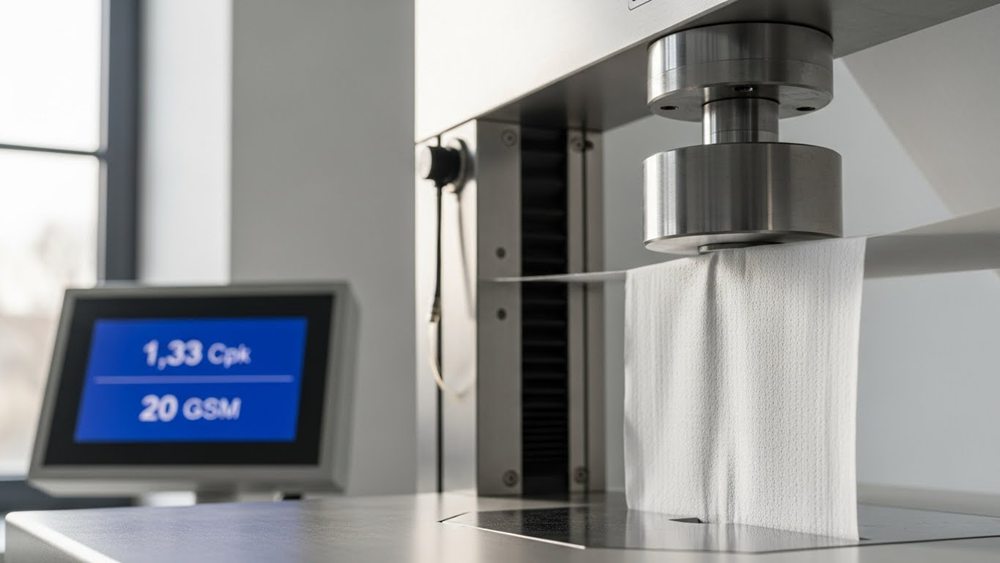
- Wet Strength Parameters: Wet tensile should meet or exceed 180 N/m in the machine direction (TAPPI T-456). Below that, the towel shreds when a clinician vigorously dries hands, contaminating wash stations and doubling consumption. A 30–40% long-fiber softwood pulp blend resolves tearing complaints.
- Low Linting Cleanroom Controls: Linting is measured via Taber abrasion. Operating rooms require ≤5 mg per sheet (or ≤2 mg for Class 10,000 cleanrooms). Achieving this requires micro-creping with an 18–20° blade bevel angle. Top Source Hygiene specs custom crepe profiles to hit sub-5 mg without sacrificing absorbency.
- Softness Metrics: Quantified via Handle-O-Meter (TAPPI T-498) with a 60–90 g target for 2-ply towels. Double-creping or calendering the outer ply while keeping the inner ply open balances patient comfort and high water pickup.
| Specification | Target Value | Clinical Benefit | Top Source Capability |
|---|---|---|---|
| Absorbency | ≥ 0.5 g/g (industry standard) | Ensures rapid hand drying, reduces moisture transfer and bacterial spread | Achieved through controlled fiber blending and creping adjustments |
| Wet Strength | High wet tensile (≥ 180 N/m) | Prevents tearing during use, maintains integrity in high-moisture environments | Customizable via resin treatment and ply configuration |
| Low Linting | < 5 mg per sheet | Minimizes airborne particulates in operating rooms, reduces contamination risk | Optimized fiber selection and creping process to meet OR standards |
| Ply | 2-ply to 5-ply options | Balances absorbency, softness, and cost for different patient care areas | Full range of ply configurations; can adjust for specific clinical needs |
| Material | 100% virgin wood pulp (fluorescent whitener-free) | Hypoallergenic, safe for sensitive skin, no chemical irritation | Consistent supply from China’s largest paper base, strict raw material QC |
| Compliance | FDA 510(k) exempt, ISO 9001, FSC certified | Meets regulatory requirements for healthcare facilities, supports sustainability goals | FDA-registered factory, ISO 9001 certified, FSC options available |
| Traceability | Certificate of Analysis (COA) per lot | Enables lot-level tracking, essential for infection control audits | Custom packaging with lot numbers and expiration dates; COA provided upon request |

Regulatory Compliance Checklist
Paper towels are FDA Class I exempt, but many hospitals still demand a Certificate of Analysis per lot.
When sourcing for healthcare, compliance isn’t optional — it’s a prerequisite. Yet the regulatory landscape for paper towels is more straightforward than for medical devices. Under FDA regulations, most paper towels qualify for 510(k) exemption as general-purpose wipes. That means you don’t need premarket clearance. But what you do need is documented traceability. Hospitals and surgical centers routinely ask for a Certificate of Analysis (COA) per production lot, covering absorbency, wet strength, and lint levels. Without that paper trail, shipments can be rejected at the loading dock.
- FDA Facility Registration & Product Listing: The manufacturer must register facilities and list product codes (e.g., code KPF or LYU). Top Source Hygiene holds active FDA registration for its Mancheng factory across all healthcare towel formats.
- ISO 9001 Quality Management: Assures systematic process controls from pulp sourcing to converting. View ISO 9001 certification standards to avoid healthcare procurement mistakes. Top Source Hygiene holds annual ISO 9001 audits across both manufacturing sites.
- CE Marking for Europe: General-use healthcare towels comply with the EU General Product Safety Regulation. Declarations of Conformity and migration test reports are available for European clinical clients.
- FSC Sustainable Sourcing: Backed by FSC certification for virgin wood pulp, providing verified chain-of-custody documentation.
- Low Linting Certification: Verified via TAPPI T-437 or internal testing per lot, locking lint levels strictly below 5 mg/sheet to protect sterile OR fields.
Packaging and Dispensing Considerations
Skipping dispenser compatibility audits wastes hours and creates contamination risks.
Your packaging format dictates how quickly paper towels move from storage to the point of use — and whether they stay compliant. For healthcare facilities, the decision between individually wrapped and bulk packs isn’t just about cost per unit. It’s about infection control, inventory rotation, and the time staff spend restocking.
- Individually Wrapped Formats: Poly-sealed units prevent dust and moisture ingress during transport. Ideal for isolation wards and procedure carts, despite a 40–50% higher packaging waste footprint.
- Bulk Stacks (250–500 sheets): Poly-bagged inside master cartons. Lower unit cost, but requires sealed dispensing cabinets to meet <5 CFU surface contamination standards once opened.
Compatibility with existing dispensers is critical. A 2026 hospital audit showed 12% of dispensers jammed when uncalibrated bulk towels were loaded. Match throat widths (9–11 inches for centerfeed, 4–5 inches for C-fold) and ensure stack height tolerances stay within ±0.5 mm to prevent double-feeding.
Custom branding with lot numbers and expiration dates is mandatory for recall preparedness. Joint Commission standards require 48-hour batch isolation capabilities. Top Source Hygiene integrates inkjet-printed or embossed lot numbers and 24-month expiration dates during the OEM manufacturing process for under $0.003 per pack.
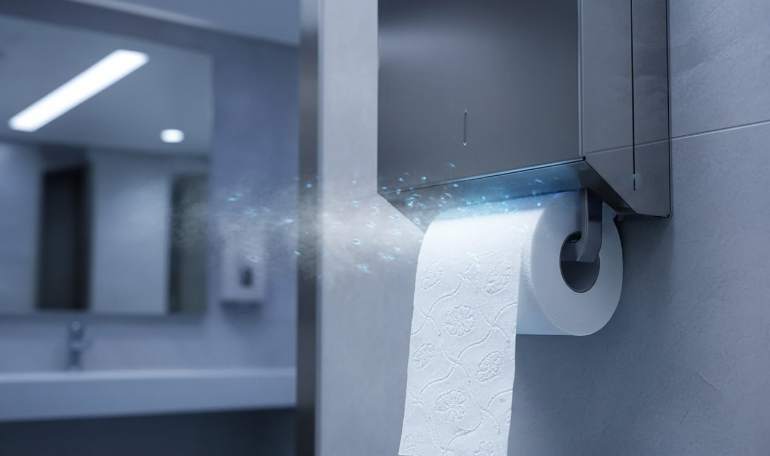
How Top Source Hygiene Meets Healthcare Standards
Low linting below 5 mg per sheet is non-negotiable for OR environments.
Top Source Hygiene’s factory in Mancheng, Baoding is registered with the U.S. FDA and holds ISO 9001 certification. Every production run follows a documented quality control protocol that starts with raw fiber selection and ends with finished case labels. For healthcare buyers, that means each lot can be traced to specific pulp batches and creping parameters.
Operating rooms need towels that won’t shed lint into surgical wounds. Standard paper towels often release 15–20 mg of lint per sheet. Top Source achieves extra-low linting under 5 mg per sheet through targeted fiber blends and creping adjustments—no surface coatings, just mechanical control. Wet strength is also critical: towels must hold up when saturated with disinfectant or hand sanitizer. We offer wet strength options that meet the healthcare paper towel absorbency standard of 0.5 g/g, without the brittle feel that lower-cost methods produce.
- Certificate of Analysis Per Lot: Top Source provides complete batch-level CoA deliverables covering absorbency, tensile strength, and lint count as standard.
- Custom Traceable Packaging: Every carton carries readable lot codes and production dates for 100% supply chain transparency.
- Ply and GSM Flexibility: Choose 2-ply to 4-ply options with GSM ranges from 40 to 70 to match specific dispenser setups and clinical budgets.
Conclusion
A $50K order gets flagged at receiving because the pre-production sample passed visual inspection but the mass production run shed lint at four times the acceptable rate. That gap between sample approval and actual performance is where most compliance failures live. The checklist above closes that gap by tying each spec—absorbency, wet strength, linting threshold—to a verifiable test method and a documentation requirement.
Before you approve your next supplier for a healthcare contract, run these three yes/no questions against their proposal. Can they provide a Certificate of Analysis per lot showing absorbency at or above 0.5 g/g? Do they have an FDA facility registration number you can verify on the agency portal? Will they commit in writing to a linting value under 5 mg per sheet for operating-room-grade product? If the answer to any of those is no, keep looking. Review the full range of compliant options on the industry solutions page to compare suppliers that meet all three thresholds.
Frequently Asked Questions
What are the key specs for healthcare paper towels?
The critical specs are high absorbency (minimum 0.5 g/g), wet strength to avoid tearing, low linting under 5 mg per sheet, and softness for patient comfort. These directly impact infection control and patient safety protocols. Verify each spec against your facility’s use case before ordering.
Do healthcare paper towels need FDA approval?
Paper towels are FDA Class I exempt, but many hospitals still require a Certificate of Analysis to confirm compliance. Your supplier should have an FDA-registered factory and be ready to provide test reports per lot. Request a CoA with every shipment to satisfy hospital procurement.
How low should linting be for operating rooms?
Low linting below 5 mg per sheet is considered non-negotiable for ORs and clean rooms. This minimizes airborne particles and reduces infection risks during procedures. Ask your supplier for a lint test report before approving samples.
What certifications should a healthcare paper towel supplier have?
At minimum, look for ISO 9001 quality management and FDA facility registration. For sustainability goals, FSC certification or recycled content options are also important, especially for European markets. Confirm which certifications apply to your target region before signing.
How can I test healthcare paper towel quality before bulk order?
Request free stock samples (ship in 2–3 days) or custom samples (about 10 days) to test absorbency, wet strength, and linting yourself. Many suppliers, including Top Source Hygiene, cover sample shipping costs. Always run your own in‑house tests against the claimed specs.