Skip to content

The landed cost china toilet paper equation is where most private label deals fall apart. You lock in a great FOB price, then watch freight eat 15-30% of your margin before the container hits the dock. For a bulky, low-density product like toilet paper, the shipping strategy is often more important than the unit cost.
Take a 40HQ container heading to Los Angeles. Ocean freight runs $1,500 to $2,500. That’s real money when your FOB cost per roll sits around $0.05 to $0.10. A buyer who focuses only on the factory price misses the bigger picture. The real lever is how you fill that container and who absorbs the logistics risk.
Why Freight Strategy Dictates Private Label Profit Margins
Freight eats 15–30% of landed cost — FOB price alone won’t save your margin.
Most buyers compare FOB prices per roll and pick the lowest number. That’s a trap. For bulky, low-density goods like toilet paper, ocean freight typically accounts for 15–30% of the total landed cost. A supplier who quotes $0.06/roll FOB but ships with poor container utilization can end up costing you more than a supplier at $0.08/roll who optimizes every cubic meter. The real metric is cost per roll delivered to your warehouse, not cost per roll at the factory gate.
Here’s a concrete example: a 40HQ container of private-label toilet paper shipped from China to Los Angeles adds $1,500–$2,500 in ocean freight. If your container holds 200,000 rolls, that’s $0.0075–$0.0125 per roll in freight alone. But if you can fit 220,000 rolls through better loading — without changing the product — the freight cost drops to $0.0068–$0.0114 per roll. On a 10-container annual order, that difference alone saves $1,500–$2,500 per year. And that’s before you factor in customs, insurance, and inland drayage.
- Floor loading vs. pallet loading: Many suppliers default to pallet loading because it’s faster for their warehouse. But floor loading a 40HQ container adds 8–12% more rolls — roughly 15,000–25,000 extra rolls per container. For a cost-driven hospitality group or facility manager, that’s an 8–12% reduction in freight cost per roll with zero increase in product cost. The trade-off: floor loading requires reinforced corner protectors and proper bracing to prevent damage.
- Carton dimensions are a hidden lever: Most Chinese factories design carton sizes for production speed, not shipping density. Standard cartons often leave 5–10% of container volume unused. Requesting custom carton dimensions and stacking patterns can boost container yield by 10–15% with zero extra product cost. Ask your supplier for an ‘optimized loading simulation’ — AI-assisted loading plans exist but are rarely offered proactively.
- The MOQ trap: A standard MOQ of one 40HQ container forces you to commit to a full container even if your demand doesn’t justify it. That leads to overstocking, warehousing costs, and cash tied up in inventory. Suppliers who offer flexible MOQs — partial containers or consolidated shipments — let you match inventory to actual demand, reducing the risk of a freight-cost blowout on slow-moving SKUs.
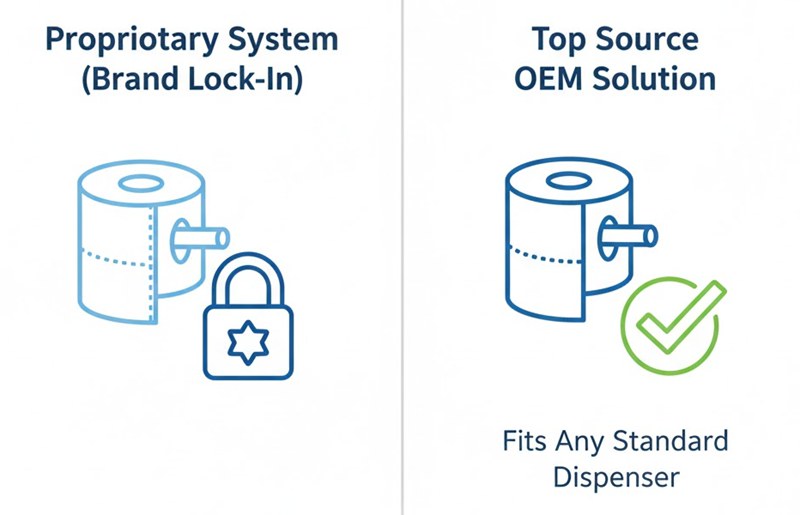
Pallet Loading vs. Floor Loading: The 8–12% Capacity Gap
Floor loading fits 8–12% more rolls per container than pallet loading — no extra product cost.
Most suppliers default to pallet loading because it’s faster for their warehouse crew. But that convenience comes at a measurable cost. A standard 40HQ pallet-loaded container holds roughly 185,000 rolls of private-label toilet paper. Floor-loading the same container — stacking cartons directly with reinforced corner protectors and proper bracing — pushes that number to 200,000–210,000 rolls. That extra 15,000–25,000 rolls per shipment reduces your freight cost per roll by 8–12%.
For a buyer moving 10 containers a year, that translates to $1,500–$2,500 in annual savings — pure margin that never touches your FOB price. The catch: floor loading requires more labor at the factory and stricter bracing standards to prevent damage during transit. A supplier that has done it for years (like Top Source Hygiene, with 30 years of export experience) knows how to brace a floor-loaded container so damage rates stay under 0.5%.
- Pallet Loading Metrics: ~185,000 rolls per 40HQ. Faster unloading at automated retail DCs. Higher freight cost per roll. Standard for US big-box retailers.
- Floor Loading Array: 200,000–210,000 rolls per 40HQ. Requires proper bracing and corner protection. 8–12% lower freight cost per roll. Preferred for hospitality, facility management, and cost-driven buyers.
The decision comes down to your downstream logistics. If your warehouse uses automated pallet jacks and you pay by the pallet position, pallet loading may be non-negotiable. But if you’re a hospitality group or facility manager receiving at a loading dock with a forklift, floor loading is the smarter choice. Ask your supplier for a loading simulation before production — most factories can run one in under an hour, and it will show you exactly how many rolls fit both ways.
Five Hidden Cost Leaks That Crush Landed Cost
Peak-season surcharges alone can erase your entire margin on a 40HQ container if left unhedged.
Most buyers fixate on FOB price per roll. That’s a mistake. Five hidden cost leaks routinely add 15–25% to the landed cost of toilet paper from China. Here’s where the money actually disappears — and how to plug each one.
- Volumetric CBM Waste: Standard cartons leave 5–10% dead air in containers. Custom box adjustments can boost container yield by 10–15% with zero extra product cost.
- Peak-Season Surcharges: Freight rates to Los Angeles normal spike 20–40% from October through January. Negotiating a cap or shifting order windows to Q1/Q3 safeguards margins cleanly.
- SKU Mix Packing Inefficiency: Combining retail packs and bulk packs causes uneven stacking patterns, triggering 15% CBM capacity loss. Solution: consolidate into uniform master cartons.
- Rigid MOQ Constraints: Rigid one-container rules force buyers to over-order slow-moving SKUs. Top Source Hygiene avoids this by offering partial shipment allocations for global channels.
- Incoterms Ambiguity: FOB quotes look cheap until adding hidden customs, ISF filing, and port handling charges. Always request full, transparent modeling at contract signing.
| Cost Leak | Description | Impact on Landed Cost | How Top Source Hygiene Fixes It |
|---|---|---|---|
| Empty Container Space | Standard carton dimensions waste 10–15% of container cubic capacity. | Increases freight cost per roll by 8–12%. | Offers custom carton sizing and AI-optimized loading simulations to boost yield. |
| Peak-Season Surcharges | Ocean freight rates spike 20–40% in Q4, eroding margins. | Adds $300–$1,000 per 40HQ container. | Provides pre-negotiated freight rates and flexible shipping schedules to avoid peak windows. |
| Packaging Mismatch | Retail vs. bulk pack dimensions cause 15% CBM waste in containers. | Reduces total roll count per shipment by up to 15%. | Designs packaging to match your distribution channel, maximizing container utilization. |
| Rigid MOQ Over-Ordering | Stiff minimum order quantities force buyers to over-purchase inventory. | Ties up capital and increases warehousing costs. | Offers flexible MOQs (one 40HQ container) with partial shipment options for smaller markets. |
| Ambiguous Incoterms | FOB vs. CIF vs. DDP confusion shifts unexpected customs, insurance, or port fees. | Can add 5–10% in unplanned costs at delivery. | Provides full landed cost breakdowns before production and transparent Incoterm guidance. |
How to Source Toilet Paper Without Freight Surprises
Locking down documentation compliance prevents expensive storage fees. Demurrage penalties at US West Coast ports erase ex-factory discounts within 48 hours.
The critical parameter for high-volume tissue procurement centers on complete paperwork transparency before the vessel arrives. Sourcing managers must require automated ISF (Importer Security Filing) logging 24 hours prior to container departure at North China docks. Mislabeling core dimensions or omitting exact packaging specs triggers intensive customs holds, adding up to $500 per day in carrier storage fees that completely wipe out upfront margin advantages.
To stabilize delivery windows across peak quarters, buyers should establish direct factory-to-broker EDI loops. Partnering with a manufacturer like Top Source Hygiene guarantees that every commercial invoice embeds verified 10-digit HS codes for tissue paper, completely shielding your logistics pipeline from random compliance holds. Free stock samples dispatch inside 2-3 days, ensuring you can review ply tensile strength before committing full container capital safely.
Before you sign a PO, demand a full landed cost breakdown: FOB price, ocean freight, insurance, customs duties, broker fees, and inland drayage. A supplier that can’t or won’t provide this is hiding something. The ones that do treat logistics as part of the product, not an afterthought.
Conclusion
For bulky, low-density goods like toilet paper, freight is the margin killer. Focusing only on the FOB price per roll ignores the 15–30% of landed cost that shipping represents. The buyers who protect their bottom line are the ones who optimize container utilization, demand floor loading, and use a supplier that provides a full landed cost breakdown before production begins.
Review the current pricing and shipping route details on the dedicated landed cost page. It includes FOB vs DDP scenarios, a cost calculator, and port-to-port transit times to help you build a realistic procurement budget.
Frequently Asked Questions
Is toilet paper affected by China tariffs?
Yes, toilet paper imported from China is subject to Section 301 tariffs, currently at 25% for most paper products. This tariff is applied directly to the declared FOB invoice value. Always confirm the current HTS code and tariff rate with your customs broker before quoting bulk volume runs safely.
Where does the US get most of its toilet paper from?
The US primarily produces its own toilet paper domestically, with major manufacturers like P&G and Kimberly-Clark dominating retail lines. Sourcing imports from China is typically optimized for private-label commercial contract supply or high-margin private label house brands. For custom or private-label needs, China factories remain a dominant sourcing pathway despite local mill capacities.
Will I be charged customs fees from China to the USA?
Yes, you will be charged customs duties, a Merchandise Processing Fee (MPF), and a Harbor Maintenance Fee (HMF) on all containerized shipments. For toilet paper lots, the Section 301 tariff applies tightly to the customs entry form. Use an explicit customs broker to calculate the exact fees for your specific product classification code cleanly.
How long does it take to clear customs from China to the USA?
Customs clearance for toilet paper from China to the USA typically takes 1 to 3 days if all documentation arrays are 100% accurate. Sudden terminal delays happen when the FDA or CBP flags missing certification tracking or mismatched packing lists. Ensure your commercial invoice and packing list parameters are completely precise to avoid unnecessary holds.
What is the difference between FOB and DDP for toilet paper?
FOB means you own the complete cargo risk and shipping cost once the container passes the vessel’s rail, while DDP means the seller handles all maritime freight, local duties, and door delivery to your warehouse. Choose FOB if you control an active freight forwarder contract; choose DDP for a hassle-free, all-in landed price structure smoothly.