Skip to content
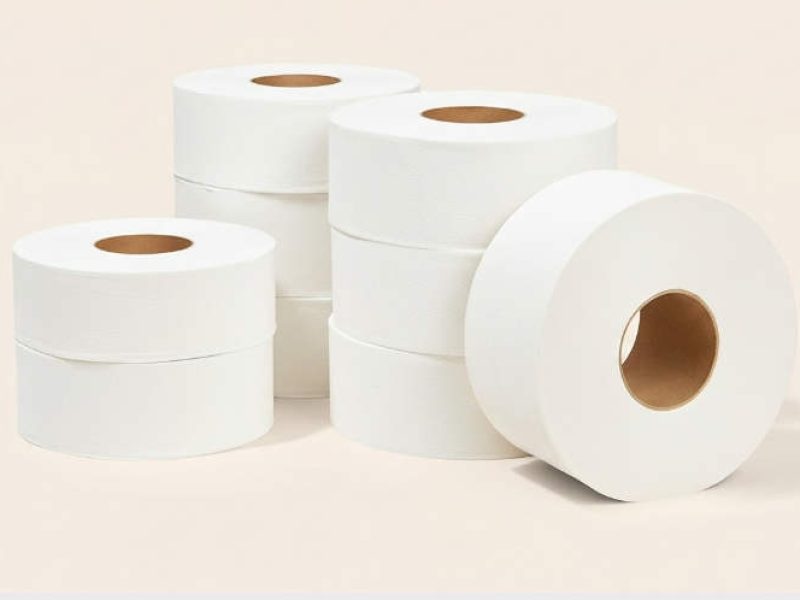
Picture this: You just signed off on an order for 500 cases of jumbo rolls—1,500 sheets per roll at an unbeatable price. But after delivery, your facilities team faces frantic complaints about jammed dispensers three times a week. It isn’t a paper quality defect; it’s a dimensional mismatch. The roll diameter measures 9.5 inches, while your wall-mounted dispenser casing maxes out at 9 inches. Each sheet costs a fraction of a cent, but every service call runs $50 to $150. Two months in, maintenance overhead has completely wiped out your upfront cost savings. This is the real price of overlooking jumbo roll dispenser dimensions.
Many procurement managers chase the lowest price-per-roll, ignoring dispenser compatibility. A 1.5-inch core versus a 3-inch core is a fraction of an inch that determines whether tissue unspools smoothly or binds and tears. Even more elusive is diameter expansion driven by sheet count: an 800-sheet roll spans ~7.5 inches, while a 1,500-sheet roll hits 9.5 inches. Without measuring the dispenser’s max clearance, you will continuously pay for this mismatch. In over 80% of commercial setups, standard wall-mount housings use a 1.5-inch spindle and cap out at a 9-inch roll diameter. Skipping a ten-minute check of these three parameters (core ID, width, diameter) can trigger thousands in hidden operational losses every quarter.
The good news is you don’t need to retrofit hardware or tie your budget to a single proprietary brand. At an integrated mill like Top Source Hygiene, we can adjust roll dimensions directly to match your existing hardware—whether reducing the outer diameter, shifting core sizes, or cutting custom widths from 2.5 to 4 inches. The playbook is simple: measure your dispensers, then validate the roll specs before ordering. Skipping this means your annualized failure maintenance costs will likely surpass any upfront paper savings—the ultimate trap in jumbo roll procurement.
Why Dispenser Misfit Costs You Money
Every jammed roll costs $50–$150 in service calls—often more than the roll itself.
That $0.02-per-sheet roll looks like a win until it jams the dispenser because the diameter is 0.5″ over the housing limit. Now a maintenance technician has to unlock the dispenser, wrestle out the oversized roll, and replace it. That single trip costs 50 to 150 dollars, depending on your facility’s labor rate and response time. If it happens once a month across 20 restrooms, you’re burning $12,000–$36,000 a year on labor alone—not counting the paper you threw away.
- Real Cost Breakdown: A 1,500-sheet jumbo roll at $0.02/sheet costs $30.00. One service call at $100 erases the savings from three full cases.
- Root Cause Analysis: Most buyers chase sheet count without checking their dispenser’s max diameter. A 1,500-sheet roll runs 9.5″ diameter—0.5″ over the standard 9″ wall-mount limit. The roll physically won’t fit, so it jams on the first turn.
Buying by price per roll alone ignores the total cost of ownership. That cheap roll that barely clears the spindle? It tears more often, leaves half a ply hanging, and frustrates users. They pull harder, the core collapses, and now you’ve got a roll that spins freely without feeding. Another service call. The math flips hard when you factor in the labor, waste, and lost user confidence.
The smarter procurement move is to match the jumbo roll dimensions to your existing dispensers before locking in a bulk order. Measure your max diameter, core size, and roll width. Then choose a sheet count that keeps the roll under that 9″ ceiling—or ask a supplier to custom cut it. Top Source Hygiene can adjust any variable: roll diameter, core size, width. That eliminates the misfit risk and makes the per-roll price comparison meaningful again.
| Cost Factor | Description | Typical Cost | Top Source Solution |
|---|---|---|---|
| Service Calls for Jams | A roll with wrong diameter or core size jams the dispenser, requiring maintenance staff to respond and fix it. | $50–$150 per call, with multiple incidents per year totaling thousands in labor. | Custom-cut rolls to your dispenser’s exact max diameter and core size eliminate jams. |
| Paper Waste from Misfits | Rolls that don’t fit are discarded or only partially used, wasting product and budget. | 10–20% of roll value lost per misfit order, plus disposal fees. | Precise width, diameter, and core matching ensure every roll fits perfectly. |
| Dispenser Damage | Forcing the wrong core size (1.5″ vs 3″) or oversized rolls strains and breaks the dispenser mechanism. | $50–$200 per repair or full replacement of damaged dispensers. | Core and diameter verification before production prevents mechanical damage. |
| Maintenance Labor Overhead | Staff time spent troubleshooting jams, restocking misfits, and reporting issues reduces productivity. | 15–30 minutes per incident, adding up to significant lost labor hours. | Standardized 15–25 day lead time and verified specs reduce restock complexity. |
| User Frustration Metrics | Empty or jammed dispensers lead to negative guest reviews and patient dissatisfaction. | Reduced satisfaction scores (e.g., 20% drop in hospitality ratings) and lost business. | High-capacity rolls with correct dimensions keep dispensers reliable between rounds. |
Key Jumbo Roll Dimensions You Must Check
Three dimensions decide if a jumbo roll fits: core, width, and diameter.
Most dispenser misfits happen because buyers only check sheet count and price. But a roll that looks like a bargain jams the moment it’s loaded. The three measurements that matter come straight from your dispenser, not the supplier’s spec sheet.
- Core Inner Diameter: Standard sizes are 1.5″ (38mm) for ~80% of commercial dispensers and 3″ (76mm) for heavy-duty units. A 1.5″ core on a 3″ spindle slips and tears. Measure the spindle with a caliper — if it’s ~0.6″ thick, you need a 1.5″ core. If it’s ~1.5″ thick, go with 3″.
- Roll Width Clearances: Most dispensers accept widths between 3″ and 3.5″. Measure internal width wall-to-wall, then subtract 0.25″ for clearance. Top Source Hygiene custom-cuts any width from 2.5″ to 4″ — no need to retrofit hardware.
- Maximum Roll Diameter Boundaries: Standard wall-mount dispensers hold a max diameter of 8″ to 9″. Sheet count drives diameter: 800 sheets ~7.5″, 1000 sheets ~8.0″, 1500 sheets ~9.5″. A 1500-sheet roll in a 9″ dispenser jams. Top Source Hygiene can reduce sheet count to fit your limit while keeping the roll usable.
| Dimension Parameter | Common Standard Sizes | Compatibility Note | Cost/Operational Impact | Custom Fit Option |
|---|---|---|---|---|
| Core Inner Diameter | 1.5″ (38mm) or 3″ (76mm) | 1.5″ fits ~80% of commercial dispensers; 3″ required for heavy-duty units | Wrong core causes jams and $50–$150 service calls per incident | Available in both core sizes to match your existing spindle |
| Roll Width | 3″ to 3.5″ (most standard dispensers) | Max internal dispenser width minus 0.125″ clearance per side | Too-wide rolls fail to feed, increasing waste and restocking frequency | Custom-cut widths from 2.5″ to 4″ available |
| Max Roll Diameter | 8″ to 9″ (typical wall-mount dispensers) | Measure from spindle center to housing top, then multiply by 2 | Oversized rolls (≥9.5″) cause jams; service calls cost $50–$150 each | Adjust sheet count to match your dispenser’s max diameter limit |
| Sheet Count Metrics | 800 sheets ~7.5″; 1500 sheets ~9.5″ | Chasing high sheet count may exceed dispenser capacity | Wrong diameter increases maintenance costs and paper waste | Custom sheet count balances capacity with dispenser fit |
Step-by-Step: How to Measure Your Dispenser
90% of jumbo roll misfits come from three missed measurements.
Walk up to any wall-mount jumbo dispenser in your facility with a caliper and a tape measure. Remove the existing roll completely. Make sure the spindle is exposed and the interior is clear of debris. This takes 30 seconds. Skipping this step and guessing the dimensions is why maintenance gets called back.
Now measure three things, in this order: spindle diameter, internal width, and maximum roll diameter. Do not reverse the order. The spindle measurement tells you the core size you need — that’s the single most common mismatch in the industry.
- Step 1: Spindle Diameter: Use a caliper to measure the metal rod that the roll sits on. If the spindle measures roughly 0.5″ to 0.75″ across, your core size is 1.5″ (38mm), covering about 80% of commercial units. If the spindle is closer to 1.5″ across, your core size is 3″ (76mm). Forcing a 1.5″ core onto a 3″ spindle tears the roll.
- Step 2: Internal Width: Measure the space between the two side walls of the dispenser interior. Most commercial units accept rolls between 3″ and 3.5″ wide. Subtract 0.125″ (3mm) on each side for clearance. Top Source Hygiene can produce custom roll widths from 2.5″ to 4″.
- Step 3: Maximum Roll Diameter: Measure from the center of the spindle straight up to the inside top of the housing, then double that number. Subtract 0.25″ (6mm) for clearance. Standard wall-mount dispensers handle a maximum diameter of 8″ to 9″. A 1500-sheet roll measures 9.5″ — that overhang will jam the mechanism.
Pro tip: Take a photo of the open dispenser with your tape measure laid along the width and diameter. Label each measurement in the image. When you send that to a custom manufacturer like Top Source Hygiene, they can match the roll exactly — no guessing, no paper samples returned that still don’t fit. We adjust sheet count, core size, and roll width to your dispenser, not the other way around.
Matching Top Source Hygiene Rolls to Your Dispenser
90% of misfit issues come from wrong core size or roll diameter — not sheet count benchmarks.
Most wall-mount commercial dispensers accept a 3″ core and a maximum roll diameter of 8″ to 9″. Our standard jumbo rolls are built to those specs and fit the majority of existing hardware. But if you’re running a mixed fleet of dispensers — or dealing with a proprietary system from Kimberly-Clark or ASI — standard dimensions won’t cut it. Those brands force you to retrofit their dispensers. We don’t. We adjust the roll to fit your dispenser, not the other way around.
As a parent roll manufacturer with in-house converting capability, the manufacturer controls every variable: core inner diameter (1.5″ or 3″), roll width (2.5″ to 4″), and finished diameter. If your dispenser accepts a 9″ max diameter but you need a 1500-sheet roll, the manufacturer can reduce the sheet count to 1300 so the diameter stays under 9″. That’s a custom solution you won’t get from a distributor who only resells fixed-spec stock rolls.
- Core Size Realignment: Using a 1.5″ core on a 3″ spindle causes the roll to spin freely and jam. We match core to your exact spindle diameter perfectly.
- Lateral Width Tolerances: A roll just 0.25″ too wide will bind against side walls. We cut to ±1/16″ of your internal dispenser width, leaving proper functional clearance.
- Diameter Overflow Buffers: An 800-sheet roll runs ~7.5″ diameter; a 1500-sheet roll hits 9.5″. We adjust sheet count to stay within your dispenser’s limit flawlessly.
Free samples are the fastest way to eliminate guesswork. Stock samples ship in 2–3 days. If you need a sample made to your specific dispenser dimensions, allow 10 days. We cover the shipping cost. Just send your dispenser model number or a photo with measurements — we’ll confirm fit before you commit to a container.
Conclusion
Dispenser compatibility isn’t a luxury — it’s a cost-control lever. Measure the core inner diameter, roll width, and maximum diameter of every dispenser in your facilities. Those three numbers eliminate the root cause of jams and the service calls that follow.
Benchmark to remember: 80% of commercial dispensers accept a 1.5-inch core and a maximum roll diameter of 9 inches. If your requirement exceeds either spec, custom sheet counts or roll widths bring it back within range. Include your dispenser dimensions when requesting FOB pricing — it streamlines the sample approval process and ensures quality tolerance matches your actual usage environment.
Frequently Asked Questions
What is the most common jumbo roll core size?
1.5 inches (38 mm) is the standard core size for most commercial jumbo roll dispensers. Heavy-duty models usually require a 3-inch core instead. Always measure your spindle with a caliper before ordering.
How do I know if my dispenser needs a 3″ core?
Heavy‑duty dispensers almost always need a 3‑inch core. Measure your spindle diameter with a caliper to confirm. If the spindle is close to 3 inches, order a 3‑inch core roll.
Can I reduce roll diameter by choosing fewer sheets?
Yes, fewer sheets per roll will reduce the overall diameter, but sheet length and paper thickness also affect final diameter. Confirm the exact diameter with your supplier at your desired sheet count. Check the spec sheet for exact diameter before ordering.
What if my dispenser has an abnormal width?
You need a custom‑width roll; standard jumbo roll widths range from 3 to 3.5 inches. Top Source Hygiene offers custom cutting to match your exact dispenser width. Provide your dispenser’s internal width measurement to your supplier.
How much does a jumbo roll service call cost?
Each service call for a jammed or misfit jumbo roll costs between $50 and $150. Repeated calls can cost thousands, so matching dimensions upfront saves money. Avoid service call costs by ensuring roll dimensions match your dispenser.